SEARCH
RECENT POSTS
Categories
- Agriculture (38)
- Automobiles (20)
- Banking and Financial services (36)
- Consumer Markets (57)
- Defence (6)
- Ecommerce (21)
- Economy (72)
- Education (14)
- Engineering (9)
- Exports (22)
- Healthcare (25)
- India Inc. (10)
- Infrastructure (31)
- Manufacturing (32)
- Media and Entertainment (17)
- Micro, Small & Medium Enterprises (MSMEs) (16)
- Miscellaneous (31)
- Perspectives from India (37)
- Pharmaceuticals (5)
- Railways (4)
- Real Estate (20)
- Renewable Energy (19)
- Research and Development (12)
- Retail (1)
- Services (7)
- Startups (16)
- Technology (66)
- Textiles (8)
- Tourism (16)
- Trade (9)
Authors






Indian Agriculture and the Rise of Organic Farming
- Dec 19, 2025, 12:05
- Agriculture
- IBEF
Agriculture is the primary occupation in India. It is considered the backbone of India’s economy, accounting for about 18% of GDP and providing a livelihood to around 46% of the population as of 2025. Indian agriculture faces a dual challenge of tradition and modernity, which weave together the future of rural incomes, consumer preferences and sustainable production systems. The Green Revolution is a good example of the capacity of modern agriculture to transform a country’s fate. It transformed India out of food shortages to the second largest in the world in rice and wheat production. However, these achievements have been accomplished at a cost. Several decades of intensive utilisation of fertilisers and pesticides saturated natural processes, deteriorating the condition of soil and causing doubts about food safety and overall productivity in the long term. These pressures have triggered an enormous drive to organic farming, which is among the fastest expanding sectors in the farming industry this decade.
Organic farming benefits India’s growing health-conscious middle class with better quality food that is fresh and free of toxins, and provides Indian farmers with long-term benefits, including crop diversification, resilience, an improved ability to export and price realisation. Technology is driving this shift. Organic supply chain transparency and traceability is made possible by digital precision-farming practices and certification platforms. Sikkim, Uttarakhand and Madhya Pradesh states are leading the pack. They're expanding organic acres and showing models that combine ecological and economic services. The domestic and export market remains strong with the government encouraging sustainable agriculture. The combination of these forces has placed the agriculture of India on the edge of great transformation. Indian heritage can be taken forward with modernity to rejuvenate livelihoods and rural prosperity and make India an organic hub of the world.
A snapshot of Indian agriculture in 2025
India has rapidly emerged as a global leader in organic farming, ranking second worldwide in terms of organic agricultural land, while holding the top position in terms of the number of producers engaged in organic cultivation as of January 2025. Such tremendous growth represents an underlying consumer change, fueled by growing urbanisation, growing health consciousness and the increasing buying power of a growing middle-class population. Transformational growth has been seen over the past few years, which is estimated to continue with India’s organic food market reaching about US$ 1.91 billion by 2024, expanding at a robust CAGR of 20.13% to hit US$ 10.8 billion by 2033.
Production has kept pace with demand, with India producing around 3.6 million tonnes of certified organic products in FY24, a mix that includes oilseeds, fibres, sugarcane (juice), cereals, spices, pulses and beverages. The Indian agricultural sector remains the primary source of occupation and base of the economy, with a gross value added (GVA) of US$ 423 billion in FY24 and a visionary target of US$ 600 billion by 2030. To reinforce this trend, the government has maintained strong policy support: in the Union Budget FY26, the Ministry of Agriculture and Farmers Welfare was allocated Rs. 1,37,757 crore (US$ 15.53 billion), which indicates the government’s focus on enhancing sustainable agricultural practices and improving farmers’ incomes and enhancing India’s agricultural competitiveness on the global stage.
Drivers of organic farming growth
Policy support and government initiatives
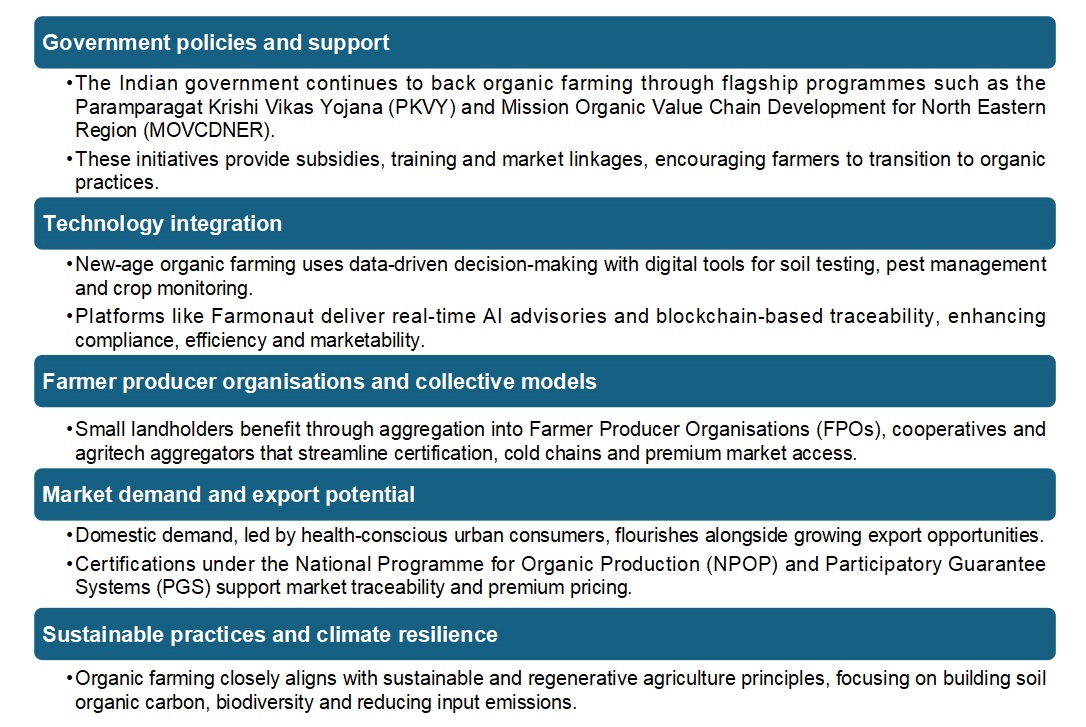
The Government of India has been promoting organic farming by certain schemes and policy support.
- Paramparagat Krishi Vikas Yojana (PKVY): PKVY is a cluster-based program, which was initiated in 2015 to establish organic farming using the Participatory Guarantee System (PGS) certification and connect different domestic markets to sell the products. The plan has financial assistance of Rs. 31,500 (US$ 355) per hectare within three years of organic inputs.
- Mission Organic Value Chain Development of the North Eastern Region (MOVCDNER): The initiative will concentrate on the development of certified organic products in the North-Eastern states and the development of value-chains, Farmers Producer Organisations (FPOs), and high prices of the niche organic products, which could be oriented towards exports.
- National Programme for Organic Production (NPOP): NPOP, which began in 2001 is the largest organic certification scheme in the world and sets up institutionalised certification systems and supervises the export of organic products. Also, there is the National Mission on Natural Farming (NMNF), founded on the idea of Zero Budget Natural Farming (ZBNF), which presupposes using on-farm natural inputs and no chemical and pesticides whatsoever in relation to Indian ways of farming.
Such projects are critical in terms of funding, training and certification processes to enable farmers abandon the conventional farming system to organic farming.
Environmental and health benefits
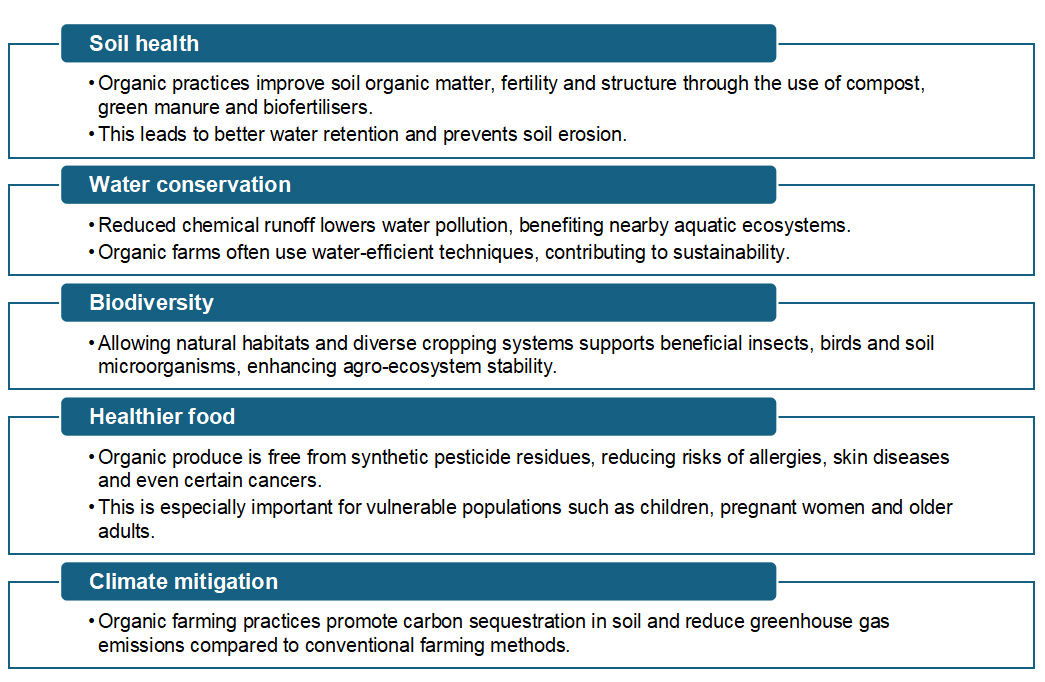
Organic farming’s core principle of not using synthetic chemicals provides numerous environmental and health benefits:
Going forward: The future of sustainable agriculture
The future of organic farming in India is a mix of traditional and modern practices. Today’s organic farming is a combination of technology aligned with modern science and data to improve productivity while still generating environmental benefits. Drones, satellite imagery and AI now help organic farmers manage pests, monitor nutrients and crop health, all without chemicals. Technologies for sustainability provide Indian farmers with options to make more money, reduce risks and enter the profitable marketplace of organic products. ‘Organic Farming 2.0’ is emerging as a major plank of India’s agricultural transformation for 2025 and beyond. The growing scale of organic production in India is an opportunity for change, where GDP growth can be harmonised with health and environmental sustainability. Thanks to strong government schemes and increasing consumer awareness combined with the technological tools available, organic farming is set to form an important cornerstone of India’s future of agriculture.
FAQs
Why is organic farming gaining momentum in India in recent years?
Organic farming is rising in India due to growing health awareness among consumers, the demand for chemical-free food, government support programmes and increasing global preference for sustainable agricultural practices. It also helps farmers achieve better price realisation through niche markets and exports.
What kind of products does India produce under certified organic farming?
India produced about 3.6 million tonnes of certified organic products in FY24, including oilseeds, cereals, sugarcane juice, spices, pulses, tea, coffee and fibres. This diverse product mix helps farmers reduce risks and tap into growing export and domestic opportunities.
How is technology transforming organic farming in India?
Advanced tools such as AI, drones, satellite monitoring and digital traceability systems help farmers manage pest control, soil fertility and crop health, all without chemicals. Traceability apps and blockchain ensure transparency in certification and supply chains, boosting consumer confidence.
What financial assistance is available for farmers shifting to organic farming?
Under Paramparagat Krishi Vikas Yojana (PKVY), farmers receive financial support of Rs. 31,500 (US$ 355) per hectare over three years, which includes funds for organic inputs, certification, training, and marketing.
How does organic farming improve farmers’ income over the long term?
While initial conversion costs can be high, organic farming reduces input costs, improves soil productivity, enables premium pricing in niche domestic and export markets, and diversifies farm produce in the long term, leading to more stable and resilient farm incomes.
Partners