SEARCH
RECENT POSTS
Categories
- Agriculture (39)
- Automobiles (21)
- Banking and Financial services (36)
- Consumer Markets (57)
- Defence (6)
- Ecommerce (21)
- Economy (72)
- Education (14)
- Engineering (9)
- Exports (22)
- Healthcare (25)
- India Inc. (10)
- Infrastructure (31)
- Manufacturing (33)
- Media and Entertainment (17)
- Micro, Small & Medium Enterprises (MSMEs) (16)
- Miscellaneous (31)
- Perspectives from India (37)
- Pharmaceuticals (5)
- Railways (5)
- Real Estate (20)
- Renewable Energy (19)
- Research and Development (12)
- Retail (1)
- Services (7)
- Startups (16)
- Technology (66)
- Textiles (8)
- Tourism (16)
- Trade (9)
Authors






Localization of Electronics Manufacturing in Consumer Appliances: India’s Growth Story
- Jun 03, 2026, 14:35
- Manufacturing
- IBEF
The electronics manufacturing sector in India is undergoing a major transformation. Over the past decade, domestic electronics production has focused primarily on smartphones, but current trends show a broader shift towards all consumer appliances and household electronics. The country now produces washing machines, air coolers, kitchen appliances, convection ovens and small electrical tools through local product design and assembly methods.
The transformation goes beyond the expansion of assembly lines, as manufacturers have expanded their operational capacity. Manufacturers are gradually integrating additional production stages, including mechanical design, control board integration and component fabrication to strengthen domestic capabilities and reduce dependence on imports finished goods.
Urban and semi-urban markets experience rising consumer electronics demand because of the three factors, including increased purchasing power, growing urban populations and better home appliance availability. India develops into a major electronics manufacturing center because of its expanded industrial capabilities and government backing of local production efforts.
Significance: Moving Beyond Assembly
The localisation of electronics manufacturing brings forth a significant milestone that marks India’s industrial evolution. Domestic production primarily focused on assembling complete products for many years while key parts of the value chain especially component production remained concentrated in established global manufacturing hubs.
The implementation of policy changes during the past decade has enabled India to establish its large-scale operational assembly work. The manufacturing operation has expanded its output capacity that has resulted in new job opportunities, but actual value creation remains dependent on improving essential manufacturing skills.
Printed Circuit Boards (PCBs), connectors, display modules, motors and enclosures together represent more than half of the value found in electronic products. The Financial Express reports that semiconductor components make up 45% of a smartphone's bill of materials and require expensive and time-consuming domestic manufacturing. The remaining 55% consists of sub-assemblies including printed circuit boards (PCBs), camera modules, enclosures and passive components that can be produced through focused local manufacturing efforts.
The impact of localisation initiatives is already visible. Production Linked Incentive (PLI) schemes have attracted investments of approximately US$ 19.05 billion (Rs. 1.76 lakh crore), according to government data, while creating over 1.2 million jobs and enabling production that reached US$ 178.5 billion (Rs. 16.5 lakh crore) through their scheme.
Industry Overview
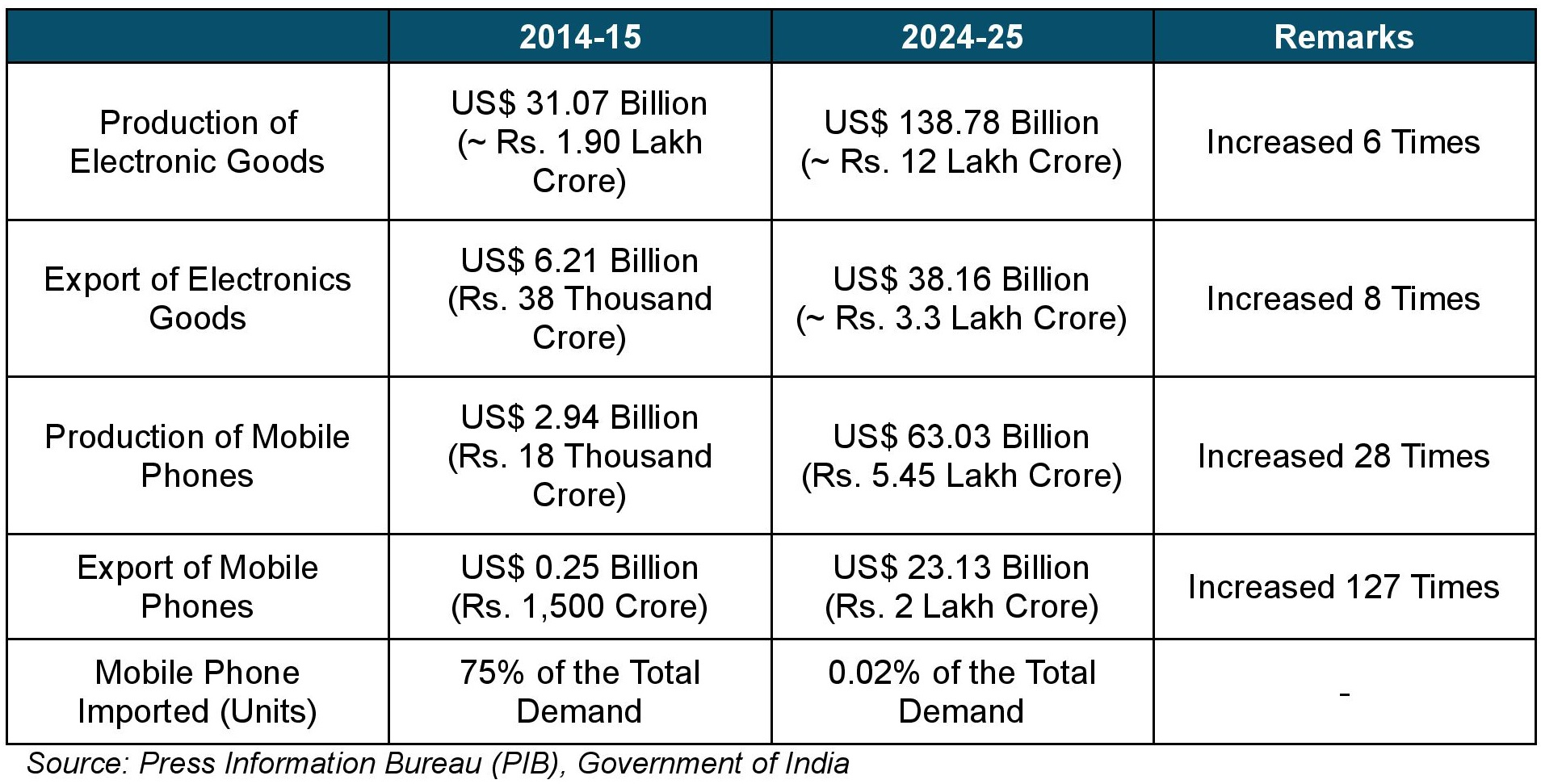
The electronics sector in India experienced substantial growth during the period from FY15 to FY25 because of effective government policies and increasing domestic market requirements. The production of electronic goods experienced a nearly sixfold increase while the export volume grew more than eightfold, which demonstrated the enhanced international competitiveness of Indian electronics manufacturers. The mobile phone industry has been the primary growth engine in India with production increasing by approximately 28 times and exports rising by 127 times, which established India as a major center for manufacturing. The country has made significant advances toward self-sufficiency because mobile phone imports now account for only a tiny fraction of total demand, which has decreased from 75%.
The domestic market for consumer electronics and appliances in India continues to grow, supported by rising household incomes. The adoption of consumer appliances is increasing across India due to rising urbanisation, electricity access is improving, supported by the expansion of organised retail and e-commerce platforms.
The International Monetary Fund projects that India will become the world's third-largest economy by 2028 when its nominal GDP reaches US$ 5.58 trillion (Rs. 464 lakh crore). The expected increase in per-capita income to over US$ 3,000 (Rs. 2.49 Lakh) by 2025 will enhance consumer spending on durable goods.
In 2019, only 20% of AC manufacturing materials originated from Indian sources. The current figure stands at 60% with an aim to achieve 80% by the year 2029. The PLI scheme has supported the development of complete AC component manufacturing capabilities within the country.
Indian electronic manufacturers focus on reducing imported products because of the Make in India initiative and their efforts to develop local components according to their needs which has resulted in reduced imports dependence among companies such as Samsung, Apple, Whirlpool, Dixon and Havells. The eight electronics companies including LG Electronics, Amber Enterprises, and Haier India experienced a 7% year-on-year decline, in total import value during 2023-24, reached US$ 10.29 billion (Rs. 95,143 crore) according to their regulatory filings with the Registrar of Companies (RoC).
Government Initiatives and Policy Support
Government initiatives have played a central role in expanding electronics manufacturing in India. The Production Linked Incentive (PLI) scheme has encouraged companies to increase local production and value addition. The programme initially supported the white goods industry includes air conditioners and LED lighting.
The National Policy on Electronics (NPE) supports these initiatives by promoting manufacturing clusters, design capability development and domestic component production expansion.
The Government of India introduced a US$ 2.7 billion (Rs. 24,954 crore) PLI scheme for electronic components in March 2025. The program aims to increase local manufacturing of printed circuit boards, connectors, capacitors, resistors, display modules and camera components. The scheme is anticipated to bring in US$ 7 billion (Rs. 6.47 lakh crore) of investments while creating over 91,600 direct employment opportunities and generating approximately US$ 6.42 billion (Rs.59,350 crore) of new manufacturing investments.
The Electronics Component Manufacturing Scheme (ECMS) has made further progress. The government authorised 22 component manufacturing projects which will generate 34,000 jobs and support domestic production of essential components required to produce smartphones, appliances and industrial electronics. Multiple global manufacturers, including Samsung and Foxconn, are increasing their production capabilities throughout India.
India has increased its domestic electronics production from US$ 20.56 billion (Rs. 1.90 lakh crore) in FY15 to US$ 103.00 billion (Rs. 9.52 lakh crore) in FY24, representing a CAGR of over 17%. The exports increased from US$ 4.11 billion (Rs. 0.38 lakh crore) to US$ 26.07 billion (Rs. 2.41 lakh crore) during the same time frame, reflecting annual growth rates exceeding 20%. The non-semiconductor component industry reached US$ 13 billion (Rs. 1.20 lakh crore) in 2022 according to Electronics Industries Association of India (ELCINA), while it is expected to grow to US$ 37 billion (Rs. 3.42 lakh crore) by 2030, indicating a potential a major domestic market demand-supply deficit.
Growth Drivers and Emerging Trends
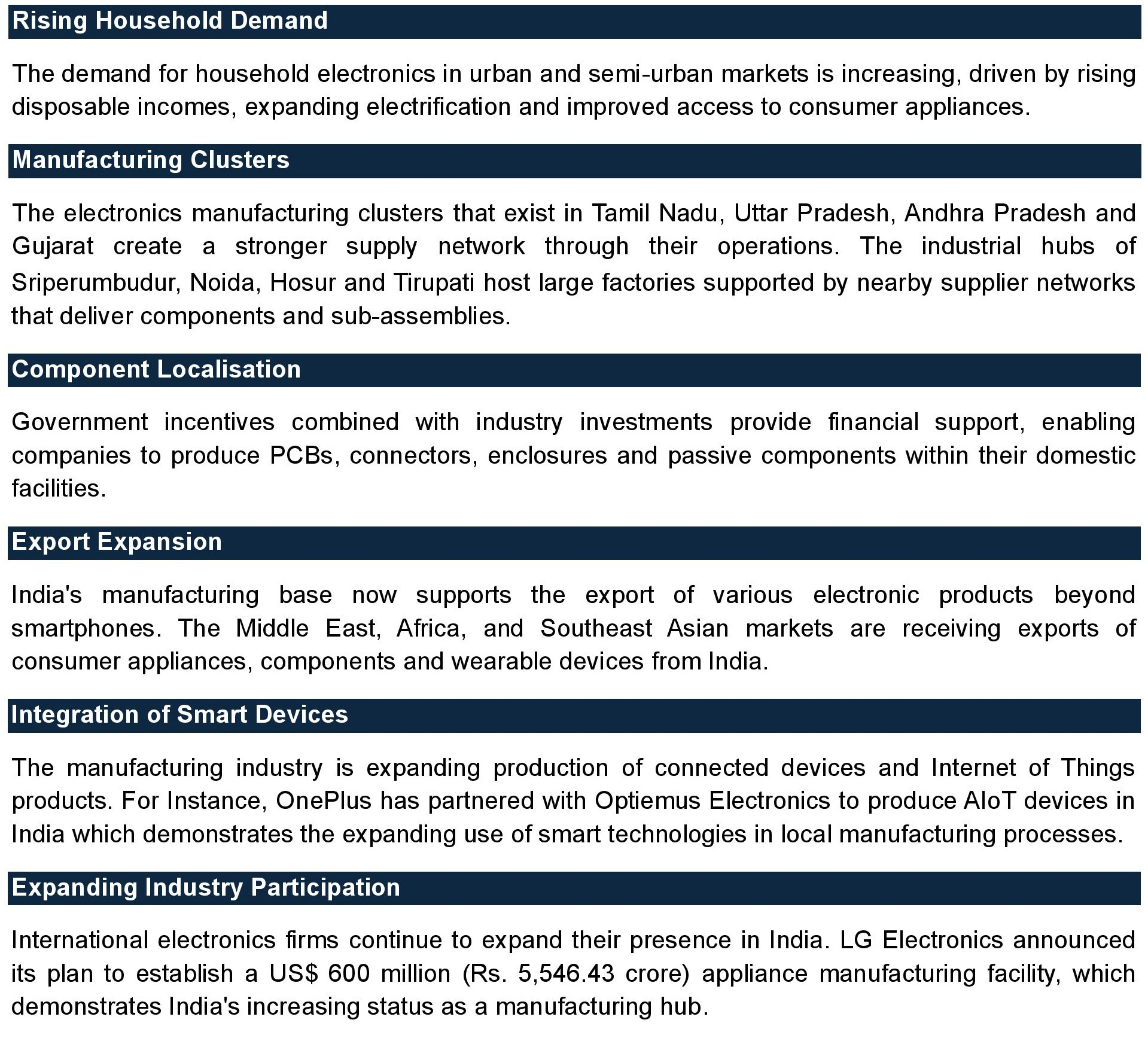
The following developments are accelerating the shift towards localised electronics manufacturing in India’s consumer appliance industry:
Outlook and Road Ahead
The electronics industry in India has experienced substantial growth during the last ten years. The initial round of policy interventions aimed to develop assembly operations in India through the creation of major manufacturing centers. The upcoming phase will center on improving domestic manufacturing capacities for components and developing more effective domestic supply chains.
The strong demand from local markets together with government assistance and the expansion of industrial zones generates positive conditions for sustained economic development. India will increase its global electronics manufacturing and trade presence through its expanding component production capacity and developing supplier networks.
FAQs
What is driving localisation in India’s electronics manufacturing sector?
Government incentives, rising domestic demand and efforts to reduce import dependence are accelerating localisation.
How large is India’s consumer electronics opportunity?
Industry estimates suggest the consumer goods market could reach Rs. 3 lakh crore (US$ 32.6 billion) by 2029.
Why is component manufacturing important?
Domestic component production increases value addition and reduces reliance on imports.
Which clusters are emerging as electronics manufacturing hubs?
Major clusters include Sriperumbudur, Noida, Hosur and Tirupati.
What is the next phase of India’s electronics manufacturing growth?
The focus is expected to shift toward component manufacturing and stronger domestic supply chains.
Partners