SEARCH
RECENT POSTS
Categories
- Agriculture (38)
- Automobiles (20)
- Banking and Financial services (36)
- Consumer Markets (57)
- Defence (6)
- Ecommerce (21)
- Economy (72)
- Education (14)
- Engineering (9)
- Exports (22)
- Healthcare (25)
- India Inc. (10)
- Infrastructure (31)
- Manufacturing (32)
- Media and Entertainment (17)
- Micro, Small & Medium Enterprises (MSMEs) (16)
- Miscellaneous (31)
- Perspectives from India (37)
- Pharmaceuticals (5)
- Railways (4)
- Real Estate (20)
- Renewable Energy (19)
- Research and Development (12)
- Retail (1)
- Services (7)
- Startups (16)
- Technology (66)
- Textiles (8)
- Tourism (16)
- Trade (9)
Authors






Manufacturing Companies in India Driving Growth Through Innovation
- Apr 02, 2026, 18:35
- Manufacturing
- IBEF
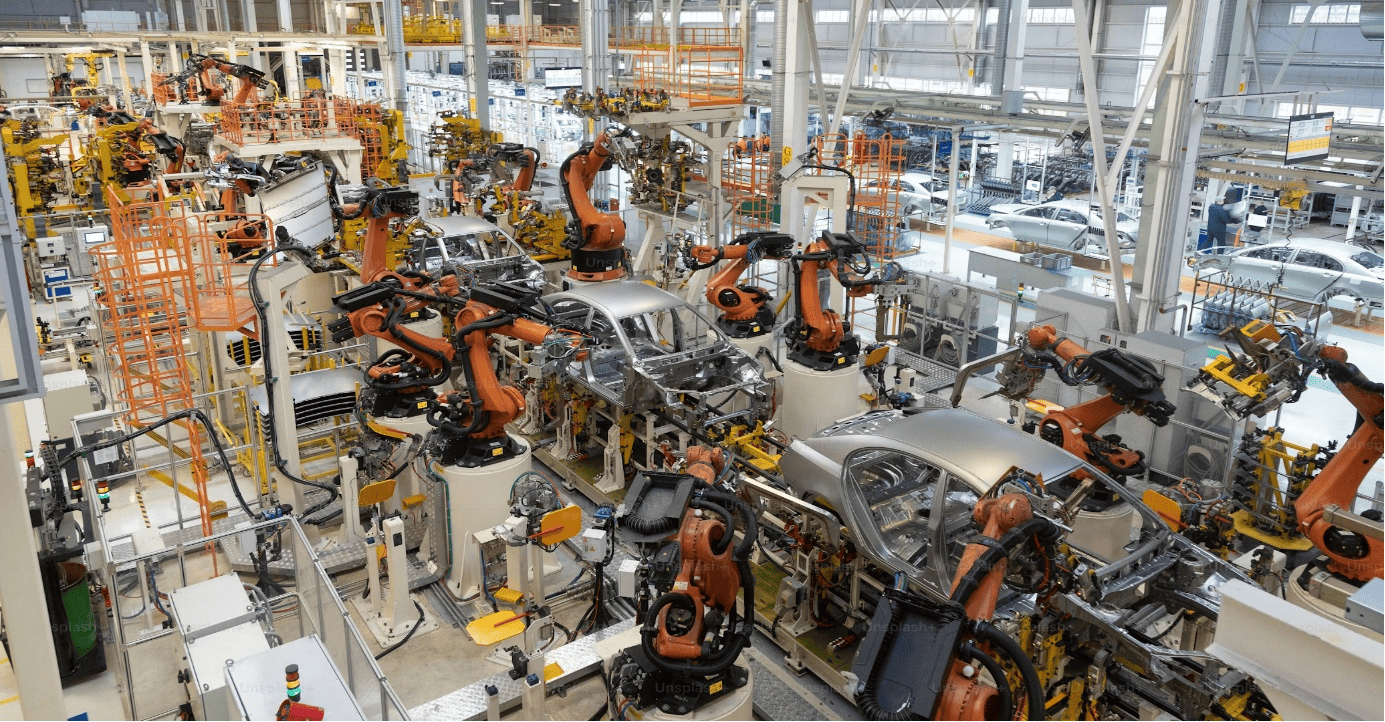
India’s manufacturing ecosystem is entering a decisive phase of transformation, driven by rising R&D intensity, accelerated technology adoption, and a strategic shift toward advanced, design-led production. Manufacturing companies are increasingly embedding innovation at the core of their growth strategies to enhance competitiveness, operational resilience, and global relevance. This evolution is moving Indian manufacturing beyond scale-driven expansion toward value creation anchored in advanced machinery, digital factories, artificial intelligence, automation, and new product platforms. Government missions and incentive frameworks are reinforcing this transition by encouraging domestic value addition, localisation of critical technologies, and deeper integration with global supply chains. As a result, high-technology manufacturing activity is becoming more concentrated, supported by expanding R&D centres, next-generation production facilities, and technology-focused capital expenditure.
Manufacturing Industry Outlook
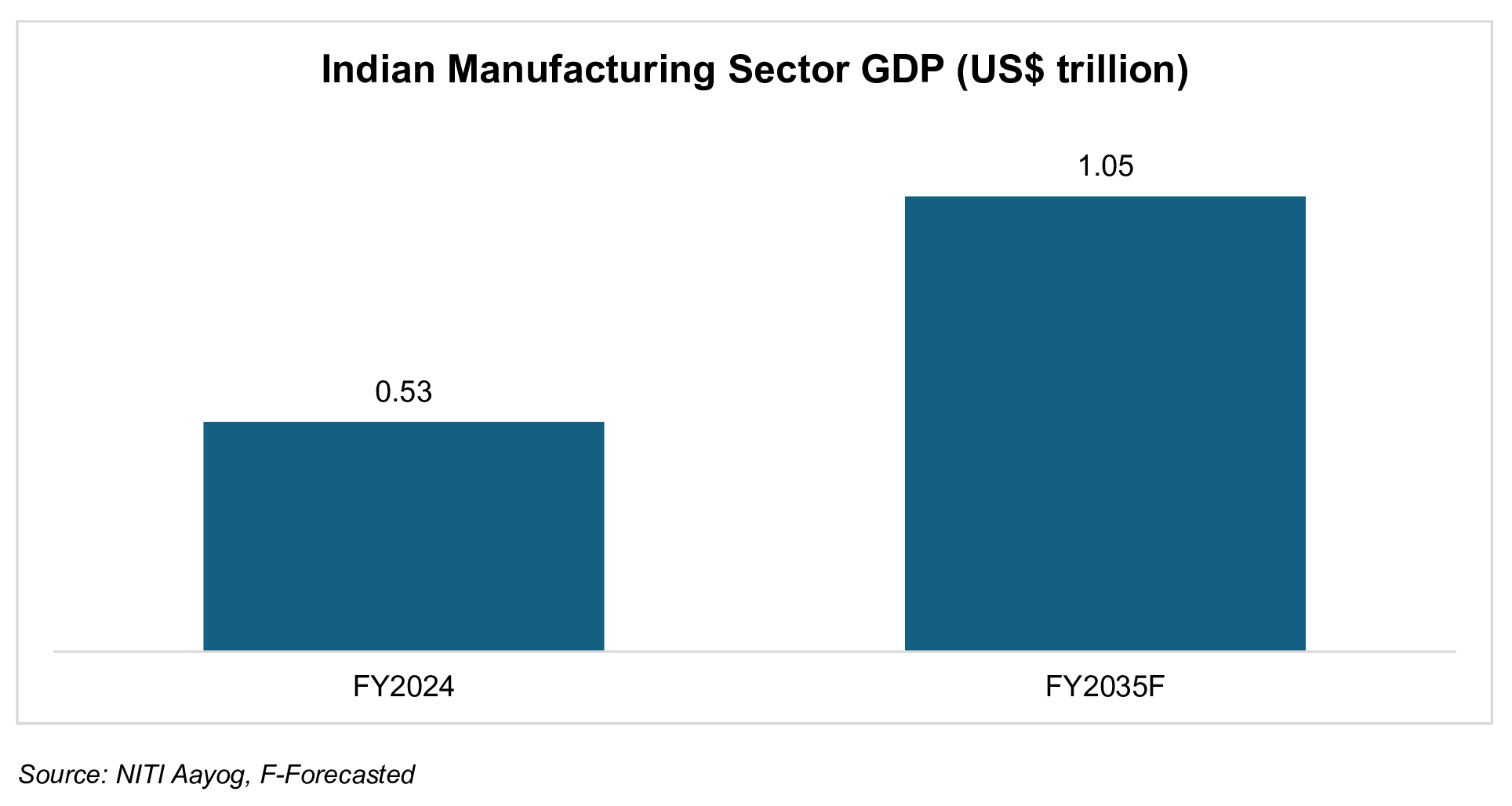
India’s manufacturing sector is on a strong medium-to-long-term growth trajectory, underpinned by expanding domestic demand, export opportunities, and rising investment in advanced manufacturing capabilities. Manufacturing GDP is projected to grow at a compound annual growth rate of 6.5%, reaching Rs. 93.5 lakh crore (US$ 1.05 trillion) by FY35 from approximately Rs. 46.9 lakh crore (US$ 0.53 trillion) in FY24. A defining structural feature of this growth is the increasing dominance of a limited number of high-impact manufacturing clusters. Five manufacturing clusters comprising thirteen key sectors currently account for nearly 75% of India’s manufacturing GDP. These clusters spanning electronics, capital goods, automotive, chemicals, pharmaceuticals, and renewable energy components are expected to contribute around 85% of manufacturing GDP by FY35, reflecting a shift toward technology-intensive and higher-value production.
Policy Architecture Enabling Innovation-Led Manufacturing
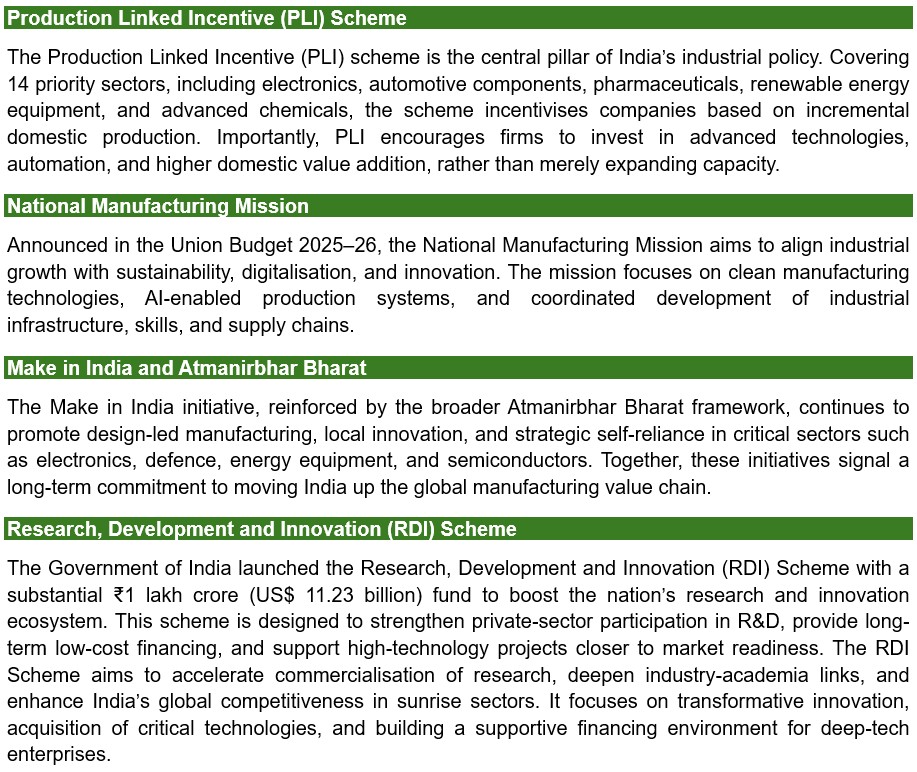
India’s manufacturing transformation is underpinned by a multi-layered policy framework designed to encourage technology adoption, R&D investment, and global competitiveness.
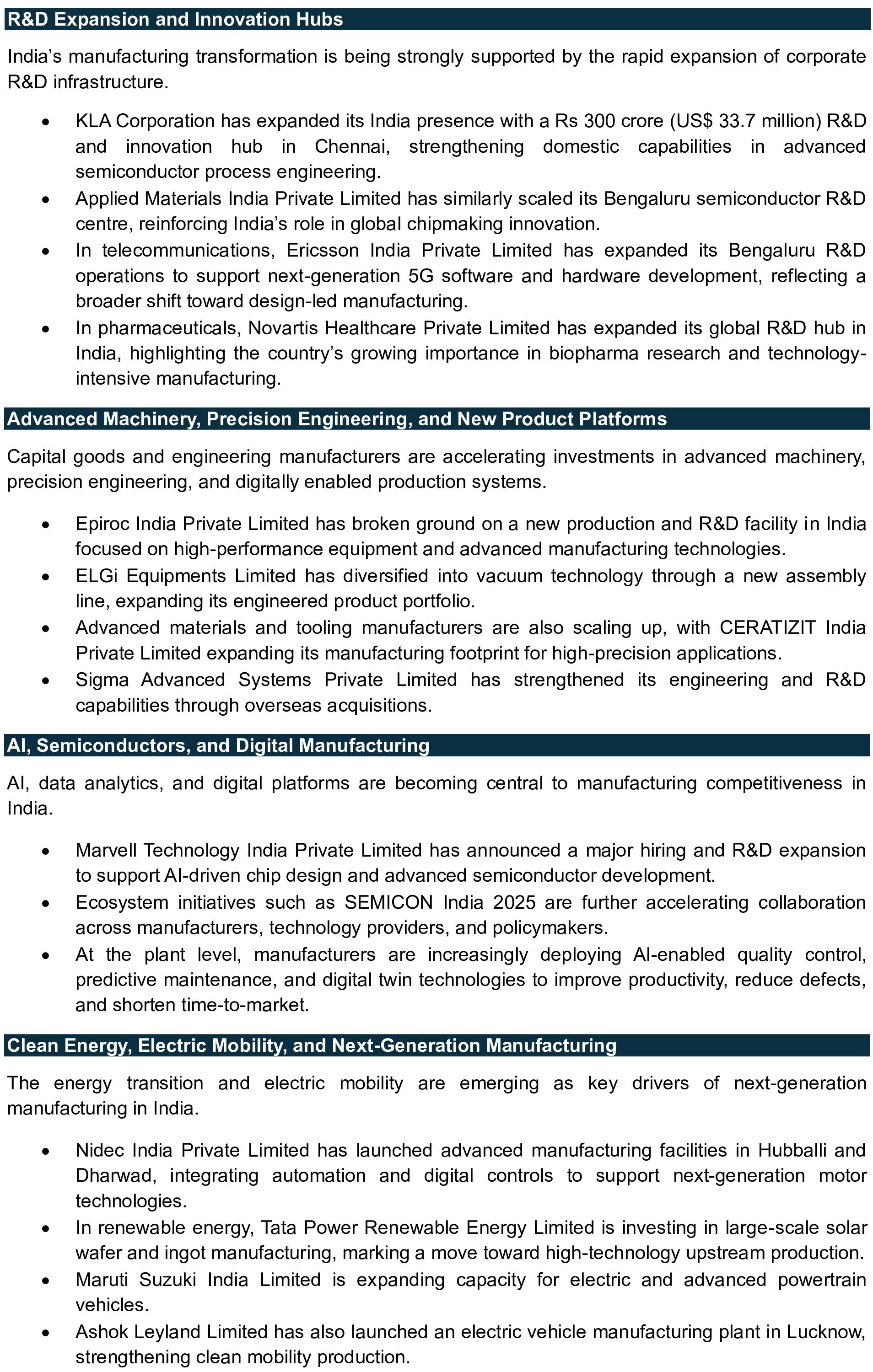
How Manufacturing Companies Are Driving Growth Through Innovation
The Road Ahead
Going forward, India’s manufacturing growth will increasingly depend on the depth of innovation across products, processes, and supply chains. Wider adoption of AI, automation, digital twins, and advanced materials, along with closer integration of R&D, design, and production, will define the next phase. Manufacturing clusters are expected to deepen specialisation, enabling higher value addition and global competitiveness. Policy continuity and targeted incentives will remain critical for scaling clean manufacturing, semiconductor ecosystems, and next-generation mobility. As global supply chains diversify, India’s technology-enabled, resilient, and innovation-driven manufacturing base positions it strongly as a future global hub for advanced manufacturing.
FAQs
How large is India’s manufacturing sector expected to become?
India’s Manufacturing GDP is projected to grow at a compound annual growth rate of 6.5%, reaching Rs. 93.5 lakh crore (US$ 1.05 trillion) by FY35 from approximately Rs. 46.9 lakh crore (US$ 0.53 trillion) in FY24.
Which segments are driving manufacturing growth in India?
Electronics, capital goods, automotive, chemicals, pharmaceuticals, and renewable energy components are the key growth-driving segments, together accounting for the majority of manufacturing output.
How is innovation reshaping manufacturing companies in India?
Manufacturers are adopting advanced machinery, AI, automation, and digital factories to improve productivity, quality, and time-to-market.
What role do government policies play in manufacturing innovation?
Policies such as PLI, the National Manufacturing Mission, and Make in India encourage technology adoption, R&D investment, and domestic value addition.
What trends will shape the future of manufacturing in India?
AI-driven production, semiconductor manufacturing, electric mobility, clean energy equipment, and precision engineering will define the next phase of growth.
Partners




