SEARCH
RECENT POSTS
Categories
- Agriculture (37)
- Automobiles (20)
- Banking and Financial services (36)
- Consumer Markets (57)
- Defence (6)
- Ecommerce (21)
- Economy (72)
- Education (14)
- Engineering (9)
- Exports (21)
- Healthcare (25)
- India Inc. (10)
- Infrastructure (31)
- Manufacturing (32)
- Media and Entertainment (16)
- Micro, Small & Medium Enterprises (MSMEs) (16)
- Miscellaneous (31)
- Perspectives from India (37)
- Pharmaceuticals (5)
- Railways (4)
- Real Estate (20)
- Renewable Energy (19)
- Research and Development (12)
- Retail (1)
- Services (7)
- Startups (16)
- Technology (66)
- Textiles (8)
- Tourism (16)
- Trade (8)
Authors






Popular Rice Varieties in India: Market Landscape, Key Varieties and Growth Opportunities
- Sep 24, 2026, 15:55
- Engineering
- IBEF
Machine tools can be considered the foundation of current manufacturing processes that help manufacture extremely accurate components used in different industries including automotive, aerospace, military, railway, electronics, and medical equipment industries. Machine tools have been called the "mother industry" as they form the base for the entire manufacturing processes providing tools that are needed for cutting, forming, drilling, grinding, and other kinds of machining of metals and other materials. India manufactures an extensive range of conventional as well as advanced machine tools which includes the computer numerical control (CNC) machine tools, machining centers, grinding machine tools, gear cutting machine tools, and EDM machine tools. The Ministry of Heavy Industries has recognized the machine tool industry as an important contributor to the manufacturing development process and has allowed 100% FDI in the sector.
With the launch of various government programs, such as Make in India and the National Manufacturing Mission, India's demand for the advanced machine tools grows both in traditional industries and high-technology industries. With increasing automation of processes and use of precision engineering and smart manufacturing techniques, the sector increases India's competitive advantage in the manufacturing sphere.
India's Machine Tool Manufacturing Market Overview
India's machine tool manufacturing industry is witnessing steady expansion, supported by rising industrialisation, increasing investments in advanced manufacturing and growing demand from sectors such as automotive, aerospace, defence, railways, electronics and medical devices. According to the IMARC Group, the India machine tools market was valued at US$ 1.83 billion in 2025 and is projected to reach US$ 3.51 billion by 2034, registering a compound annual growth rate (CAGR) of 7.49% during 2026–2034. The market is being driven by the increasing adoption of precision manufacturing solutions, digital production technologies and higher investments across India's manufacturing ecosystem.
The industry's operational performance also reached new milestones during FY26. According to the Indian Machine Tool Manufacturers' Association (IMTMA), production turnover increased to Rs. 16,478 crores (US$ 1.86 billion), while order bookings reached Rs. 16,176 crores (US$ 1.83 billion), reflecting sustained investment by domestic manufacturers. For the first time, domestic machine tool consumption exceeded Rs. 35,000 crores (US$ 3.96 billion), demonstrating robust demand from India's expanding manufacturing base. However, imports continued to account for approximately 60–65% of domestic consumption, highlighting significant opportunities for indigenous manufacturing, technology development and import substitution.
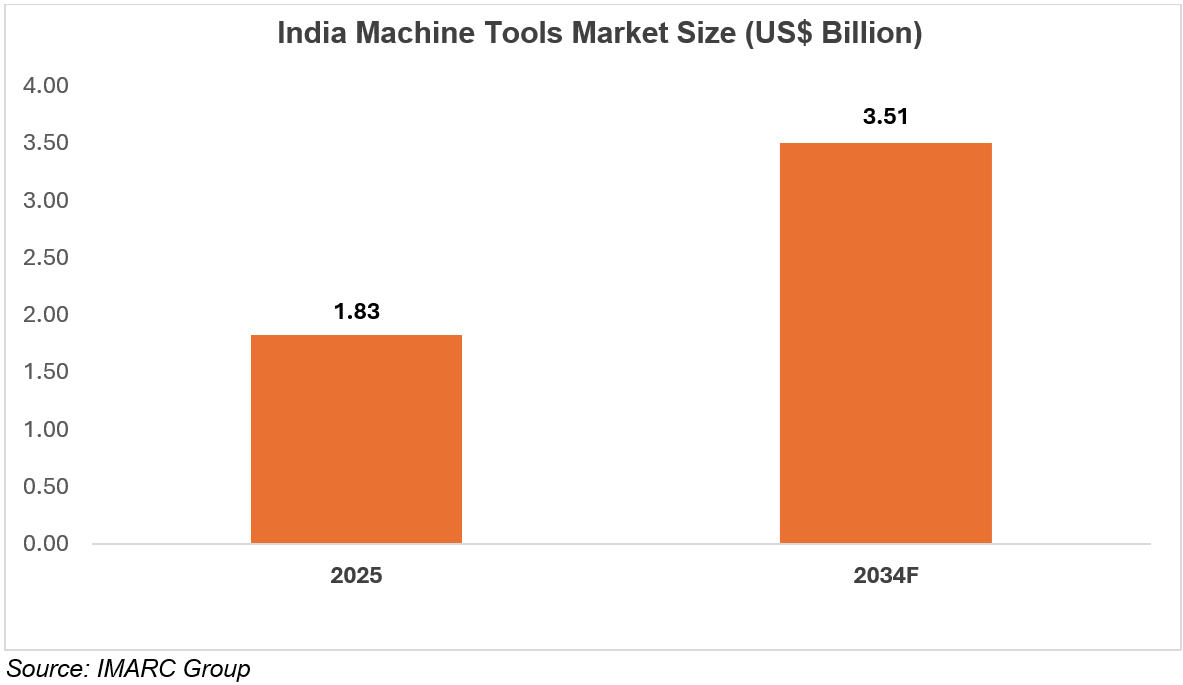
The performance of the industry clearly depicts the increasing importance of the use of machine tools in maintaining the increasing manufacturing capacity of India. The increasing investments made by the producers, along with the growing need for accurate production machines, contribute towards making the industry a crucial part of the industrial value chain of the country.
How Machine Tool Manufacturing Is Powering India's Industrial Modernisation
Machine Tools are important for industrial modernization in India because they help in manufacturing components that are highly precise in terms of accuracy and efficiency. Machine tools are considered the “Mother Industry” by the Ministry of Heavy Industries since they provide the necessary equipment required in the manufacture of machinery and components. With increasing technological advancements in the process of manufacturing, machine tools help improve manufacturing quality, use resources efficiently, and increase efficiency.
India's broader manufacturing expansion is further reinforcing the importance of the machine tool industry. According to the Ministry of Statistics and Programme Implementation (MoSPI), India's Real Gross Value Added (GVA) reached Rs. 294.91 lakh crore (US$ 3337.02 billion) in FY26, registering 7.9% growth, while real GDP expanded by 7.7%. The continued growth in manufacturing activity is accelerating demand for advanced production equipment capable of supporting precision engineering, automation and high-volume manufacturing across industrial sectors.
The latest generation of machine tools has evolved from simple machining tools to become a vital component of intelligent manufacturing systems. Thanks to the use of CNC machines, robotics, automation, and Industry 4.0 technology, the modern manufacturer is now able to achieve high accuracy, reduce production time, save raw material wastage, and improve the quality of the products. The CMTI helps develop new generation manufacturing capabilities for India by carrying out research in precision engineering and machining technology.
Key Growth Drivers Supporting India's Machine Tool Manufacturing Industry
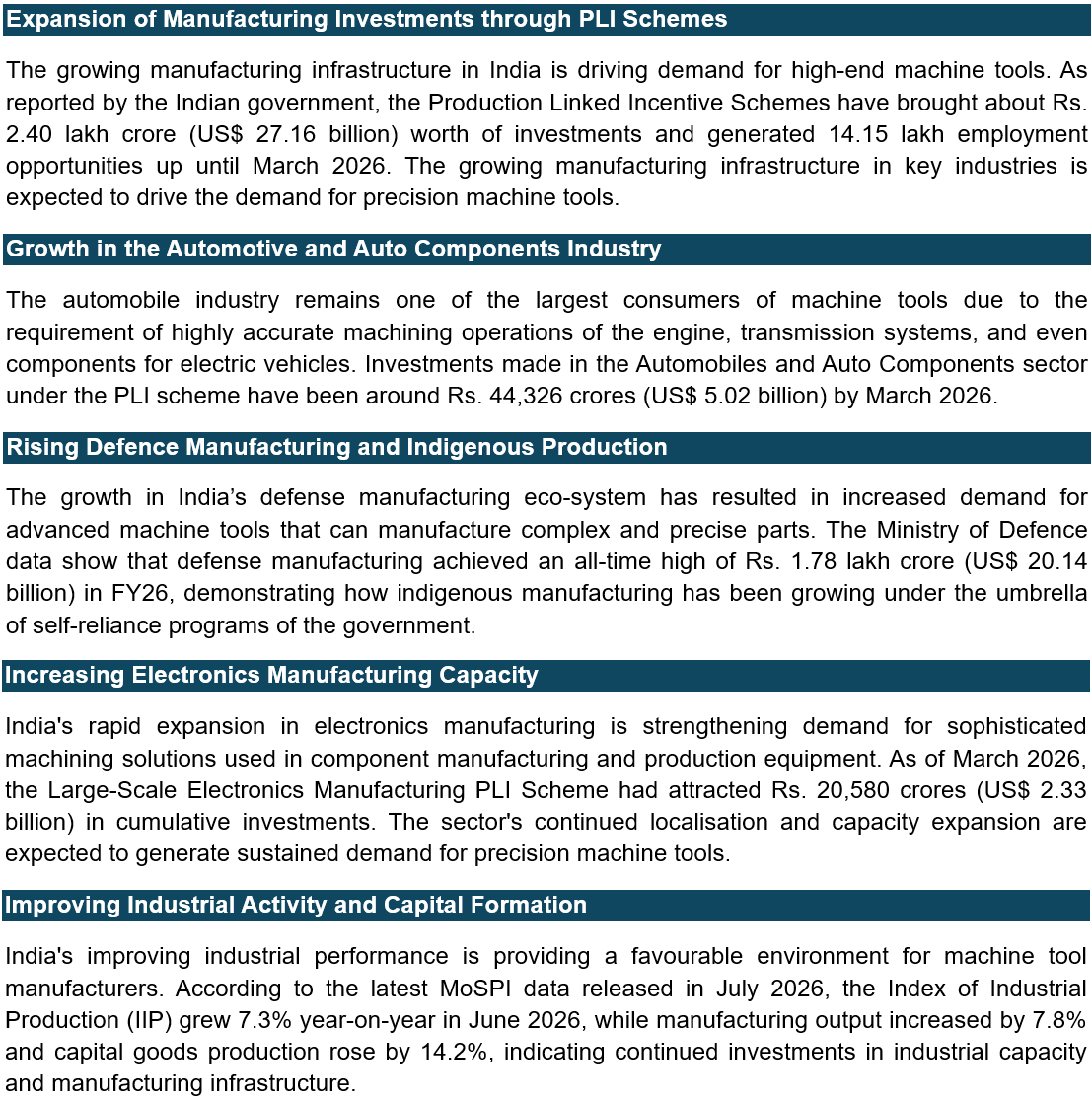
The Indian machine tool manufacturing industry is progressing owing to a combination of factors such as industrial investments, increased demand from high-end manufacturing industries, and the use of modern manufacturing technology. The government’s efforts towards developing the domestic manufacturing industry along with investment in the automotive, defense, and electronics industries have created an enabling environment for the machine tool manufacturers. The following are some of the factors that are expected to contribute to the future growth of the industry.
Government Initiatives Strengthening India's Machine Tool Manufacturing Industry
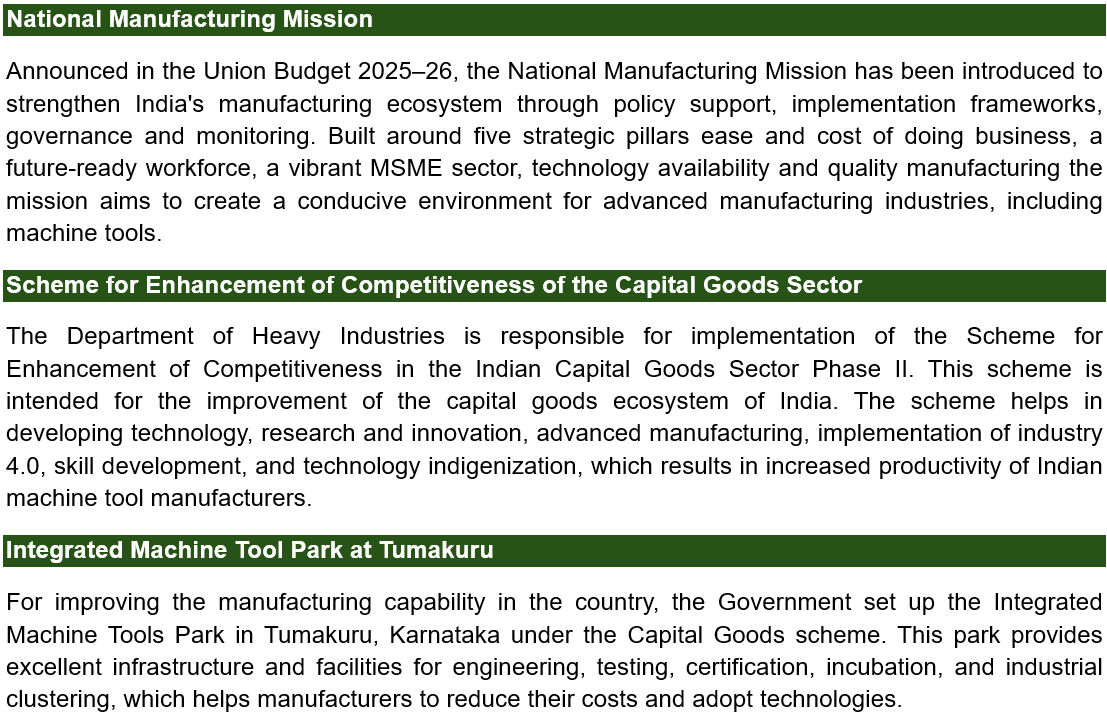
The Government of India has taken various policy steps that focus on building up a robust machine tool industry through the development of technology, making manufacturing more competitive, and promoting indigenous production. The various missions and sectoral programs, as well as efforts towards research, help modernize the manufacturing process, foster innovation, and boost India's position as a manufacturing powerhouse.
The Road Ahead
India's machine tool manufacturing industry is well-positioned to play a pivotal role in the country's transition towards advanced and globally competitive manufacturing. Rising investments across strategic sectors, increasing adoption of digital manufacturing technologies and continued policy support are creating a favourable environment for the industry's long-term development. At the same time, growing emphasis on precision engineering, automation and indigenous technology development is encouraging manufacturers to strengthen domestic capabilities and reduce dependence on imported equipment.
As India advances its vision of becoming a global manufacturing hub, machine tools will remain fundamental to enhancing productivity, improving product quality and supporting innovation across high-value industries. Continued collaboration between government, industry, research institutions and technology providers will be essential to accelerate technological advancement and build a resilient manufacturing ecosystem. With sustained investments in modern manufacturing infrastructure and capability development, India's machine tool industry is expected to strengthen its global competitiveness while supporting the country's broader industrial and economic transformation.
FAQs
What is the current market size of India's machine tools industry?
According to the IMARC Group, the India machine tools market was valued at US$ 1.83 billion in 2025 and is projected to reach US$ 3.51 billion by 2034, registering a CAGR of 7.49% during 2026–2034. The market's growth is supported by increasing industrialisation, automation and rising demand for precision manufacturing across key industries.
Why are machine tools important for India's manufacturing sector?
Machine tools are considered the "mother industry" because they manufacture the equipment used to produce precision components across industries such as automotive, aerospace, defence, railways, electronics and medical devices. They improve manufacturing accuracy, productivity, product quality and operational efficiency, making them fundamental to India's industrial modernisation.
Which industries are the major end users of machine tools in India?
The major end users of machine tools in India include the automotive, aerospace, defence, electronics, railways, medical devices and construction equipment industries. These sectors rely on advanced machining technologies to manufacture high-precision components while meeting stringent quality, safety and productivity requirements.
What are the key growth drivers of India's machine tool manufacturing industry?
The industry's growth is being driven by expanding manufacturing investments, increasing production across automotive, defence and electronics sectors, rising adoption of CNC and smart manufacturing technologies, and government initiatives that promote technology development, research and domestic manufacturing capabilities.
What government initiatives support India's machine tool manufacturing industry?
The Government of India supports the industry through initiatives such as the National Manufacturing Mission, the Scheme for Enhancement of Competitiveness in the Indian Capital Goods Sector Phase II, the Integrated Machine Tool Park at Tumakuru, and research and innovation programmes led by the Central Manufacturing Technology Institute (CMTI).
Partners




