SEARCH
RECENT POSTS
Categories
- Agriculture (40)
- Automobiles (21)
- Banking and Financial services (36)
- Consumer Markets (58)
- Defence (6)
- Ecommerce (21)
- Economy (72)
- Education (14)
- Engineering (9)
- Exports (22)
- Healthcare (25)
- India Inc. (10)
- Infrastructure (31)
- Manufacturing (33)
- Media and Entertainment (17)
- Micro, Small & Medium Enterprises (MSMEs) (16)
- Miscellaneous (31)
- Perspectives from India (37)
- Pharmaceuticals (5)
- Railways (5)
- Real Estate (20)
- Renewable Energy (19)
- Research and Development (12)
- Retail (2)
- Services (8)
- Startups (16)
- Technology (66)
- Textiles (8)
- Tourism (16)
- Trade (9)
Authors






Why Mushroom Farming Is Attracting More Interest Among Indian Farmers
- Oct 28, 2026, 17:45
- Agriculture
- IBEF
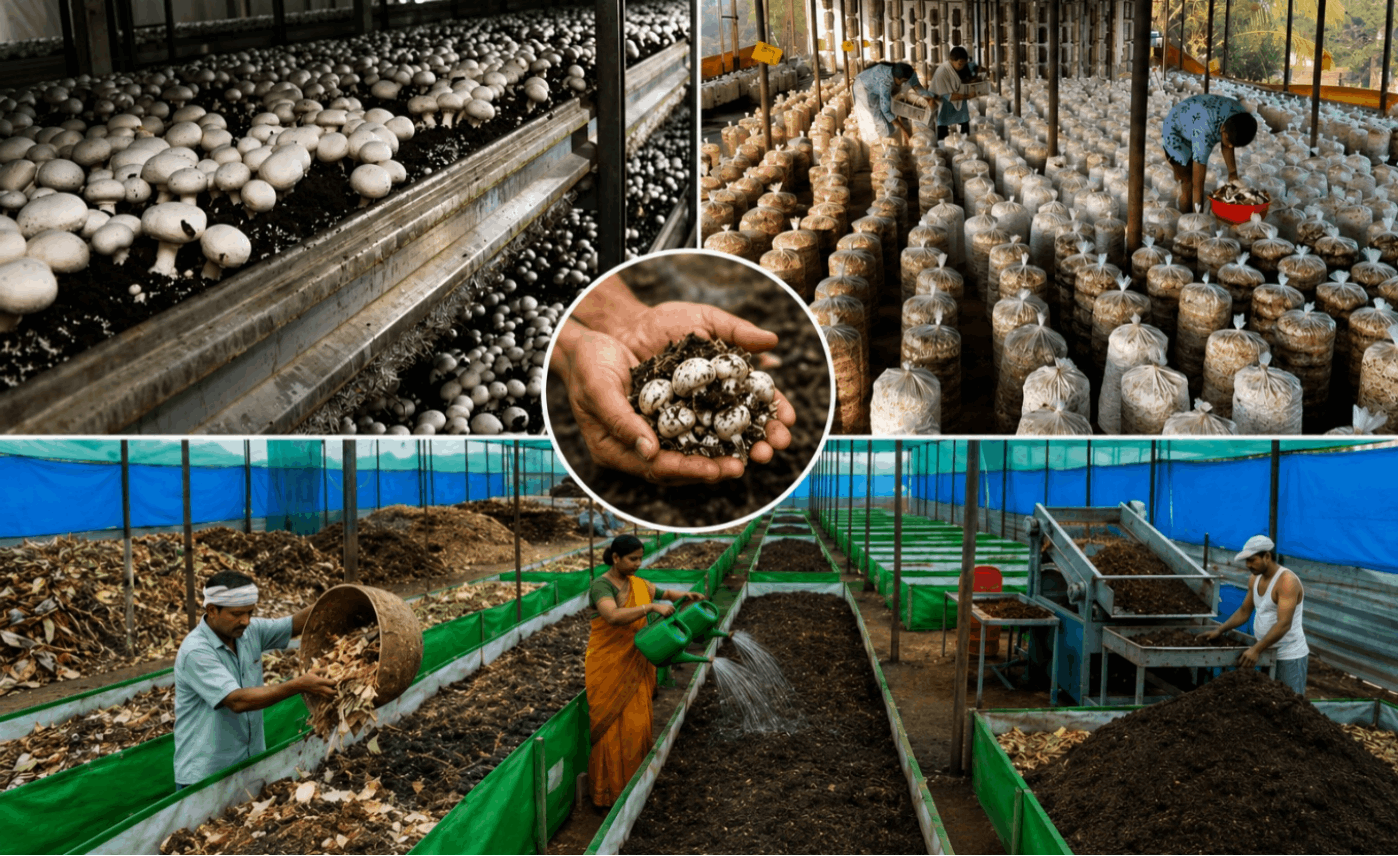
The cultivation of mushrooms is quickly emerging as one of the most promising agri-businesses for the country, attracting laborers, poor farmers, and women of the villages who can cultivate a crop which requires very little land, grows within weeks as opposed to months and converts agricultural wastes like paddy straw and sawdust into a protein rich food source. An industry that used to thrive in a few states alone has over the last five years witnessed rapid expansion throughout the country.
The production of mushrooms in India increased from 177.85 thousand metric tons (MT) in FY21 to 319.03 thousand MT in FY25. This represents a 79.4% growth over the period, driven by a combination of low start-up costs, government subsidies, and consumer demand for nutritious vegetarian foods.
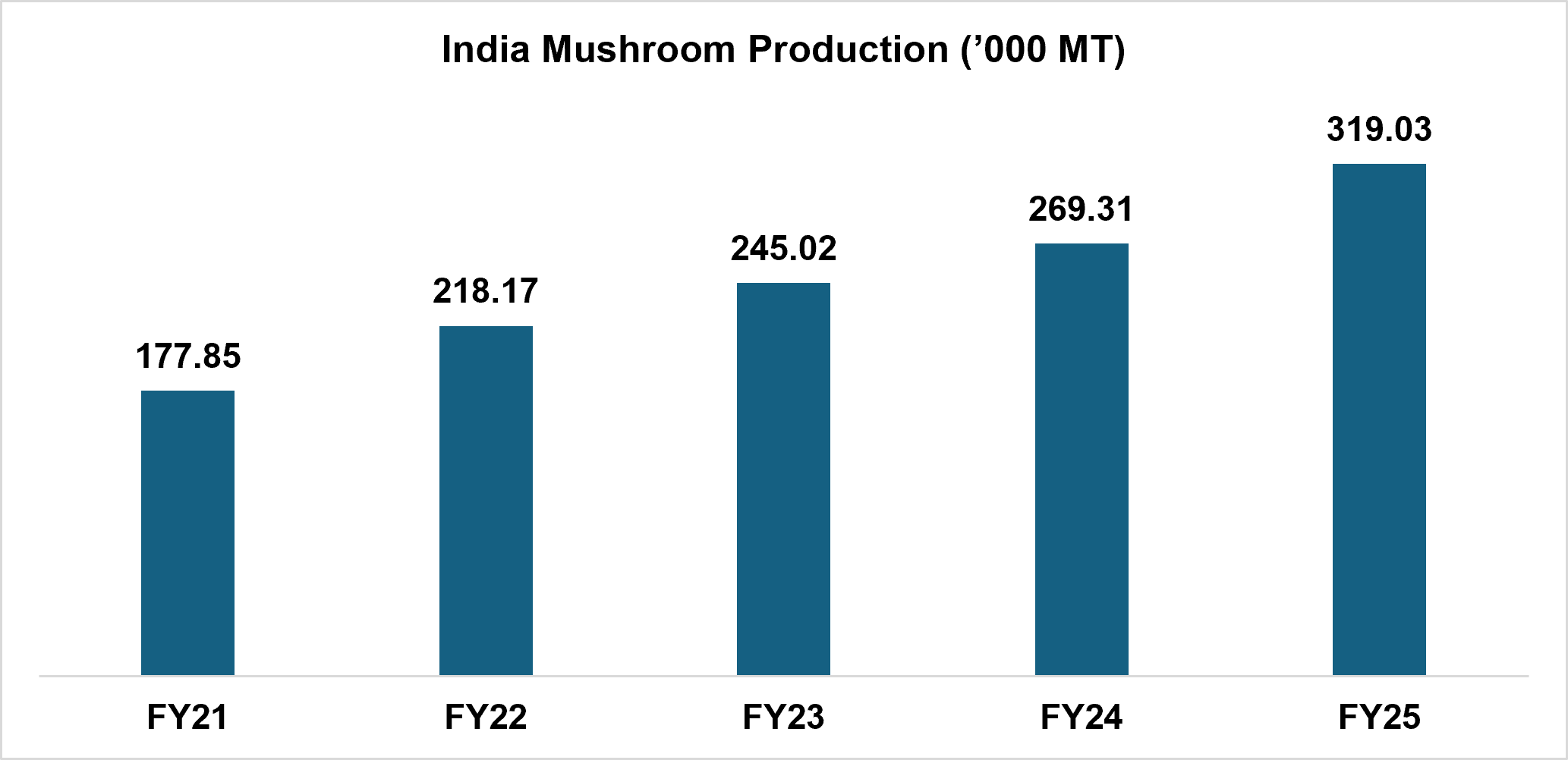
Source: Agricultural and Processed Food Products Export Development Authority (APEDA)
Government Initiatives and Policies Driving Change
A mix of both central and state-level schemes is ensuring that mushroom farming becomes an accessible venture for farmers through the reduction of costs and availability of relevant inputs.
- Mission for Integrated Development of Horticulture (MIDH): Mushroom farming has been included in the MIDH mission, where financial and technical assistance is provided for the construction of production infrastructure, spawn and compost units. Revised guidelines for 2025 allow private sector units to get 40% assistance while low-cost mushroom units get 50% assistance up to certain limit.
- Improved horticulture assistance under MIDH: Restructuring done in 2025 has made MIDH applicable to all districts; the cost norms have been modified along with promotion of modern and innovative technologies in horticulture while providing financial and technical assistance to protected cultivation along with its infrastructure. Mushroom farming has been included in MIDH.
- Farm Women’s Food Security Groups under the Agricultural Technology Management Agency (ATMA): ATMA has taken up Farm Women’s Food Security Groups, referred to as Model Food Security Hubs, involving mushroom cultivation, kitchen gardening, backyard poultry, goatery and dairying among other activities. Each such group is provided Rs. 25,000 (US$ 282.90) for training, literature and inputs, with minimum two groups being created every year in each block. Beneficiaries of women under ATMA have increased from 9.93 lakh in FY25 to 11.61 lakh in FY26 (till Feb 28, 2026).
- State level missions: There are state-specific support missions for the promotion of mushroom cultivation in various states of the country. Uttar Pradesh State Rural Livelihood Mission has supported the cultivation of mushrooms as an economically viable activity amongst rural women, while Odisha has its Mushroom and Floriculture Mission for the assistance being provided to the self-help groups for paddy straw and oyster mushroom cultivation depending on local climate.
Who Is Fueling India’s Growing Interest in Mushroom Farming?
- According to the government's report in 2026, it highlighted the role of ICAR project titled 'Sustainable She-preneurship in Mushroom Cultivation Model' (2S2M) that is contributing towards promoting women entrepreneurs in the mushroom cultivation business. Also, under Biotech-KISAN project, more than 5,000 women have been trained in mushroom cultivation, and 1,200 self-help groups have been formed or empowered in mushroom cultivation business.
- ICAR-CIWA formulated the Sustainable She-preneurship in Mushroom Cultivation Model (2S2M). It helps women entrepreneurs in mushrooms through proper training and capacity building, resource access, and market linkage. As per empirical results, the model has helped raise women’s income from mushroom cultivation beyond Rs. 1 lakh (US$ 1,059.55); access to resources and services beyond 35%; consumption of healthy foods above 30%; and reduces drudgery beyond 37% through use of small, mechanized tools. The model helps boost women's entrepreneurial skills, their employment and decision-making ability. It helps women farmers link up with research institutions, governmental organizations, financial institutions and marketing firms for enterprise development. As it tries to help with poverty alleviation, nutrition security and employment, the model seeks to create livelihood options sustainably. In essence, the model enables farm women to transit from traditional cultivation to mushroom enterprise.
- The changes have affected local infrastructure and science of production too. In April 2026, ICAR-KVK Namsai created a laboratory of mushroom spawn production to provide farmers with local inputs, whereas ICAR-KVK in other locations increased their training programs on scientific cultivation, processing, and marketing of oyster mushrooms. Workshop on All India Coordinated Research Project (AICRP) Mushrooms XXVIII was organized in Guwahati during June 2026, for the exchange of views on recent achievements made in mushroom research and its technology of production along with the ways of strengthening the mushroom sector.
Such changes indicate that the Indian mushroom industry is gradually transforming from individual to organized, women-led, technology-based, and commercial production.
Growth Drivers and Key Trends
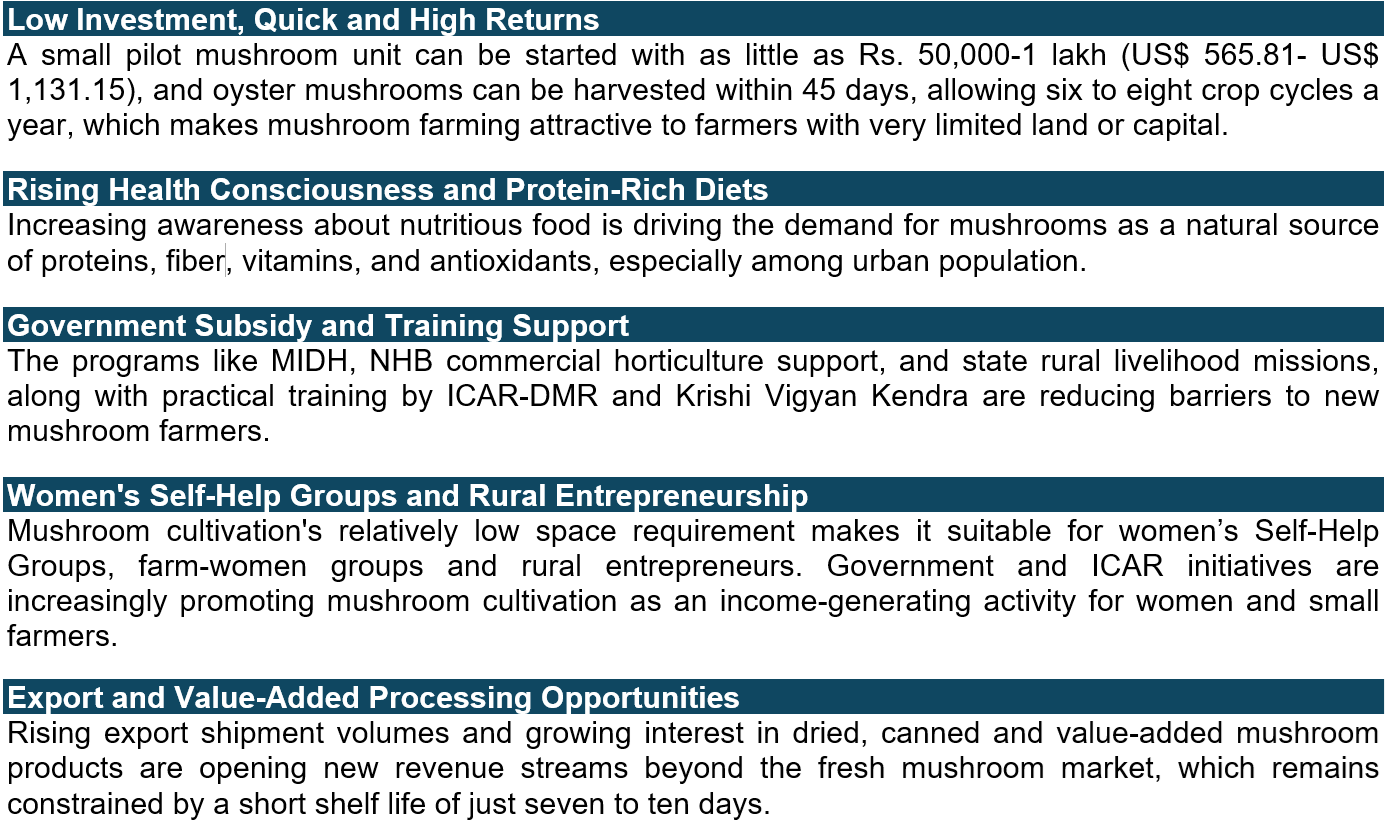
The following factors are driving greater farmer interest in mushroom cultivation:
Outlook and Road Ahead
The future looks promising for India’s mushroom industry due to increased production, more government involvement, and an increase in consumers’ preferences for health-conscious, plant-based products. Despite this progress, challenges related to post-harvest management, lack of sufficient processing facilities, and need for extending shelf life persist. Post-harvest management, value addition, entrepreneurial activities, and commercialization are some of the top priorities highlighted by the ICAR for mushroom development. Improvements in cold chain and storage facilities, increase in drying, canning, and other value-added processing, and increased farmer participation in support programs by the MIDH and NHB are important steps to ensure that increased production results in greater market stability and better incomes for farmers.
FAQs
Why is mushroom farming gaining popularity among Indian farmers?
Mushroom farming requires limited land and investment, offers quick crop cycles and can convert agricultural waste such as paddy straw and sawdust into a protein-rich food source.
How much has mushroom production increased in India?
India’s mushroom production increased from 177.85 thousand metric tonnes in FY21 to 319.03 thousand metric tonnes in FY25, representing a 79.4% increase.
What government schemes support mushroom farming in India?
Mushroom cultivation is supported under schemes such as the Mission for Integrated Development of Horticulture (MIDH), while ATMA and various state-level missions also provide financial, technical and training support.
How is mushroom farming supporting rural women entrepreneurs?
Government and ICAR initiatives are promoting mushroom cultivation among women through training, capacity building, access to resources and market linkages. The 2S2M model, for example, supports women in developing mushroom enterprises.
What opportunities exist for value-added mushroom products in India?
Growing export shipments and demand for dried, canned and other value-added mushroom products are creating opportunities beyond the fresh mushroom market, particularly because fresh mushrooms have a short shelf life of around seven to ten days.
Partners