SEARCH
RECENT POSTS
Categories
- Agriculture (39)
- Automobiles (20)
- Banking and Financial services (36)
- Consumer Markets (57)
- Defence (6)
- Ecommerce (21)
- Economy (72)
- Education (14)
- Engineering (9)
- Exports (22)
- Healthcare (25)
- India Inc. (10)
- Infrastructure (31)
- Manufacturing (33)
- Media and Entertainment (17)
- Micro, Small & Medium Enterprises (MSMEs) (16)
- Miscellaneous (31)
- Perspectives from India (37)
- Pharmaceuticals (5)
- Railways (4)
- Real Estate (20)
- Renewable Energy (19)
- Research and Development (12)
- Retail (1)
- Services (7)
- Startups (16)
- Technology (66)
- Textiles (8)
- Tourism (16)
- Trade (9)
Authors






Smart Textiles & Wearables: Weaving Tech into Tradition

The textile industry is dynamically changing. It is no longer a simple necessity, art and cultural statement, but now an active interface with the digital world. The emerging smart textiles and wearables are the byproduct of this revolution, especially in those countries with a rich textile history such as India. This promising era is a seamless integration of ancient weaving tradition and art with modern technology, which incorporates intelligence directly into the cloth. The outcome of it is a future in which clothing ceases to be a passive substance but a dynamic, responsive instrument that can monitor our health, power our devices and bring us together digitally; a testament to human ingenuity changing the fabric of our lives.
Textile heritage in India and the way it prepares the stage
The Indian textile tradition is rich, ancient and has established a special and strong base to its entrance to the modern smart textile revolution. The story, which covers the luxurious silks of Varanasi and the work of delicate embroideries of Kutch to the simple, hand-spun khadi and the rich block prints of Rajasthan, is the work of generations of unrivalled skill, mastery and a deep and subtle sense of materials, dyes and complicated weaving processes. This is not just about beauty, but a heritage – an expression of profound knowledge in cloth-making and cloth-working, all in the context of the cultural meaning of clothes.
In contrast to the countries that have industrialised their textile industries, India boasts of an enormous, decentralised community of skilled craftsmen whose traditional knowledge is an invaluable resource. It is the unique advantage of India that deeply appreciates handloom techniques and the natural structure of the fabric. The country can hence capture the magic of this ancient art and combine it with cutting-edge technology such as integrated sensors, conductive fibres and miniaturised electronics. This can bring about the development of smart textiles that are highly functional as well as innately attractive and culturally appealing. The opportunities are endless: imagine a traditional saree keeping track of the vital signs of the person wearing it without any issues, or a jacket made of khadi with a technological solution that will allow charging a phone unnoticed. This combination of tradition and innovation preconditions the fact that India will be on the forefront of creation of a new generation of wearable devices that are not only advanced but also have a strong backdrop in their artistic heritage.
Smart textile and wearable technology types
Smart wearables and fabrics represent a wide range of innovations, all of which are aimed at bringing intelligent capabilities to fabrics. They may be broadly classified according to the leading purpose:
- Passive smart textiles: Passive smart textiles are those that feel the environmental stimuli or a user´s input without any reaction or adaptative response. Examples include optical fibres woven into fabrics, such as those that change colour depending on the light, or thermochromic dyes that change colour depending on temperature.
- Active smart textiles: They are textile materials in which their response is a reaction to external stimuli, or human intervention. This category includes fabrics that themselves can be hot or cold, fabric with sensors woven into them to track the body’s response and even fabric that generates power.
- Ultra-smart textiles: The most advanced type, these can sense and respond but also learn from that information (machine) or mould to the environment or user’s needs (showing touch of artificial intelligence). This futuristic realm contains self-cleaning fabrics, self-repairing materials and textiles that can store and release energy.
Under these classifications, there are various types of wearable technology being used within these various classifications:
- Sensors: The miniaturised, flexible sensors can be integrated into clothing to monitor heart rate, body temperature and respiration as well as the content of sweat and even the movement of muscles.
- Actuators: They enable textiles to do things, such as heat up, cool down, vibrate or change shape.
- Conductive yarns and fibres: These high-performing threads can carry electrical signals, which means electronic devices could be sewn into the material, forming wearable circuits.
- Power sources: Miniaturised, flexible batteries, solar cells and even kinetic energy harvesters are being developed to supply power for smart textiles.
- Communication features: Bluetooth, Wi-Fi and Near Field Communication (NFC) modules could be added for the communication of smart textiles with a smartphone or other wearables as well as with the cloud.
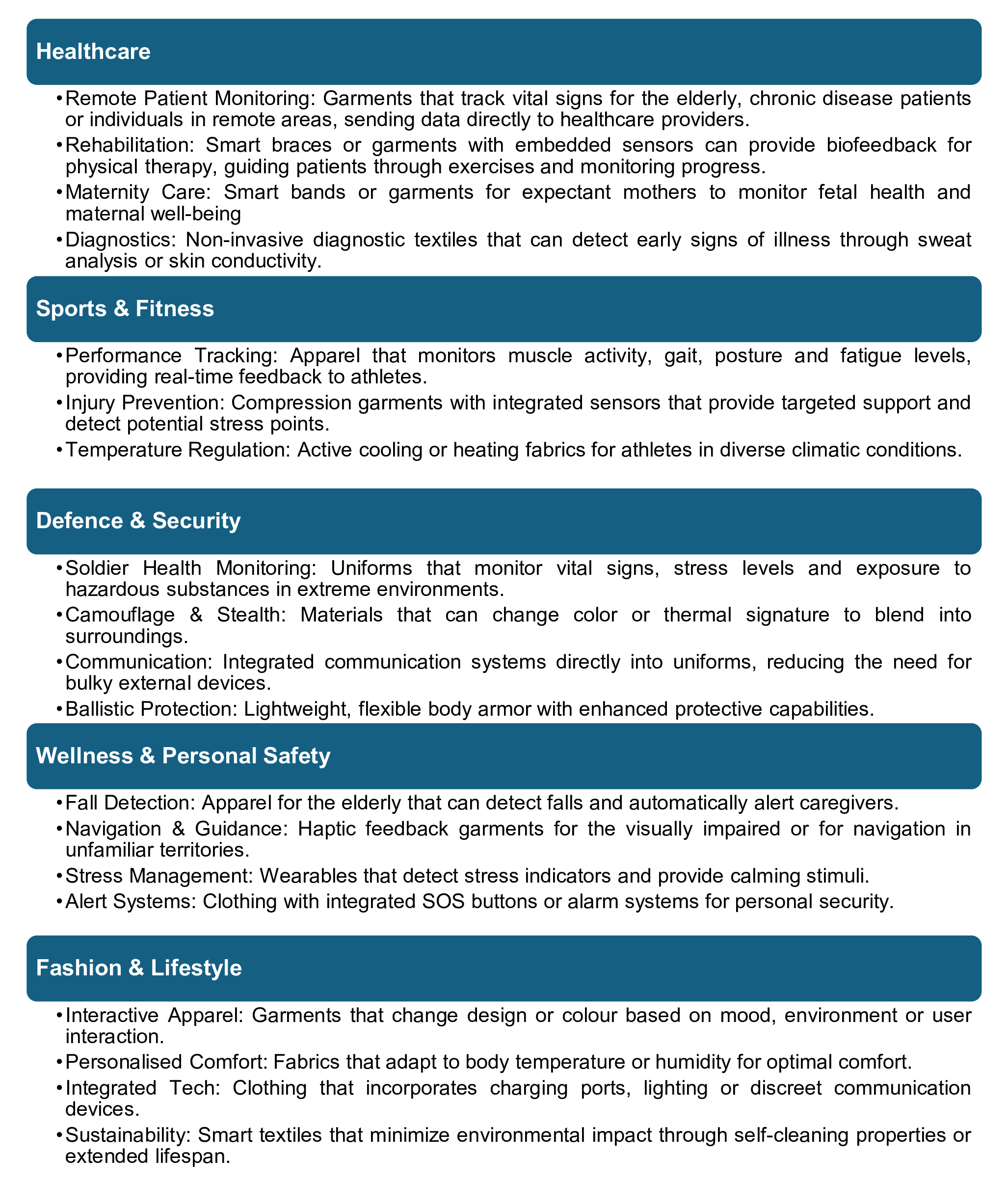
Key applications in India
The potential applications of smart textiles and wearables in India are vast and diverse, poised to impact critical sectors:
Policy support and ecosystem
To respond to the strategic value of smart textiles, the Indian government and other organisations are developing an ecosystem:
- National Technical Textiles Mission (NTTM): NTTM has been launched by Ministry of Textiles, with the objective to place India as a global leader in technical textiles (including smart fibres). It emphasises on research, innovation, skill development and market promotion and provides for substantial research and development (R&D) in smart textiles.
- Startup India & Make in India: Under these flagships, funding support, incubation support and promoting ease of doing business for startups including smart textile sector.
- Industry-Academic Partnerships: Government and industry are promoting the integration of research institutes with textile entrepreneurs to fast-track product development and commercialisation.
- Funding & Incubation: The prospects of government grants, venture capital and incubators are the greatest possible backup for smart textile start-ups by providing money and mentor support to bring innovations into existence.
- Standards and Regulation: Standards and regulatory guidelines are being developed for smart textiles, both to ensure product safety but also so it becomes known that products will work together.
The road ahead: A seamlessly integrated future
The way forward in pursuit of smart textiles is a path of integration, where dynamic functionality becomes second nature to not just how we appear but also as a comfortable extension of ourselves. The future, where a child’s pyjamas track health and running shoes conform to surfaces, or your work uniform boosts wellness is now a near reality but only as result of the collaboration between disciplines. In the context of India, this journey assumes great significance as it combines centuries-old textile traditions with avant-garde technology. The timeless craft of weaving is reinventing itself, with fibres serving as a leading protagonist in the digital revolution – following the invention of a machine capable of transforming intelligent life moment by moment into smart and responsive customised companions. So, as production becomes more efficient and parts become smaller, intelligent fabrics will silently transform our relationship with clothing, health and the world around us. It’s not just about technology, it’s about transforming the nature of man-made finery, inventing the future story of mankind one smart thread at a time.
FAQs
What are smart textiles?
Smart textiles are fabrics embedded with technology that can sense, react and adapt to environmental or user stimuli.
Which industries can adopt smart textile technology?
Healthcare, sports, defence, fashion and wellness sectors are leading adopters of smart and wearable fabrics.
What are the main types of smart textiles?
They are classified as passive, active and ultra-smart textiles based on their level of responsiveness.
What materials are used in smart textiles?
Conductive yarns, flexible sensors, microprocessors and miniaturised power sources are commonly integrated.
What government initiatives support smart textiles in India?
Schemes such as NTTM and Make in India promote R&D, innovation and startup development in this field.
Partners




