SEARCH
RECENT POSTS
Categories
- Agriculture (39)
- Automobiles (20)
- Banking and Financial services (36)
- Consumer Markets (57)
- Defence (6)
- Ecommerce (21)
- Economy (72)
- Education (14)
- Engineering (9)
- Exports (22)
- Healthcare (25)
- India Inc. (10)
- Infrastructure (31)
- Manufacturing (33)
- Media and Entertainment (17)
- Micro, Small & Medium Enterprises (MSMEs) (16)
- Miscellaneous (31)
- Perspectives from India (37)
- Pharmaceuticals (5)
- Railways (4)
- Real Estate (20)
- Renewable Energy (19)
- Research and Development (12)
- Retail (1)
- Services (7)
- Startups (16)
- Technology (66)
- Textiles (8)
- Tourism (16)
- Trade (9)
Authors






The New Indian Investor: Young, Digital and Confident

- Feb 23, 2026, 18:10
- Banking and Financial services
- IBEF
India’s investor profile is rapidly shifting to a younger, tech-savvy generation. Industry reports show the average Indian investor today is barely in their early 30s, with almost half under 30. A recent market analysis found that the ‘Gen-Z’ segment has emerged as a significant force, rising from ~25% of NSE-registered investors in FY20 to 40% by FY25. Reserve Bank of India (RBI) data likewise confirms a sharp demographic change: the share of sub-30 investors jumped from 22.6% in March 2019 to 38.9% by July 2025, driving the median investor age down from 38 to 33.
- Youthful participation: India has ~600 million people below 25 and their market presence is growing fast. For example, NSE India reported a 43% surge in new demat accounts in 2022, driven by 18-30-year-olds. Trading apps like Zerodha, Groww and Paytm Money see over 70% of new users in this age group.
- Digital reach: Mobile and online platforms dominate. App-based brokers now account for ~80% of all retail equity investors. 55-60% of new Systematic Investment Plan (SIP) registrations come from beyond the top 30 cities.
- Growing assets: Young investors now hold a big slice of investment assets. In 2025, millennials and Gen-Z together control half (~48%) of all mutual fund assets (Rs. 75.35 lakh crore (US$ 862.64 billion)). In 2025 alone, Indians under 35 opened ~40% of all new SIP accounts.
Types of investors
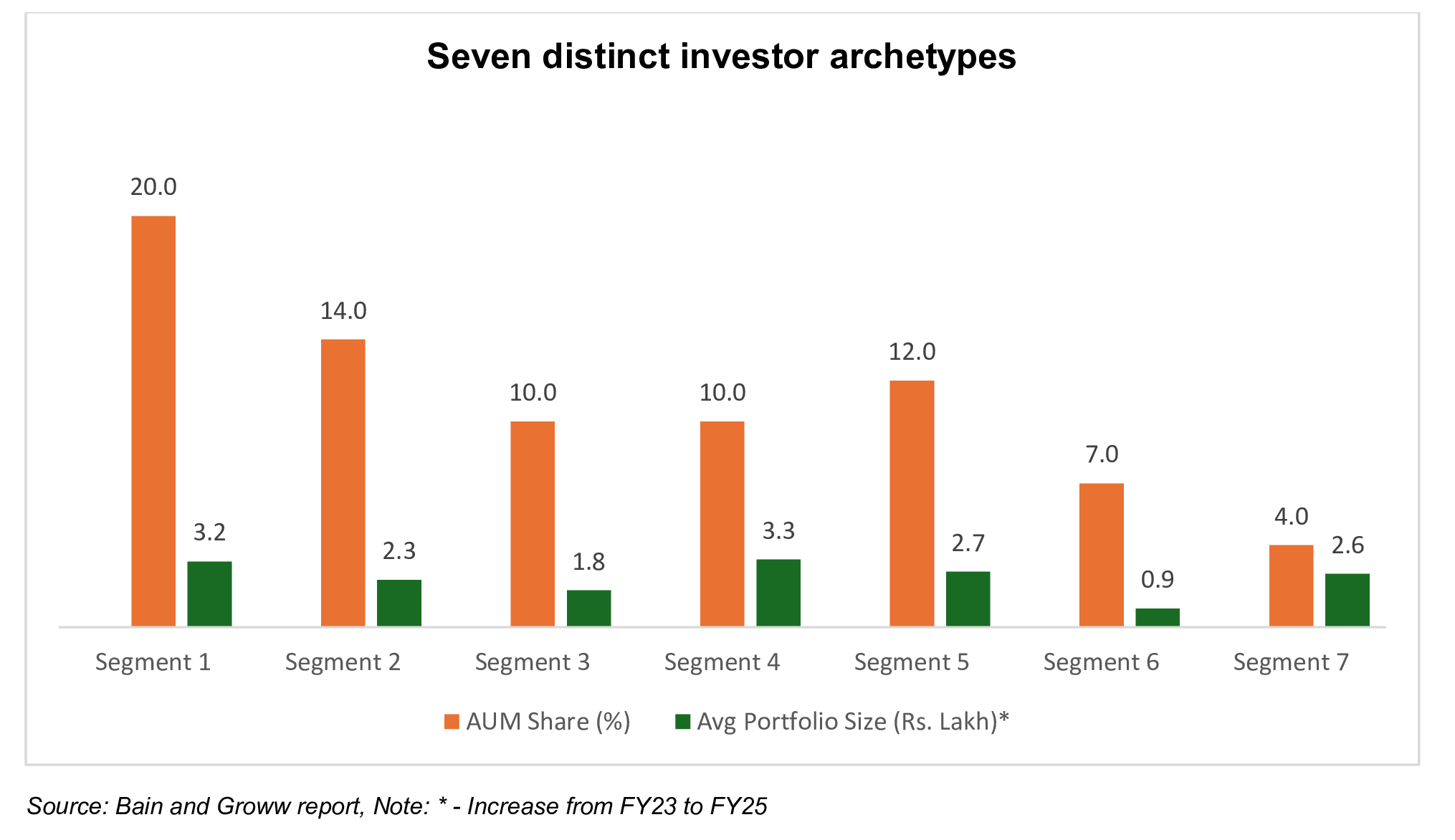
The chart above presents key investor segments actively participating in India’s digital investment space. Each group reflects unique preferences:
Segment 1: Salaried millennials in metro and tier-1 cities – digitally fluent and wealth-focused, with the highest mutual fund allocation.
Segment 2: Salaried millennials in tier-2 and smaller cities – confident but still building investment experience.
Segment 3: Young salaried Gen Z – new earners entering the market with a growing interest in SIPs.
Segment 4: Salaried Gen X across cities – older, stable investors, with slower portfolio growth.
Segment 5: Self-employed professionals – mid-career investors with balanced risk appetite.
Segment 6: Gen Z students – young entrants investing early, highly reactive to market trends.
Segment 7: Business owners – experienced investors, showing the highest risk exposure.
Together, these segments represent India’s evolving and increasingly youthful investor base.
Digital-first platforms and expectations
The new generation invests entirely through digital channels. Mobile-first fintech platforms have made it easy to invest with just a smartphone. Regulators and startups note that young investors demand fast, app-like experiences. Industry surveys find that ~35% of new investors drop out during ‘know your customer’ (KYC) verification due to slow, cumbersome processes. Those who stick around expect quick, streamlined onboarding. If a platform is slow or paperwork-heavy, the youth will simply move on.
Platforms are adapting. New digital KYC methods and e-signatures have helped, and the results show up in the data. Large fintechs now capture the bulk of retail flows. As one report notes, fully app-based brokers (Groww, Zerodha, Upstox) now contribute ~80% of retail equity investors. Mobile app usage has pushed financial markets into small towns too: many first-time investors are from tier-2 and tier-3 cities. In short, India’s investing is now mass-market and online – the domain of YouTube tutorials, mobile alerts, and influencer-driven advice as much as traditional advice desks.
Changing investment preferences
The new Indian investor is not only younger but also more focused on long-term wealth-building. Surveys show a broad shift toward disciplined investment vehicles. For example, Indians under 35 opened 40% of all new SIP accounts in 2025. 19% of Gen Z reported investing via SIPs (against 14% of millennials), and ~84% of these choose equity mutual funds. Half of all mutual fund folios are now held by investors under 30.
Young Indians are leading this change. This generation is focused on growing their money for the long term rather than making quick profits. This is evident in how they allocate their portfolios. A Bain & Groww analysis of platform data shows that salaried young investors allocate 55-65% of their assets into mutual funds. Even as first-time investors often start with simple SIPs, many graduate to larger lumpsum contributions. Over the past two years, the share of lumpsum inflows to equity funds has jumped by 11 percentage points, nearing parity with SIP flows. Notably, segments like business-owner investors (Segment 7) have increased their lumpsum investing about fivefold over two years, a sign of growing confidence and wealth.
Risk appetite is also high among the young. Recent data shows that 58% of Gen Z investment flows go into stocks or equity funds, far above allocations to gold or other assets. A Business Today survey finds 45% of Gen Z prefer stocks/SIPs over the stability of gold, and a remarkable 72% of 18-21-year-olds say they are invested in equities. Influenced by online content, many Gen Z investors are moving into high-growth funds: small-cap and mid-cap fund holdings are rising the fastest among these groups.
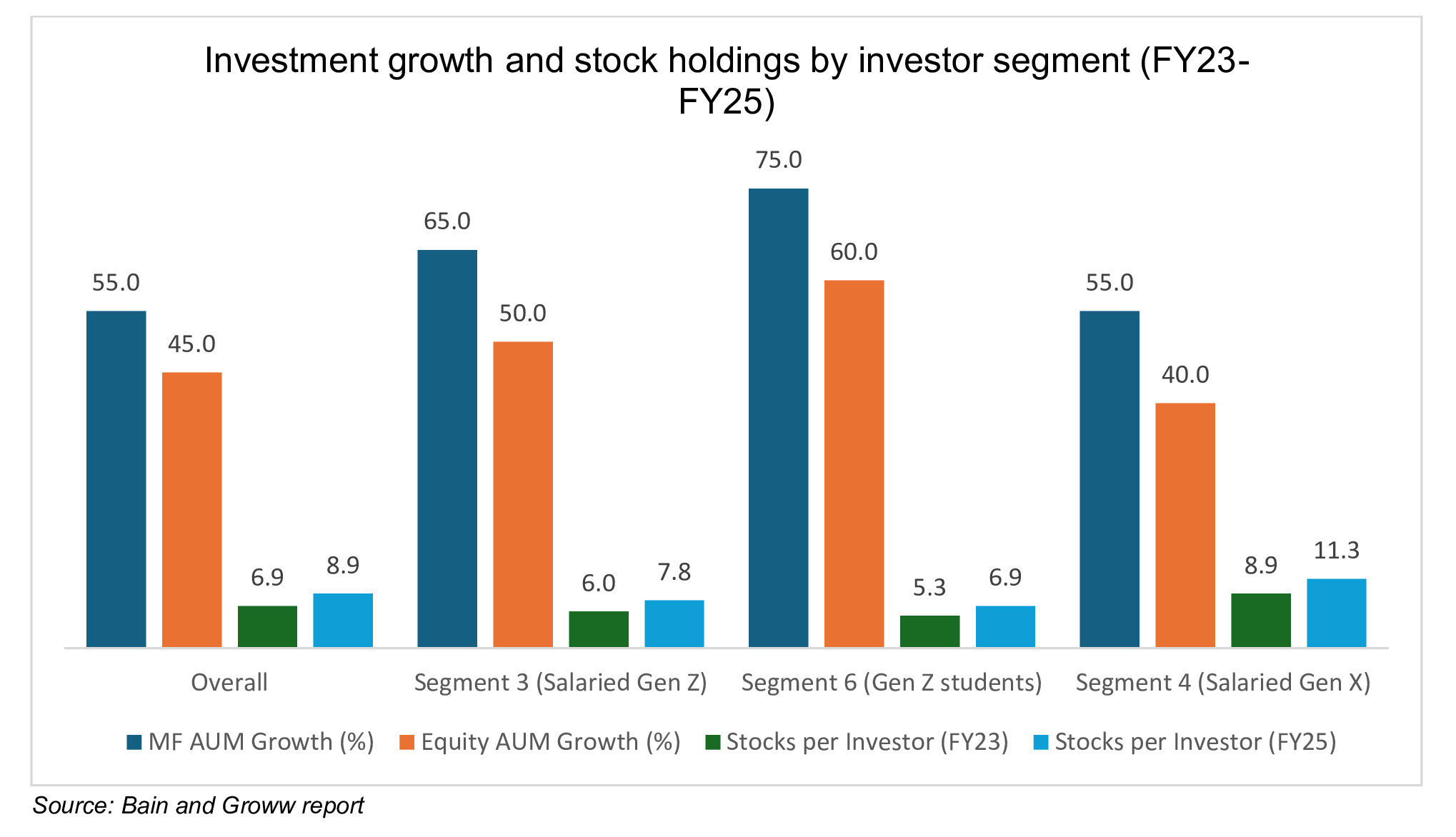
This chart highlights how different investor segments have grown their mutual fund and equity investments over FY23–25. Gen Z investors especially salaried individuals and students have shown the fastest rise in mutual fund and equity AUM, while Gen X continues to hold the highest number of stocks per person. The data reflects increasing financial participation and confidence among younger investors.
Economic impact and outlook
This surge of young investors has significant economic implications. Household flows into stocks and funds are building capital for growth. According to financial analysts, new retail inflows provide a critical source of funding for small and medium enterprises. Broader market participation by individuals, especially from non-metro areas is also seen as a stabilizing force. Retail investors and mutual funds have helped smooth volatility during global shocks.
India’s regulators and think-tanks view this as a boon. Increased domestic investment can deepen markets and foster financial inclusion. In fact, one study notes that if retail participation continues to grow, it could help India achieve its ambitious economic targets. Over the long term, rising investment by households “could cause per capita GDP growth as high as six times the current GDP” on the way to a $30-trillion economy by 2047.
The way forward
Looking ahead, India’s new investors are expected to continue shaping the market. As digital access, financial awareness, and trust in markets improve, young investors are likely to expand further. Their preferences will influence product design (more mobile-friendly interfaces and tailored fund offerings) and the growth of India’s capital markets. For now, one thing is clear: India’s investing public has grown younger, more digital, and more confident than ever before, with wide-ranging implications for the economy and society.
FAQs
Who is the new Indian investor?
The new Indian investor is typically young, digitally savvy and confident. Most are in their early 30s, with a large share below 30. This group relies on mobile apps, online platforms and digital content to make investment decisions and is increasingly focused on long-term wealth creation.
Why are more young Indians investing in the stock market?
Young Indians are investing more due to easier access through digital platforms, rising financial awareness and better long-term return potential compared to traditional savings. Higher equity returns of around 15-17% annually over the past decade have also encouraged participation.
How important is Gen Z in India’s investment growth?
Gen Z has become a major force in India’s capital markets. Their share among registered investors rose from about 25% in FY20 to nearly 40% by FY25. Many Gen Z investors start early through SIPs and equity mutual funds, shaping future market trends.
What role do digital platforms play in India’s investing ecosystem?
Digital platforms are central to India’s investing growth. App-based brokers now account for around 80% of retail equity investors. Mobile-first platforms have expanded market access beyond metro cities, bringing first-time investors from tier-2 and tier-3 regions.
Which investment products are most popular among young investors?
Equity mutual funds and SIPs are the most popular choices. In 2025, Indians under 35 opened nearly 40% of all new SIP accounts. Around 84% of young SIP investors prefer equity-oriented mutual funds for long-term growth.
Partners