SEARCH
RECENT POSTS
Categories
- Agriculture (37)
- Automobiles (20)
- Banking and Financial services (35)
- Consumer Markets (56)
- Defence (6)
- Ecommerce (21)
- Economy (72)
- Education (14)
- Engineering (8)
- Exports (21)
- Healthcare (25)
- India Inc. (10)
- Infrastructure (31)
- Manufacturing (32)
- Media and Entertainment (16)
- Micro, Small & Medium Enterprises (MSMEs) (16)
- Miscellaneous (31)
- Perspectives from India (37)
- Pharmaceuticals (5)
- Railways (4)
- Real Estate (19)
- Renewable Energy (19)
- Research and Development (12)
- Retail (1)
- Services (7)
- Startups (16)
- Technology (66)
- Textiles (8)
- Tourism (16)
- Trade (8)
Authors






The Rise of Rural Entrepreneurship in India
Economic transformation in rural India is taking place now. Despite continuing importance of agriculture as the principal source of earnings, villages are gradually becoming entrepreneurial centres because of the activities of businesses related to the food processing industry, handicrafts, dairying, agriculture technologies, tourism, IT services and renewables. So, moving from subsistence agriculture to entrepreneurship results in employment, diversification of sources of income and increasing the economic resilience of the local communities.
This transformation occurs owing to the improvement in infrastructure, digitalization, access to finance and various government programs aimed to encourage entrepreneurship and skill development. These factors provided an opportunity for Indian rural entrepreneurs to capitalize on their local resources, know-how and skills and work in both domestic and international markets. As a result, rural enterprises create sustainable livelihoods, stimulate inclusive growth, prevent people from migration to cities and contribute to the increased economic resilience of Indian rural economy.
MSMEs, Self-Help Groups (SHGs) and micro-enterprises perform crucial functions in this process stimulating entrepreneurship at the grass-root level. MSME Department of the Ministry of MSME views this sector as a constituent of socio-economic development of India ensuring employment generation, industrialization and balanced regional development. In its turn, Deendayal Antyodaya Yojana-National Rural Livelihoods Mission (DAY-NRLM) program allowed to involve 10.05 crore women into 90.09 lakh SHGs.
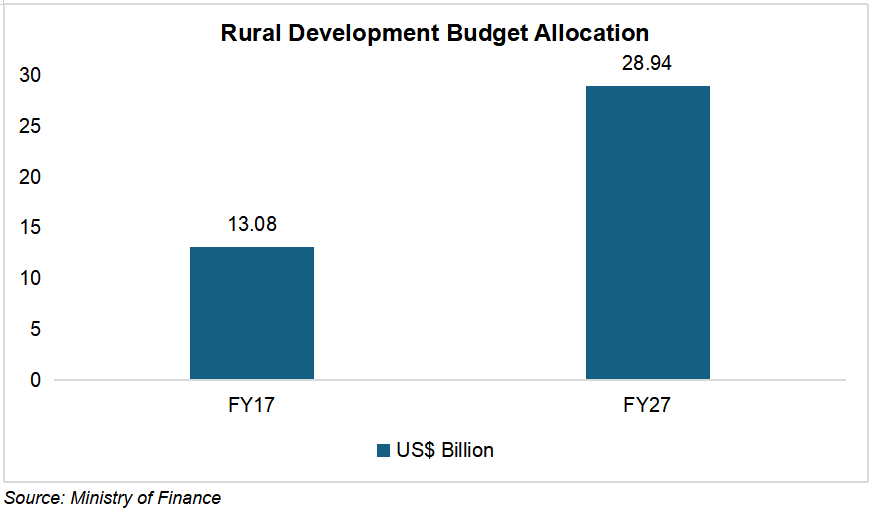
Union Budget allocations for Rural Development increased by 211.2%, rising from Rs. 87,765 crore (US$ 13.08 billion) in FY17 to Rs. 2,73,108 crore (US$ 28.94 billion) in FY27. The substantial increase in budgetary allocation reflects the Government of India's sustained commitment to strengthening rural infrastructure, enhancing livelihoods, and promoting inclusive socio-economic development across rural areas.
Why Rural Entrepreneurship is Accelerating
Digital connectivity and financial inclusion
The advent of affordable mobile phones, affordable internet services, and digitalization has changed the functioning process of rural businesses. Rural businessmen can interact with their customers, suppliers, and financiers irrespective of any geographical boundaries with the help of using e-commerce, social networking sites, and other digital services. In addition to that, the usage of UPI transaction systems has facilitated the process of digital transactions as well.
Financial inclusion has eliminated the entry barriers for rural entrepreneurs. As per the latest data available till 8th July 2026, a total of over 58.70 crore accounts have been opened through the Pradhan Mantri Jan Dhan Yojana (PMJDY) scheme of which 45.68 crore (77.8%) have been in rural and semi-urban areas. Greater availability of banking, insurance and institutional credit has motivated young entrepreneurs to start and grow their ventures in the rural locations..
Infrastructure and changing consumer demand
Construction of rural roads, electrification and broadband connectivity have increased competitiveness of rural businesses by lowering the cost of logistics and widening the markets. Changing preferences of the consumers necessitate companies to offer organic, regional, handicraft and environmentally friendly products that open up opportunities for rural businesses to move up the value chain.
Together with increasing entrepreneurial ambitions of rural youth, these trends are transforming villages into centers of innovation and entrepreneurship.
Rural Entrepreneurship Landscape in India
The growth of rural entrepreneurship has become an important aspect of India’s developmental approach towards inclusivity, driven by the increased growth of rural businesses, institutions, and technological advancement. As a result of government policy, better financial accessibility and the creation of digital platforms, rural entrepreneurs have been able to venture into many other sectors other than farming.
Deendayal Antyodaya Yojana – National Rural Livelihoods Mission (DAY-NRLM) is one of the most significant factors that contribute to rural entrepreneurship in India. As of December 2025, nearly 10.05 crore rural families have been formed in 90.91 lakh self-help groups (SHGs). It makes the DAY-NRLM one of the biggest community-driven livelihoods programs across the globe. Self-help groups act as the engine for entrepreneurship and facilitate the creation of enterprises in food processing, dairy products, handcrafts, tailoring, and agriculture-based businesses. In the Start-up Village Entrepreneurship Programme (SVEP), over 5.88 lakh rural enterprises have been supported, and around 50,548 Bank Sakhis have provided institutional credit amounting to Rs. 12.18 lakh crore to women-headed self-help groups from 2013-14 onwards.
Government Programmes Catalysing Rural Entrepreneurship
Government support has been central to the growth of rural enterprises by strengthening access to finance, skills, incubation and markets.
DAY-NRLM continues to be the flagship program for promotion of rural livelihoods, empowerment of women through self-help groups (SHGs), enterprise development, and producer collectives. Based on this, SVEP has facilitated close to 588,000 village enterprises by providing business mentoring, incubation services, and community finance access. Access to credit has increased because of PMEYP and PMMY schemes, which have enabled first generation entrepreneurs to establish and scale their manufacturing and service enterprises. Specialized programs such as PMFME scheme have upgraded the food processing industry through use of technology, branding, and ODOP concept.
ASPIRE promotes innovation through business incubators, while SFURTI has strengthened traditional industries through formation of artisan clusters, technology upgradation, and improved market linkages. In addition, Lakhpati Didi Initiative has fast-tracked women entrepreneurship through provision of skill development, funding, and market linkages.
Overall, the above schemes provide a holistic framework for promoting rural entrepreneurs in all stages from establishment of enterprises, access to finance to value addition and market expansion. This has led to the growth of rural entrepreneurship into a powerful force in promoting inclusive and sustainable economic growth.
Key Growth Drivers of Rural Entrepreneurship
The continued growth of rural entrepreneurship is being driven by several interconnected factors that are strengthening the rural business ecosystem:
- Government support: Programs such as DAY-NRLM, SVEP, PMEGP, PMFME, and MUDRA have increased access to finance, skills, incubation and market linkages.
- Digital revolution: Increased internet usage, smartphone usage, UPI-based payments, ONDC, and GeM have helped rural entrepreneurs reach bigger markets through digital business model.
- Innovations in technology adoption: Innovations like artificial intelligence, precision agriculture, drones, Internet of Things and agritech innovations.
- Improvements in infrastructure: Improved roads, logistics, better connectivity and rural electrification have lowered costs and improved market access.
- Increasing consumer demand: Consumer demand for organic food and locally produced goods has encouraged entrepreneurs to brand, package and diversify.
- Enterprises led by women and collective entities: Increasing importance of SHGs and FPOs has promoted community-based business enterprises and market access.
Outlook and the Way Forward
Rural entrepreneurship has much potential as one of the critical factors for economic transformation in India. Digital investments, coupled with advances in new technologies like artificial intelligence, unmanned aerial vehicles, and precision farming, may improve the effectiveness of rural entrepreneurship. In the future, easy availability of capital, incubation services, training programs, and market access may facilitate the emergence of start-ups. Growth in the number of women-owned businesses, SHGs, and FPOs might lead to inclusive development.
With continured policy and investment support, increased technology uptake, and involvement of the private sector, rural entrepreneurship is likely to create jobs and drive local economic development in India. Policy support, technology uptake, and increased participation of the private sector put rural entrepreneurship in a position to create jobs and promote local economic development.
FAQs
How many rural enterprises have been supported under the Start-up Village Entrepreneurship Programme (SVEP)?
The Start-up Village Entrepreneurship Programme (SVEP) has supported nearly 5.88 lakh rural enterprises across India. By providing business mentoring, incubation support and access to finance, the programme has encouraged non-farm entrepreneurship and strengthened local employment generation.
Why is rural entrepreneurship important in India?
Rural entrepreneurship plays a crucial role in generating employment, increasing rural incomes and reducing dependence on agriculture. It promotes balanced regional development, encourages local value addition, empowers communities and contributes to inclusive economic growth by creating sustainable livelihood opportunities.
Which government initiatives support rural entrepreneurship?
The Government of India supports rural entrepreneurs through initiatives such as DAY-NRLM, SVEP, PMMY, PMFME, Stand-Up India, Skill India Mission, and RSETIs. These programmes provide finance, skill development, business mentoring, and market linkages to promote rural entrepreneurship.
Which sectors offer the greatest opportunities for rural entrepreneurs?
High-growth sectors include food processing, agri-tech services, dairy, fisheries, handicrafts, rural tourism, renewable energy and digital services. Increasing consumer demand for value-added and locally sourced products, coupled with government support, is creating significant opportunities across these sectors.
How many rural households and Self-Help Groups (SHGs) have been mobilised under DAY-NRLM?
As of 2026, the DAY-NRLM has mobilised over 10.05 crore rural households and facilitated the formation of more than 90.91 lakh Self-Help Groups (SHGs). These SHGs have evolved beyond savings groups into community-led enterprises, supporting women entrepreneurs through improved access to finance, skills and markets
Partners




