SEARCH
RECENT POSTS
Categories
- Agriculture (38)
- Automobiles (20)
- Banking and Financial services (36)
- Consumer Markets (57)
- Defence (6)
- Ecommerce (21)
- Economy (72)
- Education (14)
- Engineering (9)
- Exports (22)
- Healthcare (25)
- India Inc. (10)
- Infrastructure (31)
- Manufacturing (32)
- Media and Entertainment (17)
- Micro, Small & Medium Enterprises (MSMEs) (16)
- Miscellaneous (31)
- Perspectives from India (37)
- Pharmaceuticals (5)
- Railways (4)
- Real Estate (20)
- Renewable Energy (19)
- Research and Development (12)
- Retail (1)
- Services (7)
- Startups (16)
- Technology (66)
- Textiles (8)
- Tourism (16)
- Trade (9)
Authors






Impact of the Digital India Programme on Rural Connectivity
- Aug 17, 2026, 18:05
- Perspectives from India
- IBEF
The Digital India is a flagship scheme of the Government of India which was launched on July 1, 2015, by the Honorable Prime Minister Shri Narendra Modi with the objective of converting India into a digitally empowered society and knowledge economy. Digital India has been built upon three pillars – Digital Infrastructure, Digital Governance and Digital Empowerment of Citizens. Through various initiatives taken under the scheme, the reach of digital services has been increased and the adoption of technology has been promoted throughout sectors. Over the past decade, schemes such as the Aadhar, Unified Payments Interface (UPI), DigiLocker and BharatNet have contributed to service delivery, financial inclusion and citizen participation in the digital economy. As per the report on State of India's Digital Economy Report 2024 by the Indian Council for Research on International Economic Relations (ICRIER), India is placed at the third position in terms of the digitization of the economy.
Digital India: A Decade of Milestones
- 2015: Digital India Programme launched by Prime Minister Narendra Modi on July 1, 2015, marking India's formal transition towards a digitally empowered society and knowledge economy.
- 2016: BHIM (Bharat Interface for Money) app launched on December 30, 2016, enabling UPI-based cashless transactions directly through bank accounts.
- 2017: Goods and Services Tax Network (GSTN) launched on July 1, 2017; over 44 crore returns filed in the first 34 months with Rs. 23.84 lakh crore in tax payments processed on the portal.
- 2018: Pradhan Mantri Gramin Digital Saksharta Abhiyan (PMGDISHA) launched by the Prime Minister to cover six crore rural households with foundational digital literacy skills.
- 2019: National Policy on Electronics approved, providing a comprehensive roadmap for electronics sector development, infrastructure upgradation and innovation-led growth.
- 2020: Aarogya Setu app launched as India's first AI and Bluetooth-powered public health contact-tracing platform, developed through a public-private partnership during the COVID-19 pandemic.
- 2021: UMANG International launched, extending access to Indian government services for the diaspora across nine countries including the USA, UK, Canada, UAE and Singapore.
- 2022: Digital India BHASHINI launched to enable internet and digital service access in Indian languages, including voice-based capabilities supporting 35 languages across 1,600 AI models.
- 2023: India held the G20 Presidency (December 2022–November 2023), championing digital public infrastructure, AI governance and trusted technology frameworks on the global stage.
- 2024: Global IndiaAI Summit 2024 hosted in New Delhi, covering Compute Capacity, Foundational Models, Future Skills, Startup Financing and Safe and Trusted AI frameworks.
Source: PIB
A Decade of Rural Digital Transformation
The Digital India initiative has considerably improved the digital connectivity in rural areas over the last decade. Infrastructure investments in telecommunications, development of broadband network, and affordable prices for data have provided an opportunity for many rural inhabitants of India to get connected to the Internet in order to use the online educational resources, telemedicine, banking, and e-governance. It is notable that the number of internet users in India grew remarkably due to this programme, with active internet users reaching 958 million in 2025; 57% (548 million) of whom live in rural areas. It demonstrates growing importance of digital technologies in overcoming the urban-rural gap and promoting inclusive development.
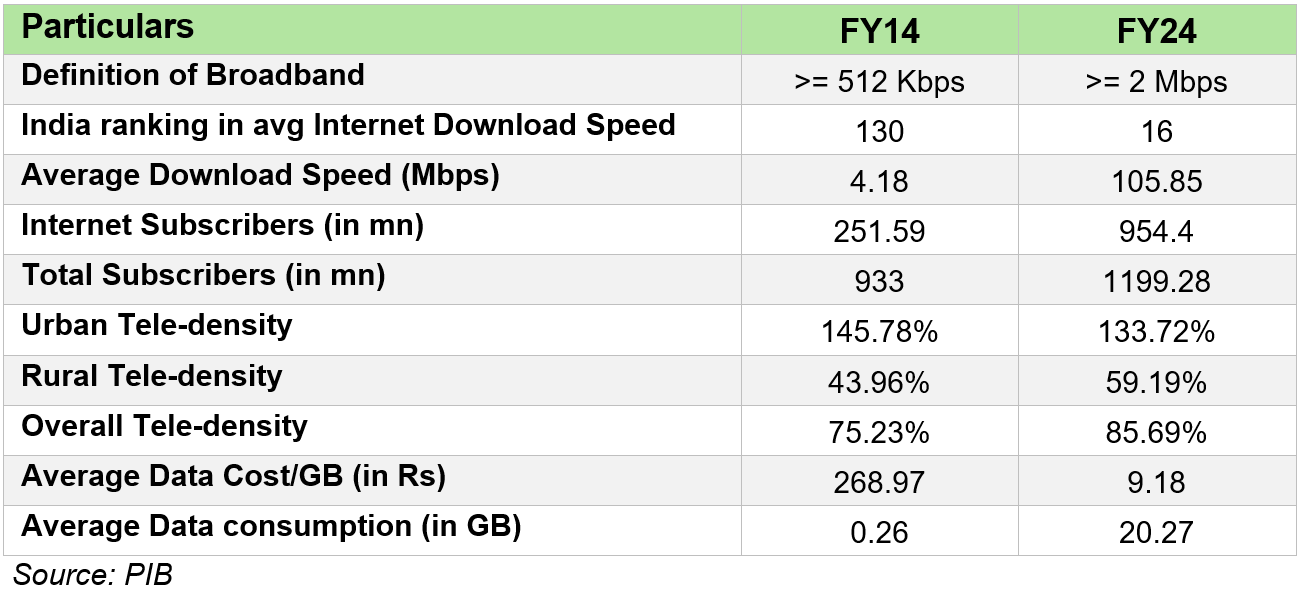
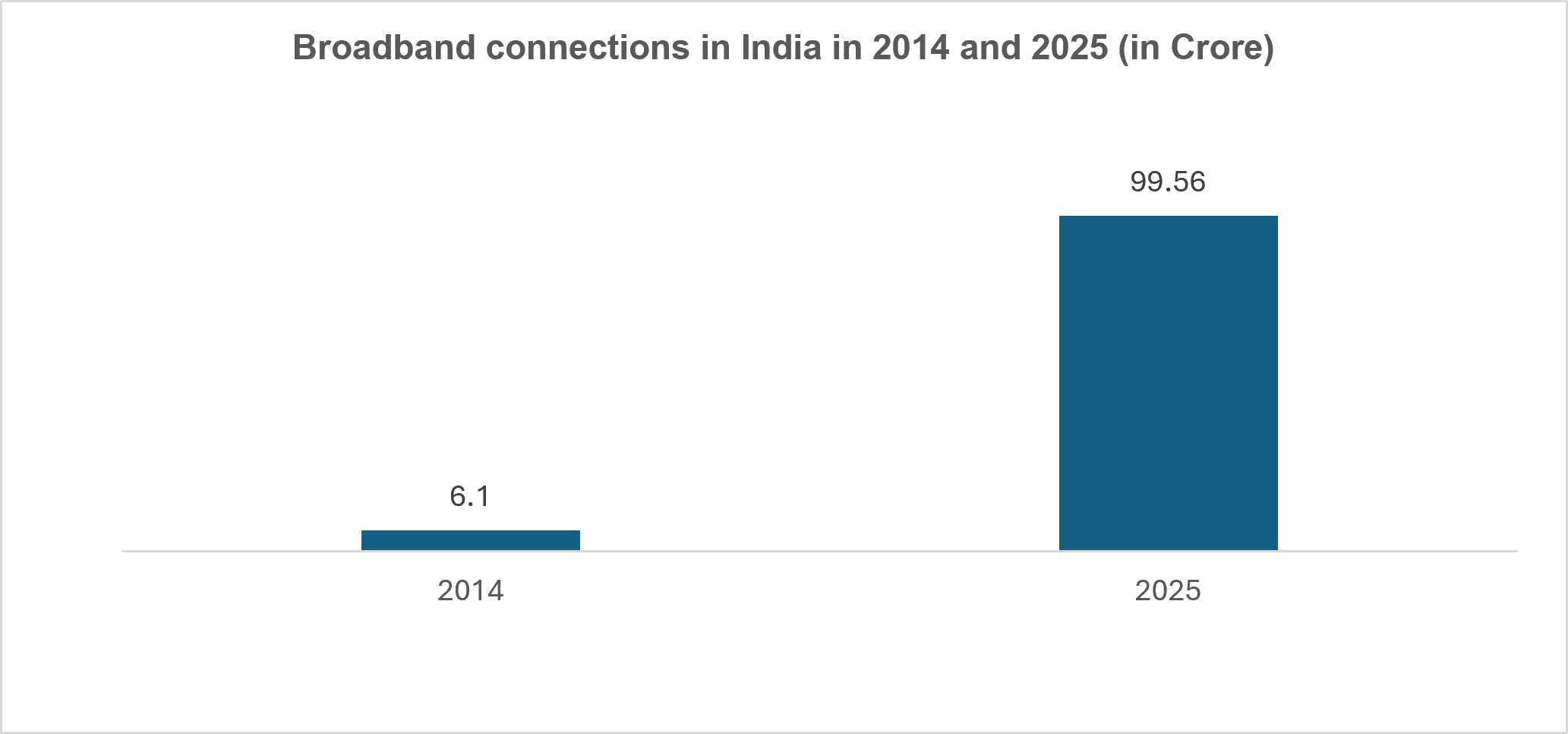
One of the major factors that led to this change was the extensive development of digital infrastructure. The number of broadband connections increased from 6.1 crore in 2014 to 99.56 crore in 2025; this is a growth of 1,532.13% owing to the programmes like BharatNet, development of optical fibre networks and installation of mobile towers all over the country. As of May 2025, mobile coverage in Indian villages was 97.65% and 4G coverage – 96.80%. By September 2025, urban telephone connections increased from 555.23 million in March 2014 to 689.11 million; that is a growth of 24.11%; rural telephone connections grew similarly. Affordable prices of internet became one of the main factors that encouraged Indians to go online: costs for mobile data decreased by about 97% since 2014. It contributed greatly to the increase of the digital population of the country; thus, by 2026 the number of internet users is expected to reach 1.05 billion people, demonstrating successful implementation of the Digital India programme. Along with increasing smartphones adoption and 5G rollout, these changes have provided better connectivity in rural India.
BharatNet: Enabling Digital Access in Rural India
BharatNet is a major component of the Digital India program, which focuses on the expansion of broadband connectivity in rural India. By October 2025, 2,14,843 Gram Panchayats have been made service-ready under this program, utilizing over 6.92 lakh kilometers of optical fiber. The program has provided access to the digital realm of the country to rural populations via more than 13 lakh FTTH and 1.04 lakh Wi-Fi hotspots. Connectivity has enabled access to the services like online education, telemedicine, digital payments, e-governance, among others, helping bridge the urban-rural divide. In order to fast-track rural connectivity, the Amended BharatNet Program aims to provide optical fiber connectivity to 2.64 lakh Gram Panchayats and also provide broadband access to far-flung villages. Through BharatNet, digital inclusion and reliable, affordable broadband connectivity will enable rural populations to reap the benefits of the Digital India Program.
Sectoral Impact on Rural Communities
The expansion of digital connectivity under the Digital India programme has created tangible benefits across key sectors in rural India.
- The advent of digital connectivity has changed rural livelihoods in several ways. For example, in the agriculture sector, the National Agriculture Market (e-NAM) has covered 1,656 mandis across 23 states and four union territories, providing over 1.80 crore farmers with a unified online marketplace. Between 2016 and March 2026, e-NAM has achieved trade value of Rs. 4.84 lakh crore (US$ 54.92 billion), highlighting the increasing importance of digital platforms in rural agricultural markets.
- Digital connectivity has also facilitated financial inclusion in India. The rise of the Unified Payment Interface (UPI) has made digital transactions easy and hassle-free and helped make cashless transactions a norm. As of June 2025, over 18.39 billion transactions were conducted on UPI in a single month.
- The telemedicine facility, eSanjeevani, of India is also playing an important role in bringing quality healthcare to rural and remote parts of the country. Since 2019, this facility has provided 47 crore consultations and has onboarded 2.34 lakh healthcare providers in the process and has become the world's largest telemedicine service provider.
- Digital literacy programs have also helped improve inclusion of rural citizens in the digital realm. Over 6.39 crore rural citizens have received training in digital literacy through schemes like PMGDISHA.
Growth Drivers and Key Trends
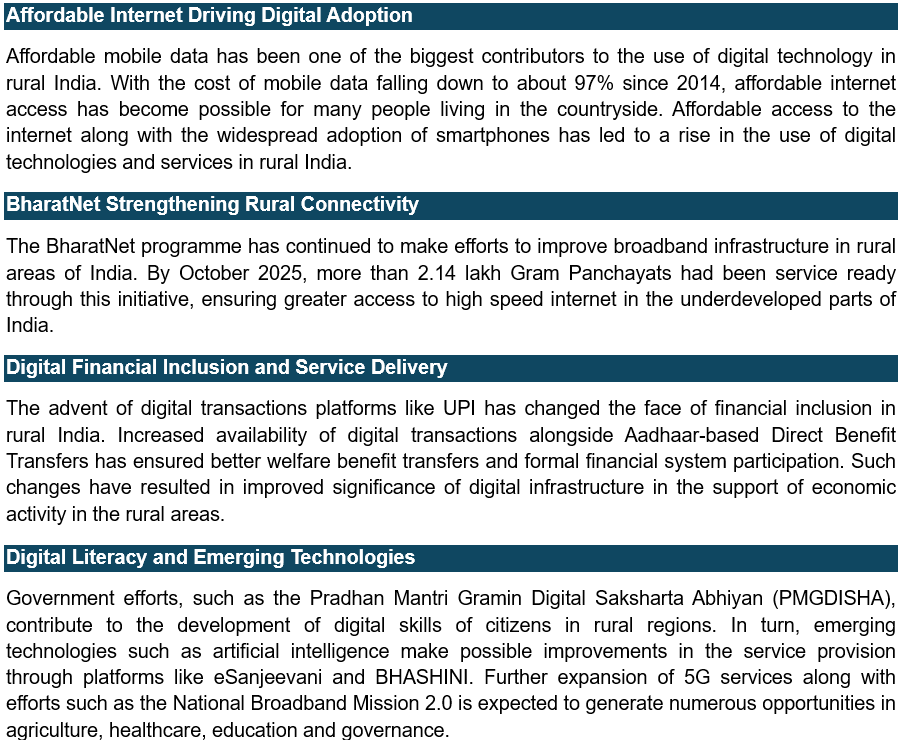
The following factors are driving the expansion of rural digital connectivity and strengthening digital inclusion across India.
Outlook and Road Ahead
The Digital India initiative has been instrumental in changing the rural connectivity landscape by making broadband services, digital transactions and platforms available throughout villages. Improved access to the internet has provided an opportunity for greater involvement in the digital economy as well as development of education, healthcare, financial inclusion and governance. As India moves closer to achieving its vision of Viksit Bharat 2047, attention will have to be paid to improving last mile connectivity and ensuring that benefits from digitalisation are delivered to hard-to-reach communities. Efforts in this direction will include the implementation of government programmes, such as the Amended BharatNet Programme, National Broadband Mission 2.0, Digital Agriculture Mission and IndiaAI Mission. Moving ahead, it will be important to pay attention to problems such as digital literacy gap, cost of devices and regional disparities in access to the Internet. Further investments in digital infrastructure, emerging technologies and digital citizen services will enable rural digital transformation.
FAQs
What are the three pillars of the Digital India programme?
Building a robust digital infrastructure, electronic delivery of government services, and promotion of universal digital literacy. Operationalised through BharatNet, UPI, PMGDISHA, DigiLocker, eSanjeevani, UMANG, and the CSC network.
What has BharatNet achieved and what does the Amended Programme target?
As of October 2025, 2,14,843 Gram Panchayats are service-ready, with 6,92,299 km of optical fibre laid, 13,01,193 FTTH connections, and 1.04 lakh Wi-Fi hotspots. ABP targets 2.64 lakh GPs in ring topology, 3.84 lakh villages on demand, and 1.5 crore rural home connections.
How has rural internet subscriber growth progressed and what is the current rural share?
Rural subscribers grew from 115.06 million (FY2015-16) to 405.33 million by September 2024. The IAMAI-Kantar 2025 report confirms rural India accounts for 57% of 958 million active internet users, growing at double the urban rate.
What is the impact of Digital India on agriculture and financial inclusion?
eNAM connects 1.7 crore farmers to 1,000+ mandis. PM-KISAN disbursed Rs. 3.24 lakh crore to 11 crore farmers via DBT. Farmer digital payment adoption rose from 11% to 43% (2022–2024). UPI processed 18.39 billion transactions worth Rs. 24.03 lakh crore in June 2025 alone.
What structural gaps remain in rural digital connectivity?
Rural wireline broadband tele-density is 0.33% (urban: 7.19%). Only 24% of rural households access quality internet (urban: 66%). About 50% of rural women lack a mobile phone. Device affordability, language barriers, and below-average speeds persist in Bihar, Odisha, Meghalaya, and Arunachal Pradesh.
Partners