SEARCH
RECENT POSTS
Categories
- Agriculture (39)
- Automobiles (21)
- Banking and Financial services (36)
- Consumer Markets (58)
- Defence (6)
- Ecommerce (21)
- Economy (72)
- Education (14)
- Engineering (9)
- Exports (22)
- Healthcare (25)
- India Inc. (10)
- Infrastructure (31)
- Manufacturing (33)
- Media and Entertainment (17)
- Micro, Small & Medium Enterprises (MSMEs) (16)
- Miscellaneous (31)
- Perspectives from India (37)
- Pharmaceuticals (5)
- Railways (5)
- Real Estate (20)
- Renewable Energy (19)
- Research and Development (12)
- Retail (2)
- Services (8)
- Startups (16)
- Technology (66)
- Textiles (8)
- Tourism (16)
- Trade (9)
Authors






Scaling the Use of Recycled Materials in India’s Construction Sector
- Jul 29, 2026, 18:55
- Perspectives from India
- IBEF
Construction industry in India is undergoing significant transformations driven by urbanization, infrastructure expansion, housing needs and industrial growth. The massive investments made for highway, railway, airway, smart cities, logistics and affordable housing are creating more demands for construction materials. According to NITI Aayog, the contribution of the buildings and construction industry to economic development and urbanization in the upcoming years would be substantial in India. At the same time, these transformations have created an intense demand for natural resources resulting in the generation of vast quantities of construction and demolition (C&D) waste. Therefore, sustainable construction practices need to be adopted. Circular economy and sustainability are becoming the priority of India in terms of infrastructure development. Recycling of various materials, including fly ash, aggregates, steel slag, plastics waste and recycled asphalt pavement (RAP), used in road and building constructions is increasing in India. Several government policies, regulations and initiatives related to sustainable construction practices have been initiated.
Government Initiatives Supporting the Use of Recycled Materials in Construction
Government policy measures, along with other sustainable actions, are becoming a significant factor in speeding up the use of recycled materials within the Indian construction and infrastructure industry. Greater emphasis on waste management and efficient infrastructure development is promoting more usage of recycled building materials, industrial waste, and waste products that have undergone scientific processing.
Moreover, India's Voluntary Vehicle-Fleet Modernization Program (V-VMP) has been encouraging the scientific recycling and recovery of secondary raw materials in registered vehicle scrapping centers. This program will improve recycled metals and industrial scrap supply to infrastructure and manufacturing sectors. Furthermore, under the SASCI 2025-26 Scheme for Special Assistance to States for Capital Investment, the Indian Government allocated Rs. 2,000 crore (US$ 220 million) for vehicle scrapping infrastructure and related actions.
Recycling Infrastructure and Emerging Technologies
India has been progressively setting up construction waste recycling infrastructure facilities within major cities. For instance, Delhi, Ahmedabad, Bengaluru and Hyderabad have established recycling plants that produce various construction waste products, which include recycled aggregates, kerb stones, paver blocks and tiles, among other infrastructure products.
According to the article on IndiaSpend, C&D waste generated in Delhi exceeds 6,500 metric tonnes per day, necessitating the establishment of recycling and reuse facilities. Recycled products, however, are currently underutilized owing to difficulties with procurement, inconsistent implementation and quality perception. Adoption of technology in the construction sector has seen an improvement in the efficiency of recycling and reuse operations. The adoption of technology has been witnessed through the establishment of waste segregation systems, mobile recycling units, artificial intelligence-based tracking tools and modern material recovery tools. Gradually, there is a rise in sustainable building material usage and technology-enabled construction waste recycling processes that promote environmental sustainability.
Innovative approaches to construction in the industry involve the use of industrial waste, construction aggregate waste and plastic waste in low-cost construction and infrastructure developments. In 2025, CSIR-CRRI developed the world's first steel slag road on the Hazira Port in Gujarat and introduced India's first end-of-life plastic waste geocells road trial on DND-Faridabad-KMP Expressway. Moreover, in April 2026, IIT Jodhpur develop bio-bricks and agro-plastic blocks from agricultural residue and plastic waste, respectively. Recycled material has also increased its adoption among urban local bodies. This was evidenced by the establishment of recycling projects piloting the use of recycled plastic tiles for footpath construction by the Greater Hyderabad Municipal Corporation.
Role of Plastic Waste and Circular Construction
The use of plastic waste has gained importance for road construction, pavements, roofs, and other composite construction materials in India’s circular economy and sustainable infrastructure schemes. For ensuring that there is an effective usage of waste plastic materials in the construction of bituminous roads to make the process sustainable, the Ministry of Road Transport and Highways (MoRTH) is encouraging this process. Based on data from the Ministry of Rural Development, as many as 43,700 km of roads have been constructed using waste plastic technology under the Pradhan Mantri Gram Sadak Yojana (PMGSY) scheme till July 2025. In the development of roads using the hot mix technology within the PMGSY scheme, it is mandatory for the Indian government to construct the roads using waste plastic technology in at least 70% of such projects. Several studies have been conducted on the request of IIT Madras, and these studies found out that roads constructed using plastic waste materials have better performance attributes than regular roads.
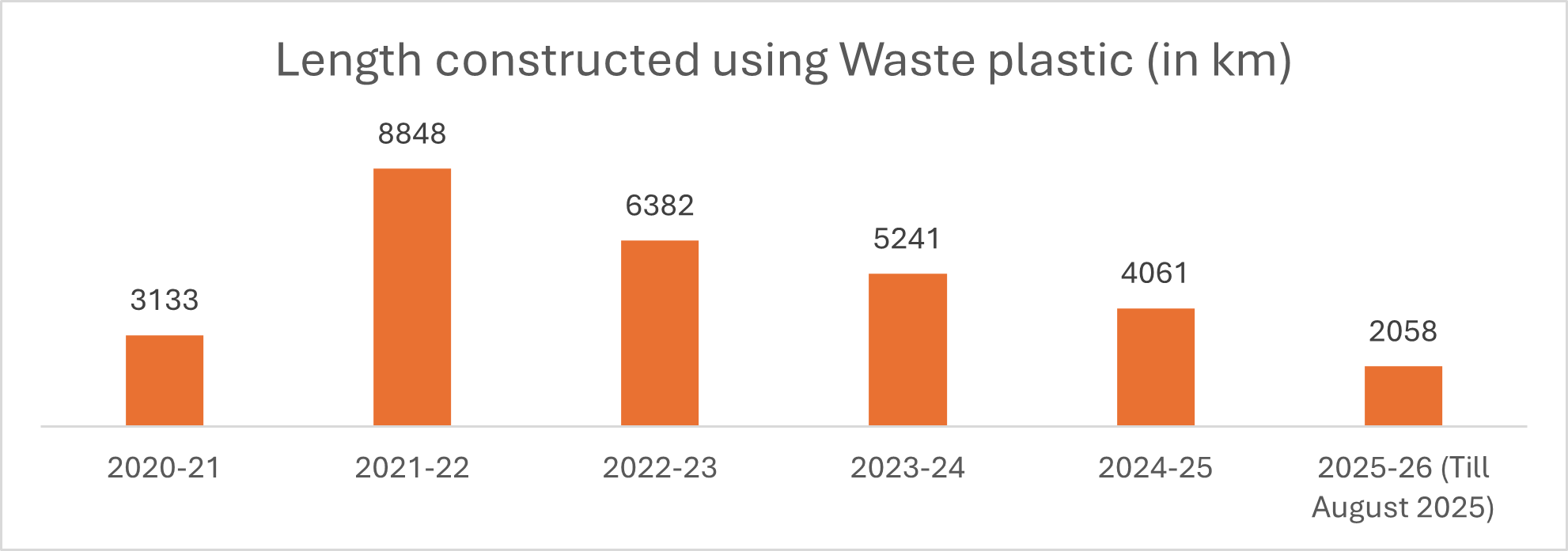
Source: PIB
Growth Drivers and Key Trends
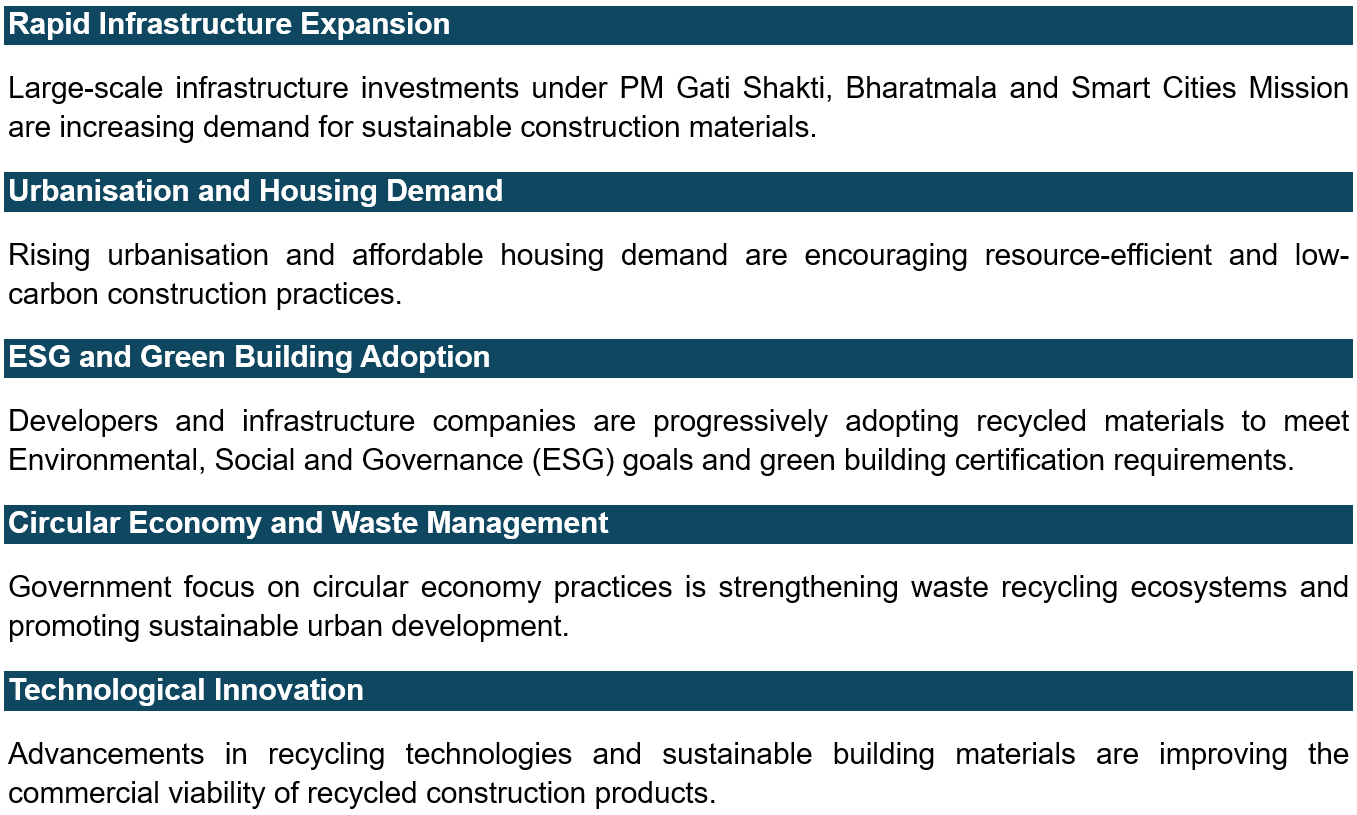
The following factors are driving the expansion and shaping the evolution of India’s recycled construction materials ecosystem:
Outlook and Road Ahead
The Indian construction sector is expected to increase the use of recycled materials in the next decade due to the expansion of infrastructure in the country and increasing emphasis on sustainability and circular economy. Government policies and urbanization strategies, as well as environmental laws, will encourage the recycling of aggregates, fly ash, steel slag, and plastics in the construction process. Sustainable buildings and infrastructure that emit less carbon dioxide will be required during India's transition toward carbon neutrality and environmentally friendly development, according to NITI Aayog. Investments in recycling infrastructure and sustainable construction materials are expected to increase in the next few years, benefiting the sustainable construction industry in India. Due to the rapid urbanization of India, the construction sector will increasingly integrate recycled materials into mainstream construction practices.
FAQs
Why is the use of recycled materials increasing in India’s construction sector?
The rapid urbanization, waste generated from the construction process, as well as other factors like sustainability objectives and laws, are making the use of recycled materials popular in India’s construction industry.
What recycled materials are commonly used in construction?
Some of the most widely used recycled materials include fly ash, recycled aggregates, steel slag, plastic waste, and RAP (reclaimed asphalt pavement).
What government initiatives support recycled construction materials?
The Construction and Demolition Waste Management Rules, Smart Cities Mission, PM Gati Shakti and fly ash utilisation policies are promoting sustainable construction practices in India.
What are the benefits of recycled construction materials?
Recycled materials help reduce waste generation, lower carbon emissions, conserve natural resources and improve environmental sustainability.
What are the key challenges in scaling recycled construction materials?
Limited recycling infrastructure, low awareness, quality concerns, weak enforcement and high transportation costs remain major challenges for wider adoption.
Partners