SEARCH
RECENT POSTS
Categories
- Agriculture (39)
- Automobiles (20)
- Banking and Financial services (36)
- Consumer Markets (57)
- Defence (6)
- Ecommerce (21)
- Economy (72)
- Education (14)
- Engineering (9)
- Exports (22)
- Healthcare (25)
- India Inc. (10)
- Infrastructure (31)
- Manufacturing (33)
- Media and Entertainment (17)
- Micro, Small & Medium Enterprises (MSMEs) (16)
- Miscellaneous (31)
- Perspectives from India (37)
- Pharmaceuticals (5)
- Railways (5)
- Real Estate (20)
- Renewable Energy (19)
- Research and Development (12)
- Retail (1)
- Services (7)
- Startups (16)
- Technology (66)
- Textiles (8)
- Tourism (16)
- Trade (9)
Authors






India’s Drone Ecosystem: From Policy Push to Commercial Adoption
- Jun 05, 2026, 10:55
- Perspectives from India
- IBEF
The drone industry in India has entered a significant phase of expansion. The industry has entered a structured growth phase, with more than 38,500 drones registered, 39,890 remote pilots certified, and over 240 training organisations approved as of February 2026. The current ecosystem has developed from its previous state of having defence-led operations and fragmented manufacturing activities to an extensive system that includes production capabilities, service offerings, software development and training facilities.
This growth has been driven by three key factors including regulatory changes, increasing strategic needs and the development of new commercial applications. Drones now deployed across agriculture, infrastructure, logistics and governance due to their capabilities have expanded beyond their original purpose as specialized aviation tool. India has developed into one of the world's fastest-growing drone markets because its policy support for drones has improved and their usage has become more widespread.
Significance: Expanding Role in Economy and Governance
Drones now serve as vital technology helps multiple industries achieve improved operational efficiency, reduced costs and enhanced service delivery. Unmanned systems now assist Defence operations through their use in surveillance, missions, intelligence gathering, reconnaissance work and logistics tasks which the systems can deploy faster while maintaining cheaper operational expenses than traditional defence systems. Recent geopolitical developments have reinforced the need for trustworthy indigenous drone systems which security operations now consider essential for their modern defence strategies.
Drones deliver benefits to governance systems extend beyond their military applications. The SVAMITVA Scheme has conducted surveys using drones in 3.28 lakh villages resulted in the distribution of 2.76 crore property cards across 1.82 lakh villages in 31 states. This has strengthened land record systems enable clearer property ownership determination while decreasing conflicts.
In agriculture, drones are supporting productivity and rural livelihoods. A total of 1,094 drones has been distributed to women self-help groups, including more than 500 under the Namo Drone Didi initiative, enabling precision spraying and enhancing farm efficiency.
Drones help infrastructure monitoring, disaster response and logistics operations by decreasing inspection time, increasing accuracy and reducing operational costs. For instance, the National Highways Authority of India (NHAI) mandates drone videos to be taken every month for all highway projects. Contractors must upload the latest month’s footage along with the previous month’s videos to the NHAI database so the progress can be compared. The economic value of adoption increases when organizations complete their operations through productivity improvements, cost savings and better public service delivery. The Ministry of Railways has instructed all railway zones and divisions to use drones for better inspection and upkeep of tracks, bridges, and other railway infrastructure.
Industry Overview
According to Drone industry Insights, the global drone market is projected to grow from about US$ 40.6 billion (Rs. 3.65 lakh crore) in 2025 to US$ 57.8 billion (Rs. 5.20 lakh crore) by 2030, with a compounded annual growth rate of 7.3% until 2030. India is experiencing this growth pattern at a faster rate because both defence and commercial sectors are increasing their demand for the technology.
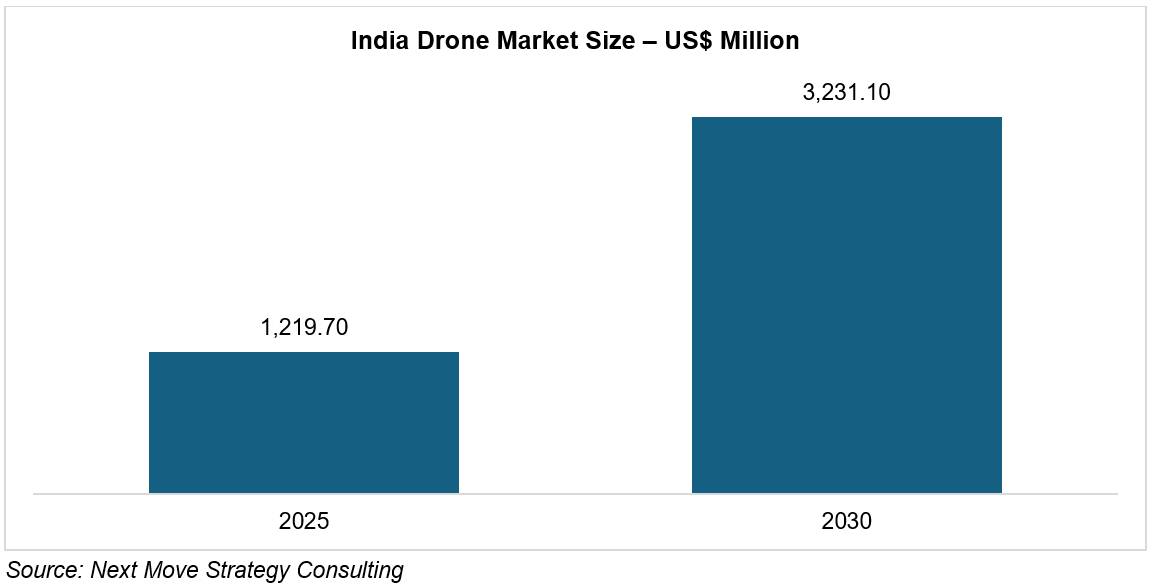
India’s drone market was valued at US$ 1,219.7 million (Rs. 10,977 crore) in 2025. Looking further ahead, the market is projected to grow sharply, reaching US$ 3,231.10 million (Rs. 29,080 crore) by 2030, supported by a strong CAGR of 21.51% between 2025 and 2030.
India possesses a dual-use advantage provides strong benefits to the country. The defence and civilian sectors share approximately 60-70% of drone components including airframes, sensors and ground systems. The shared elements between different applications result in better system expansion, capabilities, decreased expenses and faster development of new products.
Government Initiatives and Policy Support
Reforms in policies have played an essential role in fostering growth in the Indian drone market. With the introduction of Drone Rules in 2021, there was a significant paradigm shift wherein more than 90% of the compliance processes were done away with, and a new trust-based system came into existence.
The DigitalSky platform has further streamlined operations by providing a unified digital interface for registration, certification, flight approvals, improving transparency and reducing approval timelines. Tax rationalisation has also supported adoption. A uniform 5% Goods and Services Tax (GST) has reduced ambiguity and cost barriers across the value chain.
On the manufacturing side, the Production-Linked Incentive (PLI) scheme has provided incentives of up to 20% on value addition, leading to a sevenfold increase in revenue for participating firms. This has improved manufacturing economics and strengthened incentives for localisation.
Looking ahead, a proposed Drone Technology Incentive programme of approximately US$ 240 million (Rs. 2,219 crore) aims to achieve 40% localisation by FY28, focusing on components, software and services. Additional investments of Rs. 2,000 crore (US$ 217 million) over three years indicate a shift from enabling adoption to building long-term industrial capacity.
Growth Drivers and Key Trends
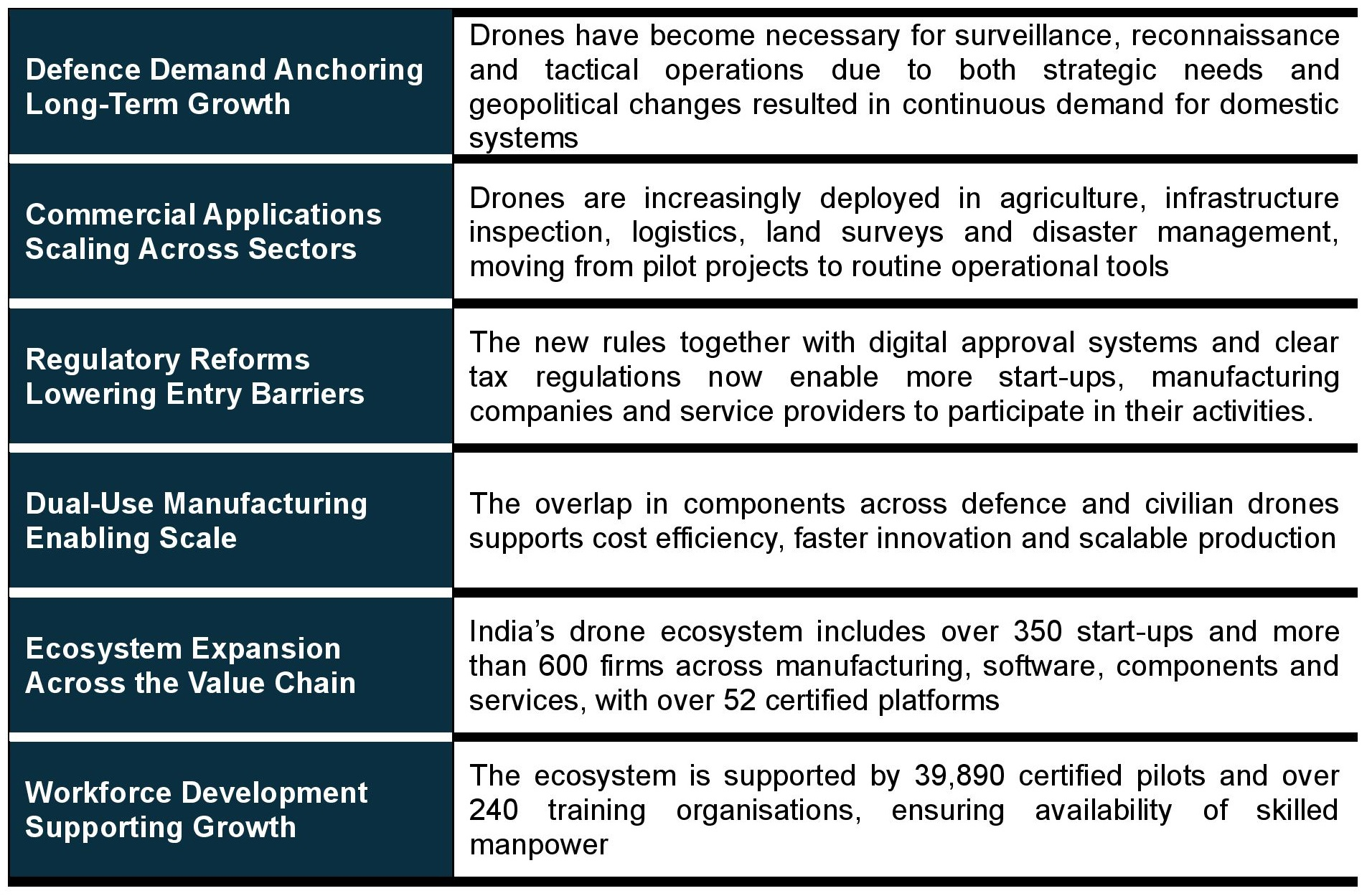
The following factors are driving the expansion and shaping the evolution of India’s drone ecosystem:
Outlook and Road Ahead
India's drone ecosystem has entered a new developmental stage which will determine its growth through complete project execution instead of measuring its progress through operational expansion. Defence and commercial sectors continue to show strong demand, but the ability to compete effectively in the long term requires India to develop its own manufacturing capabilities and stop depending on imports of components like sensors, propulsion systems and specialised payloads. The future advancement of drones is expected to depend upon artificial intelligence and dependable communication networks.
The sector is projected to generate more than 1,20,000 manufacturing jobs together with above 6,00,000 service sector positions. India's position in becoming an outstanding participant in the growth of drone manufacture and service provision stems from its efforts towards export-oriented production.
FAQs
What is driving the growth of India’s drone ecosystem?
Regulatory reforms, defence demand and expanding commercial applications are the primary drivers for the growth of India drone market.
How large is India’s drone market expected to become?
India’s drone market was valued at US$ 1,219.7 million (Rs. 10,977 crore) in 2025 and is projected to grow significantly, reaching US$ 3,231.1 million (Rs. 29,080 crore) by 2030, registering a CAGR of 21.51% during the forecast period.
What role does policy play in the drone sector?
Policies such as Drone Rules, GST rationalisation, PLI incentives and DigitalSky have reduced barriers and supported industry growth in the drone sector.
How are drones used in public programmes?
Drones are used in land surveying under the SVAMITVA scheme, agriculture initiatives such as the Namo Drone Didi programme, and infrastructure monitoring across public projects.
Partners