Introduction
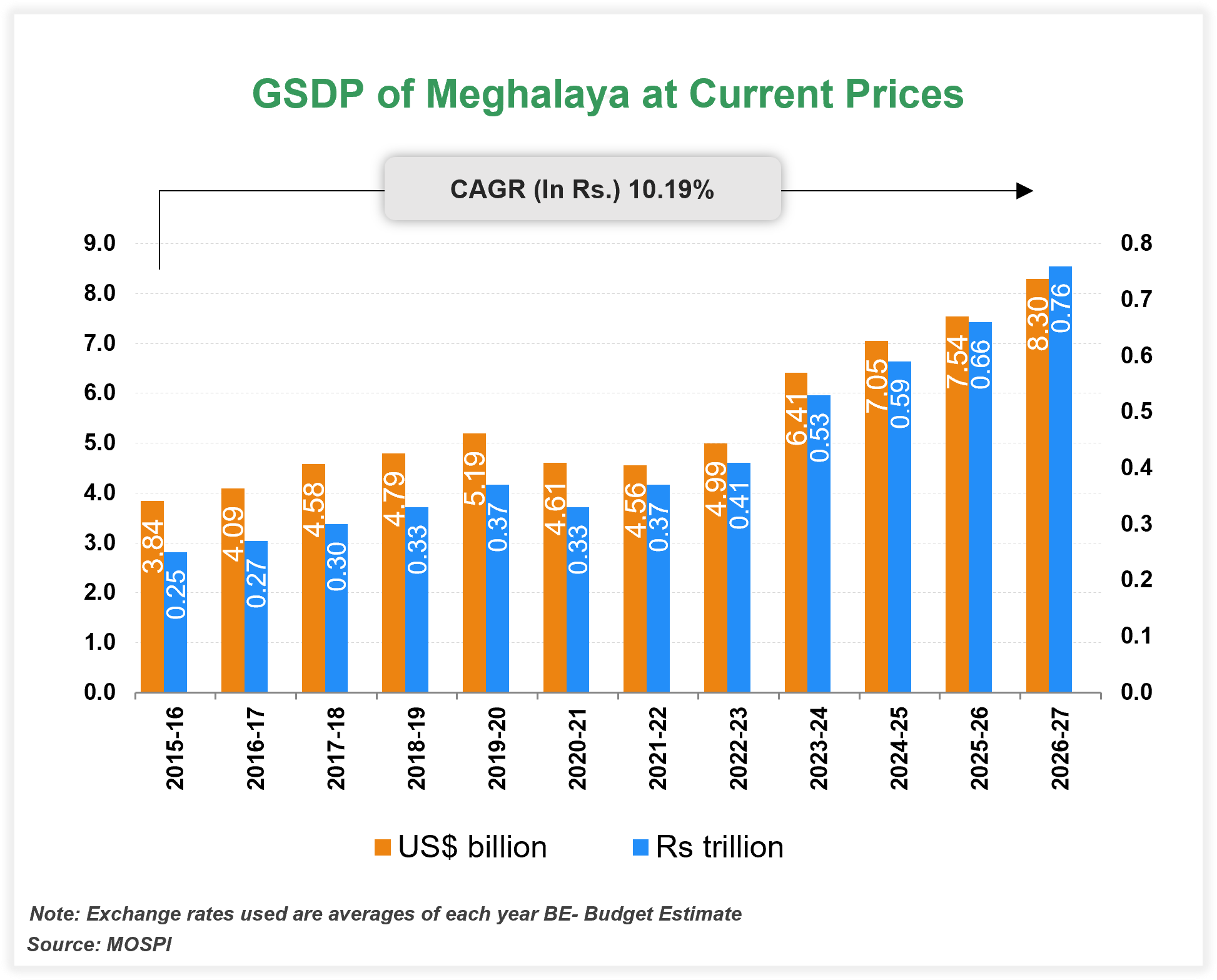
At current prices, the gross state domestic product (GSDP) of Meghalaya has been estimated at Rs. 76,320 crore (US$ 8.30 billion) in 2026-27. The state’s GSDP (in Rs.) is expected to increase at a CAGR of 10.64% between 2015-16 and 2026-27. Assam and on the south and the west with Bangladesh. Meghalaya, with an average annual rainfall of 1,150 cm, receives the highest amount of rainfall in the country. The diverse range of soil types, including red-loamy and laterite, support various agricultural crops like rice, maize, pulses, oilseeds, cotton, jute, and mesta. The state has achieved success in the cultivation of non-traditional crops like tea, cashew nuts, oilseeds, tomatoes, mushrooms, wheat, etc.
Meghalaya, with abundant deposits of coal, limestone, kaolin feldspar, quartz, granite, industrial clay and uranium, and a small deposit base of sillimanite, bauxite, base metals and apatite has great industrial potential. Meghalaya, one of the most picturesque states in the country, has two national parks and three wildlife sanctuaries. It offers many adventure tourism opportunities like mountaineering, rock climbing, hiking and trekking, water sports, etc.
In FY26 passenger traffic at Barapani Airport reached 96,716 and aircraft movements at the airport stood at 1,890.
According to the Department for Promotion of Industry and Internal Trade (DPIIT), FDI inflows in Meghalaya stood at Rs. 9.08 crore (US$ 1.2 million) between October 2019-March 2026.
Key Sectors
- In March 2026, Meghalaya became the 12th state in India to sign a reform-linked Memorandum of Understanding (MoU) with the Government of India under Jal Jeevan Mission (JJM) 2.0, aimed at strengthening sustainable and service-oriented rural drinking water supply systems.
- Limestone production in Meghalaya stood at 11,710 thousand tonnes in FY26 (April-February 2026).
- On September 3, 2025, the Meghalaya Government launched the Autumn Tourism Calendar for 2025, featuring the Shillong Cherry Blossom Festival held on November 14-15, 2025, luxury-hotel expansions, and upgraded travel infrastructure, signalling a strategic push to position the state as a cultural and adventure tourism hub.
- The state had an installed hydroelectric power capacity of 435.40 MW as of March 2026.
- Budget 2026-27
- On August 5, 2025, the Meghalaya government announced a Rs. 240 crore (US$ 28 million) investment over three years for the Floriculture Mission 1.0 to transform the state into a high-value flower hub and benefit over 3,000 farmers.
- Meghalaya allocated Rs. 5,572 crore (US$ 60.57-63.32 million) towards climate-resilient development in FY27, accounting for nearly 19% of the state budget and reinforcing its focus on sustainable growth.
- Meghalaya is set to host the 39th National Games in 2027 and allocated Rs. 844 crore (US$ 9.17-9.59 million) for sports and youth affairs, including development of the Mawkhanu Football Stadium, expected to become India’s largest dedicated football stadium.
- Meghalaya continued strengthening tourism infrastructure through projects such as the Integrated Sohra Tourism Circuit, Shillong Peak Ropeway and large-scale destination development initiatives, while tourist footfalls crossed 16 lakh visitors.
- Meghalaya intensified investment promotion efforts through the Meghalaya Industrial and Investment Promotion Policy 2024 and externally aided projects, with grounded private investments crossing Rs. 1,800 crore (US$ 19.57-20.00 million) and an investment target of over Rs. 8,000 crore (US$ 86.96-88.89 million) by 2032.
- A new initiative is set to be introduced for the enhancement of infrastructure at all tourism destinations. Communities overseeing tourist attractions will be eligible to receive grants of up to Rs. 25 lakh (US$ 29,772) for development purposes.
- In the year 2023-24, a program focused on cluster-based skill development for textile sector will be implemented, aiming to train and upskill 10,000 weavers. Additionally, the program will involve the construction of common facility centres that will cater to the needs of the weavers.
- The Meghalaya homestay scheme aims to construct 5,000 homestay facilities between the years 2023-24 and 2027-28. This includes the construction of 1,000 homestays in the year 2023-24.
- As of February 2025, Meghalaya had a total installed power generation capacity of 651.78 MW, comprising 377.03 MW from state utilities, 18.08 MW from private utilities and 256.67 MW by central utilities. Of the total installed power generation capacity, 417.38 MW was contributed by hydropower and 73.11 MW by renewable power.
- As of August 17th, 2023, there are 17 ongoing projects with a length of 388 km and an estimated total project cost of Rs. 7,252 crore (US$ 989,78 million).
- In August 2023, the Centre has proposed two railway projects in Meghalaya – the 22 km Tetelia-Byrnihat tracks and the 108 km Byrnihat-Shillong line.
- In August 2023, Northeastern Electric Power Corporation Limited (NEEPCO) halted a proposed 500 MW Meghalaya thermal power project to focus on green energy.
- According to Chief Minister Mr. Conrad K Sangma, Meghalaya is home to nearly 14,600 schools and employs over 55,160 teachers, surpassing other small states in Northeast India (2020-21).
- The Ministry of Development of Northeastern Region (DoNER) has sanctioned 41 projects worth Rs. 90 crore (US$ 10.99 billion), under Hill Area Development Programme.
Meghalaya offers a niche and sustainable growth opportunity, supported by steady GSDP expansion, rich natural resources, and a strong focus on green development. Abundant rainfall, diverse soils, and mineral reserves underpin agriculture, mining, and allied industries, while hydropower and renewable energy form the backbone of the state’s clean energy strategy. Rising public investment in healthcare, education, tourism infrastructure, and connectivity, along with targeted initiatives in floriculture, handlooms, and homestays, is strengthening livelihoods and employment. With its emphasis on eco-tourism, cultural heritage, and responsible development, Meghalaya is well positioned for inclusive, environmentally balanced economic growth.
Note: MW - Megawatt
FACTFILE
Capital
ShillongGeographical Area (sq km)
22,429State Language
English, Khasi, Pnar and GaroLiteracy Rate
74.4 per centKey Industries:
Handlooms & Handicrafts
Sericulture
Mining
Cement
Food processing
Agriculture
Floriculture
Hydroelectric power
Tourism
Related News
MOREPartners