Andhra Pradesh
Andhra Pradesh has emerged as a major SEZ hub with 25 operational Special Economic Zones across diverse industries.
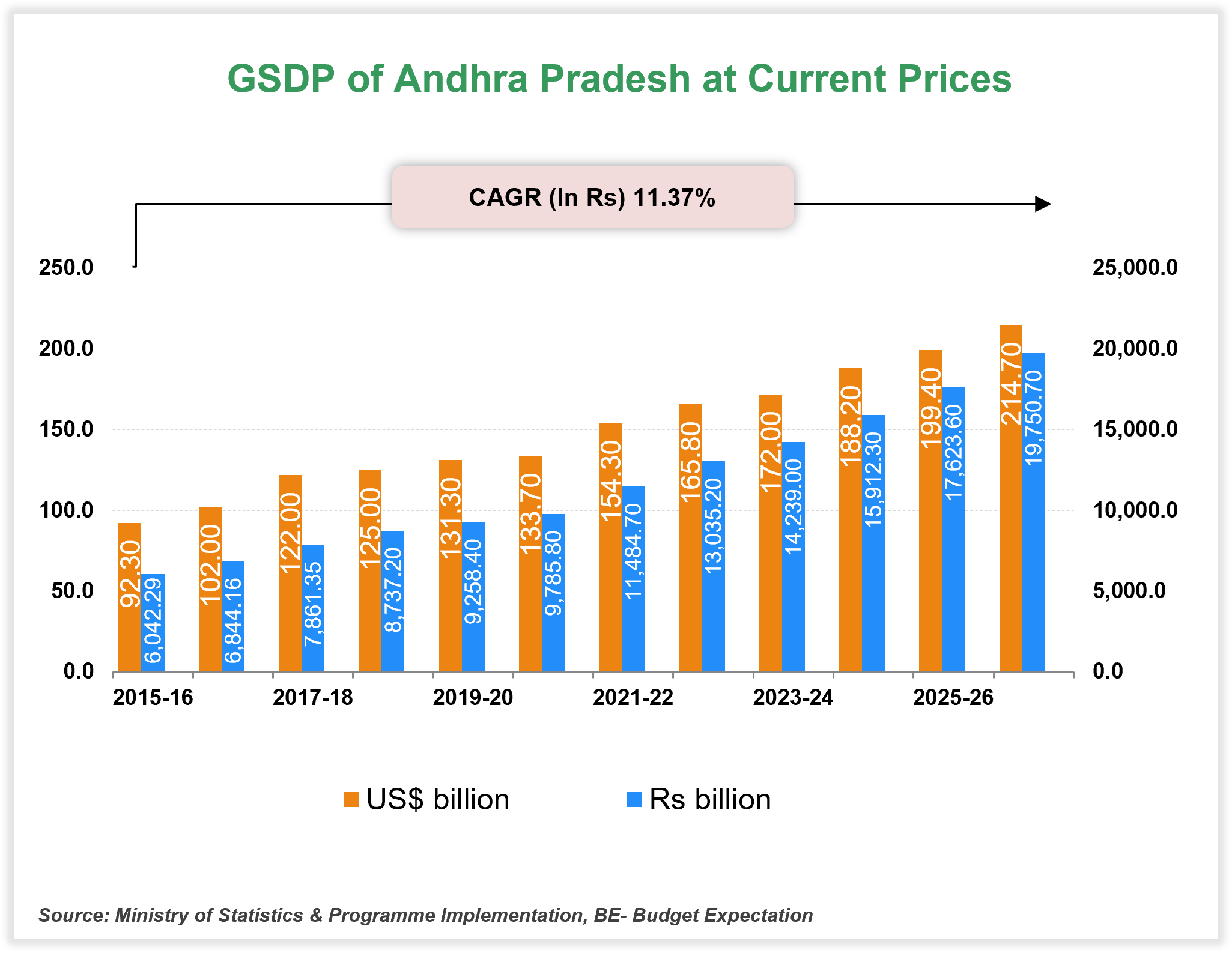
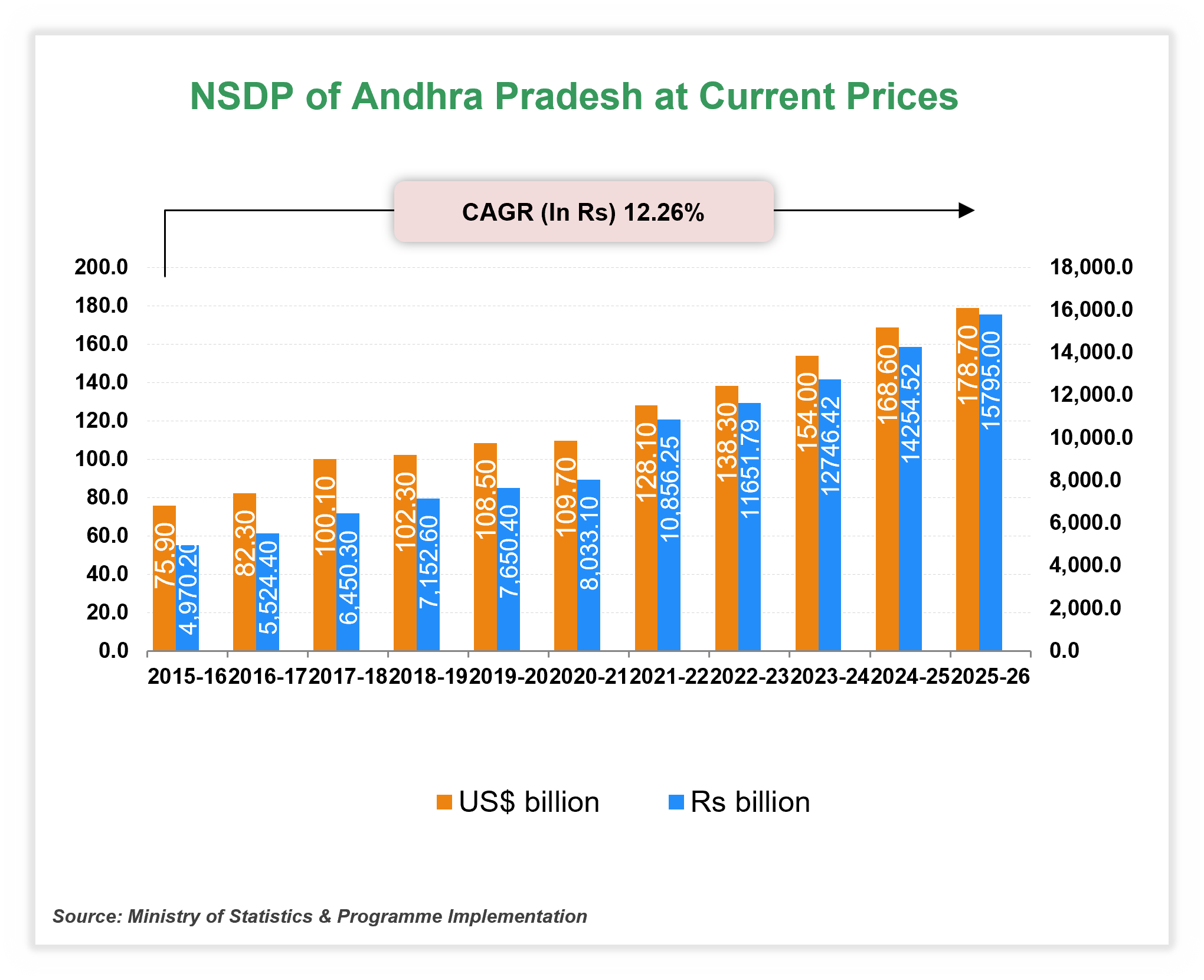
The erstwhile state of Andhra Pradesh has been bifurcated into two states, Telangana, and residuary Andhra Pradesh (Seemandhra) by the Andhra Pradesh Reorganisation Act, 2014, or the Telangana Act. The Act consists of the aspects of the division of assets and liabilities, the boundaries of the proposed new states, and the status of the capital city Hyderabad after the separation of the state.
Andhra Pradesh has a well-developed social, physical, and industrial infrastructure, as well as good virtual connectivity. It also has good power, airport, IT, and port infrastructure. At current price, Andhra Pradesh's Gross State Domestic Product (GSDP) is expected to be Rs. 19,750.7 billion (US$ 214.7 billion) for FY27. The GSDP increased at a CAGR (in Rs.) of 11.37% between FY16 and FY27.
Andhra Pradesh has been one of the foremost states to have developed sector-specific policies. Forming industrial clusters and developing infrastructure, such as biotech parks, textile parks and hardware parks has been the state's key strategy to attract investments in various industries.
Andhra Pradesh has emerged as a major Special Economic Zone (SEZ) hub with 25 operational SEZs across pharmaceuticals, multi-product manufacturing, IT/ITeS, textiles, food processing, biotechnology, chemicals, leather and engineering sectors, strengthening its position as a diversified industrial and export destination.
According to Department for Promotion of Industry and Internal Trade (DPIIT), FDI inflow in Andhra Pradesh between October 2019 to March 2026 stood at Rs. 14,119.64 crore (US$ 1.72 billion).
Merchandise exports from Andhra Pradesh is Rs. 1,59,099 crore (US$ 18.1 billion) in FY26. Engineering Goods are the largest export category of the state, accounting for around 20.89% of the total exports in FY26 while marine products being the second most exported item stood at 18.20% of total exports.
Hyderabad has become one of the preferred destinations for global pharma biotech investments and has attracted around Rs. 7,500 crore (US$ 983.52 million) of investments in FY22, which is expected to result in employment for about 35,000 people.
On October 27, 2025, the Government of India sanctioned Rs. 35,882 crore (US$ 4.05 billion) for rural road and bridge infrastructure in Andhra Pradesh under the Pradhan Mantri JanaMAN initiative. This funding aims to accelerate connectivity and support regional development across rural areas.
On August 3, 2025, Union Minister of Road Transport & Highways, Mr. Nitin Gadkari declared that Andhra Pradesh’s road connectivity will surpass that of the United States (US) within two years, while announcing 27 new road projects worth Rs. 5,233 crore (US$ 590 million) and in principle approval for several schemes' worth around Rs. 1,00,000 crore (US$ 11.28 billion).
The rail budget allocation for Andhra Pradesh has risen to Rs. 9,417 crore (US$ 1.06 billion) in FY26, over ten times higher than a decade ago.
Passenger traffic at Tirupati Airport increased by 20.1% year-on-year, rising from 995,640 passengers in FY25 to 1.20 million passengers in FY26, reflecting growing air connectivity and strengthening the city's position as a major pilgrimage and tourism destination in India.
Andhra Pradesh has most of the power projects of undivided Andhra Pradesh. Coal-based power plants are mostly located in the state due to their proximity to the ports. As of March 2026, Andhra Pradesh has a total installed power generation capacity of 30419.54 MW. Of the total, private utilities contributed 18,787.14 MW, state utilities contributed 8,995.89 MW and central utilities contributed 2,636.51 MW.
The Andhra Pradesh Electricity Regulatory Commission (APERC) has announced the Renewable Power Purchase obligation (RPPO) targets: 18% for FY23, 19% for FY24, 20% for FY25, 22% for FY26, and 24% for FY27.
Andhra Pradesh aims to build a Rs. 1,77,360 crore (US$ 20 billion) Blue Economy by 2035, leveraging its deep-water coastline and strong rail and highway connectivity. The Andhra Pradesh Maritime Board is developing three greenfield gateway ports at Ramayapatnam, Machilipatnam and Mulapeta under the PPP (DBFOT) and Landlord models, with total investments of about Rs. 17,027 crore (US$ 1.92 billion). These ports will add 145 MTPA capacity by 2030 and generate over 75,000 jobs. The state also plans to build 11 fishing harbours at a cost of Rs. 3,500 crore (US$ 395 million) to strengthen marine infrastructure and coastal livelihoods.
Traffic handled by the Visakhapatnam port reached 91.16 million tonnes in FY26.
According to the Telecom Regulatory Authority of India (TRAI), Andhra Pradesh had 87.19 million wireless and 5.15 million wireline subscribers as of March 2026. As of March 2026, the state’s overall tele-density stood at 101.52%.
Andhra Pradesh is known for its pristine beaches, sacred places of worship, lush green forests, spicy cuisine, and hospitable people.
As per budget estimates FY27:
- In the FY27 Budget, Andhra Pradesh allocated Rs. 32,308 crore (US$ 3.51 billion) for school education, making it the largest departmental allocation and reinforcing the state's focus on human capital development.
- In the Budget FY27 speech, Andhra Pradesh announced road improvement works covering 6,036 km with an investment of Rs. 2,499 crore (US$ 271.6 million), aimed at improving connectivity, logistics efficiency and road safety.
- In the Budget FY27 speech, Andhra Pradesh reported that Bhogapuram International Airport (Alluri Sitarama Raju International Airport) is 97% complete, expected to significantly enhance air connectivity and tourism potential.
- In Budget FY27, Andhra Pradesh plans to develop Kakinada SEZ Port through the PPP model, supported by external infrastructure including roads, water supply and power connectivity, improving industrial and export logistics.
Andhra Pradesh is a major industrial and export-driven state on India’s east coast, supported by strong port-led infrastructure, single-window industrial clearances, and sector-focused policies in electronics, solar power, food processing and pharmaceuticals. With an estimated GSDP of Rs. 18.3 trillion (US$ 214.2 billion) in FY26 and exports of Rs. 1.84 trillion (US$ 20.8 billion) in FY25, the state is a leader in engineering goods, marine products and pharmaceuticals. It hosts large power capacity (28.4 GW), robust road and port connectivity, and major investments such as the Nakkapalli Bulk Drug Park and Amaravati capital development. Agriculture and fisheries remain key strengths, with Andhra Pradesh contributing over 40% of India’s fish production, while ongoing reforms, infrastructure spending and investor-friendly governance continue to position the state as a competitive destination for manufacturing, exports and sustainable growth.
FACTFILE
Capital
Hyderabad (for 10 years)Geographical Area (sq km)
160,205State Language
Telugu, Hindi, English and TamilLiteracy Rate
67.4 per centKey Industries:
Agro and food-based
Biotechnology
Bulk drugs and pharmaceuticals
IT and ITeS
Textile and leather
Tourism
Automotive and auto components
Gems and jewellery
Related News
MOREPartners




