Odisha is one of the most mineral-rich states in India. Key minerals found in the state are iron, coal, bauxite, manganese, nickel, chromite, limestone, dolomite, graphite, decorative stones, beach sand, China clay, and tin ore. Odisha has emerged as the key state with regard to the mineral and metal-based industries. As per the Indian Bureau of Mines (IBM), Odisha emerged as the leading mineral-producing state in India during February 2026, contributing 37.5% of the country’s total mineral production value. The state recorded mineral output worth Rs. 7,132 crore (US$ 819.8 million), while cumulative mineral production during April 2025–February 2026 stood at Rs. 62,303 crore (US$ 7.16 billion).
Odisha accounts for over 55% of India’s bauxite reserves, making it an ideal location for setting up aluminium and aluminium-based companies. The state ranks first in the country in terms of both production capacity and actual output of aluminium.
Odisha is one of the favoured investment destinations for domestic and international iron and steel players as well as among the largest producers of iron and steel in India. In 2025-26, total exports of iron ore from Odisha stood at US$ 1,198.70 million (~11.11%).
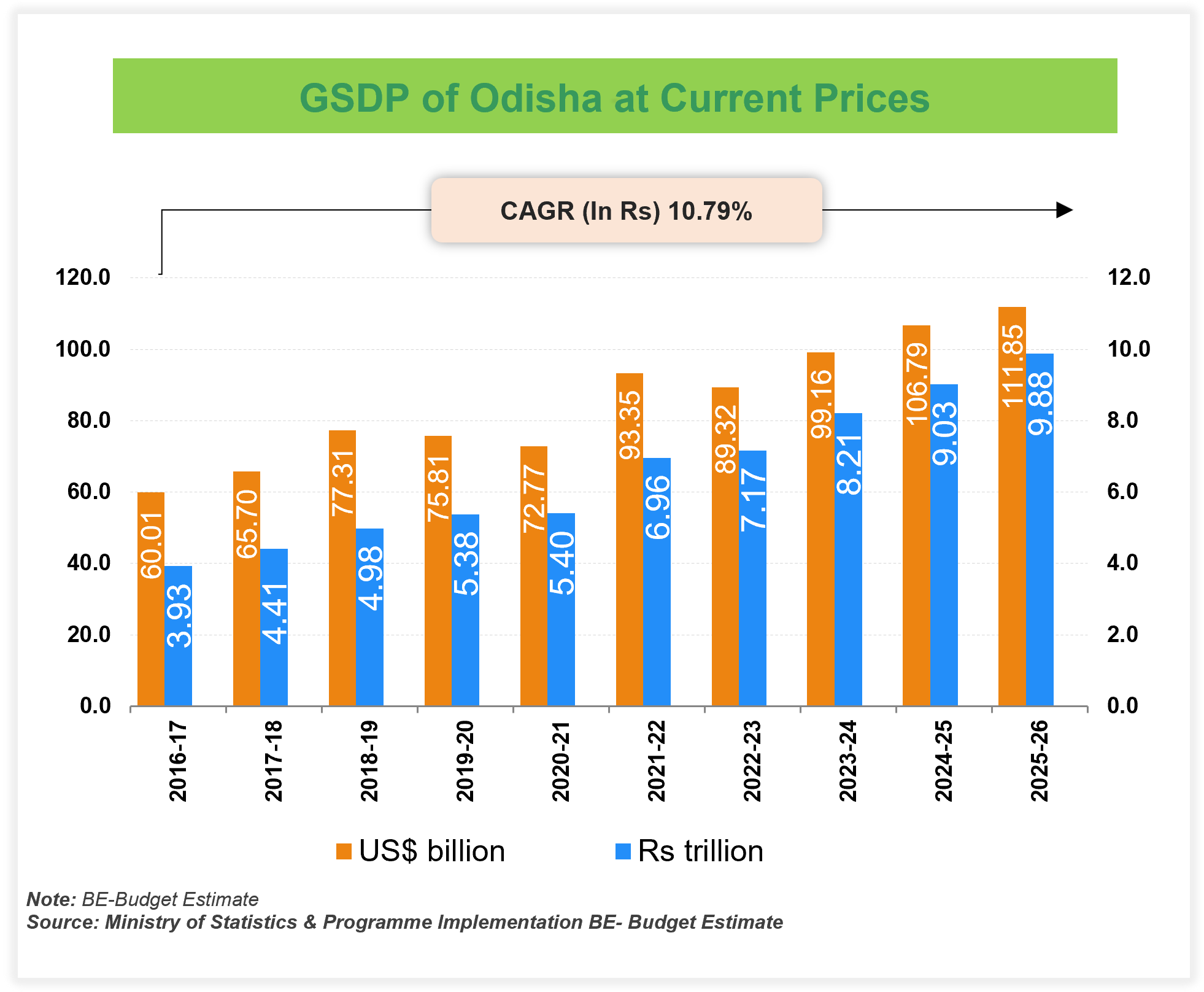
At current prices, the state’s gross state domestic product (GSDP) was estimated to be Rs. 9.88 trillion (US$ 111.85 billion) in FY26.
Odisha’s GSDP is expected to increase at a CAGR of 10.79% between FY17 and FY26.
According to the DPIIT, cumulative FDI inflows in the state stood at Rs. 2,055 crore (US$ 257.19 million) between October 2019-March 2026.
Odisha has emerged as a key state with regard to the mineral and metal-based industries.
As of April 2026, Odisha had a total installed power generation capacity of 9,255.86 MW, of which 2,251.48 MW was under the central utilities, 3,821.85 MW (under state utilities) and 3,182.53 MW (under private sector). Of the total installed power generation capacity, 5,972.47 MW was contributed by thermal, 2,179.23 MW by hydro, and 1,104.16 MW by renewable energy.
Total merchandise exports from Odisha stood at Rs. 95,568 crore (US$ 10.79 billion) in FY26. Engineering goods, mica coal, Iron ore, petroleum products, marine products, accounted for a majority share in the overall exports from the state.
Allocation under state budget:
- Under the Odisha Budget 2026-27, Rs. 21,468 crore (US$ 2.33 billion) has been allocated towards Roads and Bridges. Out of this, Rs. 17,293 crore (US$ 1.88 billion) has been earmarked as capital outlay for road and bridge infrastructure development projects across the state.
- Under the Odisha Budget 2026-27, Rs. 38,397 crore (US$ 4.17 billion) has been allocated towards Education, Sports, Arts and Culture. Key allocations include Rs. 3,805 crore (US$ 413.6 million) for Samagra Siksha Abhiyan and Rs. 1,278 crore (US$ 138.9 million) for PM Poshan to strengthen educational outcomes and student welfare.
- Under the Odisha Budget 2026-27, Rs. 22,505 crore (US$ 2.45 billion) has been allocated towards Health and Family Welfare. Of this, Rs. 6,309 crore (US$ 685.8 million) has been earmarked for Gopabandhu Jana Arogya Yojana, while Rs. 5,008 crore (US$ 544.3 million) has been allocated for the Mukhya Mantri Swasthya Seva Mission to strengthen healthcare access and medical infrastructure.
- Under the Odisha Budget 2026-27, Rs. 22,039 crore (US$ 2.40 billion) has been allocated towards Agriculture and Allied Activities. The budget includes Rs. 6,088 crore (US$ 661.7 million) for Samrudha Krushaka Yojana and Rs. 2,030 crore (US$ 220.7 million) under CM-KISAN to support farmer welfare, agricultural productivity and rural incomes.
Odisha has vast potential for the development of tourism. It is one of the critical sectors of the state’s economy, in terms of foreign exchange earnings as well as employment generation opportunities.
Below are some of the major initiatives taken by the Government to promote Odisha as an investment destination:
- In April 2026, Chief Minister Mr. Mohan Charan Majhi inaugurated 36 industrial projects with a cumulative investment of Rs. 40,811 crore (US$ 4.69 billion) at Bhuinpur near Begunia in Khordha district.
- In March 2026, the National Highways Authority of India (NHAI) awarded contracts for the construction of the 111-km six-lane access-controlled Greenfield Capital Region Ring Road (Bhubaneswar Bypass) in Odisha. Developed under the Hybrid Annuity Mode (HAM), the project will connect Rameshwar and Tangi through three construction packages and is expected to be completed within 30 months.
- In March 2026, Union Home and Cooperation Minister Mr. Amit Shah inaugurated and laid the foundation stone for development projects worth more than Rs. 3,770 crore (US$ 433.3 million) in Odisha. The projects include initiatives of the National Dairy Development Board (NDDB), the Odisha State Cooperative Milk Producers’ Federation (OMFED) and various state government infrastructure projects aimed at strengthening the cooperative ecosystem and rural economy.
- In February 2026, Odisha was identified as one of the four locations selected for the development of a Rare Earth Corridor under the Union Budget’s critical minerals strategy.
- Odisha has attracted investment intents totaling Rs. 20,900 crore (US$ 2.36 billion) in the IT/ITeS industry, reinforcing its position as a rapidly growing IT hub with strong government support and promising infrastructure development fostering significant economic growth.
- Odisha showcased itself as the Steel Capital of India, with 54 integrated steel plants and a target to reach over 130 million tonnes per annum (MTPA) steel capacity by 2030. The state aims for value-added metal-based manufacturing and downstream expansion under its Vision2036.
- Vedanta Group planned an additional Rs. 1 lakh crore (US$ 11.28 billion) investment in Odisha, including ferro-alloys and aluminum parks, expected to create over 1,00,000 direct and indirect jobs. The Odisha government pledged full support for these projects.
- Chief Minister of Odisha, Mr. Mohan Charan Majhi, laid stone for 12 projects worth Rs. 28,084 crore (US$ 3.17 billion), including a Rs. 7,200 crore (US$ 812.18 million) investment in green hydrogen and ammonia sector at Tata Steel SEZ, and Rs. 4,000 crore (US$ 451.21 million) investment by UPL Limited in speciality chemicals at the same SEZ. These projects collectively promise thousands of jobs.
- Chief Minister of Odisha, Mr. Mohan Charan Majhi launched 27 major industrial projects worth Rs. 25,308 crore (US$ 2.85 billion) at locations including Gopalpur SEZ and Jharsuguda, covering sectors from steel to solar energy, signaling a strong industrial growth push.
- Odisha government approved five industrial projects totaling Rs. 44,793 crore (US$ 5.05 billion) across sectors such as renewable energy, steel, and chemicals. These projects are expected to generate around 23,000 jobs and strengthen the state's industrial base in districts like Jajpur, Dhenkanal, and Cuttack.
- Odisha approved 25 new industrial projects worth Rs. 4,739 crore (US$ 534.57 million), likely to create 25,200 jobs across districts including Khurda, Jajpur, and Sambalpur.
- Odisha approved 33 investment proposals amounting to Rs. 1.46 lakh crore (US$ 16.47 billion), including a significant coal-to-chemical project by Adani, expected to generate substantial skilled employment opportunities and boost industrial growth.
- Odisha announced a Rs. 9,200 crore (US$ 1.04 billion) investment to redevelop four major healthcare institutes to significantly increase hospital bed capacity. For example, VIMSAR Medical College capacity will nearly double from 1,485 to 2,861 beds, and Capital Hospital's beds will increase from 750 to 2,582.
- Odisha received Rs. 4,349 crore (US$ 490.58 million) investment commitments in the healthcare sector during the Utkarsh Odisha: Make-in-Odisha Conclave 2025, which will accelerate healthcare infrastructure and biotech manufacturing progress.
- On September 28, 2025, Odisha government approved Rs. 12,000 crore (US$ 1.35 billion) for constructing 2,200 model primary schools between 2025-26 and 2027-28, aiming to improve primary education infrastructure significantly.
- Odisha Cabinet approved a new city development plan for Bhubaneswar worth Rs. 8,179 crore (US$ 922.62 million). The plan focuses on transit-oriented development, efficient public transport, housing for all income groups, creative place-making with forest parks and plazas, and integration of smart and green infrastructure for climate resilience and environmental sustainability.
- Odisha is undergoing a massive urban transformation to increase urbanization to 40% by 2036 and 60% by 2047, outpacing national goals. This includes creation of 28 new Notified Area Councils (NACs), elevation of seven NACs to municipalities, industrial growth corridors, housing projects like PMAY-Urban, improved urban amenities such as 24/7 tap water and public transport, and climate-resilient infrastructure plans. The government targets integrated urban clusters and sustainable urban governance with strong public-private partnerships.
- The Odisha government approved renewable energy projects totaling 178 MW capacity with an investment of Rs. 8.7 billion (US$ 98.14 million). Projects include solar parks and wind power initiatives in various districts.
- Odisha operates six hydropower projects with a capacity of 2,040 MW and 429.2 MW of solar power capacity. The state has MoUs for about 4 GW solar and 3 GW wind projects expected to create thousands of jobs. Odisha also hosts India’s first Silicon Carbide semiconductor manufacturing facility for renewable energy components, boosting local manufacturing.
- On November 5, 2025, Chief Minister of Odisha Mr. Mohan Charan Majhi announced a massive maritime infrastructure expansion plan with projects worth over Rs. 46,000 crore (US$ 5.19 billion). Key projects include a new port at Bahuda in Ganjam district with investment of Rs. 21,500 crore (US$ 2.43 billion), a shipbuilding and repair hub near Paradip with allocation of Rs. 24,700 crore (US$ 2.79 billion), and a world-class cruise terminal at Puri. Paradip Port's cargo handling capacity has more than doubled from 71 million tonnes in 2015 to 150 million tonnes by 2025, with plans to increase further to 300 million tonnes by 2030 and 500 million tonnes by 2047 under national maritime visions.
- Odisha government accelerated railway infrastructure development, highlighting the Puri-Konark line, a 32 km, approved Rs. 492 crore (US$ 55.50 million) linking heritage sites, other new lines in Mayurbhanj district, and a consideration for the Jaleswar–Chandaneswar line to boost coastal tourism and reduce logistics costs.
- On July 17, 2025, A sanction of Rs. 149.32 crore (US$ 16.84 million) was given for the fourth rail line between Ranital Link Cabin and Bhadrak in Odisha. This project aims to segregate freight and coaching trains, minimize delays, and improve route efficiency as part of East Coast Railway's modernization efforts.
- Odisha announced a new State Road Policy 2025 and enacted the Odisha State Highways Authority Act 2025. These reforms aim to expand and upgrade the state’s road network, with priority given to quality and speed of execution. The Comprehensive Infrastructure Master Plan envisages construction of 75,000 km of roads in the next five years i.e by 2030.
Odisha, located on India’s eastern coast, is a major industrial and mineral hub with strong connectivity through ports, railways, highways, power and telecom infrastructure. The state is a leading producer of minerals and metals, with iron, steel and aluminium dominating its export basket. Odisha has recorded robust economic growth over the last decade and has emerged as a key destination for investments in steel, downstream manufacturing, renewable energy, green hydrogen, chemicals, IT and electronics. It is positioning itself as the “Steel Capital of India” while also scaling up clean energy, port-led development and logistics. Large investments in urban transformation, healthcare, education, roads and railways are strengthening its long-term growth outlook and industrial competitiveness.
FACTFILE
Capital
BhubaneswarGeographical Area (sq km)
155,707State Language
Oriya, Hindi and EnglishLiteracy Rate
72.87 per centKey Industries:
Iron & Steel
Ferroalloy
Aluminium
Mining

Handloom
IT and ITeS
Tourism
Related News
MOREPartners