Sikkim is one of the fastest-growing states in India. The state has favourable agro-climatic conditions, which support agriculture, horticulture, and forestry. Sikkim got certified as the first fully organic state in India by the Central Ministry of Agriculture and Farmers’ Welfare as well as other recognized agencies of the country. It is home to around 5,000 species of flowering plants, 515 rare orchids, 60 primula species and 36 rhododendron species. This makes it one of the leading states in the northeast in terms of production and supply of cut flowers to mainland consumer markets. The state is also considered a huge cardamom epicentre of the world, producing around 80% of large cardamom in the country. According to the Global Childhood Report 2019, Sikkim was the best state under Protective Contexts.
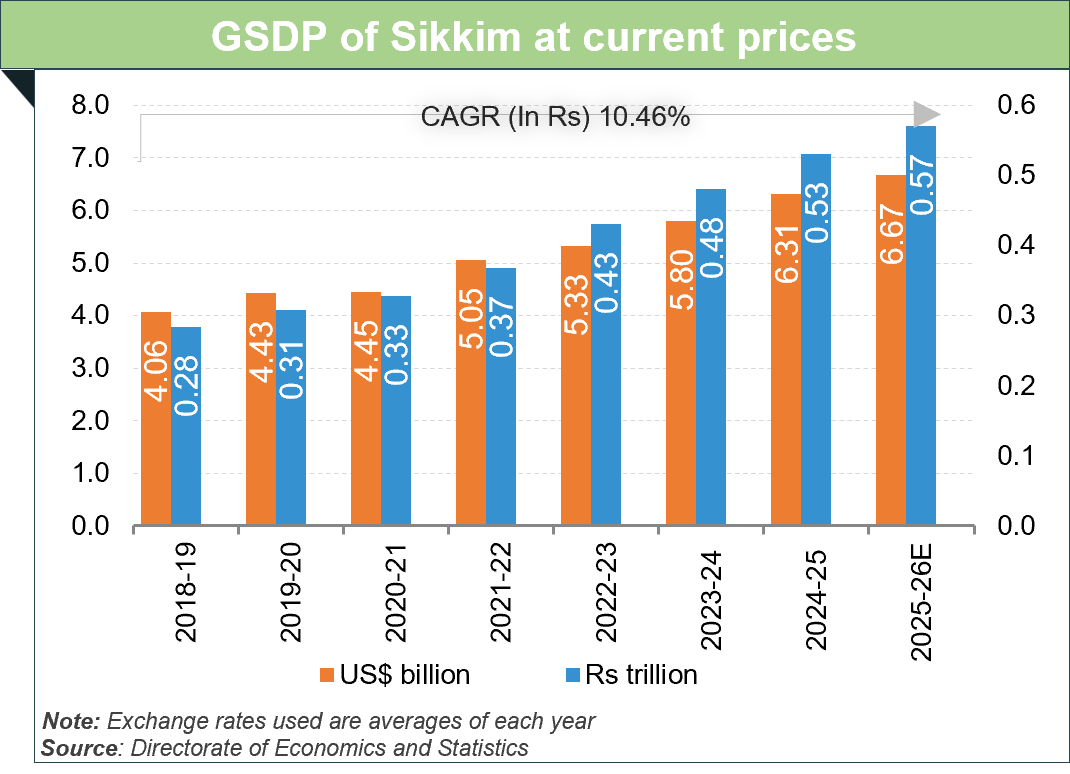
At current prices, Sikkim’s Gross State Domestic Product (GSDP) is estimated at Rs. 0.57 trillion (US$ 6.67 billion) in FY26. GSDP is estimated to expand at a CAGR of 10.46% between FY19 and FY26.
As of April 2026, Sikkim had a total installed power generation capacity of 795.15 MW, of which 163.48 MW was under central utilities, 360 MW was under state utilities, and 271.67 MW was under the private sector. Of the total installed power generation capacity, 89.21 MW was contributed by thermal and 705.94 MW by renewable energy.
Total merchandise exports from Sikkim stood at Rs. 211 crore (US$ 23.83 million) in FY26. Drug formulations, Cereal Preparations and Miscellaneous Processed Item, Engineering Goods and Organic and Inorganic Chemicals accounted for a majority share in the overall exports from the state.
Under the Vote-on-Account for FY27, the Urban Development Department received an allocation of Rs. 351.5 crore (US$ 38.2 million), reflecting the state's continued focus on strengthening urban infrastructure and public service delivery.
Some of the major initiatives taken by the Government to promote Sikkim as an investment destination are:
In March 2026, Northeast Frontier Railway (NFR) achieved a major milestone in the Sivok–Rangpo Railway Project with the successful breakthrough of Tunnel No. 8, one of the project's key tunnels with a length of 4.15 km.
The Government of Sikkim opened Cho La and Dok La, two strategically important border destinations, for tourism under the Bharat Ranbhoomi Darshan initiative in December 2025.
On November 4, 2025, the Indian Railways sanctioned Rs. 8.48 crore (US$ 1 million) for the Final Location Survey (FLS) of the proposed Melli-Dentam railway line in Sikkim to expand rail connectivity to the southern and western parts of the state.
On September 18, 2025, the Asian Development Bank (ADB) approved a Rs. 1,597 crore (US$ 179 million) loan for the Sikkim Integrated Urban Development Project, aimed at improving urban infrastructure across seven towns in Sikkim, including water supply, sanitation, urban mobility and climate-resilience measures. The project will deliver continuous piped water supply to over 90 % of residents in targeted towns, expand sewage and wastewater treatment networks, upgrade roads and transit infrastructure, install GIS-based planning systems and strengthen disaster preparedness and institutional capacity across urban local bodies.
The Goods and Services Tax (GST) reforms have reduced the tax burden on medicines and medical devices, with 30 cancer drugs now fully GST free and most other drugs and equipment taxed at 5%, resulting in a 7-13% cost reduction and improved healthcare affordability. These reforms have also strengthened export competitiveness, as pharmaceuticals and related instruments account for around 63% of the State’s total exports, enabling Sikkim-based manufacturers to price their products more competitively in global markets such as Europe, the Middle East, Nepal and Japan.
- Under state budget FY27:
- Under the FY27 Vote-on-Account, the Government of Sikkim allocated Rs. 747.1 crore (US$ 81.2 million) for Roads and Bridges to strengthen transport infrastructure and regional connectivity.
- Under the FY27 Vote-on-Account, Urban Development received an allocation of Rs. 351.5 crore (US$ 38.2 million) to support urban infrastructure development and public service delivery.
- Under the FY27 Vote-on-Account, Education, Sports and Culture-related departments received combined allocations of Rs. 3,080.1 crore (US$ 334.8 million), comprising Rs. 1,953.5 crore (US$ 212.3 million) for Education, Rs. 216.8 crore (US$ 23.6 million) for Sports & Youth Affairs and Rs. 910.8 crore (US$ 99.0 million) for Culture.
- Under the FY27 Vote-on-Account, the Health & Family Welfare Department was allocated Rs. 804.4 crore (US$ 87.4 million) to strengthen healthcare infrastructure and service delivery across the state.
- Under the FY27 Vote-on-Account, Agriculture and Allied Activities received a combined allocation of Rs. 736.7 crore (US$ 80.1 million)
Sikkim is a strategically located Himalayan state bordering Tibet, Bhutan, Nepal and West Bengal, known for its rich biodiversity, organic agriculture and strong pharmaceutical base. Home to rare flora, medicinal plants and India’s largest producer of large cardamom, Sikkim was declared the world’s first 100% organic state. Tourism is a key growth engine, driven by Kanchenjunga, eco and wellness tourism, contributing nearly 10% to GSDP. Pharmaceuticals dominate exports, supported by GST reforms that have improved cost competitiveness. The state has an installed power capacity of 795.15 MW, largely renewable energy. Policy support under the Northeast Industrial Development Scheme and sustained budgetary allocations for roads, urban development, health, education and agriculture continue to strengthen Sikkim’s investment appeal.
FACTFILE
Capital
GangtokGeographical Area (sq km)
7,096State Language
Nepali, Bhutia, Lepcha, Limboo, Magar, Rai, Hindi and EnglishLiteracy Rate
81.42 per centKey Industries:
Tourism
Agriculture
Floriculture
Agro-processing
Hydroelectric power
Tea

Large cardamom
Minerals
Electronics
Pharmaceuticals
RELATED SITES
Related News
MOREPartners