SEARCH
RECENT POSTS
Categories
- Agriculture (39)
- Automobiles (21)
- Banking and Financial services (36)
- Consumer Markets (58)
- Defence (6)
- Ecommerce (21)
- Economy (72)
- Education (14)
- Engineering (9)
- Exports (22)
- Healthcare (25)
- India Inc. (10)
- Infrastructure (31)
- Manufacturing (33)
- Media and Entertainment (17)
- Micro, Small & Medium Enterprises (MSMEs) (16)
- Miscellaneous (31)
- Perspectives from India (37)
- Pharmaceuticals (5)
- Railways (5)
- Real Estate (20)
- Renewable Energy (19)
- Research and Development (12)
- Retail (1)
- Services (7)
- Startups (16)
- Technology (66)
- Textiles (8)
- Tourism (16)
- Trade (9)
Authors






AI-Led Governance Models: Improving Efficiency in Public Administration

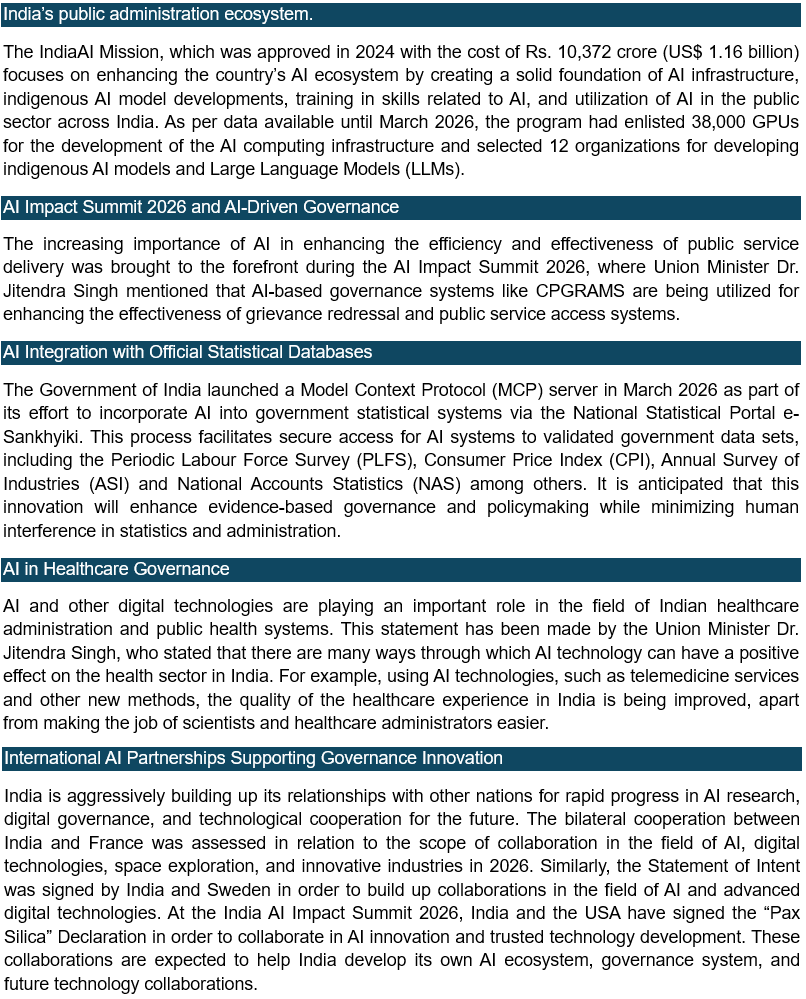
Artificial Intelligence (AI) is transforming governance and public administration in India by improving efficiency, enhancing transparency and enabling citizen-centric public service delivery. The increase in digitization, creation of digital infrastructure, and deployment of AI technology has allowed for various applications of AI in different sectors including healthcare, agriculture, collection of taxes, public safety, and grievance redressal. There are various government projects, including initiatives like Aadhaar, Unified Payment Interface (UPI), DigiLocker, and CPGRAMS which have been leveraging the power of AI enabled applications to improve administrative efficiency and delivery of public services. Various missions like IndiaAI Mission and Digital India along with smart governance projects have been increasingly creating AI ecosystem within India. According to the budget for 2026-27, there was a provision of Rs. 1,000 crore (US$ 111 million) for the IndiaAI mission to develop required AI Infrastructure and computational power in India.
Expansion of AI in Public Administration
Governments are using AI-powered solutions to enhance the administrative process by making it efficient and more transparent. For example, AI-powered platforms like CPGRAMS have been used to make the grievance redressal process more efficient and effective. AI analytics tools are being used for identifying fraud cases, detecting tax evasion, and conducting digital verification processes. In 2026, the Government of India introduced a Model Context Protocol (MCP) server that allows the integration of AI-powered tools with official statistics datasets such as Periodic Labour Force Survey (PLFS), Consumer Price Index (CPI) and National Accounts Statistics (NAS).
The Union Budget of 2026-27 allocated Rs. 1,000 crore (US$ 111 million) to the IndiaAI Mission to bolster India’s AI infrastructure, computing power, and AI governance initiatives. The government is also supporting AI data centers and cloud infrastructure for enhancing India’s digital governance landscape and AI innovation initiatives.
Government Initiatives Supporting AI-Led Governance
Government initiatives and policy frameworks are playing a major role in accelerating AI adoption across
AI Applications Across Governance Sectors
- Healthcare and Public Health: AI-assisted systems have contributed to advancements in diagnostic technology, telemedicine facilities, radiology interpretation, and healthcare analytics. According to Union Minister Dr. Jitendra Singh, AI and digital technologies have enhanced the efficiency and effectiveness of the entire health system of India.
- Agri-Rural Development: With the help of AI-driven advisory systems, farmers have been able to make plans regarding agriculture as these advisory systems help farmers monitor their crops, predict weather changes, control pests and practice precision farming.
- Taxation and Fiscal Management: There has been enhancement in fraud detection and compliance monitoring through AI-driven analytics.
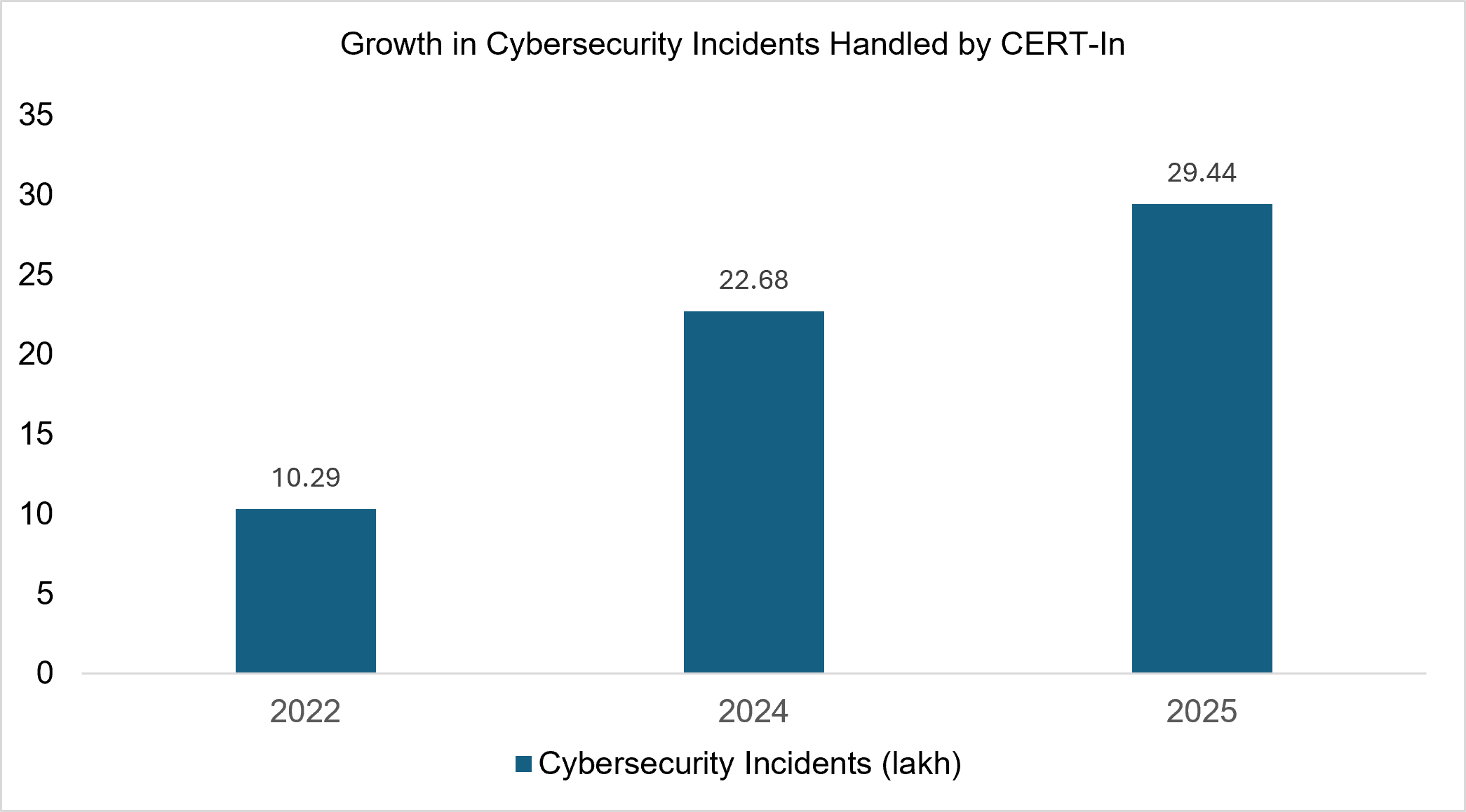
- Security and Law Enforcement: With the use of AI-powered surveillance and cybersecurity systems, there has been improvement in threat detection. As per CERT-In, there were 29.44 lakh cyber incidents in India in 2025.
- Citizen Services and Governance: There have been many initiatives such as the launching of CPGRAMS and e-Sankhyiki portals in March 2026.
Source: PIB
Growth Drivers and Key Trends
Outlook and Road Ahead
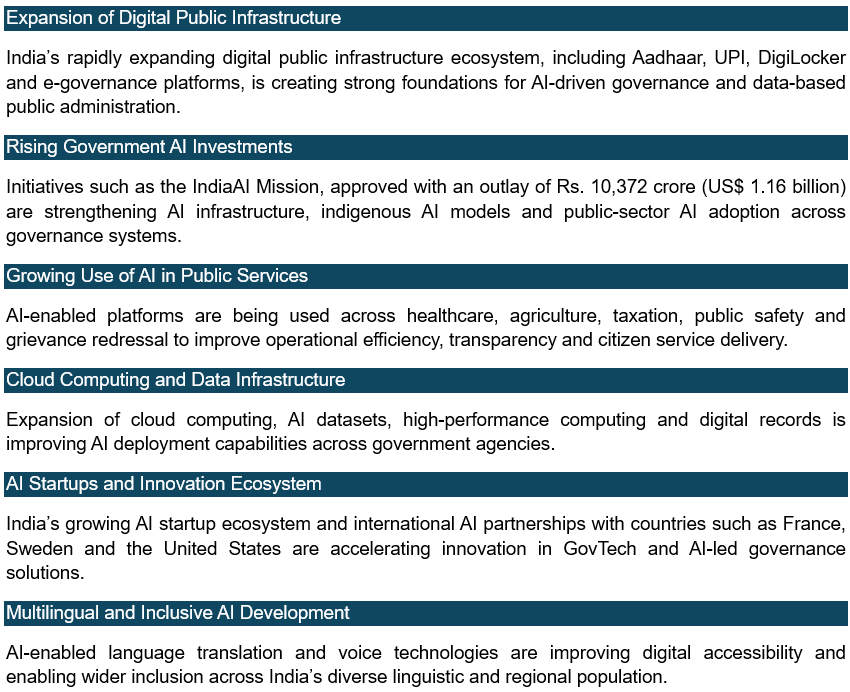
The development of AI in governance will be a significant trend in the future because it will ensure efficient administration and service delivery that is based on citizens' needs. The integration of AI with governance systems is expected to increase the importance of public databases and digital infrastructure in evidence-based policymaking. The use of AI in the automation of processes, availability of digital assistants in multiple languages, and predictive analysis will help eliminate inefficiencies, improve grievances redressing and access to government services in both urban and rural parts of the country. Attention paid to responsible AI, cybersecurity and data protection policies will ensure greater public trust and adoption of AI systems across all levels of government administration. India’s thriving AI startup scene, well-developed IT infrastructure, and cooperation with other countries in areas of new technologies will put the nation at the forefront of AI governance.
FAQs
What is AI-led governance?
AI-based governance means the employment of AI systems such as automation, machine learning, and data analysis to enhance the efficiency and effectiveness of public administration.
How is AI being used in public administration in India?
AI plays a part in areas such as healthcare, farming, tax collection, law enforcement, urban administration, and citizen services.
What is the IndiaAI Mission?
IndiaAI Mission is a government-sponsored scheme that was approved in 2024, with a budget allocation of Rs. 10,372 crore (US$ 1.16 billion), to build capacity in AI.
What are the benefits of AI-led governance?
AI may boost the efficiency of administration, lower manual work, increase transparency, promote effective implementation of policies, and ensure better citizen services.
What are the challenges associated with AI in governance?
Difficulties such as data protection issues, security issues, bias issues, digital discrimination, and regulatory challenges still pose big problems to AI-enabled governance.
Partners