SEARCH
RECENT POSTS
Categories
- Agriculture (39)
- Automobiles (21)
- Banking and Financial services (36)
- Consumer Markets (57)
- Defence (6)
- Ecommerce (21)
- Economy (72)
- Education (14)
- Engineering (9)
- Exports (22)
- Healthcare (25)
- India Inc. (10)
- Infrastructure (31)
- Manufacturing (33)
- Media and Entertainment (17)
- Micro, Small & Medium Enterprises (MSMEs) (16)
- Miscellaneous (31)
- Perspectives from India (37)
- Pharmaceuticals (5)
- Railways (5)
- Real Estate (20)
- Renewable Energy (19)
- Research and Development (12)
- Retail (1)
- Services (7)
- Startups (16)
- Technology (66)
- Textiles (8)
- Tourism (16)
- Trade (9)
Authors






Battery Recycling in India: Building a Circular Supply Chain
- Mar 09, 2026, 17:10
- Technology
- IBEF
India’s accelerated transition toward electrification and renewable energy integration has catalysed a structural surge in battery deployment, particularly lithium-ion cells used across electric vehicles (EVs) powertrains, battery energy storage systems (BESS), telecom towers, and consumer electronics. The rising scale of battery consumption has elevated end-of-life (EoL) battery management into a strategic national priority, both for environmental risk mitigation and domestic critical mineral security. India is shifting from a linear consumption model toward a circular battery value chain that embeds structured collection, recycling, refurbishment, and material reintegration to retain economic value and build supply resilience.
The Battery Landscape in India
India’s battery circularity framework is governed by the Battery Waste Management Rules (BWMR), 2022, notified by the Ministry of Environment, Forest and Climate Change, based on Extended Producer Responsibility (EPR). The rules mandate registration of producers, importers, refurbishers, and recyclers on the Central Pollution Control Board (CPCB) managed EPR portal, enforce annual collection and recycling or refurbishment targets, and introduce digital traceability mechanisms such as barcodes and QR codes on battery packs and packaging. As of December 2025, the portal includes 4,022 registered producers and 487 registered recyclers, with 58.26 lakh tonnes of battery waste processed through formal recycling pathways, signalling rapid ecosystem formalisation. Indigenous lithium-ion recycling technology developed by the Centre for Materials for Electronics Technology (C-MET) is being transferred to industry under Mission LiFE to support MSME recycler clusters and strengthen domestic recycling capacity. India’s policy approach explicitly includes formalising the informal recycling sector and scaling compliant recycling infrastructure through coordinated engagement with research institutions, CSIR labs, and industry stakeholders.
Market outlook: past, present, and future
According to study by the India Cellular and Electronics Association (ICEA) and Accenture, India currently recycles only around 1% of its end-of-life lithium-ion batteries into reusable materials; however, with effective policy interventions, the country could develop a lithium-ion battery recycling industry worth approximately Rs. 31,150 crore (US$ 3.50 billion) by 2030. Market expansion is driven by the steady rise in spent batteries from EVs and BESS deployments, stricter enforcement of EPR compliance, supply risks linked to import dependence for lithium, cobalt, and nickel, and improving maturity of hydrometallurgical and direct recycling technologies.
The recycling ecosystem is evolving with investments in scalable, modular recycling lines, improved black-mass processing capabilities, and rising interest from producers to meet future domestic recycled-content obligations. Recycling is increasingly viewed as a strategic lever to hedge raw material volatility, reduce supply bottlenecks, and localise feedstock for cell manufacturers. The expanding pipeline of EV and stationary storage batteries is expected to drive multi-chemistry recycling capacity growth, with higher policy emphasis on lithium-ion and e-waste linked mineral streams.
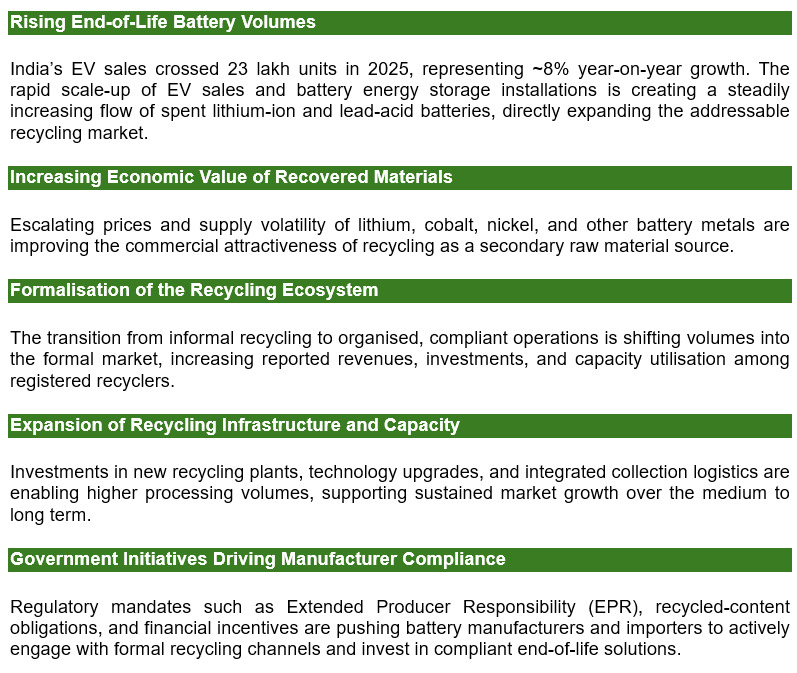
Key growth drivers
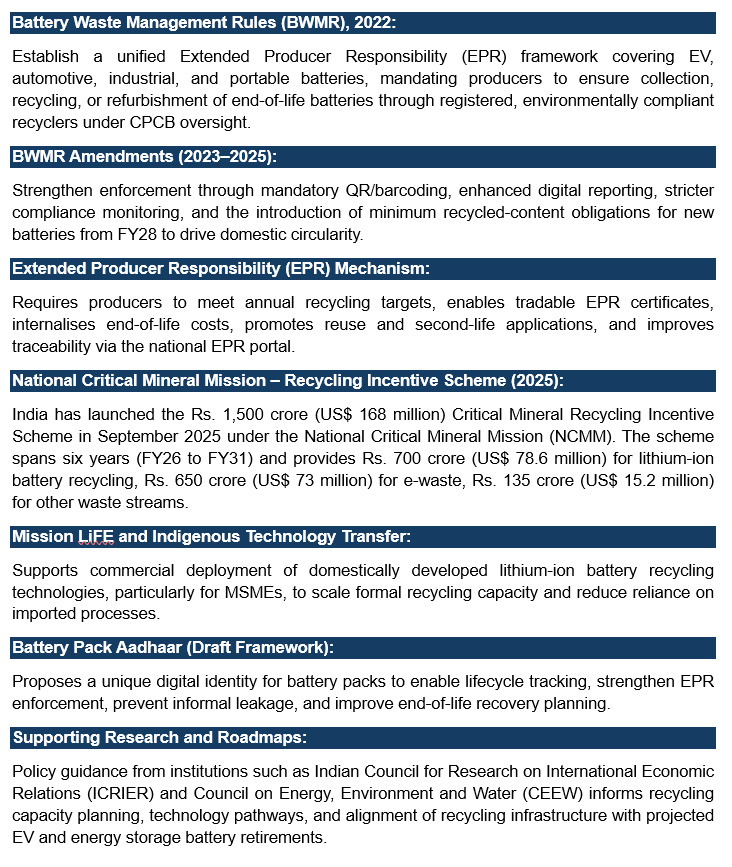
Policy and Regulatory Framework for Battery Recycling in India:
India’s battery recycling ecosystem is driven by integrated regulations and incentives that enforce circularity, improve traceability, and strengthen domestic critical mineral recovery as follows:
The Road Ahead
Battery recycling presents India with a strategic opportunity to secure critical raw materials, reduce environmental impact, and strengthen energy security. By embedding circular economy principles across the battery value chain, from design and deployment to reuse, repurposing, and recycling, India can build a resilient ecosystem that supports electrification, renewable energy integration, and industrial growth.
With strong policy backing, targeted Capex and Opex incentives, and coordinated stakeholder engagement, battery recycling is transitioning from a nascent activity to a core pillar of India’s energy and industrial strategy. As recycled-content mandates begin to take effect from FY28 and volumes of battery energy storage systems reach end of life, the sector is expected to scale rapidly, reinforcing critical mineral localisation, supply chain security, green job creation, and India’s position in the global sustainable technology landscape.
FAQs
What is driving the growth of battery recycling in India?
Rising electric vehicle adoption, increasing end-of-life batteries, and higher demand for recovered critical minerals.
How large is the battery recycling opportunity in India?
With supportive policies, lithium-ion battery recycling could reach approximately Rs. 31,150 crore (US$ 3.5 billion) by 2030.
What is the significance of the Battery Waste Management Rules, 2022?
They establish Extended Producer Responsibility and mandate formal recycling through CPCB-registered entities.
How is the government promoting battery recycling?
Through EPR enforcement, recycled-content mandates, and a Rs. 1,500 crore critical mineral recycling incentive scheme.
What is the future outlook for battery recycling in India?
The sector is expected to scale rapidly post-2027, driven by policy mandates, EV growth, and battery storage retirements.
Partners




