SEARCH
RECENT POSTS
Categories
- Agriculture (37)
- Automobiles (20)
- Banking and Financial services (35)
- Consumer Markets (57)
- Defence (6)
- Ecommerce (21)
- Economy (72)
- Education (14)
- Engineering (8)
- Exports (21)
- Healthcare (25)
- India Inc. (10)
- Infrastructure (31)
- Manufacturing (32)
- Media and Entertainment (16)
- Micro, Small & Medium Enterprises (MSMEs) (16)
- Miscellaneous (31)
- Perspectives from India (37)
- Pharmaceuticals (5)
- Railways (4)
- Real Estate (20)
- Renewable Energy (19)
- Research and Development (12)
- Retail (1)
- Services (7)
- Startups (16)
- Technology (66)
- Textiles (8)
- Tourism (16)
- Trade (8)
Authors






India’s Software-Defined Vehicle Industry: The Hidden Layer Driving E-Mobility Growth
- Apr 15, 2026, 11:00
- Technology
- IBEF
Growth in electric vehicle across India is often considered through various factors such as growth in vehicle purchases, wider availability of charging points, battery manufacturing within India, followed by support from government and state programs. Beneath such physical advancement hides a transformational layer which is software. The arrival of Software Defined Vehicles (SDVs) a major shift in automotive engineering-where what a car can do, how it performs, and how users experience it increasingly are made to be steered by software rather than fixed hardware.
This is more than a technological shift which reinvents the automotive value chain. Instead of hardware alone, intelligence embedded in coding now sets vehicle models apart, fuels income across time, shapes user attachment. Where cost matters greatly, digital tools spread swiftly and electric transitions accelerate hence India sees software-driven vehicles emerge as essential enablers of smart, growing transport systems. With more people choosing electric vehicle, the backbone of computing design, linked functions, information flow, remote upgrades gains deeper importance, turning automobiles into evolving digital entities instead of static objects. Far beneath visibility, coded logic acts as the unseen core advancing India’s future motion in mobility.
Strategic Importance for India’s Automotive Ecosystem
Software Defined Vehicles (SDVs) represent an important role automotive value chain. Vehicles are no longer fixed finished products but rather living digital platforms that can be continuously improved via software updates. With Over-The-Air (OTA) systems, manufacturers are able to implement improvements remotely by tuning performance and adding new features that sharpen user experiences-all without requiring vehicle owners to visit a dealership.
From the perspective of India’s national context, SDVs align well with some of the longer-term industrial objectives. Software-driven vehicle architectures allow domestic players to expand their capabilities in system integration, platform development, and digital services-areas that can further anchor India’s role in global automotive value creation. A strong track record of India being a reliable manufacturing center, backed by deep supplier networks, proven engineering talent, and cost competitiveness, provides a good base for growing software-defined mobility. Electric vehicles inherently require more sophisticated software-from battery management and energy optimization to regenerative braking control and charging optimization.
In India’s context, this convergence is particularly significant for three reasons:
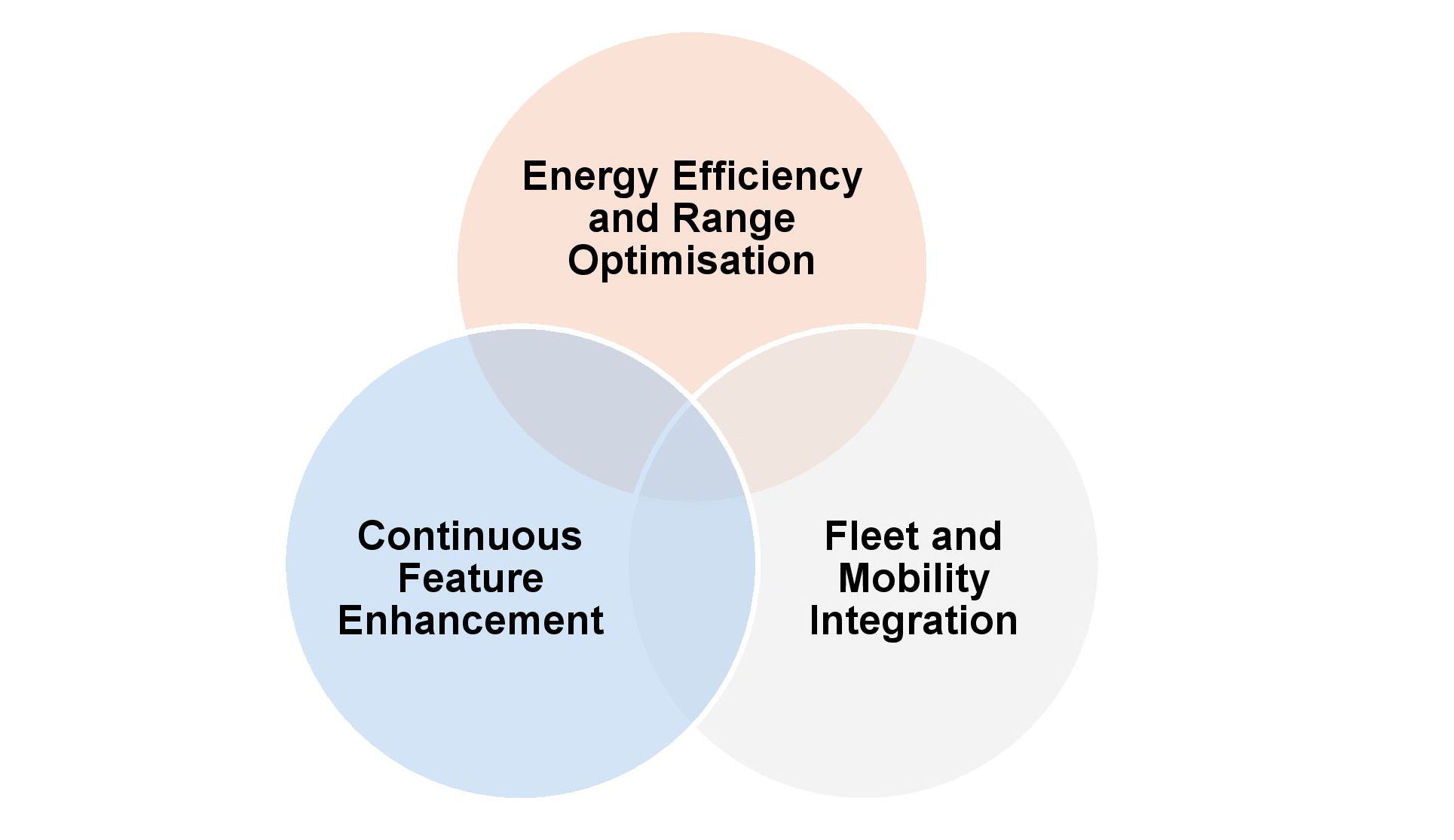
1. Energy Efficiency and Range Optimisation
Software algorithms play important roles for how the battery functions, for how its temperature is kept under control, and for how its usage is predicted. With software algorithms, it becomes possible for the original equipment manufacturers to enhance the battery without necessarily making adjustments to their hardware, which is advantageous, especially where cost is a concern.
2. Continuous Feature Enhancement
Indian consumers expect a digital experience comparable to that of any smartphone. Software Defined Vehicles (SDVs) allow manufacturers to introduce new features even after purchase, improving driver assist, infotainment, and performance with Over-The-Air (OTA) updates.
3. Fleet and Mobility Integration
Real-time diagnostics of vehicles, predictive maintenance, and remote management of fleets are game-changers for commercial EV fleets, ride-hailing services, and logistics operators. All these capabilities will collapse without software-defined architectures that can orchestrate and optimize in flight.
Industry Overview
India has a growing automobile industry, and the footprint for electric vehicles continues to expand. In fact, India’s electric vehicle market has recorded an massive sale of over 2.3 million units in the year 2025 alone; this is in addition to an achievement of around 8% of total new vehicle registration in the same year. By January 2026, the electric passenger vehicle market recorded an increased sale of 51% over the previous year, of which Tata Motors dominated the market with a commanding lead of around 43.5%.
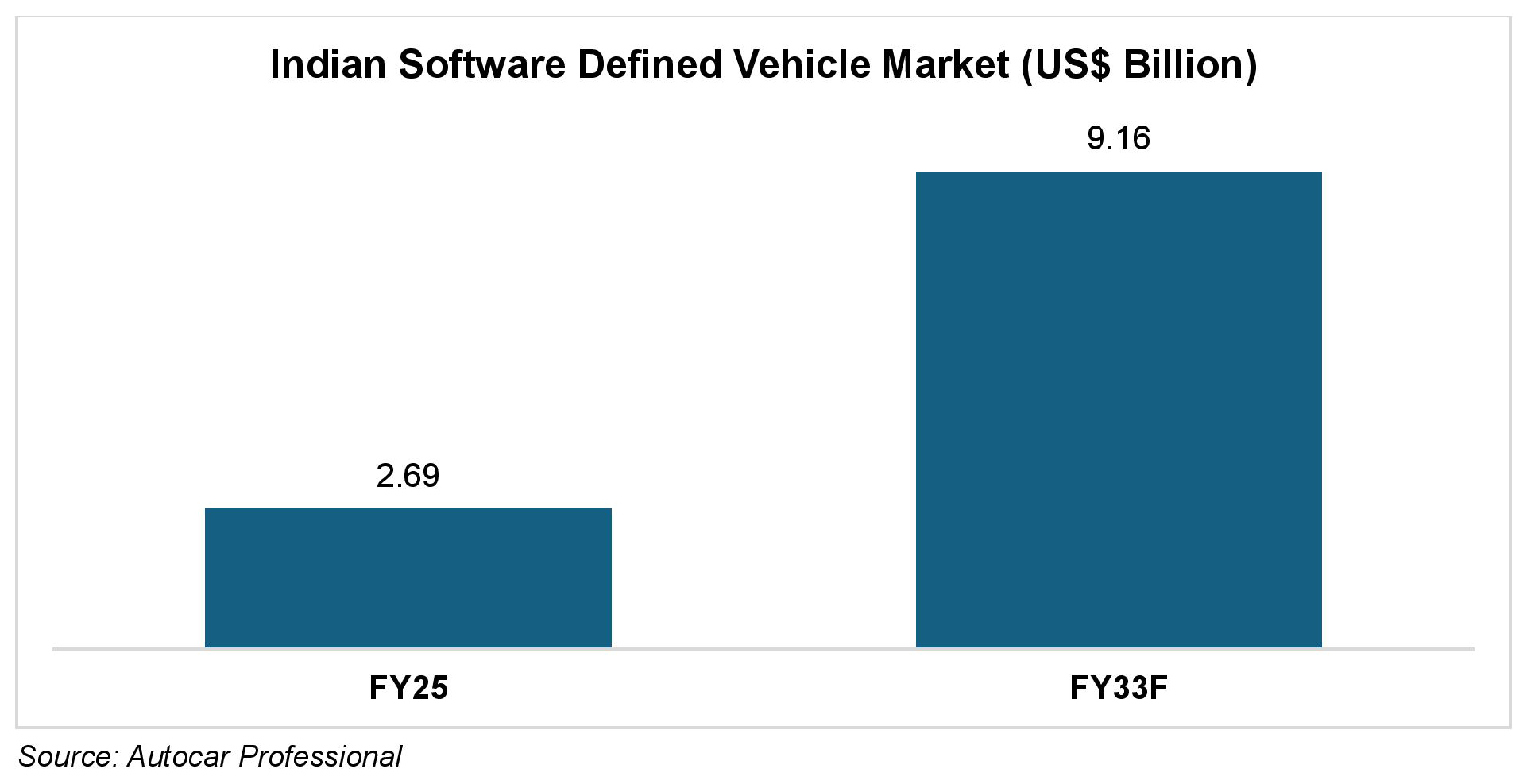
Autocar Professional estimates that the Indian SDV market is expected to grow at a compound annual rate of 16.56% between FY26 and FY33, increasing from Rs. 23,941 crore (US$ 2.69 billion) in FY25 to Rs. 81,524 crore (US$ 9.16 billion) in FY33. This expected expansion is because increased software and electronics are becoming embedded in cars, which are expected to control aspects of vehicles, including performance, safety, and convenience.
Currently, passenger cars constitute the largest segment of SDV uptake in the country. At the same time, the use of SDVs is increasingly being felt in commercial vehicles.
Government Initiatives and Policy Support
The government policies, in fact, have been moving India quietly into software-based mobility and electric vehicles. It has been further investing in automotive production and parts locally through Production Linked Incentive Schemes.
An important growth facilitator for the Software-Defined Vehicles (SDVs) domain is the National Semiconductor Mission, whose plan is to infuse as much as US$ 9.2 billion (Rs. 81,880 crore) into the nation’s semiconductor sector by 2029, including both semiconductor design and semiconductor manufacturing. As SDVs depends heavily on high-powered computing and chip technology, this additional growth accelerator for the domain is expected to support further growth in the domain.
Programs like Faster Adoption & Manufacture of Hybrid & Electric Vehicles (FAME) have motivated carmakers to launch EVs with software capabilities. The National Automotive Policy, as well as the Automotive Mission Plan 2026, lay emphasis on growth, skill development and R&D. Moreover, programs under the National Electric Mobility Mission Plan (NEMMP) are developing infrastructure for charging points as well as batteries, thus supporting the adoption of EVs.
Growth Drivers and Key Trends of SDV Ecosystem
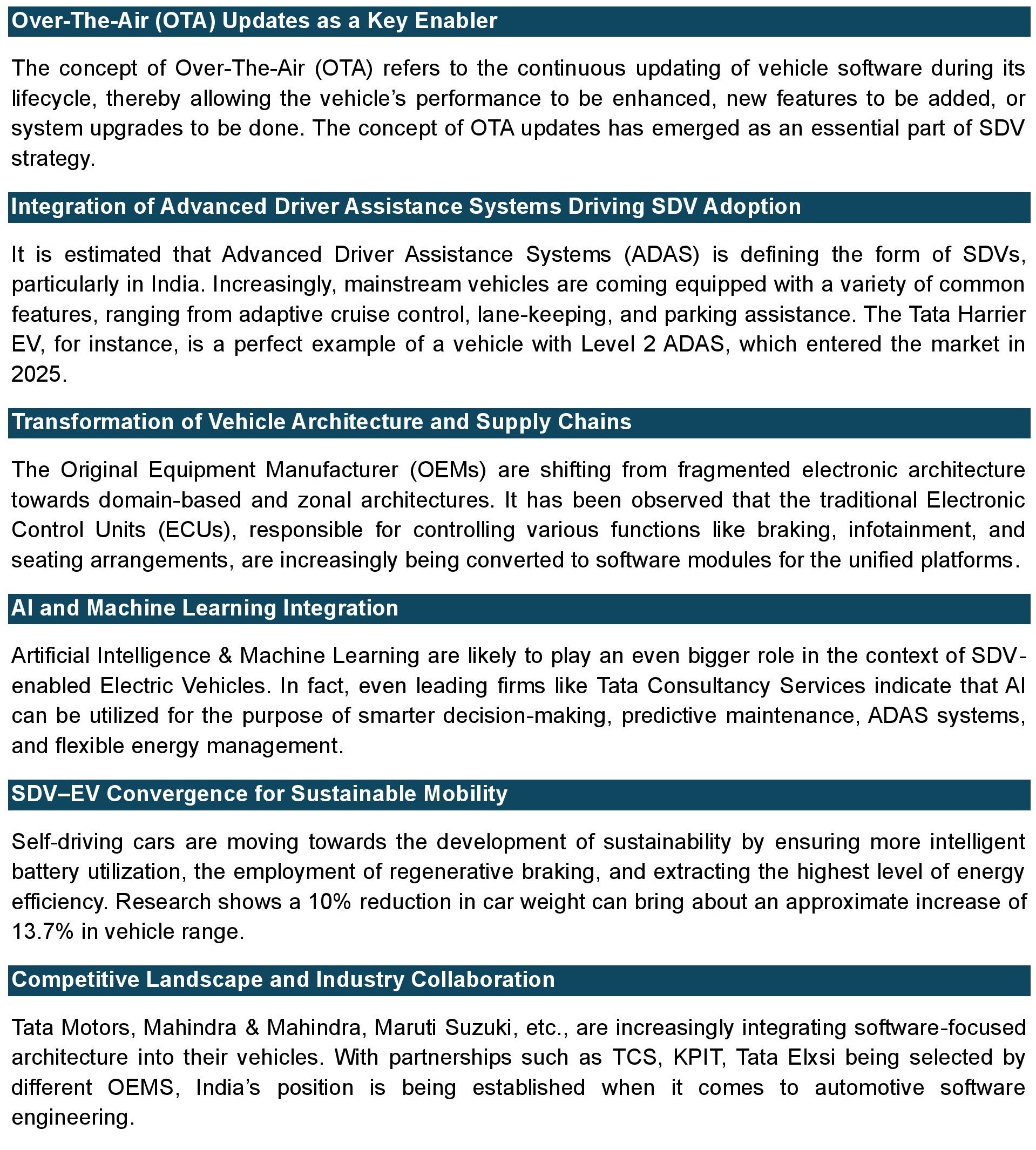
Some of the significant growth drivers and technological trends, which are currently supporting the growth of SDVs in India, are briefly outlined below:
The Road Ahead
Software will increasingly influence the way vehicles perform and are valued in the future. Although the focus is currently on electrification, software is becoming the invisible engine of long-term value creation. Software-defined vehicles are not just an automotive industry trend; they are the fusion of the worlds of mobility, computing, and digital services. OEMs are moving from being automotive manufacturers to becoming software platform managers, with competition being driven by their capabilities in software, partnerships, and data intelligence. For India, the SDV revolution provides an opportunity to break away from being just an automotive manufacturing powerhouse to becoming technology leaders in global mobility. The future of mobility in India will not be defined by batteries or motors, but by code, connectivity, and continuous innovation within the vehicle itself.
FAQs
What is a Software-Defined Vehicle (SDV)?
A Software-Defined Vehicle uses software to control and upgrade key vehicle functions, allowing features and performance to improve through over-the-air updates without hardware changes.
Why are SDVs important for India’s electric mobility growth?
SDVs improve battery management, energy efficiency, and vehicle diagnostics, helping enhance EV performance, reliability, and user experience.
How large is India’s software-defined vehicle market expected to become?
According to Autocar Professional, India’s SDVs market is expected to grow at a compound annual growth rate of 16.56% during FY26–FY33, increasing from Rs. 23,941 crore (US$ 2.69 billion) in FY2025 to Rs. 81524 crore (US$ 9.16 billion) by FY33.
How are SDVs changing automakers’ revenue models?
SDVs enable automakers to generate revenue through software upgrades, connected services, and feature-based subscriptions over the vehicle lifecycle.
How is India’s National Semiconductor Mission supporting the growth of Software-Defined Vehicles (SDVs)?
A key support for Software-Defined Vehicle (SDV) growth is the National Semiconductor Mission, which has allocated around US$ 9.2 billion (Rs. 81,880 crore) by 2029 to build semiconductor manufacturing and design capabilities in India.
Partners