SEARCH
RECENT POSTS
Categories
- Agriculture (39)
- Automobiles (21)
- Banking and Financial services (36)
- Consumer Markets (58)
- Defence (6)
- Ecommerce (21)
- Economy (72)
- Education (14)
- Engineering (9)
- Exports (22)
- Healthcare (25)
- India Inc. (10)
- Infrastructure (31)
- Manufacturing (33)
- Media and Entertainment (17)
- Micro, Small & Medium Enterprises (MSMEs) (16)
- Miscellaneous (31)
- Perspectives from India (37)
- Pharmaceuticals (5)
- Railways (5)
- Real Estate (20)
- Renewable Energy (19)
- Research and Development (12)
- Retail (1)
- Services (8)
- Startups (16)
- Technology (66)
- Textiles (8)
- Tourism (16)
- Trade (9)
Authors






Consumer Market in India Opportunities for Domestic and Global Brands
- Sep 09, 2026, 15:50
- Consumer Markets
- IBEF
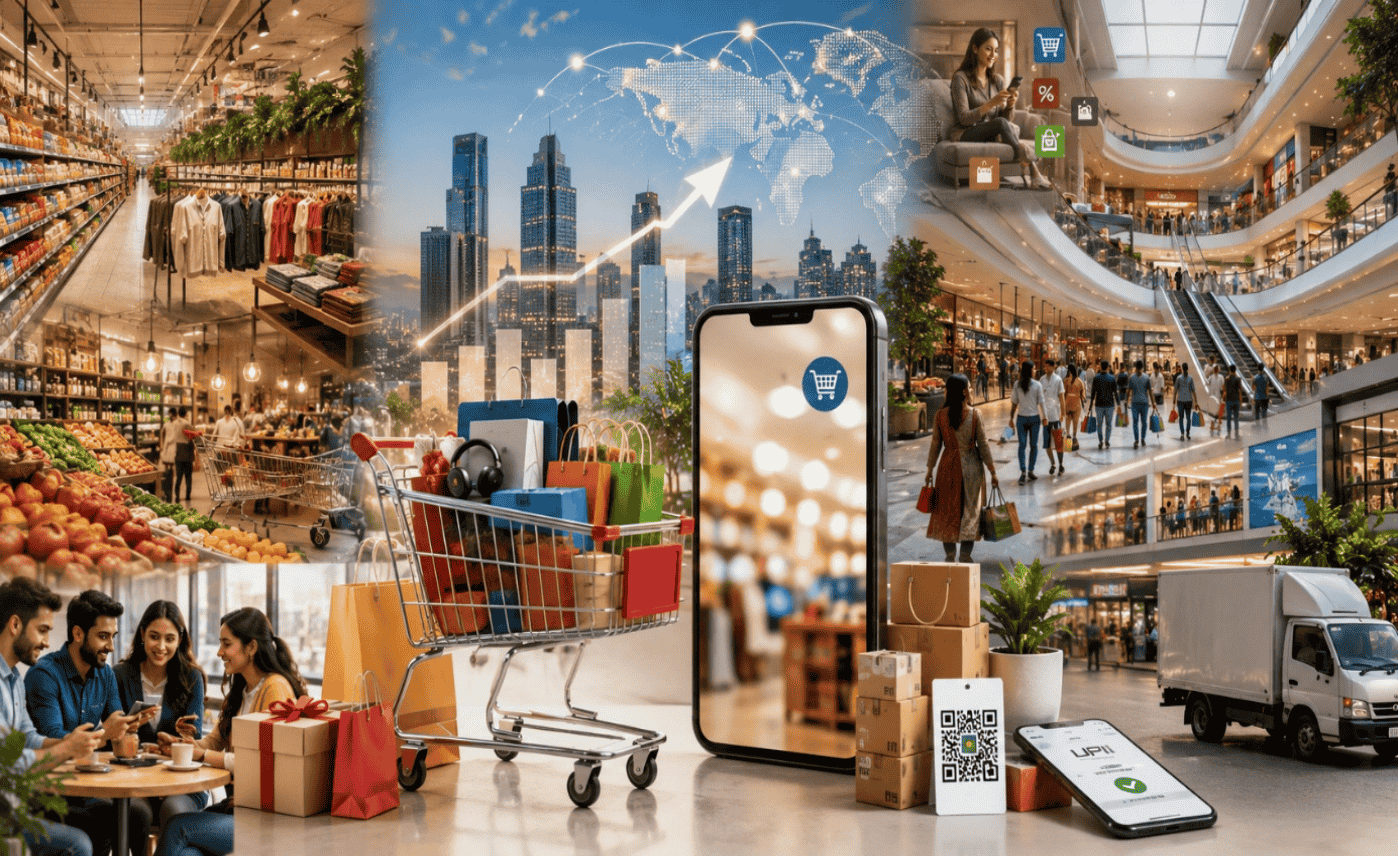
India has been transformed into one of the world's leading consumer markets due to favorable conditions including high rates of economic growth, positive demographic changes, rising levels of disposable income and digital transformation. Changing consumer aspirations, developing organized retail market and growing use of digital technologies lead to changes in the patterns of consumers' behavior both in cities and countryside. These structural transformations are creating new possibilities for businesses in terms of innovations, expansion and development of their market positions. Rising domestic brands and foreign firms' investments make India's consumption-driven economy an important factor of business success and investment opportunity. The paper will review the most significant trends, growth factors and opportunities in the consumer market of India.
India's Consumer Market: Size, Growth and Investment Potential
India has become one of the most dynamic consumer markets in the world thanks to its economic growth, favorable demographic structure, growing levels of disposable income and rapid digital transformation. Population of more than 1.48 billion people with median age of about 28 years makes India's consumer base one of the youngest in the world, which creates demand for essential and discretionary goods continuously. Private consumption remains the backbone of India's economy and the level of Private Final Consumption Expenditure (PFCE) amounted to Rs. 219.6 lakh crore (US$ 2.49 trillion) in FY26 (First Advance Estimates), which accounted for 61.5% of GDP. According to the Economic Survey 2025-26, the level of PFCE is expected to grow up by 7.0% in FY26 because of falling inflation, improved situation with rural demand, steady employment and higher household incomes. These factors keep India as one of the most dynamically growing consumption-driven economies in the world.
The Indian retail sector is rapidly changing driven by rising consumer spending, technological advancements and evolving consumer preferences. It remains one of the world's fastest-growing consumer markets due to organized retail, e-commerce, quick commerce and D2C business models. The Indian e-retail market size grew to US$ 75–85 billion in 2025 and is expected to grow to US$ 170-190 billion by 2030 due to rising internet usage, digital payments, omnichannel retail and the fast growth of quick commerce in major cities, Tier II and Tier III cities. Personalization powered by AI, experience-based store design and online-to-offline approaches are becoming widely adopted by retailers to satisfy changed expectations of consumers.
As a result of India's large consumer base and developed retail infrastructure, India remains attractive for the retail investments of local and foreign players. As per CBRE, retail leasing in the country's major cities grew to 8.9 million sq. ft. in 2025, due to strong expansion of fashion, food & beverage and D2C brands. Meanwhile, as per JLL estimates, approximately 46.1 million sq. ft. of organised retail space will be delivered by 2030. In addition, according to Department for Promotion of Industry and Internal Trade (DPIIT), the cumulative FDI inflows into retail trading have stood at Rs. 36,740.24 crore (US$ 5.03 billion) during April 2000 to March 2026. Initiatives like Digital India, Startup India, Open Network for Digital Commerce (ONDC) and 100% FDI under automatic route in single-brand retail trading are making India's retail landscape stronger with the help of which local and international brands can grow in both physical and digital realms.
Changing Consumer Behaviour and Emerging Market Trends
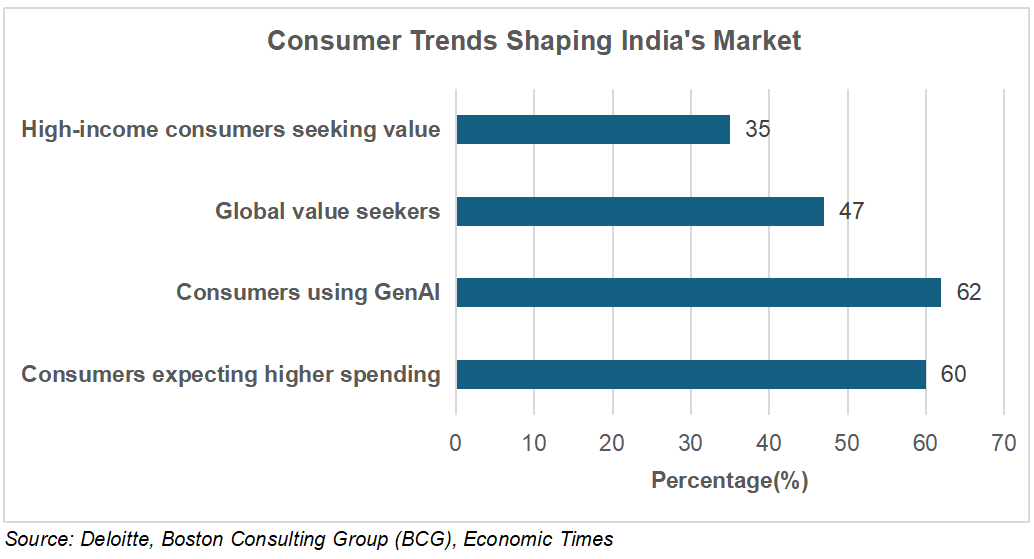
The consumer scenario of India is changing very fast, and this is mainly due to change in lifestyle of people, digitalization and rising demand of value, premium and convenience. Customers today are looking for quality products along with innovations and sustainability instead of low prices. As per the Deloitte's Consumer Products Industry Outlook 2026, 47% of consumers are identified as value seekers whereas 35% of high-income families look for better value for money. It clearly shows that the customers prefer brands that offer them higher quality products and differentiated offerings.
The consumer confidence in India is amongst the highest in the world. As per BCG Global Consumer Radar Report 2026, India has been found to be the most optimistic consumer market in the world where 60% of the consumers expect to spend more in the coming six months. The survey also revealed that 62% of the consumers use GenAI tools regularly in their life, with 64% relying on them for brand and product decisions.
Purchases are being influenced by the digital medium nowadays. As per the State of the Consumer Report of 2025 released by McKinsey, around half of the respondents of the survey in India look for product information online through social media prior to making purchases. According to the Kantar BrandZ India Report 2025, brands built on meaningful differentiation, consumer trust and superior customer experience are more likely to achieve sustained growth. The report notes that brands improving both relevance and differentiation have delivered 36% higher brand value growth.
Opportunities for Domestic and Global Brands
The growing consumer market in India offers substantial benefits for domestic firms and multinational corporations. According to Bain & Company and DSG Consumer Partners' Game Changers 2026: India Insurgent Brand Report, insurgency brands of India's consumer sector made Rs. 66,277.50 crore (US$ 7.5 billion) in FY25, which was 3.75 times higher compared to FY20. Such brands grew 1.5 to 5 times faster than the categories they operate within due to innovations in the products they offer, a digital-first model of doing business and the capability to respond to changing demands of consumers. Furthermore, the number of the companies that met the criteria for Insurgex Index has risen to 39 in FY25.
In addition, the growing strength of brands from the domestic market can be noticed through the figures provided in the report by Kantar, named BrandZ India 2025. According to that report, the combined value of India's Top 100 brands amounts to Rs. 46.37 lakh crore (US$ 524 billion), which equals roughly 13% of GDP. The inclusion of 18 new brands in the top proves that Indian brands have vast opportunities to expand within the consumer industry.
India remains one of the most promising growth markets for international brands. According to Deloitte's Consumer Products Industry Outlook 2026, seven out of ten leaders of the consumer products industry believe that growth would be achieved in regions other than their usual geographical location. India and Southeast Asia were mentioned as among the top choices to invest into.
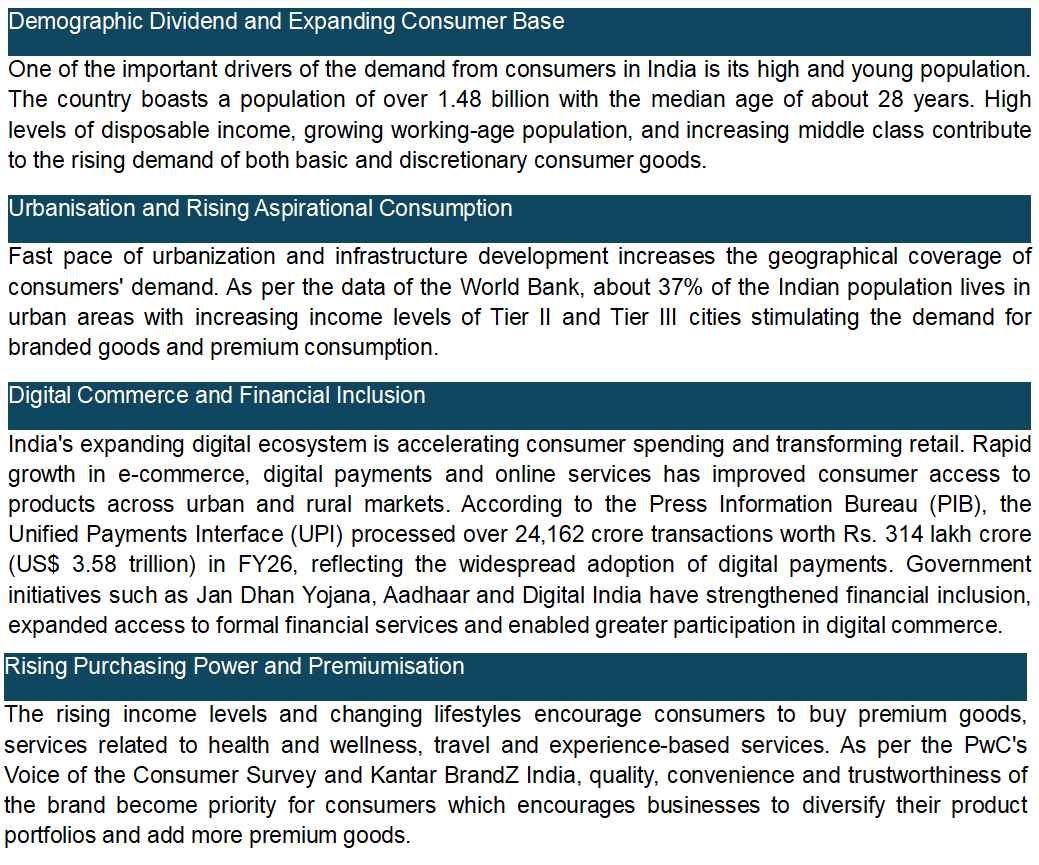
Key Growth Drivers of India's Consumer Market
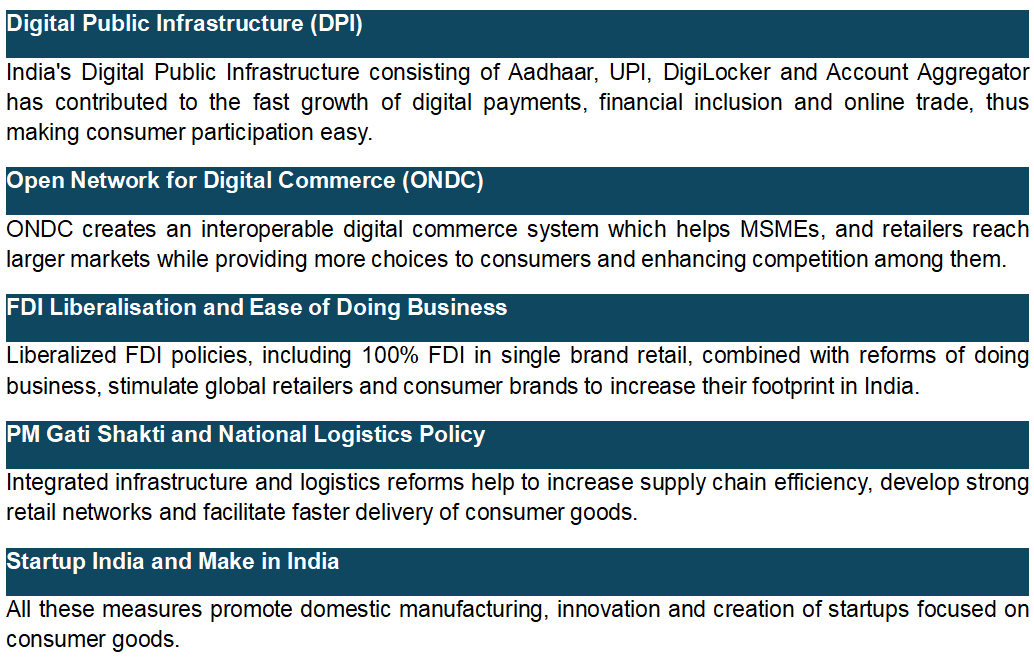
Government Initiatives Enabling Consumer Market Growth
The following government initiatives are strengthening India's consumer market by improving digital access, market connectivity and the overall business ecosystem:
Outlook and Road Ahead
The Indian consumer market is poised to stay among the most rapidly growing in the world thanks to robust internal demand, demographic conditions and continued policy support. According to the IBEF report, India's retail market is estimated to grow to over Rs. 226 lakh crore (US$ 2.36 trillion) by 2030, which shows the enormous consumption capacity of the country. Investments into digital capabilities, logistics and modernization of the retail segment, as well as projects like Digital India, ONDC, PM Gatishakti and 'Make in India', have been contributing to creating an entrepreneurial environment. With consumption trends evolving, India presents substantial possibilities for domestic and foreign businesses to innovate and develop sustainably.
FAQs
Why is India considered one of the world's fastest-growing consumer markets?
India's consumer market is driven by favourable demographics, rising incomes, rapid urbanisation, digital adoption and strong domestic demand, making it an attractive destination for businesses and investors.
What are the major trends shaping consumer behaviour in India?
Indian consumers are increasingly seeking value, premium products and digital-first shopping experiences, with AI, omnichannel retail and sustainability influencing purchasing decisions.
What opportunities does India offer to domestic and global brands?
India offers significant opportunities through its expanding middle class, growing digital economy, organised retail and supportive policy environment, enabling brands to scale and expand their market presence.
Which government initiatives are supporting the growth of India's consumer market?
The government initiatives such as Digital India, ONDC, PM Gati Shakti, Make in India and liberalised FDI policies are strengthening digital commerce, logistics and investment.
What is the future outlook for India's consumer market?
India's consumer market is expected to remain a major global growth destination for domestic and international brands supported by strong domestic demand, digital transformation and policy reforms.
Partners