SEARCH
RECENT POSTS
Categories
- Agriculture (39)
- Automobiles (20)
- Banking and Financial services (36)
- Consumer Markets (57)
- Defence (6)
- Ecommerce (21)
- Economy (72)
- Education (14)
- Engineering (9)
- Exports (22)
- Healthcare (25)
- India Inc. (10)
- Infrastructure (31)
- Manufacturing (33)
- Media and Entertainment (17)
- Micro, Small & Medium Enterprises (MSMEs) (16)
- Miscellaneous (31)
- Perspectives from India (37)
- Pharmaceuticals (5)
- Railways (4)
- Real Estate (20)
- Renewable Energy (19)
- Research and Development (12)
- Retail (1)
- Services (7)
- Startups (16)
- Technology (66)
- Textiles (8)
- Tourism (16)
- Trade (9)
Authors






How Consumer Buying Behaviour Is Shaping E-commerce in India

- Apr 13, 2026, 16:30
- Consumer Markets
- IBEF
Indian e-commerce over the last decade has taken the path of being proportionate to the development of digital media, but the current expansion of the industry is more aligned toward the behaviour of consumers as they are represented on the internet. Booming sales of smartphones and the subsequent development of the uptake of online payment services have transformed the Indian online consumer base as making it the largest contributor to the global market. The E-commerce industry Gross Merchandise Value (GMV) is estimated to be about Rs. 5.34 lakh crore (US$ 60 billion), but double-digit growth is expected as more consumers turn toward buying online.
The Change that is seen with this growth is the consumer of the online market, with the early adopters being from the metros, whereas today the market is witnessing an increased demand from Tier-2 and Tier-3 towns as the internet penetration is improving there. As Internet and Mobile Association of India (IAMAI’s) report on Internet in India states, there are around 958 million active internet users, with the rural markets contributing 57%. This has led to a dramatic shift in the manner of purchase as the new category of online shoppers entering the realm of online commerce often prefers affordability over brand names, while the trend towards the familiar nature of the internet as a means of purchase is further increasing the number of purchases per user as a whole with the increasing demand for groceries and other day-to-day items.
Market Expansion and the Changing Profile of the Indian Online Consumer
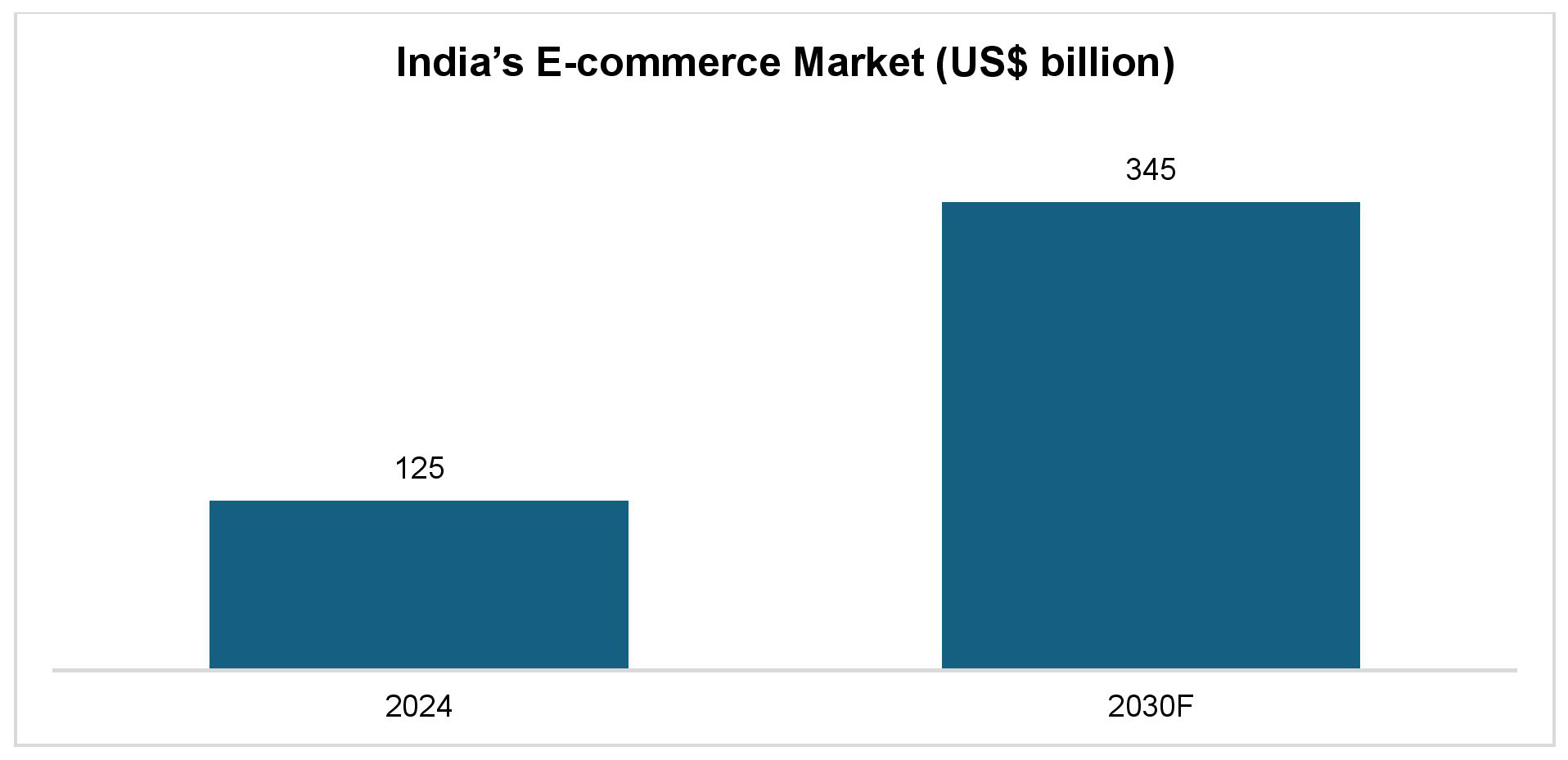
India is swiftly turning out to be a hub for e-commerce transactions due to its promising digital customer pool. As per industry estimates, India’s e-commerce industry currently stands at Rs. 11.12 lakh crore (US$ 125 billion) and is expected to grow to Rs. 30.70 lakh crore (US$ 345 billion) by 2030 at a growth rate of 15%. As for future prospects, reports indicate that India’s e-commerce industry may reach Rs. 48.95 lakh crore (US$ 550 billion) by 2035. However, these are general estimates and may differ with respect to e-retail GMV or other e-commerce revenue that incorporates services and multiple product categories.
One of the major behavioural changes in this momentum is the shift in the source of online shoppers. Since 2020, approximately 60% of new online shoppers have originated in smaller cities. Traditionally, growth was driven by big-city online shoppers purchasing big-ticket items like electronics and apparel. Growth in recent periods has increasingly been driven by categories like apparel, beauty, home products, among others.
Higher sensitivity to product authenticity, return assurance, and price-to-value ratios. Consumer expects returns to be easy and get real value for money rather than brandishing brand image. This is evident from how these e-commerce platforms are expanding their seller base by adding regional language support and cheaper products that are quintessentially needed. This can be gauged from how the e-commerce industry fares with the advent of new shopping seasons. In India’s festive e-commerce season for 2024, for example, the gross merchandise value stood at Rs. 1.24 lakh crore (US$ 14 billion). A significant amount of this came from tier-2 towns.
Government Initiatives Supporting Behaviour-Led Growth
The changes that people observe with respect to shopping online are not isolated. They are subject to the influence of supportive economic policies that facilitate online shopping by making it secure, affordable, and easily accessible. Initiatives such as Digital India have ensured that internet connectivity is extended to urban and rural areas. This allows consumers to survey markets before making any purchase.
At the same time, the emergence of the Unified Payments Interface (UPI) has altered the way payments are made, which is now faster, easier, and a reliable mode of transacting digitally. There is a sharp uptake of UPI transactions, with multiple billions of transactions taking place every month, reducing the need to opt for cash-on-delivery modes. This helps to reduce the perceived danger of online payments, causing more consumers to buy online.
A structural push in the form of the Open Network for Digital Commerce (ONDC) is also presented as a factor for the increased inclusivity of the digital commerce environment. Since it promotes interoperability across all platforms, it decreases the dependencies upon a specific marketplace and increases the degree of choice for the consumer. Besides this, the Indian stance on granting 100% FDI for the B2B model has helped the industry to raise more funds, thus improving the quality of service, which has, in turn, influenced the shopping experience in a subtle manner.
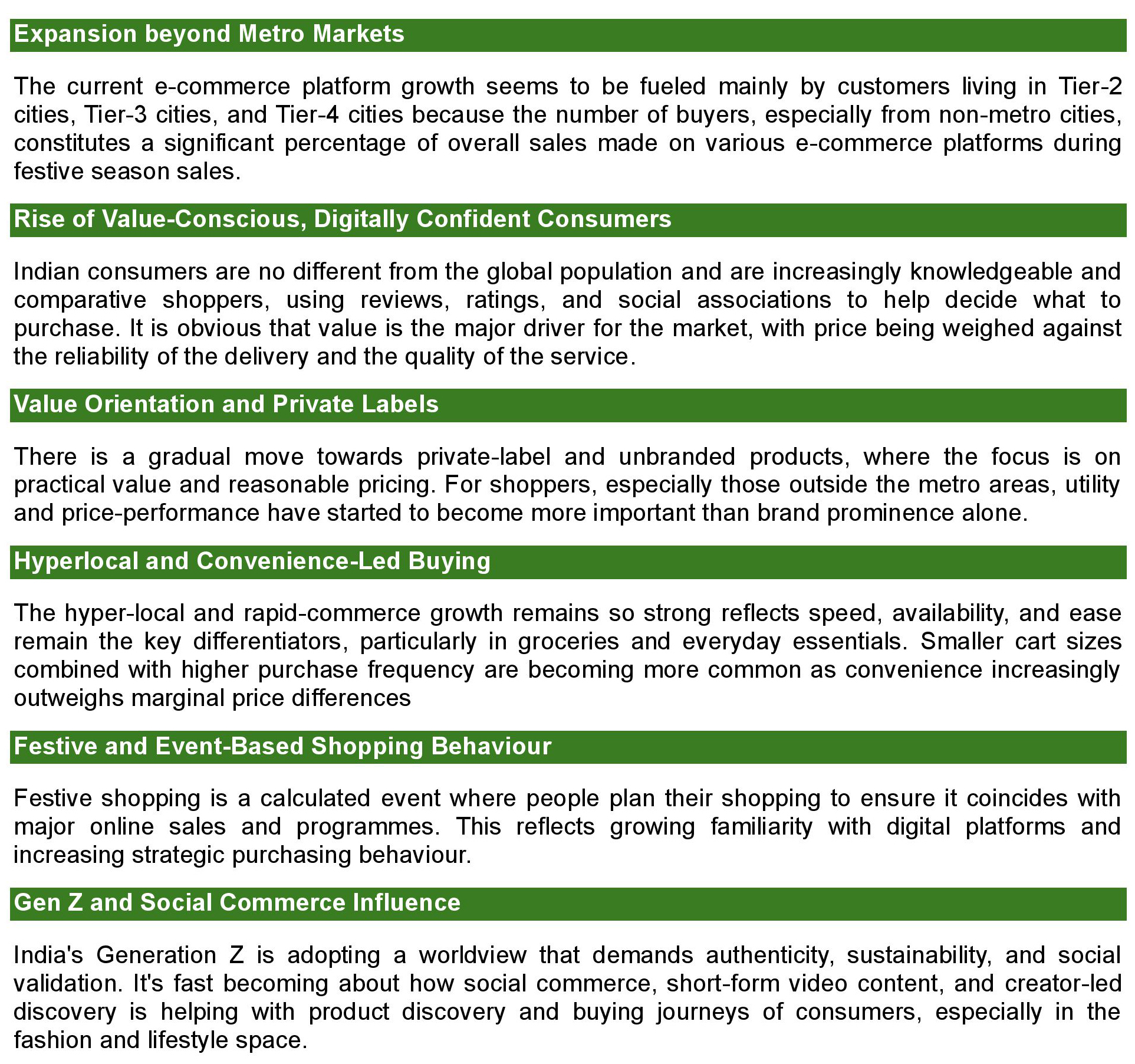
Key Consumer-Driven Trends Reshaping E-commerce
Outlook: The Road Ahead
India’s online shopping scene is now at a juncture where the emphasis needs to be on making sure that users really participate deeply, rather than on broadening the reach of users who can access it. As online penetration becomes widespread across the country, including rural and semi-rural locations the next stage of its evolution requires an understanding of the particulars of consumer behaviour with regard to language preferences, their comfort with making payments online, their expectations from delivery services, and their interests about specific categories.
The major levers for the business will be dependability in deliveries, transparent pricing, hassle-free returns, and strong after-sales services to create trust and sustain repeated business. At the same time, convenience driven business models such as quick commerce and hyperlocal will also increase the number of orders. Going forward, the e-commerce industry in India is expected to become even more differentiated, data-driven, and consumer-centric with focus on personalization and understanding consumer behaviour to sustain growth and retain customers.
FAQs
How large is India’s e-commerce market?
According to industry estimates, India’s e-commerce industry was valued at approximately Rs. 11.12 lakh crore (US$ 125 billion) in 2024 and is projected to grow to around Rs. 30.70 lakh crore (US$ 345 billion) by 2030, registering a compound annual growth rate (CAGR) of about 15%.
Why are Tier-2 and Tier-3 cities driving growth?
Tier-2 and Tier-3 cities are driving e-commerce growth due to improved internet access, wider online product availability, and increasing digital familiarity, which are encouraging more consumers outside metro cities to adopt online shopping.
How do digital payments influence buying behaviour?
Digital payment systems such as UPI reduce transaction friction, increase consumer trust in online transactions, and encourage more frequent and higher-value online purchases.
Why is convenience becoming important in e-commerce?
Convenience is becoming a key factor in e-commerce as consumers increasingly prefer faster delivery, easy return policies, and seamless checkout experiences that reduce effort and save time.
What will shape the future of e-commerce in India?
The future of e-commerce in India will be shaped by higher repeat usage, stronger consumer trust, and personalised shopping experiences enabled by data analytics and improved digital platforms
Partners