SEARCH
RECENT POSTS
Categories
- Agriculture (37)
- Automobiles (20)
- Banking and Financial services (35)
- Consumer Markets (56)
- Defence (6)
- Ecommerce (21)
- Economy (72)
- Education (14)
- Engineering (8)
- Exports (21)
- Healthcare (25)
- India Inc. (10)
- Infrastructure (31)
- Manufacturing (32)
- Media and Entertainment (16)
- Micro, Small & Medium Enterprises (MSMEs) (16)
- Miscellaneous (31)
- Perspectives from India (37)
- Pharmaceuticals (5)
- Railways (4)
- Real Estate (18)
- Renewable Energy (19)
- Research and Development (12)
- Retail (1)
- Services (7)
- Startups (15)
- Technology (66)
- Textiles (8)
- Tourism (16)
- Trade (8)
Authors






India’s Wearable Medical Device Market: Growth Potential Across Hospitals and Homes
- Apr 27, 2026, 18:30
- Consumer Markets
- IBEF
India’s wearable medical devices are being integrated into our healthcare system as our healthcare paradigms move towards continuous monitoring, early risk detection, and technology-aided disease management. Hospitals are under increasing stress from rising rates of chronic conditions and an elderly population profile, as well as an increasing shortage of staff to meet that growing need. Individuals need reliable means to cope with these conditions on an ongoing basis outside the four walls of our healthcare system.
Globally, wearable technology devices are projected to grow at a compound annual growth rate of 14.6% through 2030, with biowearables devices that monitor physiological or biochemical markers accounting for an increasingly larger share of this expansion. In the Indian context, growth opportunities are emerging across two key areas: hospitals, which can leverage scalable monitoring solutions to enhance operational efficiency, and home-based care, where continuous monitoring can support round-the-clock health management and help reduce unnecessary clinical visits.
Strategic Importance of Wearable medical device in India
Medical wearables differentiate themselves from run-of-the-mill gadgets since they monitor physiological signals of medical importance. They are primarily used for:
- Cardiac surveillance (ECG and heart rhythm)
- Diabetes Care Through Continuous Glucose Monitoring
- Examining blood pressure and blood oxygen levels
- Sleep quality and Respiratory Health Tracking
- Recovery and after-surgery monitoring
In India, the market is poised at a crossroads where consumer electronics and healthcare overlap. For instance, smart watches and fitness bands are opening doors to health monitoring. However, real growth lies further ahead, where these devices are validated medically and incorporated further into the health care matrix.
Accordingly, as medical technology continues to integrate with the digital platforms from which it is accessed, the pattern of patient care will change. Rather than scheduling the odd medical test, patients and physicians will have the benefit of their health data.
Industry Overview
The wearable medical devices market is also growing, driven by healthcare’s increasing adoption of such connected sensors for improved patient outcomes and reduced healthcare costs. Among these, biowearables are coming into their own, evolving beyond mere activity monitoring to keep tabs on hard clinical stats such as glucose, heart rhythms, and blood pressure.
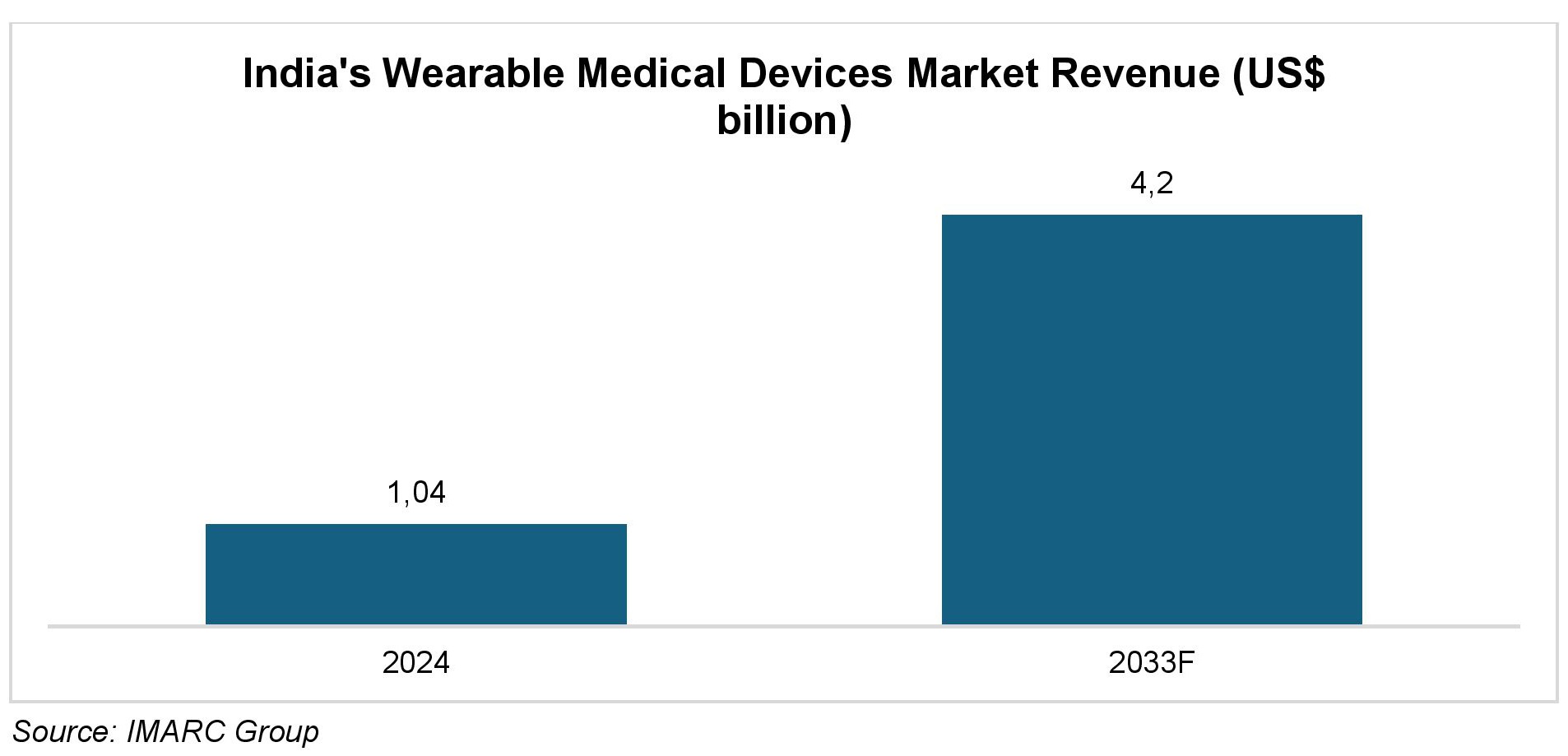
As per estimates by the IMARC group, the wearable medical devices market is poised to increase from the existing Rs. 9,256 crore (US$ 1.04 billion) in 2024 to Rs. 37,380 crore (US$ 4.20 billion) by 2033, at a pace of 15.5%. In this, the increase is happening through two routes. On one hand, ICUs and other areas are utilizing wearable medical devices for improving patient care. At the same time, home usage is being brought into the mainstream with the increase in remote patient monitoring programs for patients.
The industry's ecosystem comprises global consumer tech companies, medical device companies, and emerging Indian health tech companies. Market giants like Apple, Fitbit, and WHOOP occupy a space where consumer and medical segments coexist, while companies like Abbott and Medtronic focus primarily on clinically validated wearable solutions.
Government Initiatives and Policy Environment
India has not established a specific policy and subsidy framework for only wearable medical devices. However, the broad digital health landscape the Indian government is developing is paving the way for the integration of wearable medical devices into the regular health scenario.
In the case of the Ayushman Bharat Digital Mission (ABDM), for example, it would involve the establishment of interoperability between systems for digital health records, data sharing based on consent, and the use of common standards in health data exchange. ABDM does not fund or procure wearables; however, it enables the use of data collected by wearables in clinical workflows, remote monitoring systems, and continuous care paths. This is an important enabler in the move to integrate wearables as connected devices in healthcare.
Growth Drivers and Key Trends
Outlook and the Road Ahead
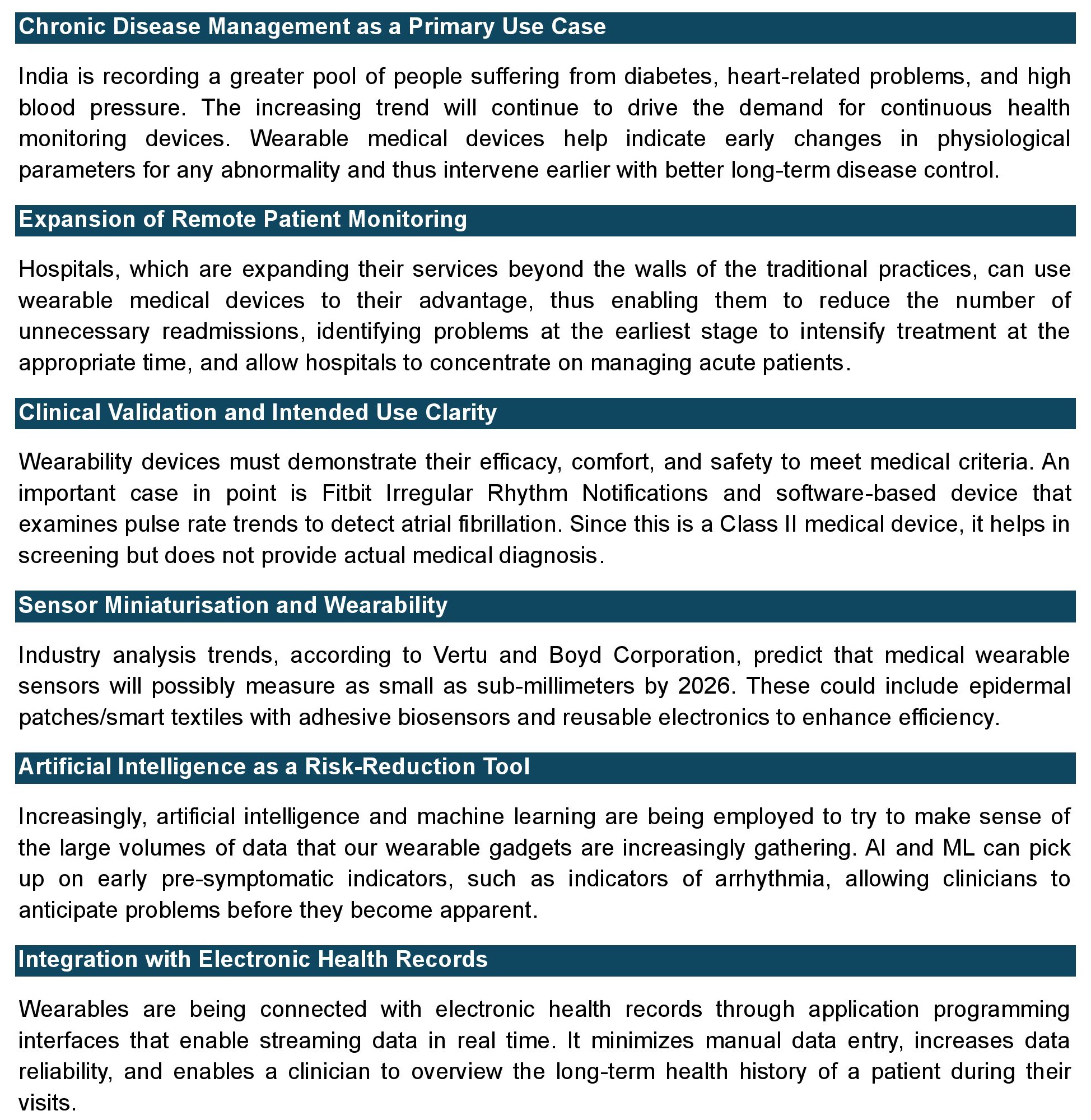
The future of wearables in India depends on the collaboration between doctors, technology platforms, and patients. The future trends in medical wearables in India will come from beyond gadgets and technology that provide clinical accuracy and outcomes. In future, it is possible that hospitals will increasingly use data collected by wearables as a standard part of treatment, integrating personal visits with remote monitoring. This hybrid model has tremendous potential for helping manage chronic diseases, assisting in patient recovery after surgery, and helping care for the elderly. At the same time, insurers may use data collected by wearables to enhance wellness programs and risk models.
Technological advancement will take these features even further. The information obtained through artificial intelligence will take wearable devices from just a fitness tracker to a health and wellbeing system that can detect early risk indicators even before the onset of symptoms. The devices will become smaller and have longer batteries. With its huge population base, growing digital footprint, and favourable regime to support growth, India has the potential to be one of the world’s fastest-growing markets for wearable medical devices. Wearables will drive the country into a new phase, shifting the approach of health care delivery from hospital-based models to home-based, delivering continuous, personalized, and accessible health care and redefining how health is monitored in the country.
FAQs
What differentiates wearable medical device from fitness wearables?
Wearable medical devices monitor physiological parameters with clinical relevance, such as ECG, glucose levels, blood pressure, or oxygen saturation. Unlike fitness wearables focused on wellness tracking, these devices support disease monitoring, remote care, and clinical decision-making.
What is driving the growth of wearable medical devices in India?
Growth is driven by rising chronic diseases, increasing preventive health awareness, and expansion of digital health infrastructure. Hospitals are adopting remote monitoring solutions, while households are using wearables for long-term health management outside clinical settings.
What is the market size of Wearable medical device in India?
In India, the wearable medical devices market is estimated to expand from Rs. 9,256 crore (US$ 1.04 billion) in 2024 to Rs. 37,380 (US$ 4.20 billion) by 2033, reflecting a CAGR of around 15.5%.
What role does artificial intelligence play in wearable medical devices?
AI helps analyse continuous health data generated by wearables, identifying early risk patterns such as irregular heart rhythms or abnormal glucose levels and enabling earlier clinical intervention.
What is the future outlook for wearable medical devices in India?
The market is expected to shift toward clinically integrated solutions supported by better sensor accuracy, digital health integration, and home-based care models, making wearable monitoring a key part of future healthcare delivery.
Partners