SEARCH
RECENT POSTS
Categories
- Agriculture (39)
- Automobiles (21)
- Banking and Financial services (36)
- Consumer Markets (58)
- Defence (6)
- Ecommerce (21)
- Economy (72)
- Education (14)
- Engineering (9)
- Exports (22)
- Healthcare (25)
- India Inc. (10)
- Infrastructure (31)
- Manufacturing (33)
- Media and Entertainment (17)
- Micro, Small & Medium Enterprises (MSMEs) (16)
- Miscellaneous (31)
- Perspectives from India (37)
- Pharmaceuticals (5)
- Railways (5)
- Real Estate (20)
- Renewable Energy (19)
- Research and Development (12)
- Retail (1)
- Services (7)
- Startups (16)
- Technology (66)
- Textiles (8)
- Tourism (16)
- Trade (9)
Authors






Consumer Market in India: The Rise of Premium, Sustainable and Experience-Based Consumption
- Oct 22, 2026, 18:10
- Consumer Markets
- IBEF
The consumer market in India is undergoing the process of transition fueled by factors like digitization, urbanization, higher incomes, and lifestyle changes which altogether impact the way consumers spend money. The shift is further characterized by a trend among consumers who increasingly prefer to spend on premium, sustainable, and experience-based products.
Moreover, consumer spending is increasingly becoming selective about where the money is spent. As per the Deloitte Consumer Signals India report published in May 2026, although consumer spending is generally prudent, discretionary spending is increasingly directed at certain experience-based categories. Premiumization is further seen in the travel segment with factors like value, comfort, and reliability coming to the fore.
All the above points to three major changes occurring in India's consumer market - premiumization of products and services, sustainability-focused spending, and allocation of discretionary spending on experience-based products.
India’s Consumer Market: Size, Growth and Potential
Private consumption has been identified as one of the major drivers of the Indian economy. According to Ministry of Statistics and Programme Implementation (MoSPI), the share of Private Final Consumption Expenditure (PFCE) accounted for 61.5% of GDP in FY26, matching the highest level recorded since FY12, while PFCE itself increased by 7.0% during the year. Additionally, PFCE grew by 7.5% in the first half of FY26, while its share in GDP rose to 61.4%. These numbers demonstrate the high pace of consumption dynamics and contribute to the growth of retail and consumer segments in India.
According to the research conducted by IMARC Group, the size of the market of luxury goods in India is estimated at US$ 10.6 billion in 2025 and might increase to US$ 18.8 billion by 2034, thus demonstrating CAGR of 6.17% during 2026-34. The reasons behind this trend are the income growth, expansion of the middle and upper classes, increased interest in premium services, and options provided by online retail.
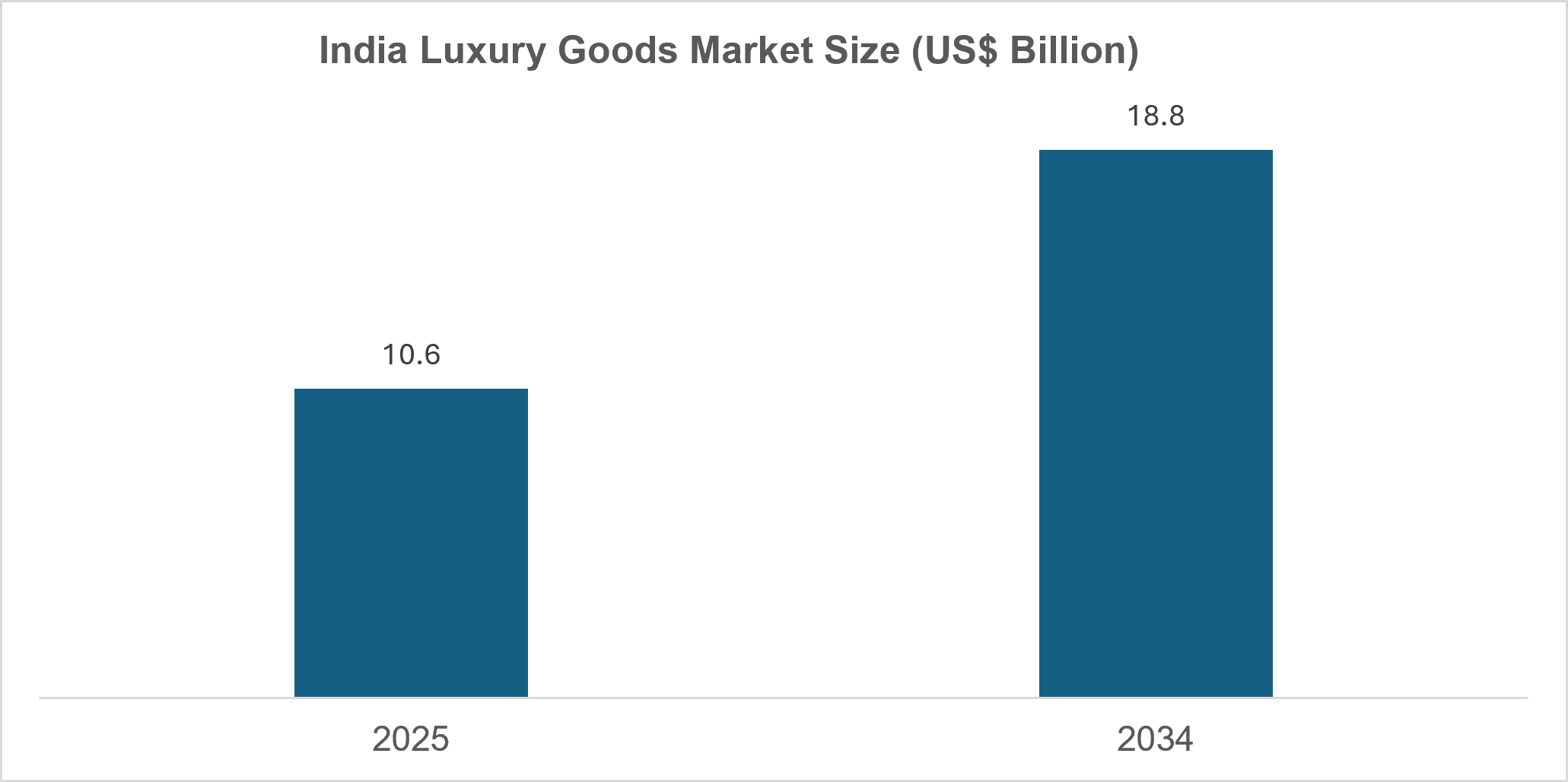
Source: IMARC Group
This tendency is characteristic of online luxury retail. Online platforms like Tata CLiQ Luxury provide customers with curated access to luxury goods from both India and the international market in the categories of fashion, beauty, watches, and jewelry, while Myntra, Nykaa, and AJIO expand their portfolio by offering premium and luxury goods. The expansion of the segment is stimulated by the presence of a significant number of digitally savvy consumers in India. Thus, a Google-Deloitte report released in April 2026 estimates that 220 million Gen Z consumers in India will be responsible for 45% of online spending, which emphasizes their increasing importance as consumers. At the same time, the same report estimates that India will gain 150 million more digital-economy participants by 2030.
Premiumisation: Indian Consumers Trade Up
Premiumization has become a key characteristic of consumption growth in India, with consumers opting for higher-value products and services rather than merely increasing the volume of purchases. The forecasts show that private consumption in India will amount to US$ 5.7 trillion by 2030, with experts estimating that roughly US$ 2 trillion of the growth might come from premiumization of consumers' purchasing behavior.
The phenomenon can be observed in various sectors. According to NielsenIQ, premium Fast-Moving Consumer Goods (FMCG) brands are growing almost twice as fast as mass-market ones, accounting for 27% of sales in FMCG and providing 42% of value growth.
According to Deloitte India’s 2026 report, the mid-premium apparel segment, priced at Rs.3,500–7,000, is expected to grow at a CAGR of around 25% from FY23–27, while the premium apparel segment is projected to grow at over 45% by FY27.
Premiumization also occurs in the real estate sector. Thus, Knight Frank reports that in the first half of 2026 homes priced at Rs. 1 crore and more accounted for 54% of total residential sales in eight Indian cities.
Overall, these trends reveal that the consumers in India do not abandon value-driven spending, but become more selective and willing to pay more for quality, better brand, increased functionality, and experience, etc.
Sustainable Consumption: The Shift Towards Responsible Choices
Environmental sustainability has increasingly been becoming an influential factor behind young Indians' purchasing decisions. The findings of the Deloitte 2025 Gen Z and Millennials Survey based on responses from 809 Indian respondents, comprising 505 Gen Zs and 304 millennials show that 89% of Gen Z in India and 90% of Millennials in India are prepared to pay extra for environmentally sustainable goods or services. Moreover, according to the findings, 85% of Gen Z and 92% of Millennials either do research on the environmental impact of a particular company or plan to do that before making purchases.
Such a trend progressively manifests itself in consumption. Electric mobility is one example as consumers compare the cost-effectiveness of choosing an electric vehicle along with its environmental impact. As for consumer goods, Hindustan Unilever (HUL) increased the use of post-consumer recycled plastic in flexible packaging and, in March 2025, acquired Lucro Plastecycle which is a plastics recycling company to develop its competencies in sustainable packaging.
On the other hand, sustainability relates to health and responsible consumption. Goods which promote natural ingredients, clean label, plant-based nutrition, and decreased environmental impact attract the attention of consumers in India. Such is the case with HUL's acquisition of Oziva which is a plant-based nutrition brand.
However, at the same time, sustainability cannot outweigh value consciousness. According to the Deloitte findings, money can be a reason why people prefer not to spend more on premium goods which have environmental preferences like electric cars and solar panels.
Experience Economy: Consumers Spend on Experiences
Indian consumers are increasingly focusing on experiences along with products, particularly in travel, hospitality, dining, entertainment, and leisure. The change, however, does not imply that consumers will be spending without any restrictions. According to the Deloitte's Consumer Signals India report released in May 2026, the consumerism in India is increasingly becoming discerning, with people protecting their savings but spending their discretionary income on areas that give them better value and pleasure.
Travel stands out as an example of this change. Despite a decline in the intention of leisure travel after the festive season, consumers showed an inclination towards upgrading rather than downgrading, as there was a clear preference for full-service airlines, upgraded seats, and upscale lodging. The share of consumers planning to spend money on curated experiences grew to 29% in March 2026, showing a one percentage point increase compared to last year.
Experience consumerism will also have important implications for physical retail. As mentioned in the Deloitte-FICCI 2025 report, the change is towards malls and high streets turning into experiential centers with retailers blending the physical store with digital and omnichannel experience.
Therefore, the experience economy provides opportunities in hotels, airlines, restaurants, tourism providers, entertainment companies, malls, and lifestyle brands. Companies that combine their products with experience become more likely to receive more of consumers' discretionary money.
It is important to note that experience-driven consumerism does not necessarily imply luxury spending. The insights from Deloitte's research prove that consumers in India are being prudent and thoughtful in terms of expenditure locations. The new pattern shows selective indulgence, where there is more spending on experiences worth spending on and putting off other purchases.
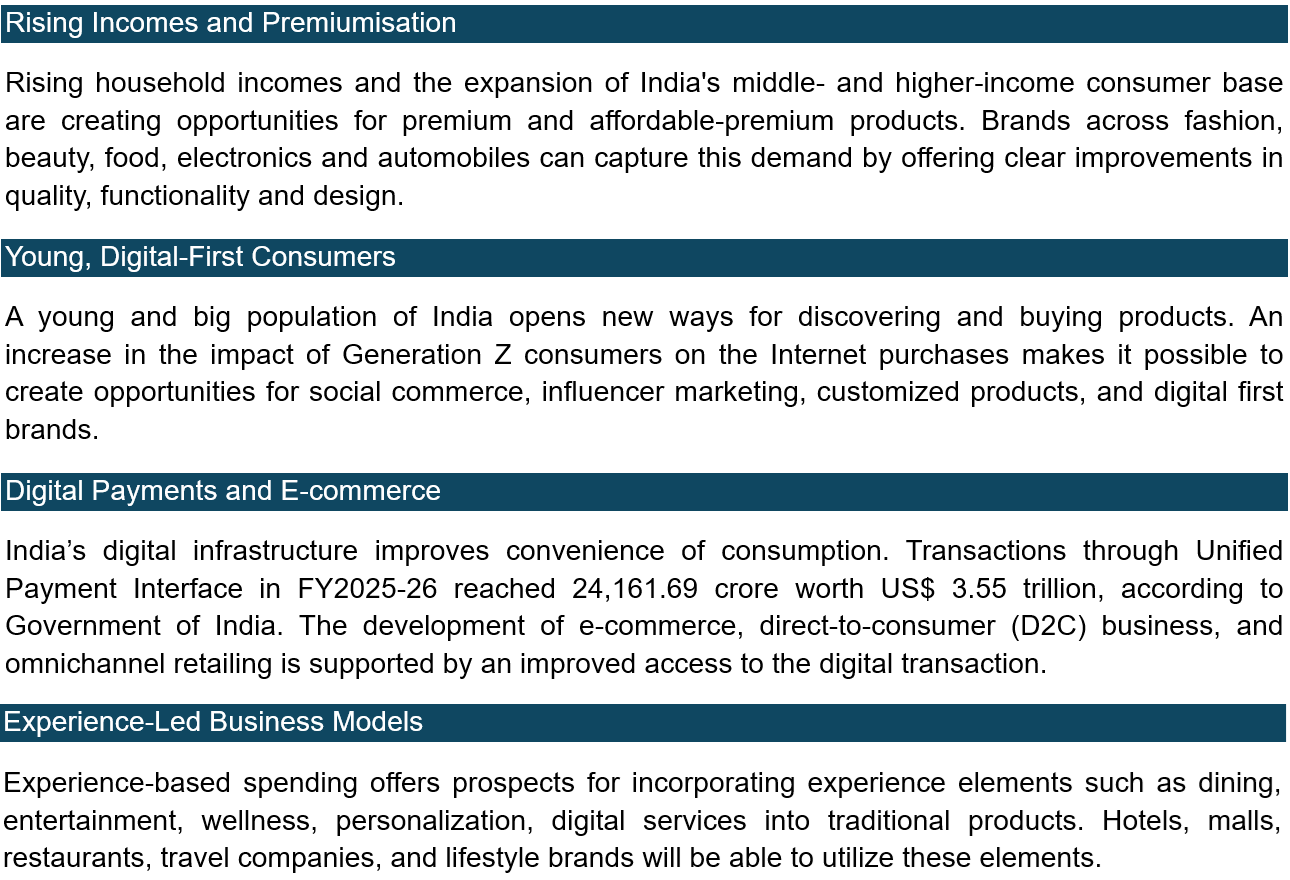
Growth Drivers and Opportunities for Businesses
Outlook and Road Ahead
Consumers' preferences and needs in India's market will be characterized by greater diversity, digitalization and selectivity rather than the increase of their numbers.
They will be ready to spend more on products offering significant advantages in terms of quality and experience. Sustainability will play an increasingly significant role in brand selection.
For companies, the next chapter of India's consumption story will mean not just selling more, but offering better-quality, environmentally-friendly and experientially-driven goods and services.
FAQs
What is driving the growth of India's consumer market?
The drivers of India's consumer market include growing incomes, urbanization, young population, digitalization, growing e-commerce and changes in consumers' lifestyle. They all result in growing need in both essential and luxury products and services.
What is premiumisation in India's consumer market?
Premiumization can be defined as consumers' tendency to switch to products and services of a higher value offering better quality, functionality, design, convenience or brand experience. The premiumization trend in India can be seen in FMCG, apparel, automobile, electronics, hotels and real estate industries.
Are Indian consumers willing to pay more for sustainable products?
Yes. 89% of Indian Gen Z and 90% of Indian millennials are ready to spend more money on environmentally sustainable products or services according to Deloitte's 2025 Gen Z and Millennial Survey.
Which sectors are benefiting from experience-led consumption in India?
Such industries as travel, hospitality, dining, entertainment, wellness, tourism and experiential retail benefit from consumers' inclination to allocate their discretionary income in memorable and personalized experiences.
How is e-commerce changing India's consumer market?
E-commerce allows Indian consumers to get access to products and brands not available in major metropolitan markets. Besides, growing digital payment systems, internet penetration and e-shopping allow brands to reach consumers in Tier II and Tier III cities.
Partners