SEARCH
RECENT POSTS
Categories
- Agriculture (37)
- Automobiles (20)
- Banking and Financial services (35)
- Consumer Markets (57)
- Defence (6)
- Ecommerce (21)
- Economy (72)
- Education (14)
- Engineering (8)
- Exports (21)
- Healthcare (25)
- India Inc. (10)
- Infrastructure (31)
- Manufacturing (32)
- Media and Entertainment (16)
- Micro, Small & Medium Enterprises (MSMEs) (16)
- Miscellaneous (31)
- Perspectives from India (37)
- Pharmaceuticals (5)
- Railways (4)
- Real Estate (20)
- Renewable Energy (19)
- Research and Development (12)
- Retail (1)
- Services (7)
- Startups (16)
- Technology (66)
- Textiles (8)
- Tourism (16)
- Trade (8)
Authors






How Jute Products Support India's Eco-Friendly Economy

- Sep 18, 2026, 15:05
- Consumer Markets
- IBEF
As the global economy moves towards sustainable production and consumption practices, natural fibres have become the alternatives to man-made fibres. Of all these fibres, jute stands apart with respect to its biodegradable and renewable characteristics and low environmental impact. Also referred to as the "Golden Fiber," jute has been an indispensable part of India's agricultural as well as industrial economy for many decades and continues to be one that provides a living to millions and sustains environmentally friendly industrial growth.
India is amongst the top producers and processors of jute products in the world. The industry creates a vital link between agriculture and industries and serves farmers, mill workers, artisans, and exporters. Unlike petrochemical plastics that are non-biodegradable, jute products can biodegrade in relatively shorter periods and thus find their applications in packing material, bags, home textiles, technical textiles, and geotextiles. Considering the importance of the jute industry in sustainable growth, the Indian government has always been supportive of this industry by implementing various policies such as the Jute Packaging Material (Compulsory Use in Packing Commodities) Act of 1987, Minimum Support Price (MSP) of raw jute, and diversification programs run by the National Jute Board.
India's Strong Production Ecosystem
India is the largest producer of raw jute owing to the favourable agro-climatic conditions, well-established agricultural base, and integrated manufacturing system. Official statistics by the Office of the Jute Commissioner show that the production of raw jute occurs mainly in the eastern and north-eastern parts due to favourable rainfall, rich alluvial soil, and humid climate, which ensures the high quality of the produced fibre. Such a strong agricultural base allows for a sufficient amount of raw jute for internal use and manufacturing. Therefore, the resilient value chain connecting farmers, processors, manufacturers, and exporters has been developed in India, thus supporting jute in the environmentally-friendly economy of India.
The state-level statistics prove the dominating position of West Bengal which produces up to 75% of the total amount of raw jute in India. The favorable natural conditions and composite jute mills in the state make it the leader in the production and processing of jute. Bihar and Assam are the significant producers of raw jute due to expanded cultivation processes and favorable climatic conditions. Moreover, the other states such as Meghalaya, Orissa, Tripura, Andhra Pradesh, and Chhattisgarh produce jute, contributing to the diversification of cultivation bases of the raw material in the country.
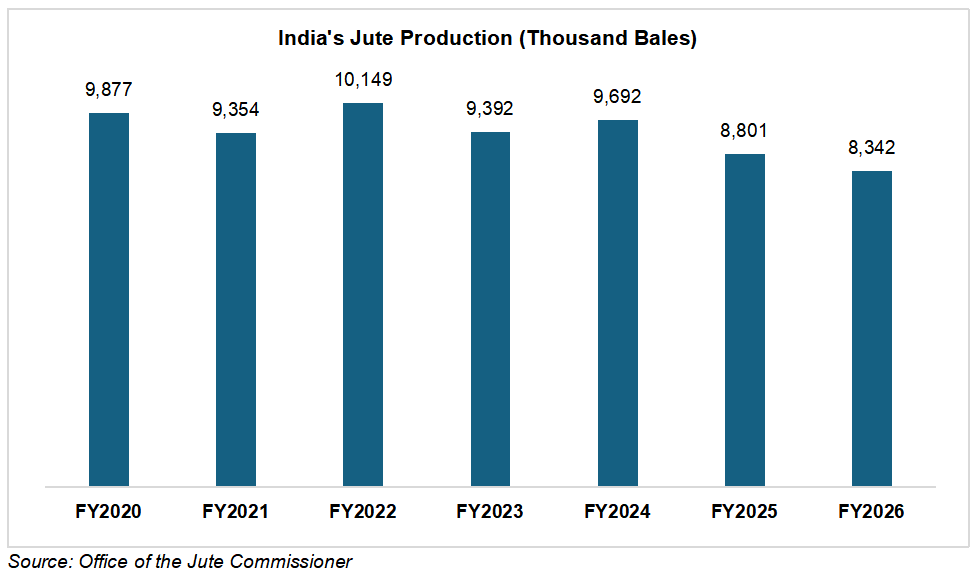
It is worth mentioning that the widespread cultivation of jute has a significant socio-economic role, employing farming, transportation, processing, and manufacturing activities. The statistics by the Office of the Jute Commissioner show that the production of raw jute and mesta in India is 8.34 million bales annually, cultivating it in an area of 2,772 kg per hectare. Thus, the well-established production system forms a good basis for developing biodegradable packaging and diversified jute products in India.
India’s Export Performance in Raw Jute
India occupies an important place in the global market of jute production, which is based on its strong production capacity and wide range of export products made of jute. According to data presented by the Ministry of Textiles, India produces 52 percent of all jute products manufactured in the world and holds first place in the global market. Besides, India is the second largest country exporting jute products after Bangladesh.
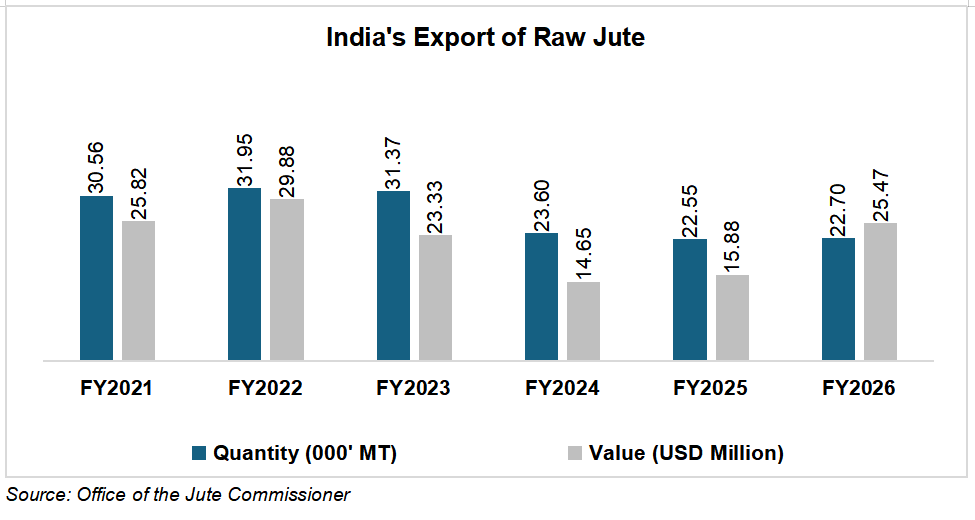
As per the Office of the Jute Commissioner, based on figures provided by the Directorate General of Commercial Intelligence and Statistics (DGCI&S), raw jute exports by India stood at around 22.70 thousand metric tons in 2025-26, amounting to Rs. 2,251.10 million (US$ 25.47 million). Hessian goods and sacking bags accounted for a major share of the exports in terms of quantity, whereas jute products in diversified form have been increasingly finding popularity in foreign markets owing to growing concerns about sustainability. The continued expansion of value-added product offerings, supported by government export promotion initiatives, is expected to further strengthen India's position in the global jute trade.
Government Initiatives Supporting the Jute Ecosystem
- Jute Packaging Materials (Compulsory Use in Packing Commodities) Act, 1987
- Mandates the use of jute bags for packing notified commodities such as foodgrains and sugar.
- This creates assured domestic demand for jute products. Government procurement under the Act supports around Rs. 12,000 crore worth of jute sacking annually.
- Minimum Support Price (MSP) Operations
- Implemented through the Jute Corporation of India (JCI).
- JCI procures raw jute from farmers whenever market prices fall below the MSP, helping stabilise farmer incomes and ensuring a consistent supply of raw material to the industry. Procurement is carried out through more than 110 Departmental Purchase Centres across major jute-growing states.
- National Jute Board (NJB)
- Promotes diversified jute products, entrepreneurship, design development, skill development and export promotion.
- It also supports research and development through institutions such as the Indian Jute Industries' Research Association (IJIRA) to improve product innovation and manufacturing competitiveness.
- Jute-ICARE (Improved Cultivation and Advanced Retting Exercise)
- Implemented by the National Jute Board in collaboration with JCI and the Central Research Institute for Jute and Allied Fibres (CRIJAF).
- The programme promotes improved seed varieties, line sowing, advanced retting techniques and better agronomic practices. According to the Ministry of Textiles, these interventions have increased farmer income by around Rs. 10,000 per hectare, improved productivity by 15%, and enhanced fibre quality by one grade.
- JUTE-SMART Digital Procurement Platform
- Developed by the Office of the Jute Commissioner to digitise the procurement of B-Twill jute sacking by government agencies.
- The platform improves transparency, reduces paperwork and streamlines procurement between jute mills and government buyers.
Growth Drivers and Key Trends
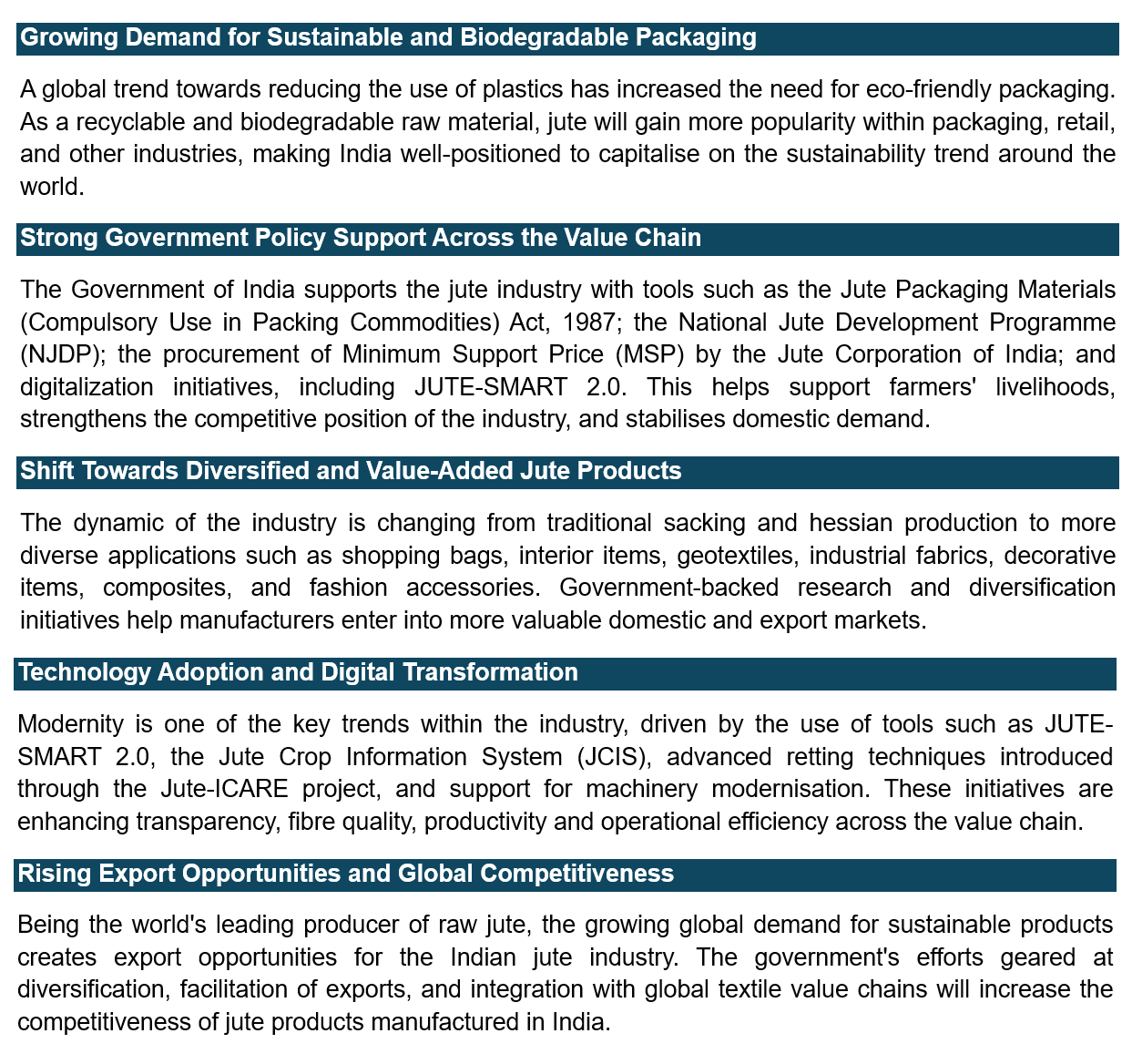
Outlook and Road Ahead
The jute industry in India is set to play an important part in enabling sustainable manufacturing and circular economy goals for the country. The rising demand worldwide for biodegradable packaging and growing regulatory and business sustainability requirements have created many prospects for Indian jute industry players in both the national and international markets. At the same time, the continued involvement of the government through programs like National Jute Development Programme (NJDP), Jute Packaging Materials (Compulsory Use in Packing Commodities) Act, 1987, Jute-ICARE, JUTE-SMART 2.0, and Jute Mark India is likely to benefit the industry through increased productivity, diversification, and digitisation of processes. In the future, additional investments in R&D, advanced manufacturing technologies, technical textiles, geotextiles, and innovative bio-applications would be crucial for expanding the application scope of jute beyond its current uses. Improving the competitiveness of exports through the quality certification, product innovation, and market diversification coupled with the inclusion of MSMEs and startups in the industry could ensure India's leadership in sustainable jute production. With its plentiful resource base, efficient manufacturing infrastructure, and supportive policies, India is well-positioned to become a key player in developing its sustainable jute sector.
FAQs
Why are jute products considered environmentally friendly?
Jute-based products can be considered environmentally friendly due to their capability of being completely biodegradable, renewable, and recyclable. Such materials break down naturally without producing any toxic leftovers and require fewer chemicals to grow, serving as an example of sustainable alternative to artificial materials and helping India meet its goal to implement the principles of circular economy.
What role does the Government of India play in supporting the jute industry?
Various incentives have been introduced by the Government in order to support the development of the jute industry in the form of the National Jute Development Programme, Minimum Support Price procurement, Jute-ICARE, JUTE-SMART 2.0, and the Jute Packaging Act.
Which states are the leading producers of raw jute in India?
West Bengal is recognized as the largest producer of raw jute in India, followed by Bihar and Assam. Additionally, jute grows in Meghalaya, Odisha, Tripura, Andhra Pradesh, and Telangana states, guaranteeing enough raw material for Indian jute manufacturers.
How is India's jute industry contributing to global sustainability?
India promotes sustainable practices on the global scale through exporting biodegradable products made out of jute which helps to decrease the dependence on plastic packaging. With increasing demand for sustainable products, there appear more opportunities for India to provide international market with such products as packaging, textiles, and jute-based goods.
What is the future outlook for India's jute industry?
The Indian jute industry is expected to face the growing demand for sustainable products, appropriate government policies, and innovative jute products. Increasing application of jute in the production of technical and geotextiles will help to develop exports further.
Partners