SEARCH
RECENT POSTS
Categories
- Agriculture (40)
- Automobiles (21)
- Banking and Financial services (36)
- Consumer Markets (59)
- Defence (6)
- Ecommerce (21)
- Economy (72)
- Education (14)
- Engineering (9)
- Exports (22)
- Healthcare (25)
- India Inc. (10)
- Infrastructure (31)
- Manufacturing (34)
- Media and Entertainment (17)
- Micro, Small & Medium Enterprises (MSMEs) (16)
- Miscellaneous (31)
- Perspectives from India (37)
- Pharmaceuticals (5)
- Railways (5)
- Real Estate (20)
- Renewable Energy (19)
- Research and Development (12)
- Retail (2)
- Services (8)
- Startups (16)
- Technology (66)
- Textiles (8)
- Tourism (16)
- Trade (9)
Authors






The Rise of Organic Personal Care Products Among Indian Consumers
- Oct 30, 2026, 12:45
- Consumer Markets
- IBEF
The Indian consumer is increasingly opting for organic and natural beauty products rather than using conventional personal care items with heavy chemicals. This change, which was previously limited to just urban areas, has become a mainstream trend due to increasing health awareness and increasing transparency about ingredients. This trend has taken place in skincare, hair care, bath and shower products, and color cosmetics.
The overall value of India's beauty and personal care industry stood at Rs. 74,557 crore in 2026, up from Rs. 59,351.96 crore in the previous year, out of which around 42% comes from organic products. The organic product segment represents the highest share among all segments in the country's beauty and personal care industry.
Why Organic Personal Care Matters
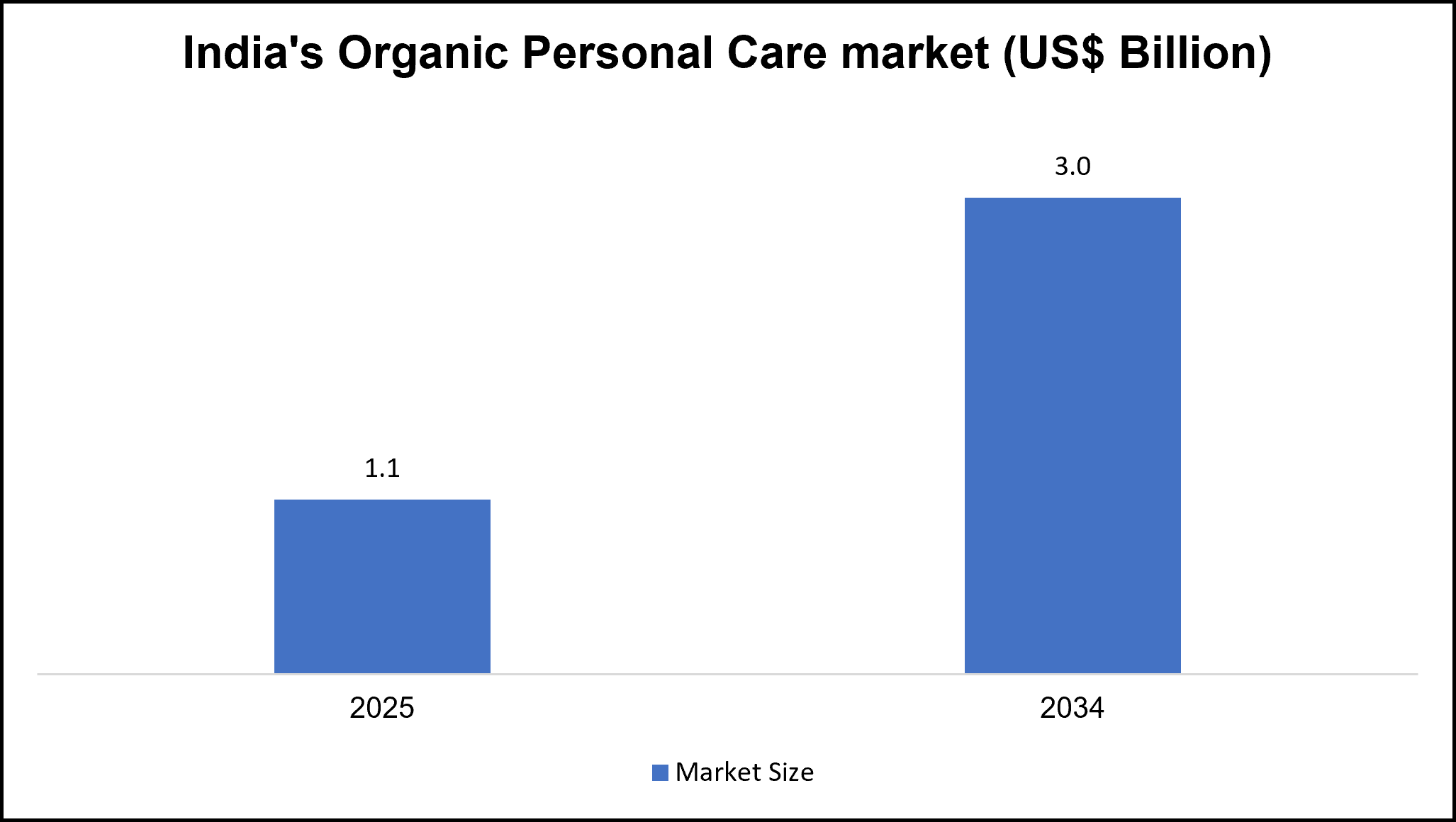
India's organic personal care products market alone was valued at US$ 1.1 billion in 2025 and is projected to reach US$ 3.0 billion by 2034, growing at a compound annual growth rate (CAGR) of 10.76%. Skincare remains the largest and fastest-growing segment, followed by haircare, with rising demand also visible in oral care and colour cosmetics as consumers extend their preference for natural ingredients across categories.
Distribution has been transformed by e-commerce and, more recently, quick commerce. Beauty and personal care sales through platforms such as Blinkit, Zepto and Swiggy Instamart are approaching US$ 1 billion annually, with more than 30 million shoppers buying through these platforms every month, giving both established and emerging organic brands rapid access to consumers in metros and smaller towns alike.
Source: IMARC Group
Government Initiatives and Policies Driving Change
Several regulatory and promotional measures are shaping how organic and natural claims are made, certified and exported.
- Organic certification under NPOP: The Agricultural and Processed Food Products Export Development Authority (APEDA) implements the National Programme for Organic Production (NPOP). Since 2020, NPOP includes criteria for certifying organic cosmetics and personal care products.
- Cosmetics Rules, 2020 & BIS standards: All cosmetics manufactured in India and claiming themselves to be ‘organic’ or ‘natural’ shall be manufactured in accordance with the rules specified in the Cosmetics Rules, 2020 under the Drugs and Cosmetics Act, 1940 and BIS safety requirements like IS 4707.Manufacturers should be able to justify their claims for any organic or chemical-free labeling of their products.
- Ecomark Rules, 2024: the BIS introduced the Ecomark scheme to give consumers a credible, government-backed eco-label and curb greenwashing, at a time when unsubstantiated 'natural' and 'clean' claims have become widespread across the beauty industry.
- Ministry of AYUSH support: the Ministry of AYUSH's Union Budget allocation rose to US$ 501.0 million (Rs. 4,408.93 crore) for FY27, up 20.1% from FY26, while India's AYUSH and herbal product exports reached US$ 638.71 million (Rs. 5,644.62 crore) in FY26. In May 2026, AYUSHEXCIL and the Spices Board of India signed an MoU to strengthen research, scientific validation and standardisation of AYUSH products, indirectly benefiting Ayurveda-led personal care brands.
- Production Linked Incentive (PLI) support: incentives under the PLI Scheme for manufacturing have helped organic-focused brands scale their research and production; independent skincare brand Juicy Chemistry, for instance, has expanded with the help of such support alongside external funding.
Key Players in India's Organic Personal Care Market
India's organic personal care space now spans listed consumer companies, digitally native beauty groups and heritage Ayurvedic houses. Honasa Consumer, the listed parent of Mamaearth, The Derma Co., Aqualogica, Dr Sheth's, BBlunt and Staze, reported its highest-ever quarterly revenue of Rs. 755.94 crore (US$ 79.68 million) in the first quarter of FY27 (April-June 2026), up 27% year-on-year, with net profit more than doubling to Rs. 90.45 crore (US$ 9.53 million). In addition, the company has been acquiring other companies like the majority stake in the men's grooming line Reginald Men in January 2026 and 58% equity in the nutraceuticals company Fluence Pharma in June 2026.
Dabur India, which includes heredity Ayurvedic brands such as Dabur Amla and Vatika, posted revenues worth Rs. 3,764.39 crore (US$ 396.81 million) in the same quarter, registering growth of 10.6% from the year ago quarter, with its Home & Personal Care business witnessing growth of 12.3%. Apart from these listed brands, a host of organic and Ayurvedic only brands, such as Kama Ayurveda, Forest Essentials, Biotique, Khadi Natural, Just Herbs, WOW Skin Science, and Juicy Chemistry brands are also gaining a loyal following.
Growth Drivers and Key Trends
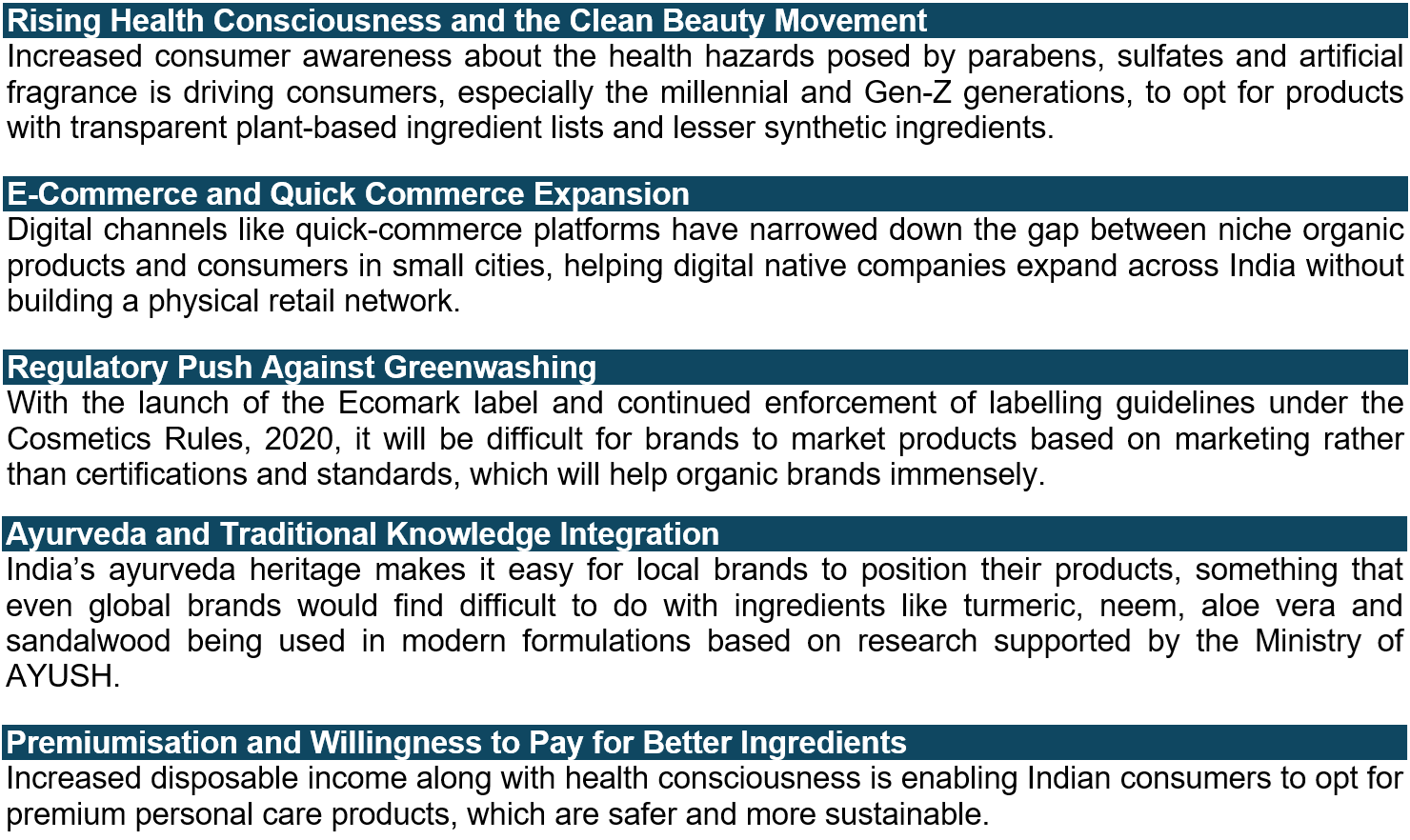
The following factors are driving the expansion of organic personal care products in India:
Outlook and Road Ahead
The personal care products industry for organic cosmetics is forecasted to grow at a CAGR of double digits throughout the next decade due to rising disposable incomes, increasing penetration of e-commerce and quick commerce, and a regulatory environment which is increasingly restricting the definition of the terms 'organic', 'natural' and 'clean'. Industry experts predict that the wider clean-beauty category will be able to grow at a CAGR exceeding 15% until 2030 as a result of increased regulation of greenwashing practices and competition based on product transparency at the ingredient level.
M&A activity is likely to increase, with larger publicly held companies acquiring organic and wellness brands to expand their portfolio, while export options will expand further as a result of international recognition gained by AYUSHEXCIL and APEDA. With certification, reach of online commerce and consumer awareness developing simultaneously, organic personal care is likely to become a mass-market segment rather than a niche one.
FAQs
What counts as an “organic” personal care product in India?
A personal care product qualifies as organic if it is certified according to National Programme for Organic Production (NPOP) run by APEDA, which has been including organic cosmetics/personal care products since 2020. Any brand making "organic" or "natural" claims needs to provide evidence thereof under Cosmetics Rules, 2020.
How big is India's organic personal care market?
India's standalone organic personal care products market is valued at US$ 1.1 billion in 2025 and forecast to reach US$ 3.0 billion by 2034, registering a CAGR of 10.76%.
Which government bodies regulate organic and natural claims on cosmetics?
APEDA certifies organic cosmetics according to NPOP. CDSCO and BIS are regulators of cosmetic safety and labeling under the Cosmetics Rules, 2020. The BIS has also introduced eco-label named "Ecomark" in 2024 to address "greenwashing".
Who are the major players in India's organic personal care space?
Listed players include Honasa Consumer (Mamaearth, The Derma Co., Aqualogica) and Dabur India (Dabur Amla, Vatika). Heritage brands and pure-play organic brands include Kama Ayurveda, Forest Essentials, Biotique, Khadi Natural, Just Herbs, WOW Skin Science and Juicy Chemistry.
What is driving demand for organic personal care products?
Increasing health consciousness, rising distrust of chemicals, increased availability via e-commerce/quick commerce, India's Ayurvedic heritage, and increasing income levels are all driving the demand for organic/natural personal care products.
Partners