SEARCH
RECENT POSTS
Categories
- Agriculture (38)
- Automobiles (20)
- Banking and Financial services (36)
- Consumer Markets (57)
- Defence (6)
- Ecommerce (21)
- Economy (72)
- Education (14)
- Engineering (9)
- Exports (22)
- Healthcare (25)
- India Inc. (10)
- Infrastructure (31)
- Manufacturing (32)
- Media and Entertainment (17)
- Micro, Small & Medium Enterprises (MSMEs) (16)
- Miscellaneous (31)
- Perspectives from India (37)
- Pharmaceuticals (5)
- Railways (4)
- Real Estate (20)
- Renewable Energy (19)
- Research and Development (12)
- Retail (1)
- Services (7)
- Startups (16)
- Technology (66)
- Textiles (8)
- Tourism (16)
- Trade (9)
Authors






Farmer Producer Organisations (FPOs): Strengthening Rural Supply Chains
- Aug 18, 2026, 18:55
- Agriculture
- IBEF
Agriculture continues to form an important base of India’s economy, sustaining the livelihoods of millions of rural families and contributing significantly towards food security and economic development. However, the predominance of small and marginal landholdings often makes it difficult for the farmers to get access to quality inputs, technological innovations, proper storage facilities, credit, and better markets. In order to overcome these barriers and boost the bargaining power of farmers, the Government of India has been encouraging the creation of Farmer Producer Organisations (FPOs). FPOs are farmer collectives that allow them to participate jointly in production, procurement, processing, marketing, and various other agricultural operations. A Farmer Producer Organisation (FPO) can be defined as the legally registered association of the primary producers wherein farmers act as owners and conduct business operations related to the farming sector and its allied sectors. FPOs can be registered as Producer Companies, Cooperative Societies, or any other entity according to law. Such associations operate on the premise of ‘farmer-owned’ and ‘farmer-controlled’. Through FPOs, the economies of scale are achieved by aggregating the outputs and requirements of inputs, while at the same time reducing dependence on middlemen and getting better prices. With the country moving towards strengthening its agricultural and rural supply chains, the FPOs are gaining importance. The Central Sector Scheme for Formation and Promotion of 10,000 FPOs is one of such government initiatives.
Evolution of FPOs in India: Current Landscape
Farmer Producer Organisations (FPOs) refer to farm businesses owned by farmers that enable them to conduct their activities such as procurement, production, processing, and marketing collectively and reap the economies of scale from the same. FPOs have gained significance as an important part of the strategy followed by the Indian government to improve the agricultural value chain and enhance incomes of the farmers. In order to solve the problems faced by small and marginal farmers regarding bargaining power and market access, the Government of India started the Central Sector Scheme for Formation and Promotion of 10,000 FPOs on 29 February 2020, with allocation of Rs. 6,865 crore (US$ 777.50 million) till FY28. The Scheme will help promote collective farming enterprises in terms of aggregation, value addition, processing, marketing, and institutional finance.
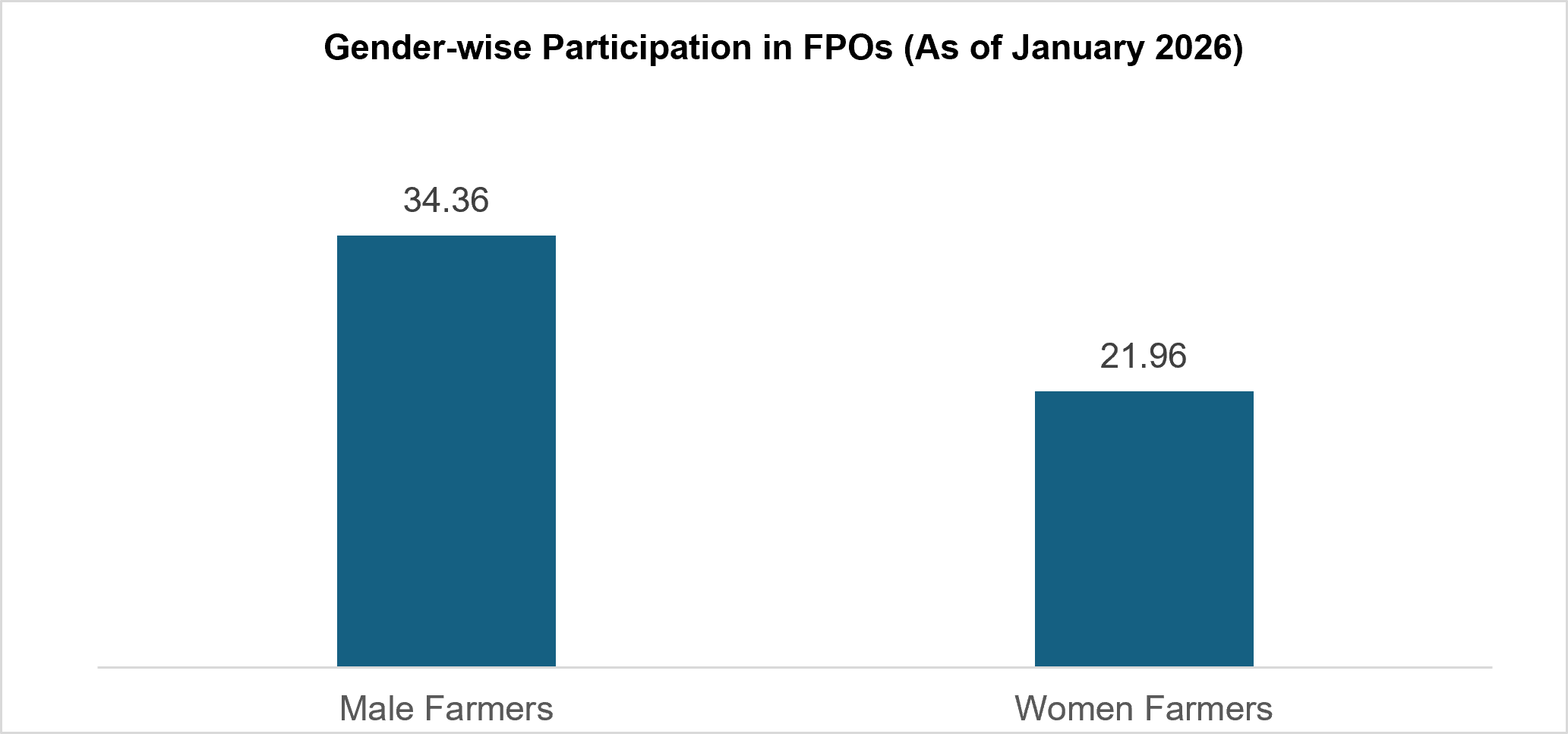
A significant development has been made in February 2025 with the formation of 10,000 FPOs across the country, with the 10,000th FPO being formed in Khagaria, Bihar. Till 1 January 2026, the number of farmers mobilised under the Scheme is 56.32 lakh, out of which the number of women farmers is 21.96 lakh and 1,175 FPOs have been constituted with 100% women membership. Through collective procurement of inputs, access to markets, modern technologies and undertaking value addition activities, the FPOs are gradually enhancing the efficiency of the rural supply chains in India.
Source: Ministry of Agriculture & Farmers Welfare; Global Agriculture
Government Initiatives Supporting FPO Growth
The Government is working on improving the functioning of FPOs through institutional measures at the state level. As per the official statement released on 28 January 2026 by the Agriculture Ministry, a high-level committee has been formed to improve governance, market linkages and value addition in Tamil Nadu FPOs. The time frame for submitting the report is two months. The members of the high-level committee include NABARD, NAFED, SFAC-Tamil Nadu, ICAR-NRCB, FPOs, NGOs and Agriculture Department Officials. Seven cooperative societies and two FPOs have received awards at the hands of NCDC in December 2025 under the Regional Cooperative Excellence and Merit Awards 2025. This clearly indicates the growing importance of farmers' collectives in the context of rural development. The Central Sector Scheme for formation and promotion of 10,000 FPOs provides considerable institutional and financial assistance for strengthening the farmer collectives. Under the scheme, each FPO can receive management support up to Rs. 18 lakhs ($0.20 million) for three years. The FPO can get matching equity grant up to Rs. 15 lakhs ($0.17 million) and guarantee support for project loan up to Rs. 2 crore ($0.23 million). Till December 31, 2025, matching equity grants worth Rs. 430.77 crore ($48.74 million) have been given to 6,557 FPOs and credit guarantee support worth Rs. 662.71 crore ($74.99 million) have been extended to 2,671 FPOs.
FPOs and Rural Supply Chain Transformation
Farmer Producer Organisations (FPOs) have become quite significant in terms of enhancing rural supply chain efficiency, as FPOs help small and marginal farmers to jointly access inputs, technology, infrastructure and markets. The process of joint procurement of agricultural inputs like seeds, fertilizers and crop protection is helped by FPOs, which help the farmers to jointly buy quality inputs at cheaper wholesale rates, thus cutting down costs of production. Moreover, access to farm machinery and post-harvest equipment is facilitated by FPOs, thereby enabling farmers to adopt better management practices.
FPOs are also improving the efficiency of supply chains through the process of aggregation, storage, transportation and market intelligence. Aggregation of the produce of many farmers by FPOs leads to creation of bulk quantities, thereby enhancing the bargaining capacity of farmers with the processors, exporters, retailers and institutional buyers. Moreover, FPOs help the farmers in logistics, provide them with market intelligence and help them with high-value agriculture like seed production, bee keeping and mushroom farming. These interventions are helping reduce dependence on intermediaries, improve price realisation and create more resilient and efficient rural supply chains across India.
Growth Drivers and Key Trends
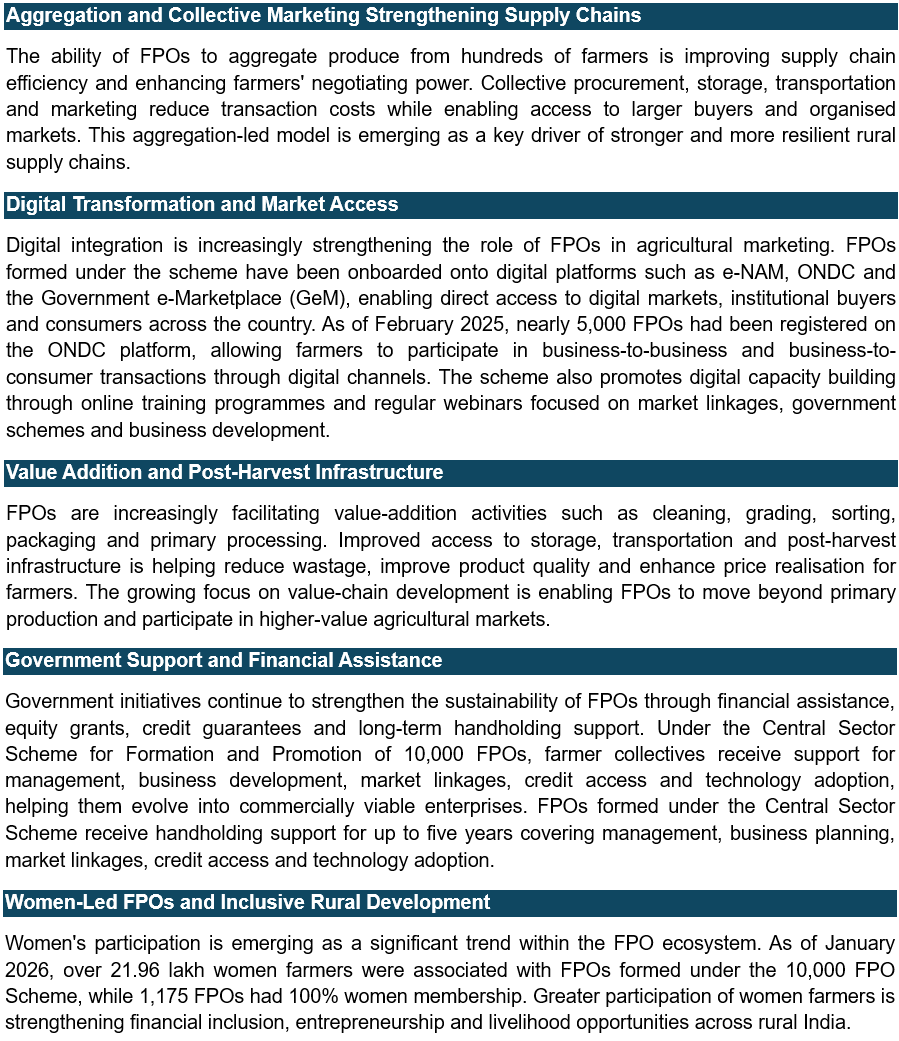
The following factors are driving the expansion of Farmer Producer Organisations and strengthening agricultural value chains and rural supply chains across India.
Outlook and Road Ahead
Farmer Producer Organizations are expected to take up a significant share in terms of enhancing the value chains and rural supply chains in India in future by ensuring proper aggregation, market linkage, value addition, and income generation for farmers. Since more than 10,000 FPOs have been established along with 56.32 lakh farmers, the emphasis on commercial sustainability and market orientation of these farmer cooperatives is gaining momentum in future. Further government support through financial, digital, and infrastructural initiatives can ensure long-term sustainability of FPOs.
In the future, the involvement of digital marketplaces, food processing industry, organised retail sector, export organizations, and agritech platforms can help increase the markets and prices for farmers. With time, FPOs are expected to be the pillars of rural entrepreneurship and sustainable agriculture in India.
FAQs
What is a Farmer Producer Organisation (FPO)?
A Farmer Producer Organisation (FPO) is a legally registered collective of farmers that enables members to jointly undertake activities such as input procurement, production, processing, value addition and marketing. The objective is to improve economies of scale, strengthen bargaining power and enhance farmer incomes.
How do FPOs strengthen rural supply chains?
FPOs aggregate produce from multiple farmers, facilitate storage, transportation, processing and market linkages, and enable direct engagement with buyers. This reduces dependence on intermediaries, improves supply chain efficiency and helps farmers secure better prices for their produce.
What is the Government's 10,000 FPO Scheme?
Launched in February 2020, the Central Sector Scheme for Formation and Promotion of 10,000 FPOs aims to strengthen farmer collectives through financial assistance, capacity building, credit support, market linkages and technology adoption. The scheme has an outlay of Rs. 6,865 crore (US$ 777.50 million).
What benefits do farmers receive by joining an FPO?
FPO members gain access to quality agricultural inputs at lower costs, shared farm machinery, storage and logistics facilities, market information, institutional finance and better marketing opportunities. These benefits help reduce production costs and improve profitability.
How are digital platforms supporting FPO growth?
Digital platforms such as e-NAM, ONDC and GeM are helping FPOs access wider markets, institutional buyers and digital commerce opportunities. They also provide market intelligence, pricing information and digital transaction capabilities, improving transparency and efficiency across agricultural supply chains.
Partners