SEARCH
RECENT POSTS
Categories
- Agriculture (39)
- Automobiles (21)
- Banking and Financial services (36)
- Consumer Markets (58)
- Defence (6)
- Ecommerce (21)
- Economy (72)
- Education (14)
- Engineering (9)
- Exports (22)
- Healthcare (25)
- India Inc. (10)
- Infrastructure (31)
- Manufacturing (33)
- Media and Entertainment (17)
- Micro, Small & Medium Enterprises (MSMEs) (16)
- Miscellaneous (31)
- Perspectives from India (37)
- Pharmaceuticals (5)
- Railways (5)
- Real Estate (20)
- Renewable Energy (19)
- Research and Development (12)
- Retail (1)
- Services (8)
- Startups (16)
- Technology (66)
- Textiles (8)
- Tourism (16)
- Trade (9)
Authors






Green Logistics in India: Developments and Opportunities

- Sep 08, 2026, 16:25
- Infrastructure
- IBEF
As supply chains become more sustainable and efficient, green logistics becomes a core part of sustainable development. In terms of adopting environmentally friendly practices in logistics, green logistics seeks to reduce carbon emissions, increase resource efficiency, and improve movement of goods in the supply chain. As transport accounts for a large portion of greenhouse gas emissions globally, both states and companies become increasingly interested in clean technologies, multimodal transport and digital logistics to achieve their climate and economic goals.
India makes significant strides towards a new generation of sustainable and technologically advanced logistics. Several projects such as the PM Gati Shakti National Master Plan, the National Logistics Policy (NLP), the ULIP, and E-Logs are focused on improving multimodality, logistics processes, and digitalization of the industry. As a result, India is expected to lower logistics costs, increase logistics efficiency, and create a sustainable logistics system that is crucial for Indian manufacturing and export.
As the country strives for achieving Net Zero emissions by 2070, the use of electric vehicles, alternative fuels, green warehouses, rail freight, inland waterways, and other innovations in the field of logistics is expected to grow. With continuous infrastructure and regulatory improvements in logistics, green logistics becomes a key driver of sustainable industrialization, supply chain resilience, and economic development.
India's Logistics Sector: Foundation for Sustainable Growth
Green logistics is something that India is currently going through as a result of the incorporation of environmentally friendly transport, energy-efficient warehousing, and carbon-neutral logistics within current operations. It is as a consequence of the growing industrialization, booming online commerce, supportive government policies, and sustainability promises made by companies. It is leading to a lot of investments in the logistics sector in a bid to ensure that it becomes greener. Green logistics is expected to boost efficiency and help the country meet its Net Zero goal by 2070.
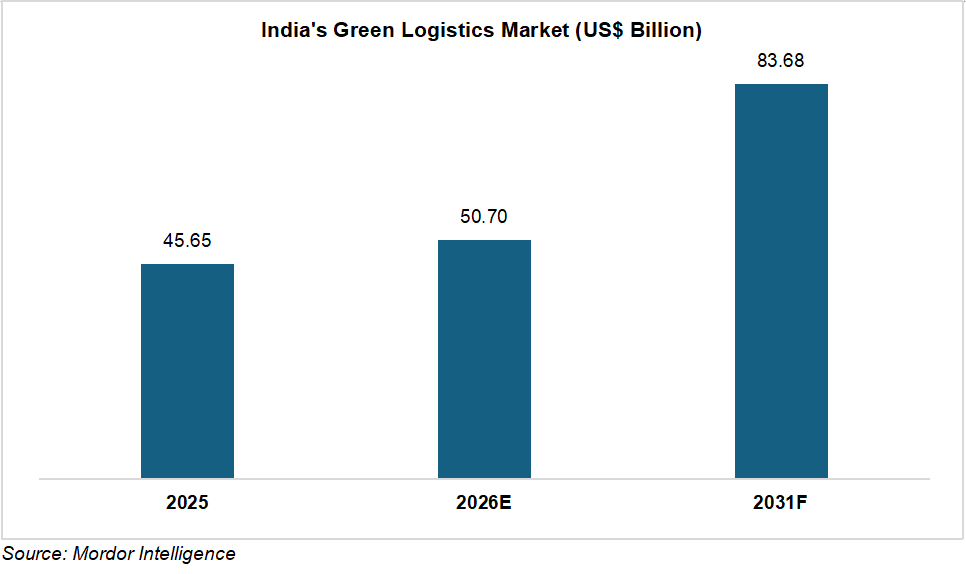
The India Green Logistics Market was valued at Rs. 3,860.16 billion (US$ 45.65 billion) in 2025 and is expected to grow to Rs. 8,061.31 billion (US$ 83.68 billion) by 2031, registering a CAGR of 10.54% during the forecast period 2026E-2031F. This growth has been credited largely to the increase in investments towards multimodal logistics, electric commercial vehicles, sustainable warehousing and digital logistics services. In line with these market trends, the Government of India has introduced various programs such as the PM Gati Shakti National Master Plan, the National Logistics Policy (NLP), Unified Logistics Interface Platform (ULIP), and Ease of Logistics Services (E-Logs). These programs have been introduced to build an integrated, efficient and eco-friendly logistics infrastructure. Moreover, the DPIIT-NCAER Assessment of Logistics Cost in India conducted in 2025 put India's logistics cost at 7.97% of the country's GDP. This shows how the logistics costs have improved owing to developments in logistics infrastructure in the country.
Government Policies Enabling Sustainable Logistics
- PM Gati Shakti National Master Plan
The Government is strengthening multimodal connectivity through the PM Gati Shakti National Master Plan, which integrates infrastructure development through roads, railways, ports, airports, and inland waterways on one integrated GIS-enabled digital platform. The aim is to decrease travel time, increase efficiencies for freight transportation, and achieve sustainable logistics through better infrastructure development.
- National Logistics Policy (NLP)
Established to improve logistics effectiveness, the National Logistics Policy calls for an integrated and technologically driven logistics environment that is also sustainable from an environmental perspective. The policy focuses on lowering logistics costs, making India more competitive in logistics, and encouraging multimodal cargo transport.
- Digitalisation of Logistics Operations
The use of digital platforms such as ULIP and E-logs has led to improvement in information exchange, regulatory adherence, and collaboration among stakeholders involved in the logistics supply chain. This development leads to increased transparency in operations, reduction in documentation, and faster movement of cargo.
- Development of Sustainable Multimodal Infrastructure
The government is continuously building upon its sustainable transport infrastructure through various programs such as the DFCs, the Sagarmala program, the Bharatmala program, Multi Modal Logistics Parks (MMLPs), and the creation of National Waterways. Through these programs, there will be higher use of railways, coastal shipping, and inland waterways to lessen dependence on roadways.
- Promotion of Clean Mobility and Alternative Fuels
India promotes low-carbon freight transportation through various projects such as the PM E-Drive Project and the National Green Hydrogen Mission, which help promote electric trucks, green hydrogen, and other sustainable fuel alternatives. It is expected that these projects will lead to lower emission rates in the transport sector.
Competitive Landscape
The logistics sector in India has adopted a strategy shift as major logistics firms embrace sustainable practices through eco-friendly transportation, digitalization, and energy-saving infrastructures. Leading logistics firms in the country include Blue Dart, Delhivery, Mahindra Logistics, Container Corporation of India (CONCOR), and DHL Express India. They have increased investments in the adoption of electric delivery vans, AI for route planning, warehouse automation, and renewable energy in an effort to increase efficiencies in their operations while reducing emissions of greenhouse gases. Such efforts have been encouraged by the Government’s focus on multimodal logistics that enable the wider adoption of rail, coastal shipping, and inland water transport to move goods. The combination of the private sector investment in logistics together with developments in public infrastructure is helping the emergence of a stronger and more sustainable logistics industry. For example, in June 2026, Delhivery partnered with Bajaj Auto to accelerate the electrification of its last-mile delivery network. Under the first phase, the company is deploying 200 Bajaj RIKI electric cargo vehicles, with plans to expand the fleet to approximately 1,500 electric three-wheelers during 2026–27, reinforcing its commitment to sustainable logistics and lower transportation emissions.
Currently, warehouse development is a key component of India’s green logistics program. Warehouses are increasingly being constructed in India under green standards, which feature the use of solar panels on rooftops, LED lighting, rainwater harvesting, energy-saving cooling solutions, and warehouse automation. In addition to this, there is increasing adoption of digital technologies, including AI, IoT, cloud-based transport management software, and predictive analytics that help optimize the use of trucks to avoid empty miles. There are government-led platforms for data exchange among logistics industry stakeholders, including ULIP. The growing importance of sustainability as a factor in competitiveness will make logistics companies invest even more in sustainable mobility, smart infrastructures, and digital solutions.
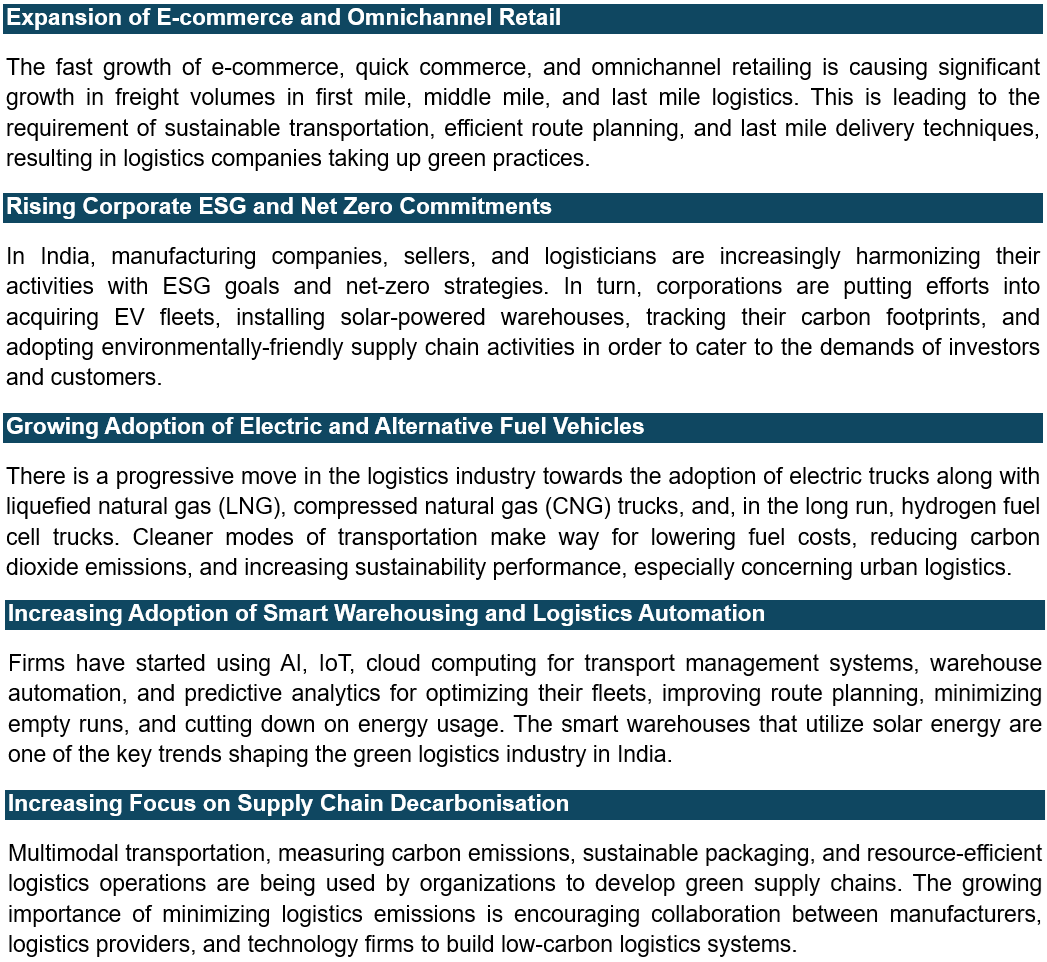
Growth Drivers and Key Trends
Outlook and Road Ahead
There are promising prospects for India's green logistics industry in the future owing to the development of India towards a greener, smarter and technology-based supply chain ecosystem. Growth drivers such as increased industrialization, development in e-commerce, export activities, and greater focus of corporations on ESG factors have created an opportunity for adoption of green logistics. Moreover, continued government support in terms of various schemes such as PM Gati Shakti National Master Plan, National Logistics Policy (NLP), Unified Logistics Interface Platform (ULIP), PM E-Drive Scheme and National Green Hydrogen Mission will result in enhanced multimodal connectivity, low emission freight movement, and improved logistics efficiency.
In future, increased investments in electric and hydrogen based commercial vehicles, smart warehousing, fleet management using artificial intelligence and multimodal logistics infrastructure will bring down carbon emissions while improving the resilience of the supply chain. Increased usage of rail freight, coastal and inland waterway transport through digitization and advanced logistics systems will further increase the efficiency and sustainability of operations. With the increasing adoption of green supply chains to meet the needs of regulations and consumers, India has every possibility of becoming a center for sustainable logistics industry. Through proper development of infrastructure, adoption of advanced technology and policy reforms, India has the potential to develop a world-class logistics industry which will contribute to the economic growth of the country while meeting its net zero emission goal by 2070.
FAQs
How is green logistics transforming India's supply chain ecosystem?
Green logistics is redefining India's supply chain management by incorporating sustainable modes of transport, multimodal systems of freight transport, logistics systems that are digitized, and energy-efficient warehouses. This ensures that there is decreased fuel usage, increased efficiency, and greater resiliency within the supply chain.
Which sectors are expected to benefit the most from green logistics in India?
Green logistics can be extremely useful in manufacturing, ecommerce, automotive industry, pharmaceutical, FMCG, retail, and agricultural sector. The reason for this is that sustainable freight services, intelligent warehousing and multimodal transport can help these sectors decrease their logistics expenses and increase delivery efficiency.
How are digital technologies accelerating the adoption of green logistics?
Innovations like Artificial Intelligence (AI), Internet of Things (IoT), transport management systems that operate via the clouds and Unified Logistics Interface Platform (ULIP) offer features such as real-time tracking, optimization of routes and analytics. This leads to better use of fleets, reduction of empty trips and savings on fuel costs.
What role does multimodal transportation play in advancing green logistics?
The multimodal transport system combines the modes of road, rail, maritime coastal, and inland waterway to facilitate better transportation of freight. Through this approach, corporations can decrease their carbon footprint, conserve fuel, and increase the efficiency of logistics through transporting the goods in alternative modes to those on roads.
What opportunities are emerging for businesses in India's green logistics sector?
The emergence of many opportunities in relation to electric commercial vehicles, green warehouses, renewable energy sources, smart logistics technologies, and sustainable supply chains is attributed to the increasing interest in the aforementioned concepts among logistics players, infrastructure companies, and technology firms. Companies that embrace environmentally friendly logistics will have the potential to improve their competitiveness.
Partners