SEARCH
RECENT POSTS
Categories
- Agriculture (37)
- Automobiles (20)
- Banking and Financial services (36)
- Consumer Markets (57)
- Defence (6)
- Ecommerce (21)
- Economy (72)
- Education (14)
- Engineering (8)
- Exports (21)
- Healthcare (25)
- India Inc. (10)
- Infrastructure (31)
- Manufacturing (32)
- Media and Entertainment (16)
- Micro, Small & Medium Enterprises (MSMEs) (16)
- Miscellaneous (31)
- Perspectives from India (37)
- Pharmaceuticals (5)
- Railways (4)
- Real Estate (20)
- Renewable Energy (19)
- Research and Development (12)
- Retail (1)
- Services (7)
- Startups (16)
- Technology (66)
- Textiles (8)
- Tourism (16)
- Trade (8)
Authors






How Digital Banking is Transforming the Indian Banking Industry

- Sep 23, 2026, 17:55
- Banking and Financial services
- IBEF
Over the last decade, the Indian banking sector has seen considerable changes in the context of accelerated digitalization, prevalence of smartphones, wide Internet availability, government policies favoring digitalization and FinTech innovations. Digital banking has become an integral part of the digital economy in India where people and businesses are provided with universal access to banking services without the need to visit traditional banking institutions.
Increased popularity of digital banking is changing the face of the financial sector by providing customers with faster, more secure and highly accessible banking services. At the moment, users can open their bank accounts in a digital way, conduct fast fund transfers using the Unified Payments Interface (UPI), take out loans online, buy mutual funds and insurance, and manage finances with the help of mobile apps. The greater integration of such technologies as Artificial Intelligence (AI), cloud computing, blockchain technology, and data analytics improves the customer experience and makes banking operations even more efficient.
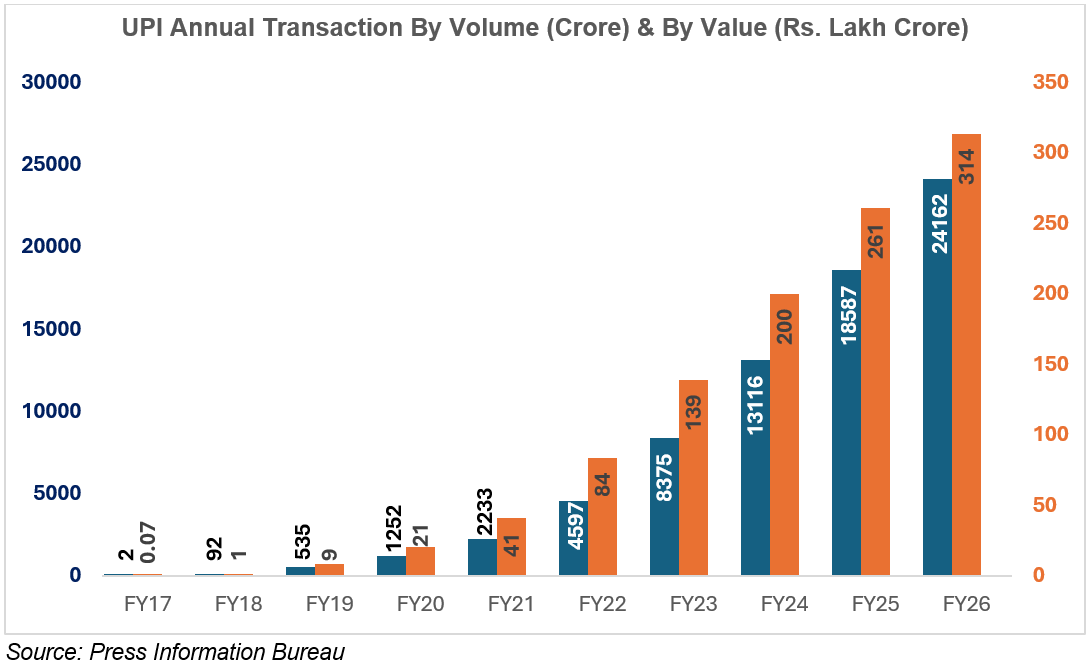
According to RBI, the volume of digital payments increased with CAGR that exceeded 44% during the last five years. According to the NPCI, the Unified Payments Interface (UPI) processed 24,161.69 crore transactions with a value of Rs. 314 lakh crores (US$ 3,552.94 billion) in FY2025-26, showing 30% year-on-year growth in transactions volumes. In June 2026, the UPI linked 731 banks and accounted for about 85% of digital payment transactions in India. UPI is recognized by the International Monetary Fund (IMF) as the largest real-time payments system in the world accounting for nearly 49% of the real-time payment transactions worldwide. Digital banking has therefore become a major catalyst in supporting financial inclusion, economic growth and innovation across the banking ecosystem.
Digital Public Infrastructure Driving India's Banking Transformation
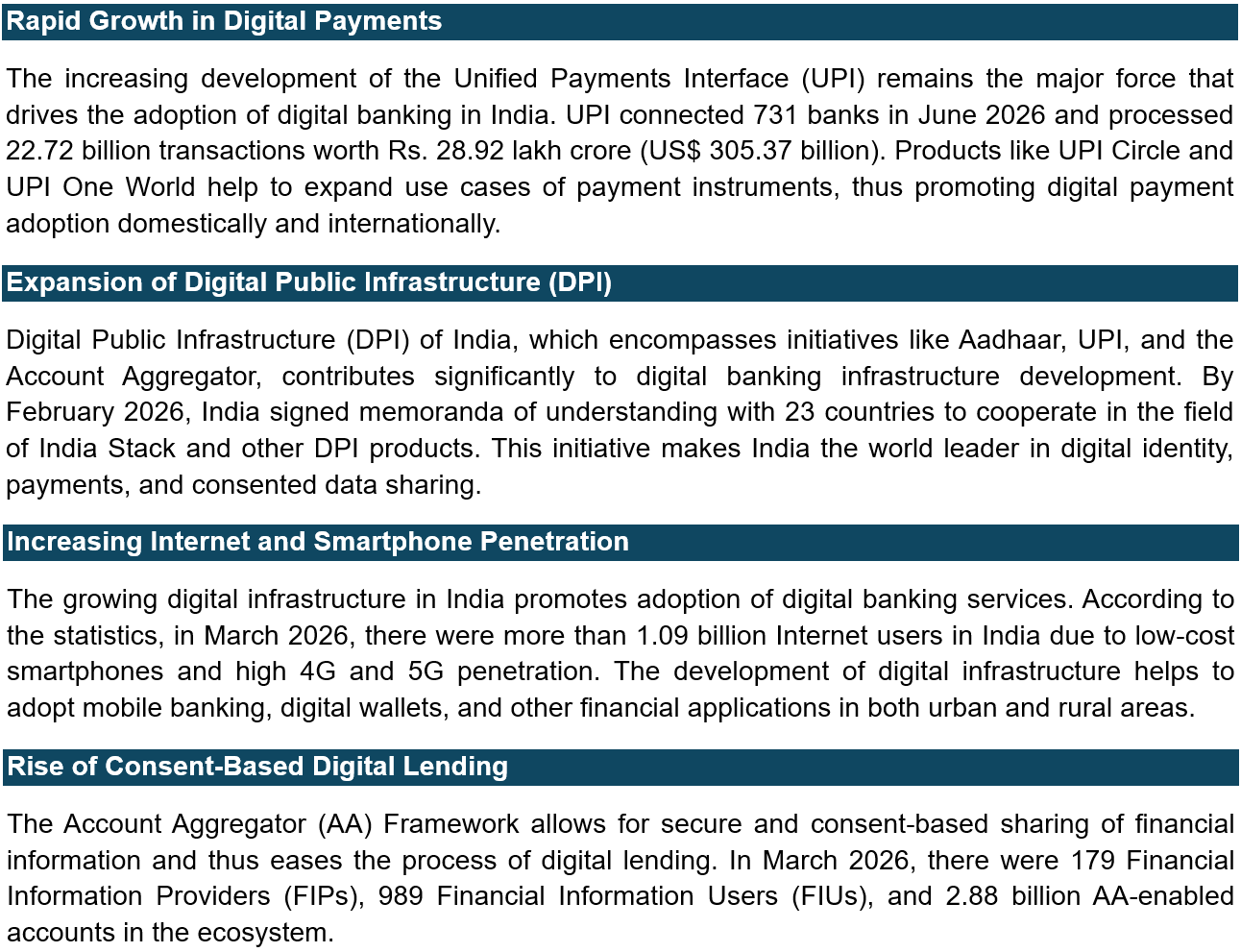
India has created a digital banking ecosystem, which goes beyond internet and mobile banking to become a fully-fledged Digital Public Infrastructure (DPI) enabled financial ecosystem. With the integration of various platforms like Aadhaar, Unified Payments Interface (UPI), DigiLocker, electronic Know Your Customer (e-KYC), and Account Aggregator (AA) framework, Indian banks have been able to digitize their customer onboarding, payments, lending, and exchange of financial information. With growing digital connectivity, India had more than 1,092.79 million Internet subscribers as of March 2026, creating a strong base for widespread adoption of digital banking services.
The Digital Public Infrastructure in India has earned recognition internationally as well. By February 2026, the Government of India signed Memorandums of Understanding (MoUs) and cooperative agreements with 23 nations for the adoption of India Stack and other DPIs. The international collaborations focus on digital identity, digital payments, data sharing, and delivery of digital public services, demonstrating how India is increasingly becoming a leading player in the domain of digital governance internationally.
The international expansion of UPI is yet another example of how international acceptance of the digital payment system of India has been growing. UPI is currently live in eight countries: United Arab Emirates (UAE), Singapore, Bhutan, Nepal, Sri Lanka, France, Mauritius, and Qatar, thereby facilitating cross-border payments. India has introduced India Stack Global platform to help accelerate the adoption of DPI solutions internationally, featuring 18 DPI solutions: Aadhaar, DigiLocker, UPI, CoWIN, GeM, UMANG, and PM GatiShakti, among others. Meanwhile, Global DPI Repository, which was launched during India's G20 Presidency in 2023, is a global knowledge-sharing platform on Digital Public Infrastructure and India contributes the highest number of DPI solutions to it.
Government Initiatives Supporting Digital Banking
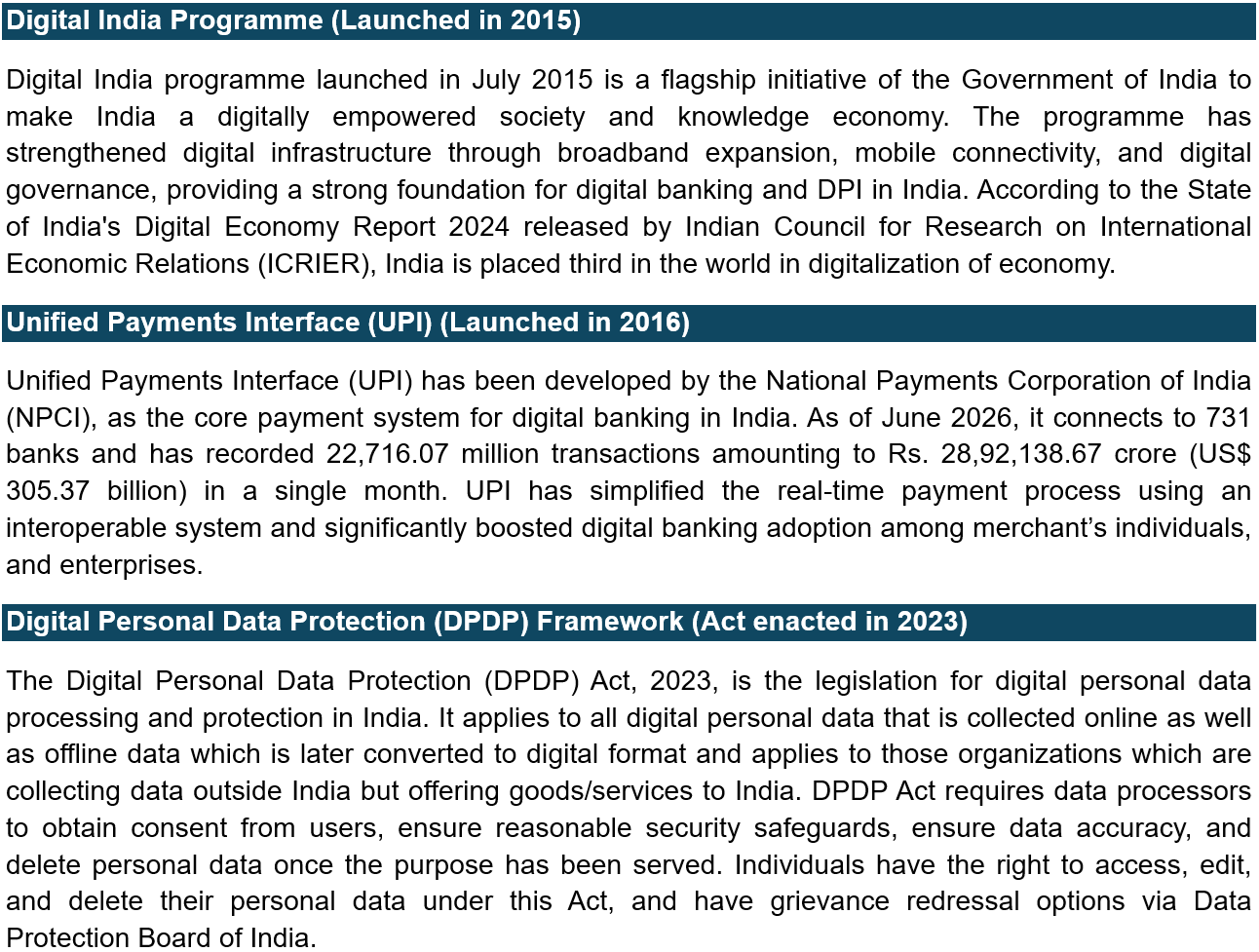
The Government of India, in partnership with the Reserve Bank of India (RBI) and the National Payments Corporation of India (NPCI), has undertaken several policy measures to ensure that there is faster adoption of digital banking, increase financial inclusion, and create a safe digital financial ecosystem. These initiatives have significantly improved access to formal banking while facilitating cashless transactions and digital financial literacy.
Growth Drivers and Key Trends
The following factors are driving the growth of India’s digital banking:
Outlook and Road Ahead
The digital banking sector in India is slated for growth with factors such as DPI expansion, regulatory changes, and adoption of advanced technologies driving the growth. The following factors include cross-border UPI, account aggregator, digital banking units, and the Digital Personal Data Protection (DPDP) Act, 2023, which will boost financial inclusion, ensure enhanced data security, and enhance customer experience.
Going forward, the increased adoption of AI, cloud computing, open banking, and CBDC is expected to drive growth within the banking industry through more efficient and secure banking. With continued investments in digital infrastructure and innovations in India, the nation is well on course to become a leader in digital finance and create a robust banking environment.
FAQs
What role does UPI play in India's digital banking ecosystem?
UPI serves as the core structure of India’s digital payment system, facilitating fast, secure, and interoperable payments. Widespread use of the system by both individuals and enterprises has significantly aided in moving towards a cashless society.
What was the scale of UPI transactions in FY2025–26?
UPI processed 24,161.69 crore transactions worth Rs. 314 lakh crore (US$3,552.94 billion) in FY2025–26. Transaction volumes grew by around 30% year-on-year, highlighting the rapid adoption of UPI-based payments. This has established UPI as a major pillar of India's digital banking ecosystem.
How is Digital Public Infrastructure (DPI) supporting digital banking in India?
The Department of Promotion of Industry & Internal Trade (DPI) of India, along with projects like Aadhaar, Unified Payments Interface (UPI), DigiLocker, e-KYC, and Account Aggregator model, has made customer onboarding, payment processing, digital lending, and data-sharing easier. It has helped to make the process more efficient and inclusive from a financial perspective.
What government initiatives are promoting digital banking in India?
Some of the important initiatives that have helped the nation in making the digital transformation journey easier include the Digital India Programme, Unified Payments Interface (UPI), and the recently introduced Digital Personal Data Protection (DPDP) Act of 2023.
What is the current scale of India's Account Aggregator ecosystem?
As of March 2026, the Account Aggregator ecosystem had 179 Financial Information Providers and 989 Financial Information Users. It also had around 2.88 billion AA-enabled accounts. The expanding ecosystem is strengthening consent-based financial data sharing and supporting the growth of digital lending.
Partners