SEARCH
RECENT POSTS
Categories
- Agriculture (39)
- Automobiles (21)
- Banking and Financial services (36)
- Consumer Markets (57)
- Defence (6)
- Ecommerce (21)
- Economy (72)
- Education (14)
- Engineering (9)
- Exports (22)
- Healthcare (25)
- India Inc. (10)
- Infrastructure (31)
- Manufacturing (33)
- Media and Entertainment (17)
- Micro, Small & Medium Enterprises (MSMEs) (16)
- Miscellaneous (31)
- Perspectives from India (37)
- Pharmaceuticals (5)
- Railways (5)
- Real Estate (20)
- Renewable Energy (19)
- Research and Development (12)
- Retail (1)
- Services (7)
- Startups (16)
- Technology (66)
- Textiles (8)
- Tourism (16)
- Trade (9)
Authors






How Indian Airlines are Expanding Domestic and International Routes

The aviation industry in India is witnessing rapid growth driven by rising passenger traffic, increased investments in airport facilities, rising disposable incomes, and fleet augmentation by Indian airlines. The domestic networks of Indian airlines are being enhanced for Tier-II and Tier-III cities, while simultaneously expanding their international presence via extended international routes.
It is fast becoming an important sector for stimulating economic growth via tourism, trade, employment generation, and connectivity. At present, India holds the position of the third largest domestic aviation market in the world and is expected to become one of the most rapidly growing aviation markets internationally in the coming years.
Strong Growth in Passenger Traffic
India’s aviation industry has continued to witness steady growth in passenger traffic and aircraft movements. According to Airport Authority of India (AAI), domestic air passenger traffic increased to 339.45 million passengers in FY26 from 334.70 million passengers in FY25, registering a year-on-year growth of 1.4%. International passenger traffic also recorded healthy growth, rising to 80.64 million passengers in FY26 from 77.38 million passengers in FY25, reflecting an annual growth of 4.2%. Overall passenger traffic in India stood at 420.09 million passengers in FY26 compared with 412.09 million passengers in FY25, registering growth of 1.9%.
The aviation sector has also shown strong growth over the past few years. Domestic passenger traffic rose from 270.34 million passengers in FY23 to 306.79 million passengers in FY24, recording a growth of 13.5%. International passenger traffic increased significantly from 56.94 million passengers in FY23 to 69.64 million passengers in FY24, reflecting a growth of 22.3%. Total passenger traffic in India reached 376.43 million passengers in FY24 compared with 327.28 million passengers in FY23, registering an overall growth of 15.0%.
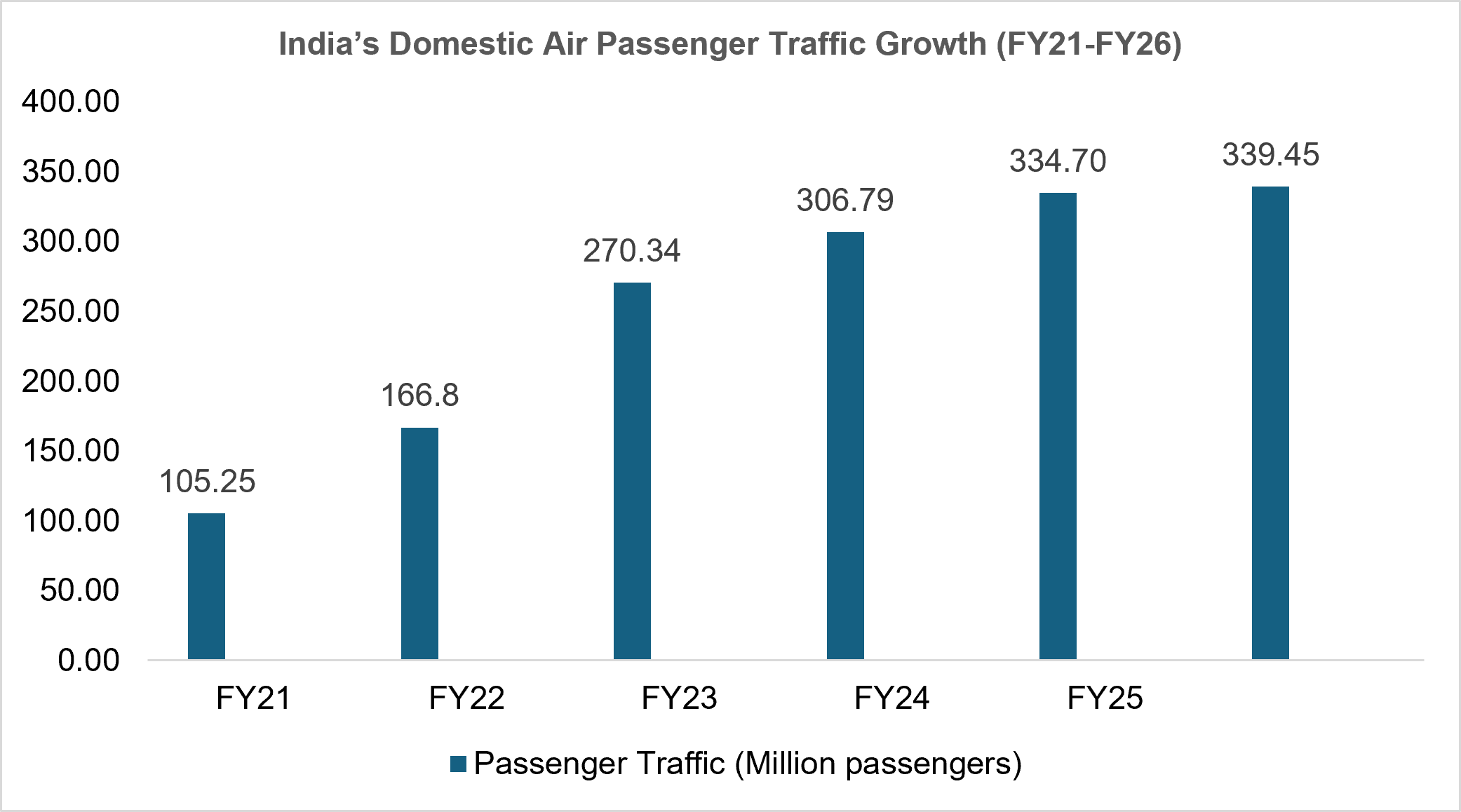
Source: Airport Authority of India
Indian Airlines Expanding International Presence
Indian airlines have steadily increased their share in international passenger traffic, reducing the dominance of foreign carriers on international routes. According to the forecast by CRISIL Ratings, the market share of Indian airlines in international passenger traffic that comprises both international passenger traffic to and from India will grow to 50% in FY28, up from 43% in FY24, resulting an increase of 700 basis points in the next four years. Indian airlines are gaining market share because of fleet enhancement, international flight route addition and strong domestic feeder service.
Indian airlines have substantially scaled up international operations within the last few years with the help of additional aircraft deployments, long-haul international flights and partnering with international carriers. Indian airlines are now focusing on providing direct connections to a variety of locations spread over different regions such as Europe, North America, Southeast Asia, Australia and West Asia. This trend has further been validated due to the use of some of the most modern planes for international operations in aircraft like Airbus A321XLRs, Airbus A350, and Boeing 787 aircraft. Indian airlines are now more capable of performing international flights in such planes.
Government Initiatives and Infrastructure Expansion Supporting Aviation Growth
- UDAN Scheme (Ude Desh ka Aam Nagrik) is the regional connectivity scheme which was introduced on October 21, 2016. In this regard, for the regional connectivity scheme, till March 25, 2026, the Government of India has created 663 Regional Connectivity Scheme (RCS) routes through the UDAN scheme. These routes involve 95 underserved and unserved airports, heliports, and water aerodromes.
- Long-term objective of aviation in India is extremely expansive. Based on PIB Aviation Vision 2047, the aviation infrastructure of India will consist of 350-400 airports in the year 2047 as compared to 163 airports in 2025. Further, aviation provides employment opportunities to about 7.7 million people in India. Schemes such as Digi Yatra, Greenfield Airports Policy, and Drone PLI Scheme have made India a friendlier destination for aviation.
- Air India is positioning India as a transit hub. According to a press statement issued on February 27, 2025, by Air India, the international route map of Air India has been optimised in order to strengthen connection from the UK and Europe to Australia and South-East Asia. This route plan has reduced connecting time to around 2.5 hours and made Delhi and Mumbai major hub airports.
- Increase share of Indian airlines in international traffic. According to CRISIL Ratings in May 2024, international passenger traffic share by Indian airlines to, from or through India will increase by 700 basis points to 50% in FY28 from 43% in FY24. The reason behind increased market share was attributed to addition in aircraft, additional number of routes, long-haul flights and increased domestic feeder routes.
- Significant addition in international routes of domestic carriers. According to CRISIL Ratings, Indian airlines have added 55 new international routes in the last 15 months to take the count to over 300 routes and providing a direct flight service to the United States, Europe and Australia.
- FY26 international traffic has witnessed growth despite headwinds. In FY26 (April-February), international passenger traffic has seen a growth of 7.7% year on year to 331.5 lakh whereas domestic traffic in FY26 is 1,677.4 lakh, up 1.4% year on year.
- The core economic rationale for the case is high domestic connectivity. According to CRISIL, the Indian airlines enjoy a competitive edge over the foreign airlines since they provide international connectivity between Tier II and Tier III cities using their domestic networks.
Growth Drivers and Key Trends
The following factors are driving the expansion of India’s aviation industry:
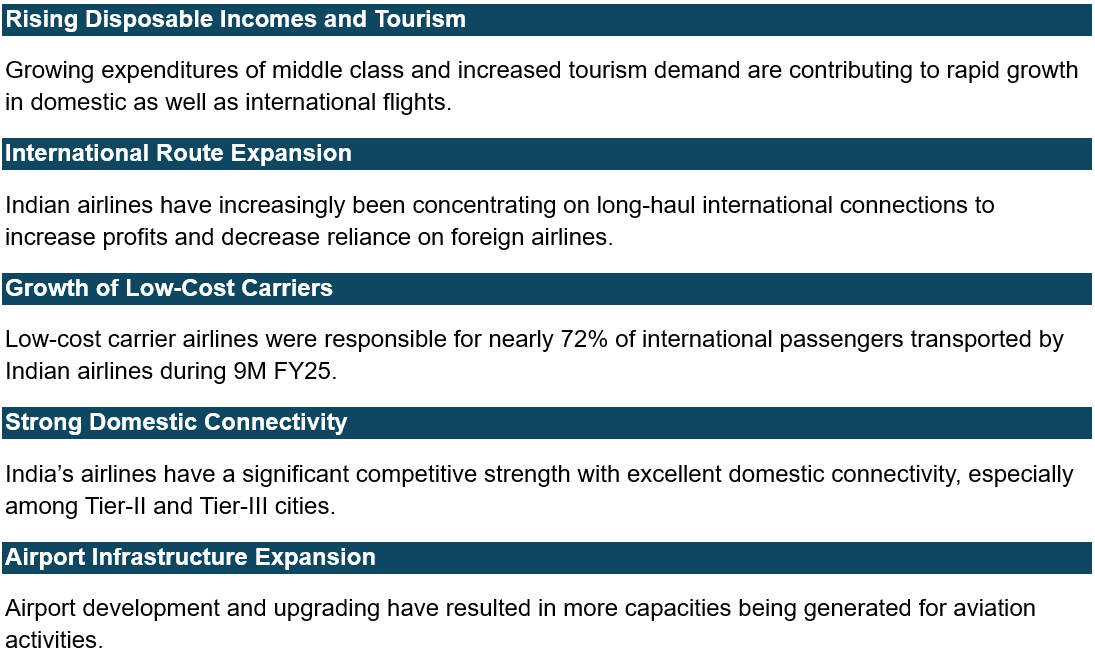
Outlook and Road Ahead
The aviation industry in India is expected to see strong growth due to the rise in aircraft, airport construction and international passenger traffic. According to CRISIL Ratings, Indian airlines are expected to carry close to 50% of passengers in India by FY28 owing to an increase in aircraft, introduction of international routes, and improved domestic feeder service. Furthermore, it is projected that in FY25 and FY26, ICRA expects a higher growth rate for international passenger traffic compared to domestic passenger traffic due to the increased volume of tourism, involvement of the government, and operating international routes by Indian airlines. Airport constructions, increasing usage of air transport in smaller cities, and the expansion of international flight connectivity are key factors driving the robust growth of the aviation industry in India.
FAQs
What is driving the growth of India’s aviation industry?
Rising passenger traffic, increasing disposable incomes, airport infrastructure expansion, regional connectivity initiatives and large-scale fleet additions by Indian airlines are major factors driving the growth of India’s aviation sector.
What is the future growth potential of India’s aviation market?
India is expected to remain one of the world’s fastest-growing aviation markets. Under Aviation Vision 2047, the government aims to expand the country’s airport network to nearly 350-400 airports, while international and domestic passenger traffic is projected to witness strong long-term growth.
How is the UDAN scheme supporting aviation growth?
The Regional Connectivity Scheme (RCS)-UDAN is improving air connectivity to underserved and unserved regions across India. The initiative is helping strengthen regional connectivity, tourism, trade and economic integration by expanding access to affordable air travel.
Why are Indian airlines expanding international routes?
Indian airlines are expanding international operations due to rising outbound tourism, growing business travel demand, increasing fleet capacity and stronger domestic feeder connectivity. Airlines are also launching direct long-haul flights to reduce dependence on foreign transit hubs.
What are the key challenges facing India’s aviation industry?
High aviation turbine fuel (ATF) costs, aircraft delivery delays, airport congestion, supply-chain disruptions and global geopolitical uncertainties remain major challenges for the aviation sector.
Partners