SEARCH
RECENT POSTS
Categories
- Agriculture (40)
- Automobiles (21)
- Banking and Financial services (36)
- Consumer Markets (58)
- Defence (6)
- Ecommerce (21)
- Economy (72)
- Education (14)
- Engineering (9)
- Exports (22)
- Healthcare (25)
- India Inc. (10)
- Infrastructure (31)
- Manufacturing (34)
- Media and Entertainment (17)
- Micro, Small & Medium Enterprises (MSMEs) (16)
- Miscellaneous (31)
- Perspectives from India (37)
- Pharmaceuticals (5)
- Railways (5)
- Real Estate (20)
- Renewable Energy (19)
- Research and Development (12)
- Retail (2)
- Services (8)
- Startups (16)
- Technology (66)
- Textiles (8)
- Tourism (16)
- Trade (9)
Authors






How Recycling and Sustainable Manufacturing Are Reshaping the Paper Industry in India
- Oct 29, 2026, 17:30
- Manufacturing
- IBEF
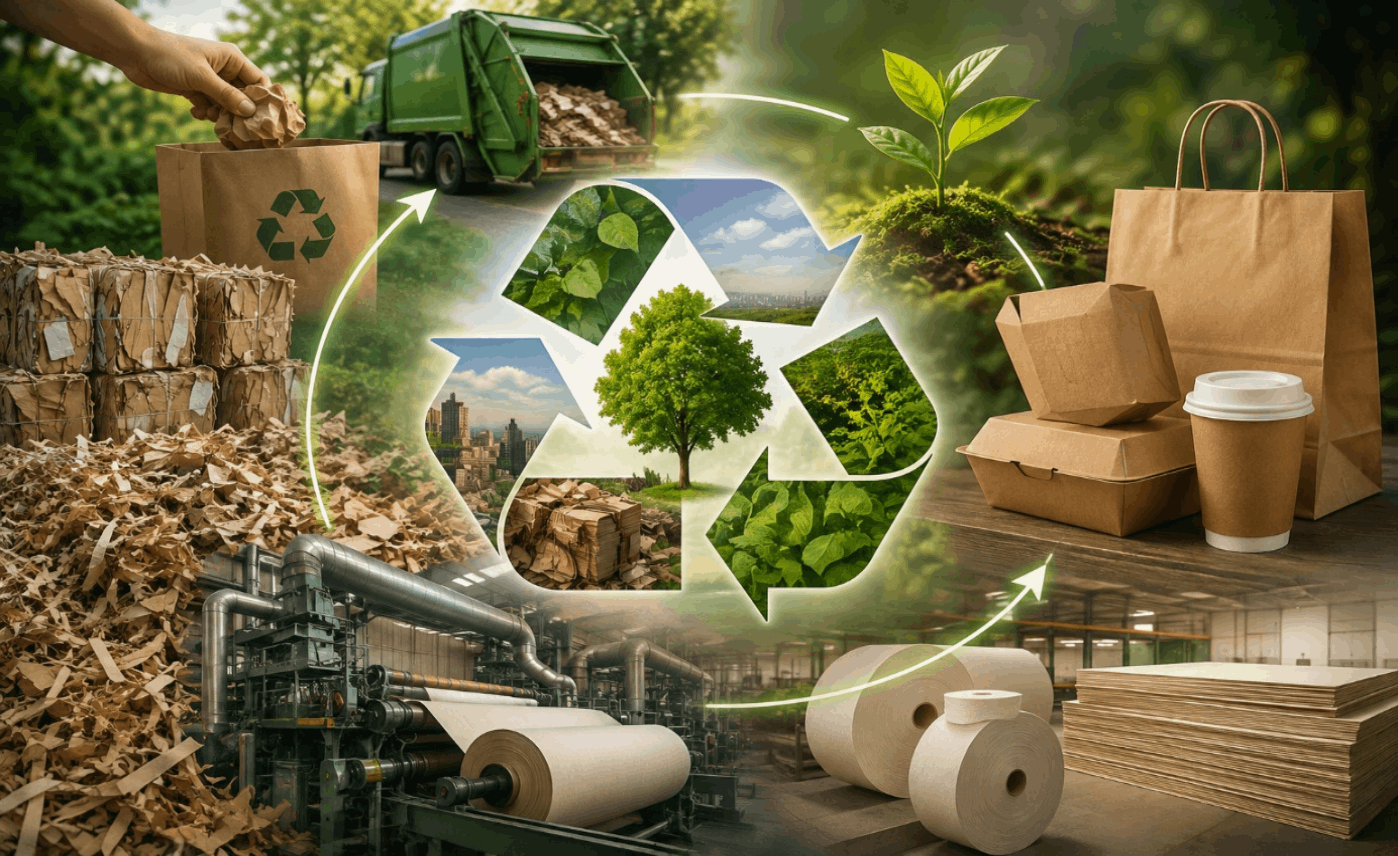
India’s paper industry is undergoing a significant shift in its approach to raw materials and manufacturing. With demand for paper and paperboard continuing to grow, manufacturers are increasingly integrating recovered paper, recycled fibre and agricultural residues into their production processes.
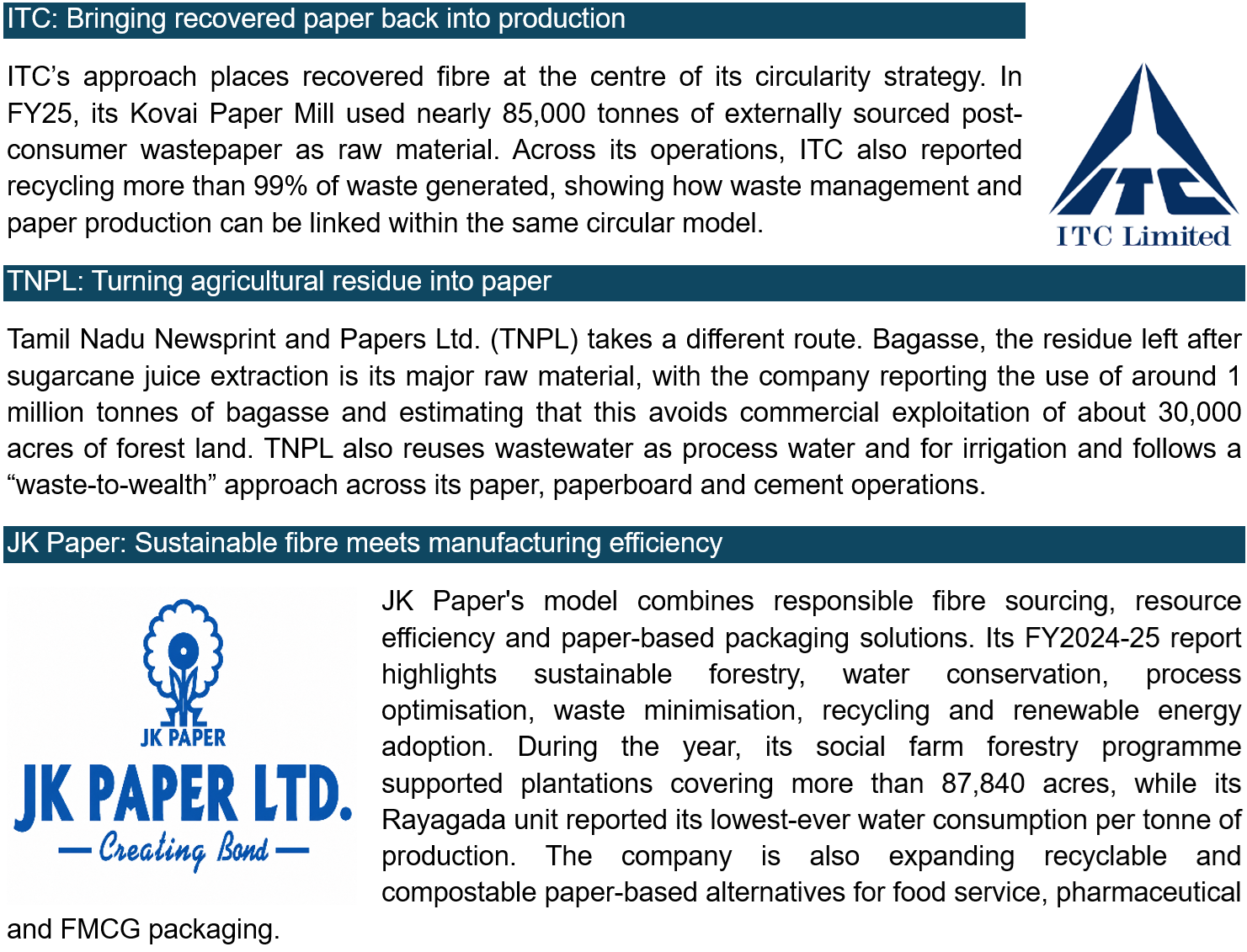
This transition is driving the industry towards a more circular manufacturing model, where waste materials are reintroduced into the value chain as productive inputs. For example, ITC’s Kovai Paperboards division used 85,000 tonnes of external wastepaper in FY25, while Tamil Nadu Newsprint and Papers Ltd. (TNPL) uses sugarcane bagasse as a key raw material for paper production.
These developments reflect a broader transformation in India’s paper manufacturing sector. Sustainability is increasingly influencing decisions at the raw-material and production levels, with manufacturers focusing on reducing dependence on virgin fibre, improving resource efficiency and expanding the use of recycled and alternative materials.
Rising Demand and Recycling Drive India’s Transition Towards a More Sustainable Paper Industry
The paper industry in India is entering FY27 in good condition with strong demand and a focus on sustainable production. According to the data provided by member companies of the Indian Paper Manufacturers Association (IPMA), the production of 5.21 million tonnes out of the total installed capacity of 5.37 million tonnes was achieved during FY26, making the capacity utilization of 97.01%. This proves high demand for paper products.
Packaging is the main area that is expected to experience growth, as it accounts for 65% of the whole paper market in India. Packaging paper and paperboard segment grew by 7.68% in FY25, which occurred due to the rising demand for e-commerce, food processing, organized retail, and consumer goods. Total consumption of paper in India grew from 23.04 million tonnes in FY24 to 23.84 million tonnes in FY25.
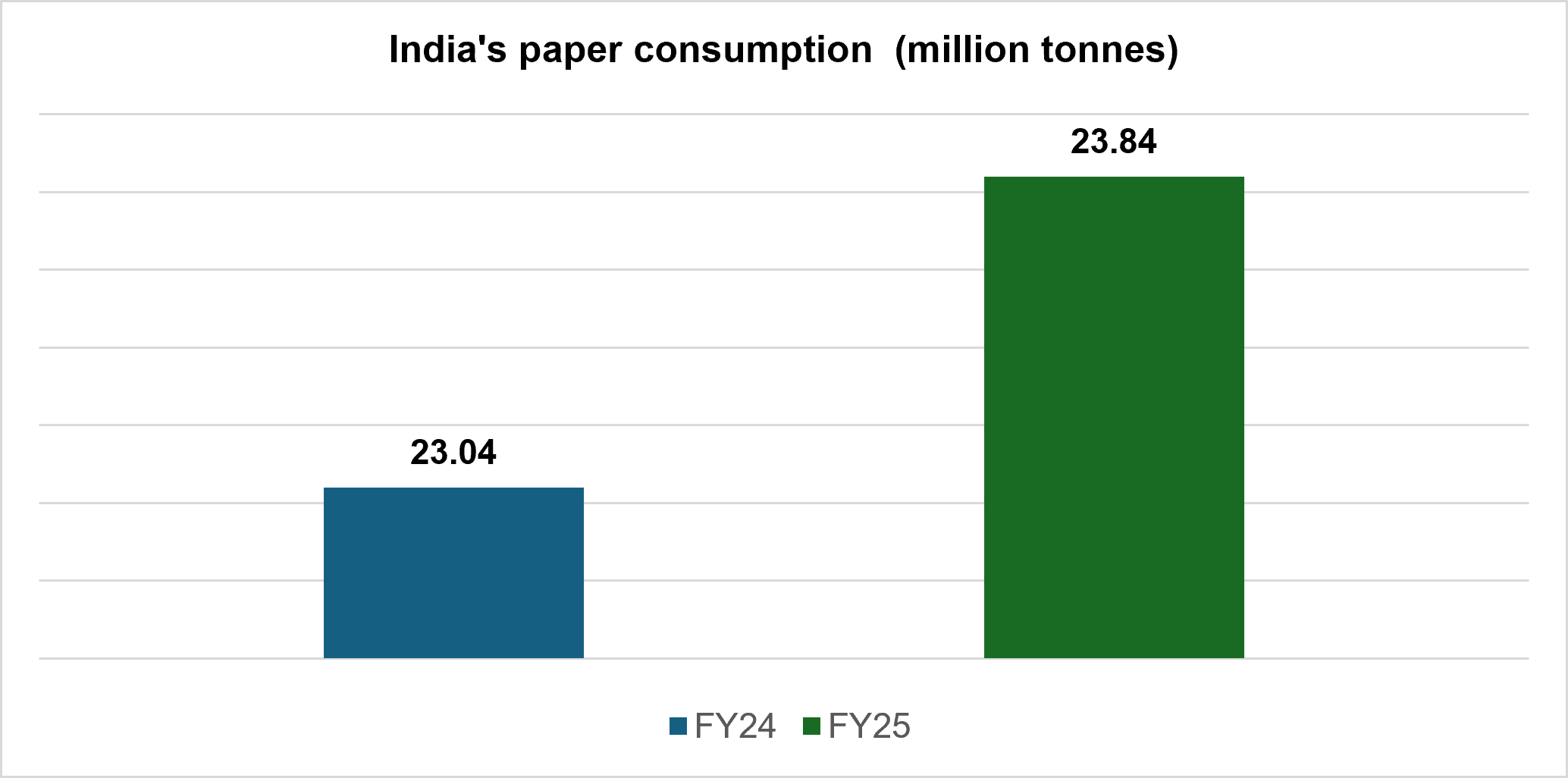
Source: Central Pulp & Paper Research Institute (CPPRI)
Despite such growth, there is still a lot of room left for increasing paper consumption in the country. Per capita consumption is 16 kg in comparison with average 57 kg per capita consumption globally, providing great chances for growth of the industry through satisfying rising demand and sustainable production.
The trends are also noticeable in emerging paper segments. Consumption of tissue paper has increased by 12.88% in FY25, while consumption of cup stock increased by 8.50%. The reason for the latter one is rising hygiene and use of paper alternatives in food and beverages packaging.
The First Big Shift: Wastepaper Is Becoming a Valuable Raw Material
One of the most significant transformations that will take place in the Indian paper industry may happen even before a sheet of paper is made. Ecosystem dynamics show that the ingredients used in the mill are changing. Instead of using only virgin wood fiber, the manufacturers are increasingly relying on the use of recovered paper and agriculture residues as industrial raw materials.
The scale of change is considerable. In 2024-25, around 76% of India's total paper output was based on recovered paper and recycled fiber, 18-20% on wood and bamboo, and 6-8% on agro-residues like bagasse and wheat straw.
ITC provides a tangible example of this circular model. In FY25, the Kovai Paper Mill used up almost 85,000 tonnes of external wastepaper as the source of input material. Essentially, the paper that had been used somewhere else was turned into new paperboards and specialty papers.
But circular manufacturing can also involve more than just paper-to-paper recycling. The company Tamil Nadu Newsprint and Papers Ltd. (TNPL) provides a good illustration: the use of agricultural waste to make paper. As one of the key raw materials, it uses bagasse, which is the fibrous residue left after juice is squeezed out of sugarcane. It uses around 1 million tonnes of bagasse, thus saving 30,000 acres of forest from commercial exploitation.
Also, it shows how circularity can be applied to more than just the initial raw material: wastepaper is used in making pulp, and internal mill waste, such as lime sludge and deinked pulp sludge, is reused to make cement.
Thus, the question is not anymore whether it is possible to recycle paper, but whether India is able to create the infrastructure for collection, segregation, sorting, and processing of the paper to ensure a steady supply of mills with quality recovered fiber. In fact, the forthcoming implementation of phased recycling targets for paper packaging under EPR regulations starting from April 2026 can become another evidence for such an ecosystem.
The Paper Mill Is Becoming a Resource-Recovery Plant
Sustainability in the Indian paper manufacturing industry involves much more than just choice of raw material but encompasses management of fiber, water, energy, and production waste during the whole production process.
An improvement in the efficiency of water usage has been observed in Emami Paper Mills, which decreased its water consumption from 12.6 m³ per tonne in FY22 to 10.88 m³ per tonne in FY25. Moreover, the company uses around 3,000 m³ of treated effluent daily for its internal requirements and implemented additional steps which help save several hundred m³ of fresh water on a daily basis.

Energy and waste recovery are becoming increasingly interconnected. Tamil Nadu Newsprint and Papers Ltd. (TNPL) reports 100% renewable energy across its facilities and a 42% reduction in carbon footprint since 2020. In FY25, its bio-methanation plants generated 79.70 lakh Nm³ of methane, replacing furnace oil and imported coal in its operations.
The same circular approach extends to production residues. In FY25, TNPL used around 1.21 lakh tonnes of solid waste, including lime sludge, fly ash and deinked pulp sludge, in its cement plant. These materials accounted for about 69% of the raw material required to produce 1.77 lakh tonnes of cement.
The Factory-to-Shelf Connection: Why Sustainable Packaging Matters
India's paper industry is more closely associated with post-production operations, since the growth in manufacturing, food processing, pharmaceuticals, FMCG, organized retail, and e-commerce results in increasing the demand for packaging material to cater to the needs of packing, transport, and delivery. The scale of this opportunity is visible in the numbers: India's packaging industry is set to achieve a value of Rs. 8.5 lakh crore (US$ 92 billion) by FY2030, growing at a CAGR of 9%, according to the Avendus Capital report quoted by IBEF. Growth is driven by industries such as food and beverages, pharmaceuticals, personal care, agriculture, consumer durables, and e-commerce.
Paper and paperboard play a critical role within this context. Around 76% of India's paper output in 2024-25 is based on recovered paper and recycled fiber. As for the end-use breakdown, it makes it clear why there is so much demand for packaging: food processing takes 45% share of packaging materials and machinery end-user volume, pharmaceuticals follow with 25% while personal and homecare, hot beverages, and industrial products contribute with 10% each.
Companies Are Taking Different Routes to the Same Goal
There is no single blueprint for making India’s paper industry more sustainable. Different manufacturers are addressing different parts of the resource equation from where fibre comes from to how efficiently water and energy are used and what happens to waste after production.
From Waste to Compliance: How Regulation Is Reshaping Paper Packaging
India’s circular-economy push is becoming more measurable. The Solid Waste Management Rules, 2026, which came into effect on April 1, 2026, make source segregation mandatory across four waste streams and bring stronger tracking and accountability into the waste-management system. Importantly for the paper industry, the rules explicitly integrate circular-economy and Extended Producer Responsibility (EPR) principles.
According to the draft Environment Protection (Extended Producer Responsibility for Packaging made from paper, glass and metal as well as sanitary products) Rules, 2024, the minimum recycling target would increase from 70% in FY2026-27 to 100% from FY2029-30 onwards. The draft also proposed mandatory recycled-content targets for paper packaging, starting at 40% in FY2026-27 and increasing to 70% from FY2029-30 onwards.
This directly creates an interrelation between packaging sold and the need to ensure post-use results and the use of recycled content in new packaging. As for the economic effect, there may be positive effects throughout the supply chain due to increased recovery requirements. There could be higher demand for collection systems, sorting and processing facilities, recyclers, suppliers of recycled fibre, testing equipment, and traceability systems. Moreover, the existing EPR ecosystem in India shows this tendency: up to 4,574 registered recyclers have processed 417.57 lakh MT of waste as of March 2026.
Outlook and Road Ahead
India’s paper industry is entering a phase where growth and sustainability are becoming increasingly interconnected. Rising packaging demand is expanding the market for paper and paperboard, while recovered paper and agricultural residues are becoming important alternatives to conventional fibre. At the mill level, companies are also looking beyond raw materials to improve water efficiency, renewable energy use and waste recovery. Meanwhile, tighter recycling and recycled-content requirements are creating a stronger commercial incentive to keep paper packaging within the production cycle.
The significance of this shift goes beyond reducing waste. It is changing the economics of the industry. Wastepaper can become raw material, agricultural residue can become fibre, process waste can become a useful input, and recycled packaging can feed the next manufacturing cycle.
FAQs
Why is paper recycling important for India’s circular economy?
Paper recycling helps reduce dependence on virgin fibre, diverts waste from landfills, conserves forests, and enables wastepaper to be reused as a valuable raw material. It also supports India’s transition towards a circular economy by keeping paper packaging within the production cycle.
How is sustainable packaging contributing to the growth of India’s paper industry?
Growing demand from food processing, pharmaceuticals, FMCG, organised retail and e-commerce is increasing the need for paper-based packaging. India’s packaging industry is projected to reach Rs. 8.5 lakh crore (US$ 92 billion) by FY2030, creating further opportunities for paper and paperboard manufacturers.
How much of India’s paper production is based on recycled fibre?
Around 76% of India’s total paper output in FY25 was based on recovered paper and recycled fibre, highlighting the growing role of circular manufacturing in the industry.
How are paper mills improving resource efficiency?
Paper manufacturers are focusing on reducing water consumption, increasing renewable energy use and recovering production waste. TNPL, for instance, reports 100% renewable energy across its facilities and a 42% reduction in carbon footprint since 2020.
How is regulation supporting recycling in India’s paper packaging industry?
India’s evolving waste-management and EPR framework is increasing recycling and recycled-content requirements for paper packaging. The draft EPR rules proposed increasing the minimum recycling target from 70% in FY27 to 100% from FY30, alongside higher recycled-content requirements.
Partners