SEARCH
RECENT POSTS
Categories
- Agriculture (39)
- Automobiles (20)
- Banking and Financial services (36)
- Consumer Markets (57)
- Defence (6)
- Ecommerce (21)
- Economy (72)
- Education (14)
- Engineering (9)
- Exports (22)
- Healthcare (25)
- India Inc. (10)
- Infrastructure (31)
- Manufacturing (33)
- Media and Entertainment (17)
- Micro, Small & Medium Enterprises (MSMEs) (16)
- Miscellaneous (31)
- Perspectives from India (37)
- Pharmaceuticals (5)
- Railways (4)
- Real Estate (20)
- Renewable Energy (19)
- Research and Development (12)
- Retail (1)
- Services (7)
- Startups (16)
- Technology (66)
- Textiles (8)
- Tourism (16)
- Trade (9)
Authors






Smart Warehousing in India: Role of Automation and IoT in Supply Chains
- Aug 28, 2026, 17:05
- Manufacturing
- IBEF
Warehouses have been seen as a critical element of the contemporary logistics environment in India, ensuring smooth transit of goods from manufacturing through retail and e-commerce, agriculture, and exports. The development of modern technologies along with the focus of organizations on efficiency, speed, and visibility has led to the evolution of traditional warehouses to the use of modern logistics facilities using automation, IoT, artificial intelligence, and data analytics. Such changes are possible due to the rise in e-commerce activities, growth in manufacturing operations, the expectation of fast delivery among consumers, and logistics sector reforms by the government. The use of Warehouse Management Systems (WMS), Automated Storage and Retrieval Systems (ASRS), robotics, RFID tracking, IoT sensors, and digital twins helps to improve accuracy of inventory, reduce expenses, and increase supply chain visibility. At the same time, PM GatiShakti, the National Logistics Policy (NLP) and the Unified Logistics Interface Platform (ULIP) contribute to the creation of the integrated and connected logistics system of India. As the country strengthens its position as a manufacturing and consumer power, smart warehousing will become a major factor in increasing logistics efficiency in the future of India.
India's Warehousing Landscape
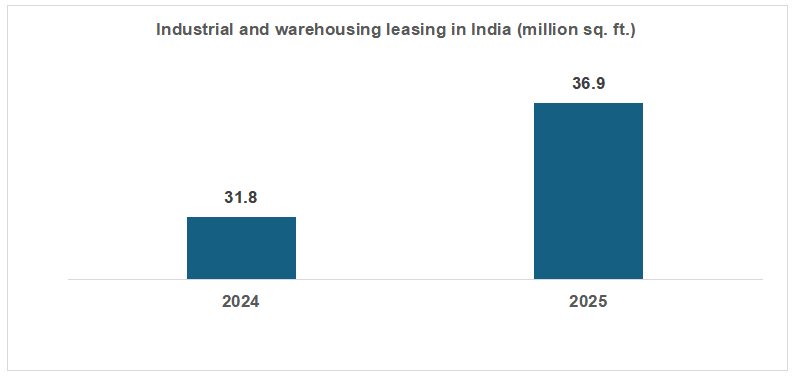
The Indian warehousing industry is currently developing dynamically due to the expansion of e-commerce, manufacturing, retail, and third-party logistics (3PL). In 2025, the leasing volume of industrial and warehousing space in the top eight cities of India amounted to a record high 36.9 million square feet, increasing by 16% compared to the previous year, as the share of 3PL companies was about one-third of the total demand. In the first quarter of 2026, the leasing volume exceeded 18 million square feet due to growing demand in manufacturing, engineering, and e-commerce segments. The stock of warehousing in India also increased and currently amounts to approximately 533 million square feet, including 100 million square feet in Tier II and Tier III cities.
The infrastructure created by the government still plays a critical role in the development of the segment. By December 2024, there were 2,278 owned and hired godowns that could store 402.62 lakh metric tonnes of goods. Besides, there were more than 700 warehouses controlled by the Central Warehousing Corporation (CWC) which could store approximately 103 lakh metric tonnes of goods.
Modernization efforts in warehousing are being aided by the general improvements in the logistics industry's policy reform. According to the Government of India (2024), the logistics sector constitutes around 14.4% of India's GDP and provides employment to more than 22 million people. Thus, it plays the primary role in facilitating economic development and supply chain management in the country. National Logistics Policy, PM GatiShakti, and multimodal logistics parks are helping create a connection between production centers, warehouses, and consumption markets. Thus, Grade-A warehouses with automation, IoT monitoring, and advanced management technologies are becoming popular in the country, which allows them to become full-fledged logistics hubs for contemporary supply chains.
Government Initiatives Supporting Smart Warehousing and Logistics
Public policies have become an essential driving force behind the modernization of the warehousing and logistics industry in India. The NLP was published in September 2022 and aimed to develop a technologically integrated, efficient, and resilient logistics ecosystem. One of the main goals of this policy is to improve the modern warehousing system by optimizing its spatial distribution, standardization, digitization, and automation in the entire logistics value chain. Additionally, NLP emphasises the need to introduce tracking systems to increase traceability, transparency, and visibility in the logistics process and use analytics-based approach to make decisions. In order to implement this policy, the Indian government has introduced several digital initiatives simultaneously, including the Unified Logistics Interface Platform (ULIP), Ease of Logistics Services (E-Logs) platform, e-Handbook on Warehousing, and logistics-specific training programs on the iGOT platform. The ambitious targets of this policy include reduction of logistics costs to global standards and raising India's Logistics Performance Index (LPI) ranking among the top 25 countries worldwide by 2030.
Parallel with NLP, PM GatiShakti, which was launched in October 2021, aims to improve the integration of infrastructure planning in multimodal transportation and strengthen connections. PM GatiShakti brings together many ministries and states in one digital planning platform that can help to plan and execute integrated infrastructure development projects in order to ensure smooth cargo movement. With the help of geospatial technologies and integrated planning, the program seeks to improve last-mile connectivity, resolve logistics bottlenecks, and optimise infrastructure investments. As of October 2024, more than 44 central ministries and 36 states and union territories joined this platform with more than 1,600 data layers integrated. This program is expected to increase warehousing connectivity and foster integrated logistics ecosystem development in India.
The Unified Logistics Interface Platform (ULIP), launched through the National Logistics Policy in 2022, is increasingly playing the role of India's logistics integration and supply chain visibility platform. Launched as a single-window logistics platform for India, ULIP facilitates smooth data interchange between the government bodies and the private players at various stages along the logistics value chain. More than 30 digital platforms from different ministries/departments have been integrated on the ULIP platform, providing real-time visibility on India's transport logistics network, including roads, railways, airlines, and marine transport. Up until August 2025, more than 160 crore digital transactions have been supported on the ULIP platform by way of API integration, facilitating fast decision-making and improved operational efficiencies. ULIP is helpful in streamlining the process of compliance, cargo tracking, documentations, approvals and improving visibility along the logistics value chain. Through the provision of end-to-end visibility along the supply chain, ULIP is expected to boost the adoption of smart warehousing and integrated logistics across India.
Growth Drivers and Key Trends
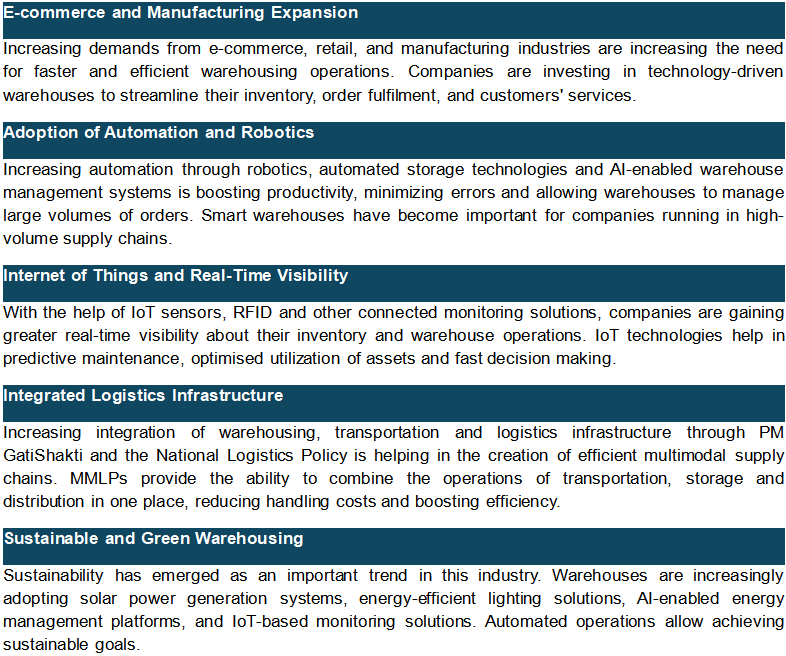
The following growth drivers are driving the adoption of smart warehousing technologies and enhancing the efficiency of the supply chains in India.
Outlook and Road Ahead
The warehousing industry of India is about to enter another phase of its evolution that will be marked by automation, digitization, and intelligent supply chain management. With more and more companies investing in artificial intelligence, Internet of Things (IoT), robotics, and analytics tools, warehouses will become not just the places for storing goods but also valuable logistics resources enabling full-fledged end-to-end supply chain visibility. Government programs such as National Logistics Policy, PM GatiShakti, and the Unified Logistics Interface Platform (ULIP) create favourable conditions for this evolution thanks to their focus on improved multimodal connectivity, technology adoption, and integration of the logistics ecosystem. At the same time, the steady growth of e-commerce, manufacturing, organised retailing, and exports will ensure the demand for smart warehousing infrastructure throughout the country. In the upcoming years, investments in Grade-A warehousing, automation tools, sustainable logistics infrastructure, and digital platforms will likely increase rapidly. With India moving towards becoming a world-class manufacturing and logistics hub, the importance of smart warehousing is going to become even more pronounced due to the ability to cut logistics costs, increase supply chain resiliency, and boost competitiveness of Indian businesses in international markets.
FAQs
What is smart warehousing?
Smart warehousing refers to the use of advanced technologies such as automation, Internet of Things (IoT), artificial intelligence (AI), robotics, Warehouse Management Systems (WMS) and data analytics to improve inventory management, operational efficiency, accuracy and supply chain visibility.
How are automation and IoT transforming India's warehousing sector?
Automation and IoT enable real-time inventory tracking, predictive maintenance, automated storage and retrieval, robotics-assisted order fulfilment and data-driven warehouse management. These technologies help reduce operational costs, improve productivity and enhance supply chain efficiency.
Which government initiatives are supporting smart warehousing in India?
Key initiatives include the National Logistics Policy (NLP), PM GatiShakti and the Unified Logistics Interface Platform (ULIP). These initiatives are strengthening digital infrastructure, improving multimodal connectivity and promoting the adoption of technology-enabled logistics and warehousing solutions.
What technologies are commonly used in smart warehouses?
Smart warehouses utilise technologies such as Warehouse Management Systems (WMS), Automated Storage and Retrieval Systems (ASRS), robotics, RFID, IoT sensors, artificial intelligence, digital twins and cloud-based analytics to improve inventory accuracy, warehouse operations and supply chain visibility.
What are the future growth prospects for smart warehousing in India?
Growing demand from e-commerce, manufacturing, organised retail and third-party logistics providers, along with continued government investment in digital infrastructure and logistics reforms, is expected to accelerate the adoption of smart warehousing and strengthen India's position as a global manufacturing and logistics hub.
Partners