SEARCH
RECENT POSTS
Categories
- Agriculture (39)
- Automobiles (21)
- Banking and Financial services (36)
- Consumer Markets (58)
- Defence (6)
- Ecommerce (21)
- Economy (72)
- Education (14)
- Engineering (9)
- Exports (22)
- Healthcare (25)
- India Inc. (10)
- Infrastructure (31)
- Manufacturing (33)
- Media and Entertainment (17)
- Micro, Small & Medium Enterprises (MSMEs) (16)
- Miscellaneous (31)
- Perspectives from India (37)
- Pharmaceuticals (5)
- Railways (5)
- Real Estate (20)
- Renewable Energy (19)
- Research and Development (12)
- Retail (1)
- Services (8)
- Startups (16)
- Technology (66)
- Textiles (8)
- Tourism (16)
- Trade (9)
Authors






India Men’s Grooming Industry: Expanding Product Categories and Consumer Base
- Mar 11, 2026, 17:20
- Consumer Markets
- IBEF
India’s men’s grooming industry is undergoing a significant transformation, evolving from a limited, function-led category into a lifestyle-driven market shaped by changing social norms, rising disposable incomes, and increasing exposure to global beauty and wellness trends. Today, Grooming is an essential component of self-expression, confidence, and professional identity among Indian men.
The shift is being driven by urbanisation, digital influence, and a younger demographic that is increasingly open to experimentation. Social media, e-commerce platforms, and celebrity endorsements have played a pivotal role in normalising grooming conversations and broadening awareness across metros as well as tier 2 and tier 3 cities. As a result, men’s grooming in India has moved from the periphery of personal care to becoming one of the fastest-growing segments within the broader beauty and personal care industry.
The journey: From shaving essentials to lifestyle-led grooming
Historically, the Indian men’s grooming market was dominated by a handful of categories such as shaving creams, razors, deodorants, and hair oils. Products were largely positioned around hygiene and basic maintenance, with minimal focus on skin health, styling, or personal aesthetics. Barbershops played a central role in grooming routines, while in-home product usage remained limited and functional.
Over the past decade, this landscape has changed rapidly. Exposure to international brands, the influence of global fashion and fitness trends, and increased participation of men in social and professional spaces have reshaped grooming expectations. Beards, once considered a low-maintenance style choice, have become a major grooming statement, driving demand for specialised beard oils, balms, washes, and trimmers. Similarly, skincare products such as face washes, moisturisers, sunscreens, serums, and anti-aging solutions have gained mainstream acceptance among male consumers.
The emergence of digital-first and D2C brands has further accelerated category expansion. Brands such as Beardo, Ustraa, Bombay Shaving Company, and The Man Company have built grooming narratives centered on masculinity, confidence, and modern lifestyles, breaking traditional stereotypes associated with male grooming. These brands have not only expanded product portfolios but also invested heavily in education-led marketing, explaining routines, ingredients, and benefits in a simplified manner.
Market outlook: past, present, and future
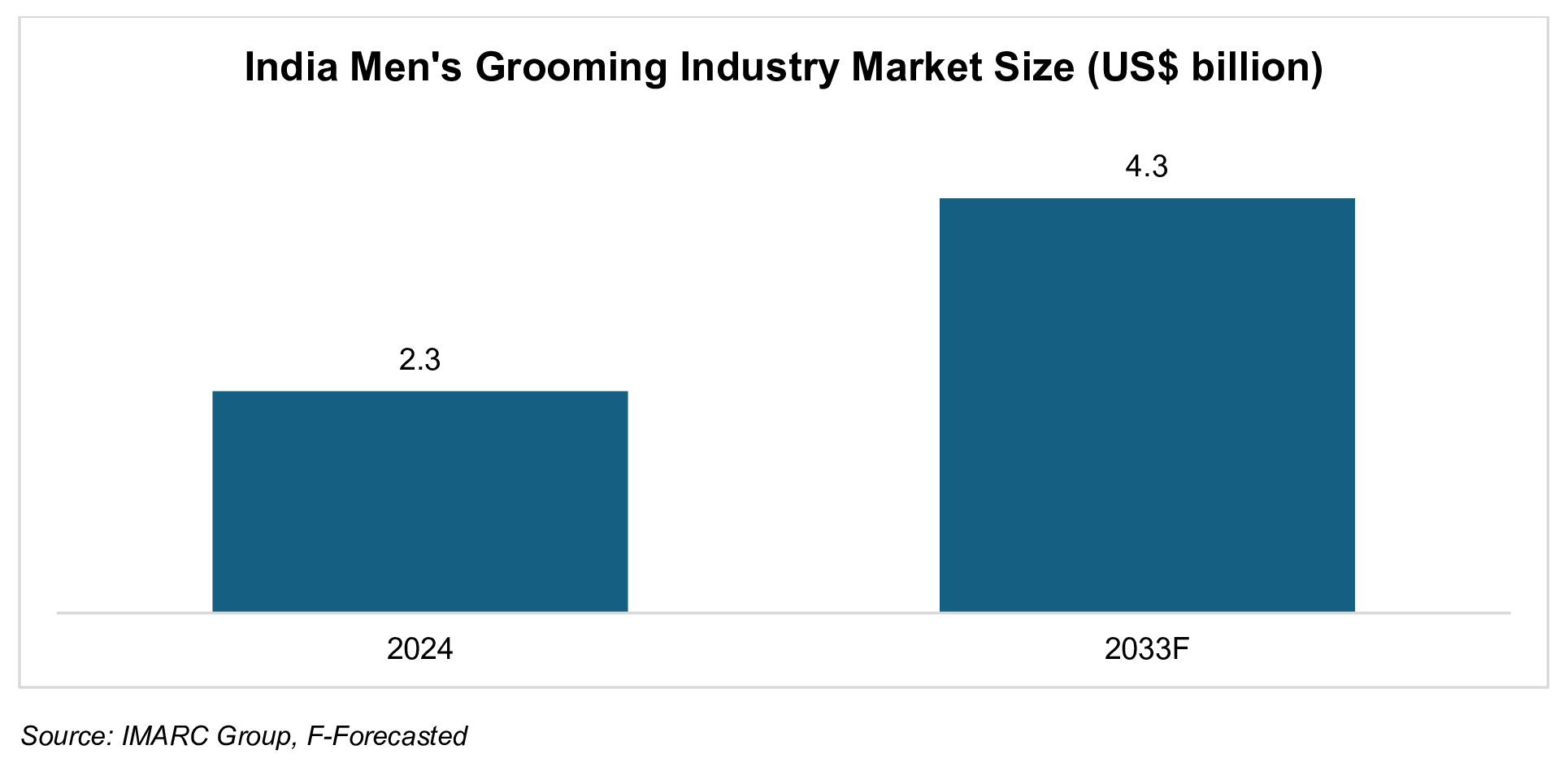
The men’s grooming market in India has demonstrated robust growth over the last few years and continues to outperform several other personal care segments. In 2024, the market was valued at approximately Rs. 20,500 crore (US$ 2.3 billion) and is expected to reach Rs. 38,300 crore (US$ 4.3 Billion) by 2033. This growth is significantly higher than the overall personal care market, reflecting the category’s relatively low penetration and strong headroom for expansion. This growth is significantly higher than the overall personal care market, reflecting the category’s relatively low penetration and strong headroom for expansion.
Haircare and deodorants currently contribute the largest share of revenues, owing to their widespread adoption and repeat usage patterns. However, skincare and beard care are emerging as the fastest-growing segments, supported by rising awareness around skin health, pollution-related concerns, and changing fashion preferences.
E-commerce has emerged as a critical growth channel, accounting for an estimated 30–35% of men’s grooming sales in urban India. Online platforms offer access to a wider assortment, enable product discovery, and allow brands to directly engage with consumers. At the same time, offline retail, including modern trade and salons, continues to play a key role in driving trial and trust, especially in non-metro markets.
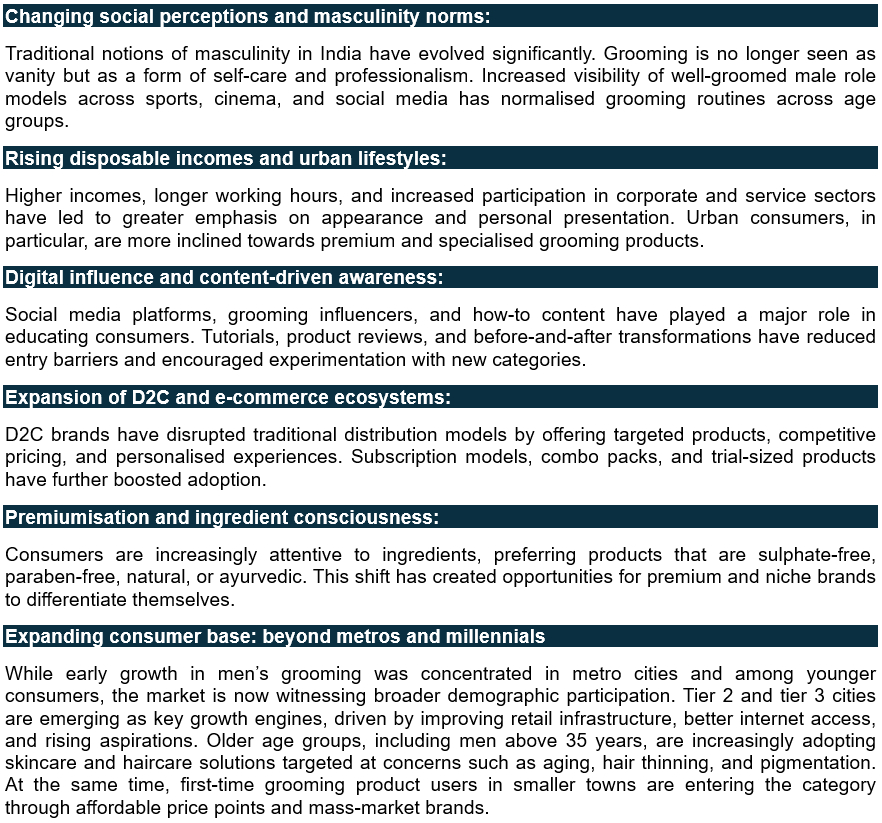
Key growth drivers
Innovations, initiatives, and opportunities
Product innovation remains central to sustaining momentum in the men’s grooming industry. Brands are investing in multifunctional products, such as all-in-one washes, hybrid skincare solutions, and grooming kits that simplify routines. There is also growing interest in wellness-oriented products, including anti-stress skincare, scalp health solutions, and grooming products infused with active ingredients.
Salons and barbershops are evolving into experience centres, offering premium grooming services and acting as offline touchpoints for product discovery. Collaborations between grooming brands and salons are creating omnichannel ecosystems that enhance brand visibility and consumer trust.
From a manufacturing perspective, localisation and contract manufacturing are helping brands optimise costs and improve supply chain efficiencies. Sustainability, though still nascent, is gaining traction through recyclable packaging, refill formats, and cruelty-free positioning.
The Road Ahead
The Indian men’s grooming industry stands at a pivotal point in its evolution. With strong tailwinds from demographic shifts, cultural acceptance, and digital enablement, the category is poised for sustained long-term growth. As grooming becomes increasingly intertwined with wellness, confidence, and self-expression, product portfolios are expected to become more sophisticated and personalised.
Future growth will likely be driven by deeper penetration in non-metro markets, continued premiumisation, and innovations that address Indian skin and hair needs. Brands that successfully balance education, affordability, and aspiration will be best positioned to capture market share. Much like the broader personal care industry, men’s grooming in India is transitioning from basic maintenance to a holistic lifestyle proposition, redefining how Indian men engage with self-care in the years to come.
FAQs
What is driving the growth of the men’s grooming industry in India?
The market is being driven by changing social norms, rising disposable incomes, digital influence, and increasing awareness of grooming as part of self-care and professional identity.
Which men’s grooming product categories are growing the fastest?
Beard care and skincare are the fastest-growing segments, supported by evolving fashion trends, skin health awareness, and demand for specialised products.
What role does e-commerce play in the men’s grooming market?
E-commerce has become a critical channel for product discovery, consumer education, and direct-to-consumer sales, especially for digital-first and premium brands.
Are tier 2 and tier 3 cities contributing to market expansion?
Yes, improving digital access, rising aspirations, and expanding retail infrastructure are making tier 2 and tier 3 cities key growth markets.
What is the current and projected size of India’s men’s grooming market?
The market was valued at approximately Rs. 20,500 crore (US$ 2.3 billion) in 2024 and is projected to reach Rs. 38,300 crore (US$ 4.3 billion) by 2033.
Partners