SEARCH
RECENT POSTS
Categories
- Agriculture (37)
- Automobiles (20)
- Banking and Financial services (36)
- Consumer Markets (57)
- Defence (6)
- Ecommerce (21)
- Economy (72)
- Education (14)
- Engineering (9)
- Exports (21)
- Healthcare (25)
- India Inc. (10)
- Infrastructure (31)
- Manufacturing (32)
- Media and Entertainment (16)
- Micro, Small & Medium Enterprises (MSMEs) (16)
- Miscellaneous (31)
- Perspectives from India (37)
- Pharmaceuticals (5)
- Railways (4)
- Real Estate (20)
- Renewable Energy (19)
- Research and Development (12)
- Retail (1)
- Services (7)
- Startups (16)
- Technology (66)
- Textiles (8)
- Tourism (16)
- Trade (9)
Authors






India’s Agri Value Chain Expansion through Nuts, Cocoa and Fisheries

- Jun 26, 2026, 18:10
- Agriculture
- IBEF
The agricultural industry in India is at a stage where it is moving from the approach that emphasizes quantity production to value addition through diversification into high-growth potential sectors such as nuts, cocoa and fisheries. This development is essential for India's agriculture value chain because the three sectors have huge export potential and increasing domestic demand owing to the change in eating habits worldwide. With rising incomes and changing consumer demands toward protein-rich food items and higher quality food products, nuts, cocoa and fisheries continue to witness steady demand in urban and semi-urban markets.
Nut items such as almonds, cashews and walnuts are no longer occasional foods but rather have become regular nutritional products for consumers due to increased health consciousness. In the case of cocoa, the growth potential is due to the rising importance of processed food and confectionery sectors in India and the localization of the cocoa item to avoid the cost of importing them. Fishery products form part of the fastest-growing sub-sector in the agriculture industry owing to favourable climate conditions, aqua farming and steady exports from the US, Europe and Southeast Asia.
The combination of supportive government policies and private sector investments is contributing to the further improvement of these value chains. Through cold storage facilities, processing, and digitisation of the supply chain, efficiency is improving while minimizing post-harvest losses. As India continues to grow into an international agricultural exporter, nuts, cocoa and fisheries play a major part.
India Market Overview and Growth
India’s agri value chain is steadily expanding beyond traditional staples into high-value horticulture, processed foods and export-oriented protein segments, with nuts, cocoa and fisheries emerging as major growth pillars. The broader food processing industry now accounts for nearly 32% of India’s total food market, reflecting the rapid rise of value addition, branding and organised supply chains across agricultural commodities. This expansion is also supported by cumulative Foreign Direct Investment (FDI) inflows of US$ 13.57 billion (Rs. 1,22,162 crore) in food processing between April 2000 and December 2024, underlining strong investor confidence in India’s evolving agri ecosystem.
Within this landscape, fisheries remain the strongest export-led segment, with India’s seafood exports reaching an all-time high of US$ 6.93 billion (Rs. 62,408 crore) in FY25, driven by frozen shrimp, fish and processed marine products. The cocoa value chain is also gaining scale as domestic chocolate manufacturing and premium confectionery demand expand. In FY25, India exported 45,489.28 MT of cocoa products worth US$ 308.38 million (Rs. 2,775.50 crore), signalling the increasing integration of cocoa into processed food exports.
The nuts category, which includes cashew processing and premium snacks sub-categories, is experiencing increased domestic demand as well as export performance. Both categories indicate India’s move toward processing-based agriculture and premium exports through improved farm-to- market linkages, providing a reliable route for agri exports growth till 2030.
Policy Landscape
There are many policy initiatives in India, which encourage the growth of high value agri segments through various initiatives that help in increasing the productivity levels, infrastructure development and exports. This includes several policies that emphasize value chain development through integration of farming activities, processing and marketing activities.
Through the Pradhan Mantri Matsya Sampada Yojana (PMMSY), India is focusing on the fisheries industry through investments in aquaculture infrastructure, cold chain development and disease management system improvements, therby increasing both production and export capacity.
The Agriculture Infrastructure Fund (AIF) initiative in India focuses on developing the post-harvest infrastructure for the industry, with the development of warehouses, cold storage and processing units to increase value realization in supply chains involving nuts and cocoa production.
The Production Linked Incentive (PLI) Scheme for food processing activities encourages the development of downstream value added products, such as ready-to-eat snacks, confectionery products and processed fish products, thereby increasing demand for raw material inputs, such as nuts and cocoa.
Further, efforts to promote exports by organizations such as Marine Products Export Development Authority (MPEDA) and other organizations promote the export capabilities of India in seafood products through certification programs, traceability and market entry.
In addition, the government is promoting farmer producer organizations (FPOs) for increased aggregation, improved bargaining capacity and direct access to markets for farmers involved in these high value agri sectors.
Key Drivers and Trends
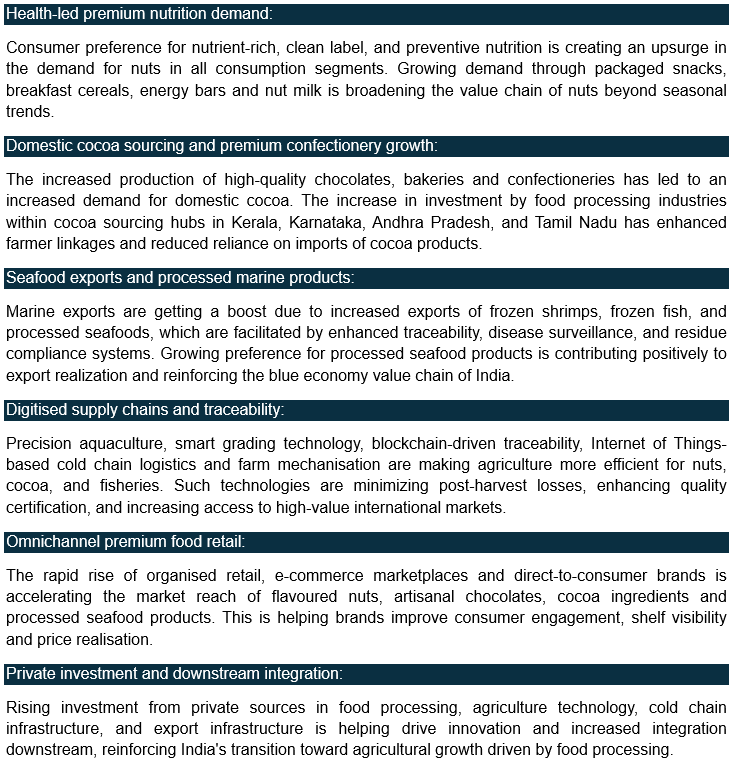
India’s agriculture value chain is experiencing a definite transition to premium-oriented growth through processing, with nuts, cocoa, and fisheries being some of the high value segments which have emerged due to changing consumer preferences, exportability, and robust domestic supply chain systems. With digitalisation of the supply chain, omni-channel retailing, and increasing investments, these segments are helping India position itself in the premium foods and blue economy space.
Outlook and Road Ahead
India’s agri value chain is entering a stronger phase of premiumisation, processing-led expansion and export diversification, with nuts, cocoa and fisheries expected to remain among the most scalable high-value segments through 2030. The continued rise in protein-rich snacking, premium confectionery and ready-to-cook seafood is likely to sustain domestic demand, while global buyers are increasingly favouring traceable and processed agri products sourced from reliable supply ecosystems.
Recent export momentum reinforces this trajectory. India’s marine product exports reached US$ 6.93 billion (Rs. 62,408 crore), while cocoa product exports crossed US$ 292.14 million (Rs. 2,629.33 crore) in FY25, reflecting stronger shipments to premium food manufacturing markets. Alongside this, the nuts segment continues to gain strength through expanding cashew processing, premium kernel exports and branded nut-based snacking categories.
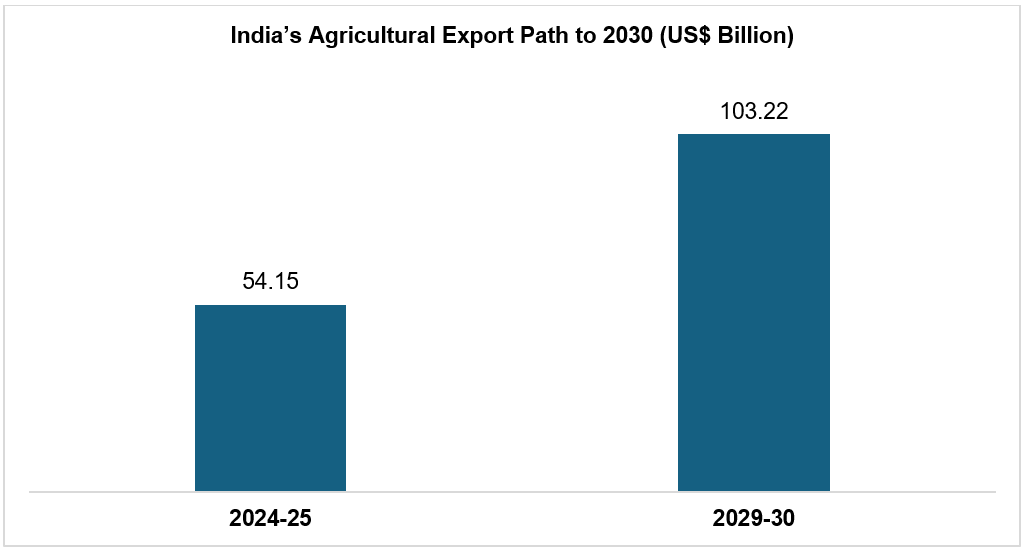
These trends are expected to deepen India’s position in high-value food trade over the coming years. With India’s agricultural and allied exports standing at US$ 54.15 billion (Rs. 4,87,366 crore) in FY25, the broader agri and processed food ecosystem is well-positioned to move closer to the US$ 103.22 billion (Rs. 9.29 lakh crore) milestone by FY30, supported by higher value addition in marine products, cocoa derivatives, premium nuts and health-focused packaged foods.
The next stage of development is likely to be powered by intelligent farm management through AI, traceability via blockchain technology, smarter cold chain logistics and more efficient processing facilities. Investments in export-focused logistics, consolidation of farmers and integration of food processing centres are likely to build greater resilience into these value chains. Given its natural resource advantages, increasing domestic premium food demand and favourable policies, India is poised to become one of the most dominant players in the global high-value agricultural commodities market by FY30.
FAQs
Why are nuts, cocoa and fisheries important to India’s agri value chain?
These segments generate higher value realisation than many traditional crops due to strong processing potential, premium domestic demand and export competitiveness. They also support farmer income diversification, better price discovery and stronger integration with food processing industries.
What is driving the growth of India’s fisheries value chain?
The fisheries segment is being driven by strong export demand for frozen shrimp, fish and processed seafood, along with government support under the Pradhan Mantri Matsya Sampada Yojana (PMMSY), better traceability systems and cold chain expansion. India’s marine exports reached US$ 6.93 billion (Rs. 62,408 crore) in 2024-25, highlighting the sector’s strong global positioning.
How is cocoa becoming a strategic agri segment in India?
Cocoa is gaining importance due to the expansion of India’s premium chocolate, bakery and confectionery industries. Rising domestic manufacturing is encouraging local sourcing clusters in southern states, reducing import dependence and supporting higher-value processed food exports.
What role does technology play in these value chains?
Technologies such as blockchain-led traceability, smart cold storage, precision aquaculture, AI-enabled farm management and digital grading systems are improving quality assurance, reducing post-harvest losses and strengthening access to premium domestic and export markets.
How are policy measures supporting value chain expansion?
Government schemes such as PMMSY, the Agriculture Infrastructure Fund (AIF), Production Linked Incentive (PLI) for food processing and Farmer Producer Organisation (FPO) promotion are supporting infrastructure creation, aggregation, value addition and export readiness across these segments.
What is the outlook for India’s high-value agri exports by 2030?
With stronger value addition in marine products, cocoa derivatives, premium nuts and health-focused packaged foods, India’s broader agri and processed food exports are expected to move closer to the US$ 104.33 billion (Rs. 9,39,048 crore) milestone by 2030, supported by processing infrastructure, logistics upgrades and rising global demand.
Partners