SEARCH
RECENT POSTS
Categories
- Agriculture (39)
- Automobiles (20)
- Banking and Financial services (36)
- Consumer Markets (57)
- Defence (6)
- Ecommerce (21)
- Economy (72)
- Education (14)
- Engineering (9)
- Exports (22)
- Healthcare (25)
- India Inc. (10)
- Infrastructure (31)
- Manufacturing (33)
- Media and Entertainment (17)
- Micro, Small & Medium Enterprises (MSMEs) (16)
- Miscellaneous (31)
- Perspectives from India (37)
- Pharmaceuticals (5)
- Railways (4)
- Real Estate (20)
- Renewable Energy (19)
- Research and Development (12)
- Retail (1)
- Services (7)
- Startups (16)
- Technology (66)
- Textiles (8)
- Tourism (16)
- Trade (9)
Authors






India’s Fresh Powerhouse: How Fruits and Vegetables Are Reshaping Agri-Exports
- Feb 25, 2026, 11:20
- Agriculture
- IBEF
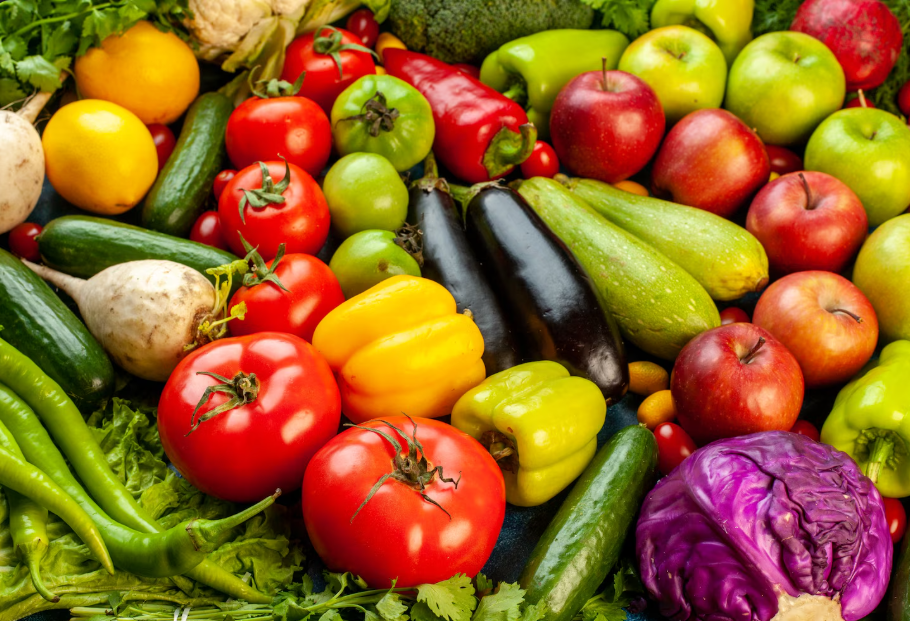
From a traditional global supplier of staples including rice and wheat, India sees a clear structural change in its agricultural export basket as it emerges as a "fresh powerhouse." This evolution marks a key turning point from the cereals-dominated Green Revolution to the "Golden Revolution" with fruits and vegetables taking over as leading growth drivers. This creation of value is predicted because of a huge, four-fold increase in production since 1991, with projections reaching record levels of 367.72 million tonnes in 2024-25 and firmly positioning India as the second largest global producer of horticultural commodities.
Changing consumer choices, rising disposable income and smart government support through projects such as the Integrated Development of Horticulture are driving this demand. Significantly, horticultural production has grown faster than food grains recently, pointing to a deliberate shift from mere “food security” to offering fruits and vegetables as a “nutritional bonanza.” For small and marginal farmers, such diversification is crucial, providing a route to better liquidity and income realisation significantly above conventional crops. By harnessing its varied topography to support a full-year crop cycle, India isn’t just positioning the sector as an agricultural alternative; but rather, a necessary engine of sustained economic growth.
Market size
The Indian greenhouse horticulture market is estimated at US$ 1.24 billion in 2024 and is projected to reach US$ 3.08 billion by 2033 (at a CAGR of 9.84 %). Horticulture contributes over Rs. 1,00,000 crore (US$ 11.12 billion) in annual value and has become a key component of India’s agri-transformation journey. This expansion is supported by a large, integrated production base, with the third advance estimate by Ministry of Agriculture and Farmers Welfare forecasting India’s aggregate horticulture output to rise to 369.05 million tonnes in 2024-25 from 354.74 million tonnes in 2023-24. The fresh food segment continues to dominate domestic consumption, but the industry is undergoing a shift, driven by rising agricultural exports which reached US$ 3.8 billion in FY25, up 5.67% from the previous year and a rapidly growing food processing sector. Major factors driving the sector include growing health consciousness among consumers, increasing organised retail and initiatives such as Pradhan Mantri Kisan SAMPADA Yojana to eliminate post-harvest losses and improve value addition in food & other agri produce.
Growth drivers: Demographic changes and dietary diversification
India’s horticulture boom is an outcome of rising incomes and urbanization, with changes in diets, from cereals to vitamins and minerals rich food baskets.
Key factors driving this industry are:
- Changing food habits: Growing health awareness among the urban consumers with higher per capita income has spurred the demand for fresh fruits and vegetables throughout the year. These include a surge in the consumption of “exotic” crops such as avocados, broccoli and dragon fruit that were invisible in Indian markets two decades ago.
- Demographic and lifestyle changes: A growing young population and a rising participation of women in the workforce have modified household patterns. These changes have resulted in a high demand for convenience, fuelling the market for processed and ready-to-eat products, pre-cut vegetables, and processing varieties of tomatoes, potatoes, and citrus fruits.
- Modern retail and quick-commerce: Quick-commerce platforms and modern retail channels have disrupted the supply chain. Known for delivering fresh products within minutes, these platforms create an immediate pull for high-quality, graded perishables - from farms to consumers.
- Market potential: Although the average daily consumption of fruit and vegetables is still ~3.5 servings which is less than the World Health Organization’s (WHO) recommended level), the aggregate demand for fruits and vegetables is increasing. Consumption patterns are increasing rapidly, especially among the wealthy, which allows for further market expansion.
The role of agriculture in diversification and secure livelihoods
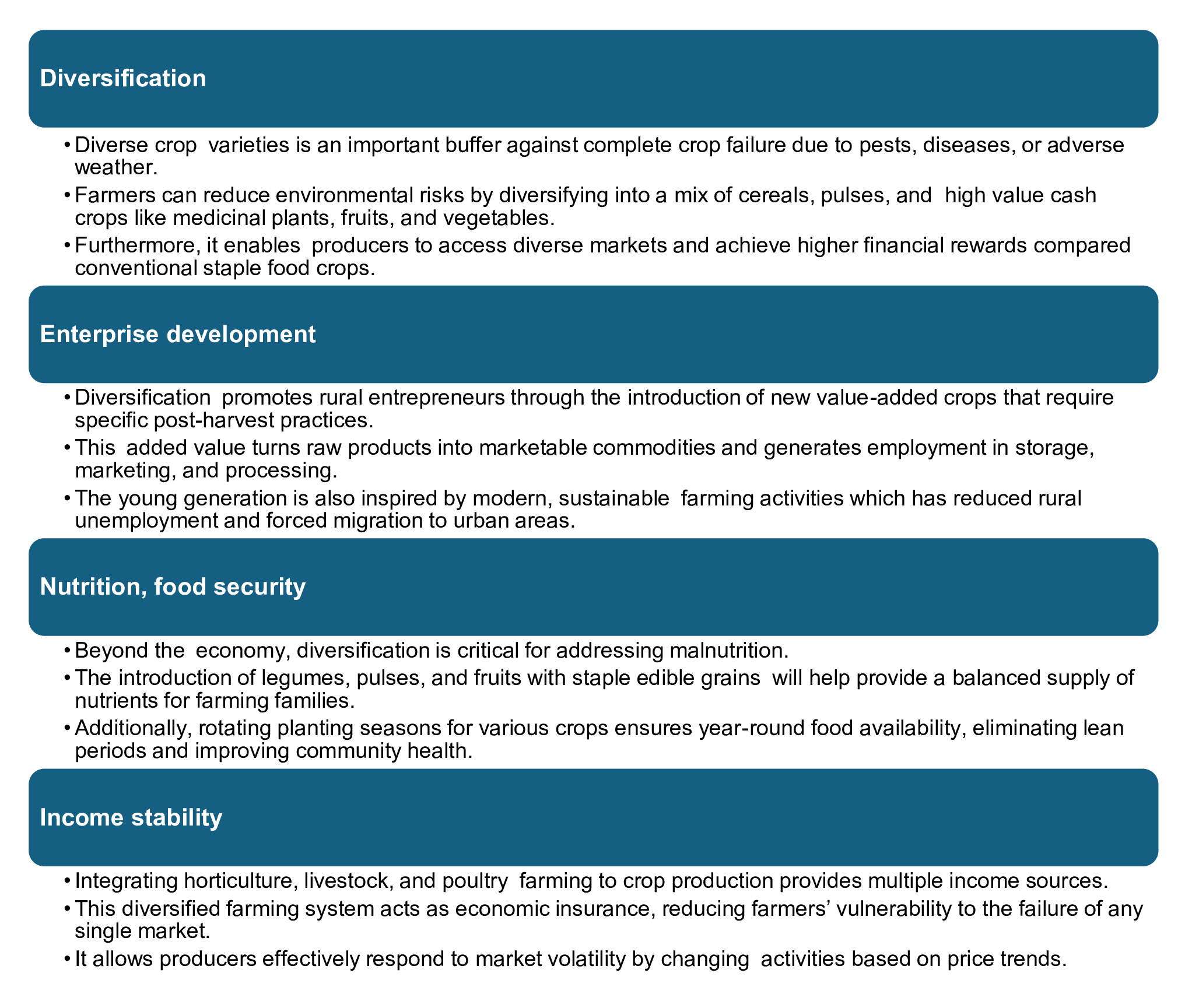
Emerging, diversified agriculture is increasingly seen as a key strategy for improving rural livelihoods. By abandoning monoculture in favour of polyculture, farmers can reduce financial risk and create economic and ecological stability.
Climate-resilience: Safeguarding horticulture against environmental shocks
As the climate becomes increasingly unpredictable, transitioning to climate-resilient horticulture is important for safeguarding the rapid growth of the sector against natural disasters. Adaptive measures and sustainable approaches are critical to guarantee long-term food security while protecting the livelihoods of farmers. Horticulture crops are more sensitive to temperature variability compared with cereals.
To reduce these risks, the industry is now seriously adopting Climate-Resilient Agriculture (CRA) through the following:
- Resilient varieties: Institutions such as ICAR are releasing heat-tolerant varieties of wheat and tomato, while drought-resistant cultivars for pomegranate and citrus fruits have been released by the research bodies.
- Protected agriculture: The adoption of the mulching technique (i.e. covering soil with plastic film) continues to be popular among farmers as a way of conserving soil moisture and reducing weed growth.
- Water management: The initiative ‘Per Drop More Crop’ is encouraging community water tanks and on-farm ponds that can save lives through irrigation in dry periods.
These adaptations are not merely environmental measures but economic imperatives to ensure consistent and robust supply chains.
Market access and value chains: From farm to consumer
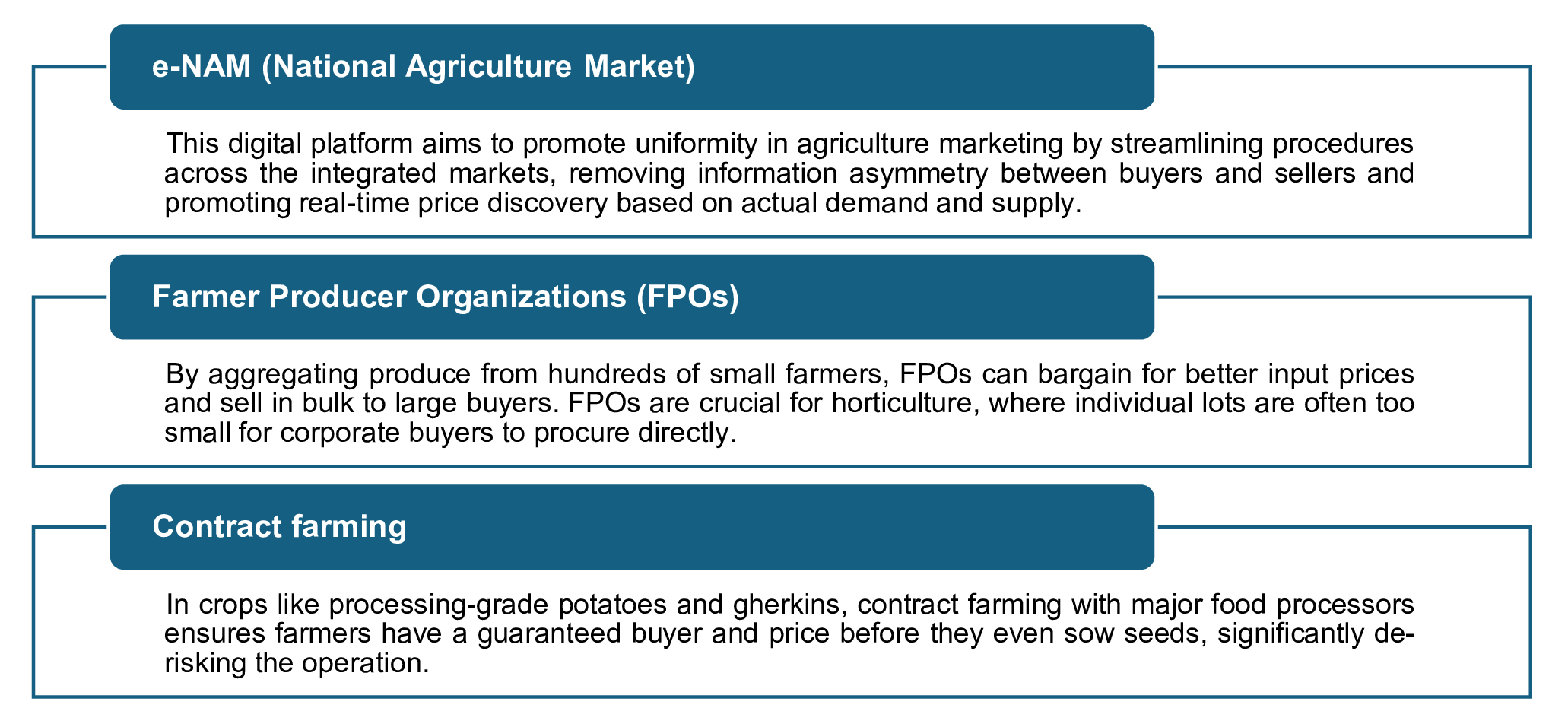
Ensuring direct access for farmers to markets is critical for maximizing their earnings and reducing post-harvest loses. A healthy value chain is key to ensure that fresh, high quality produce flows from farms to consumers.
However, the cold chain system is still a main obstacle. Post-harvest loss for perishables is 15-20% at the national level. Although investment in modern storage and transport is rising, the void between booming production levels and adequate infrastructure remains.
Unlocking potential: The future of Indian farming
Farming in India is undergoing a major shift as farmers switch to high-value horticulture crops to boost their income. Beyond ordinary field crops, many are also discovering that fruits, vegetables, spices, and flowers offer greater profit. This transformation is actively supported by the government through various initiatives, such as the MIDH, which specifically targets higher quality, improved productivity, and better market accessibility across different crop varieties and types.
The results are evident since India has now become second largest global producer of fruits and vegetables, and production is constantly growing boosting the agri-export. By developing Centres of Excellence and upgrading cold storage, the sector addresses key supply-chain challenges. This emphasis not only leads to higher farmer income but also enhances the country’s food security. Finally, horticulture is important for increasing rural incomes, boosting India’s agri-export, and developing the economy.
FAQs
How has India’s horticulture output changed since 1991?
It has increased almost four-fold, reaching an estimated 350-370 million tonnes, making India the world’s second largest horticultural producer.
Why is diversification into horticulture important for rural livelihoods?
It spreads risk across multiple crops and markets, supports on- and off-farm enterprises, and generates year-round employment.
What is the current export performance of India's fresh food segment?
Exports touched US$ 3.8 billion in FY25, registering a 5.67% growth compared to the previous year, driven by rising global demand and value-added processing.
How are demographic changes influencing horticultural demand patterns?
Rising disposable incomes, increased female workforce participation, and rapid urbanization have fueled demand for convenience foods, pre-cut vegetables, and exotic crops like avocados.
What signifies the shift from the "Green Revolution" to the "Golden Revolution" in Indian agriculture?
The transition is marked by a structural change where fruits and vegetables have overtaken cereals as primary growth drivers, supported by a four-fold production increase since 1991.
Partners