SEARCH
RECENT POSTS
Categories
- Agriculture (37)
- Automobiles (20)
- Banking and Financial services (36)
- Consumer Markets (57)
- Defence (6)
- Ecommerce (21)
- Economy (72)
- Education (14)
- Engineering (9)
- Exports (21)
- Healthcare (25)
- India Inc. (10)
- Infrastructure (31)
- Manufacturing (32)
- Media and Entertainment (16)
- Micro, Small & Medium Enterprises (MSMEs) (16)
- Miscellaneous (31)
- Perspectives from India (37)
- Pharmaceuticals (5)
- Railways (4)
- Real Estate (20)
- Renewable Energy (19)
- Research and Development (12)
- Retail (1)
- Services (7)
- Startups (16)
- Technology (66)
- Textiles (8)
- Tourism (16)
- Trade (9)
Authors






India’s Seeds Reform and Agricultural Productivity Enhancement
- Jun 25, 2026, 22:55
- Agriculture
- IBEF
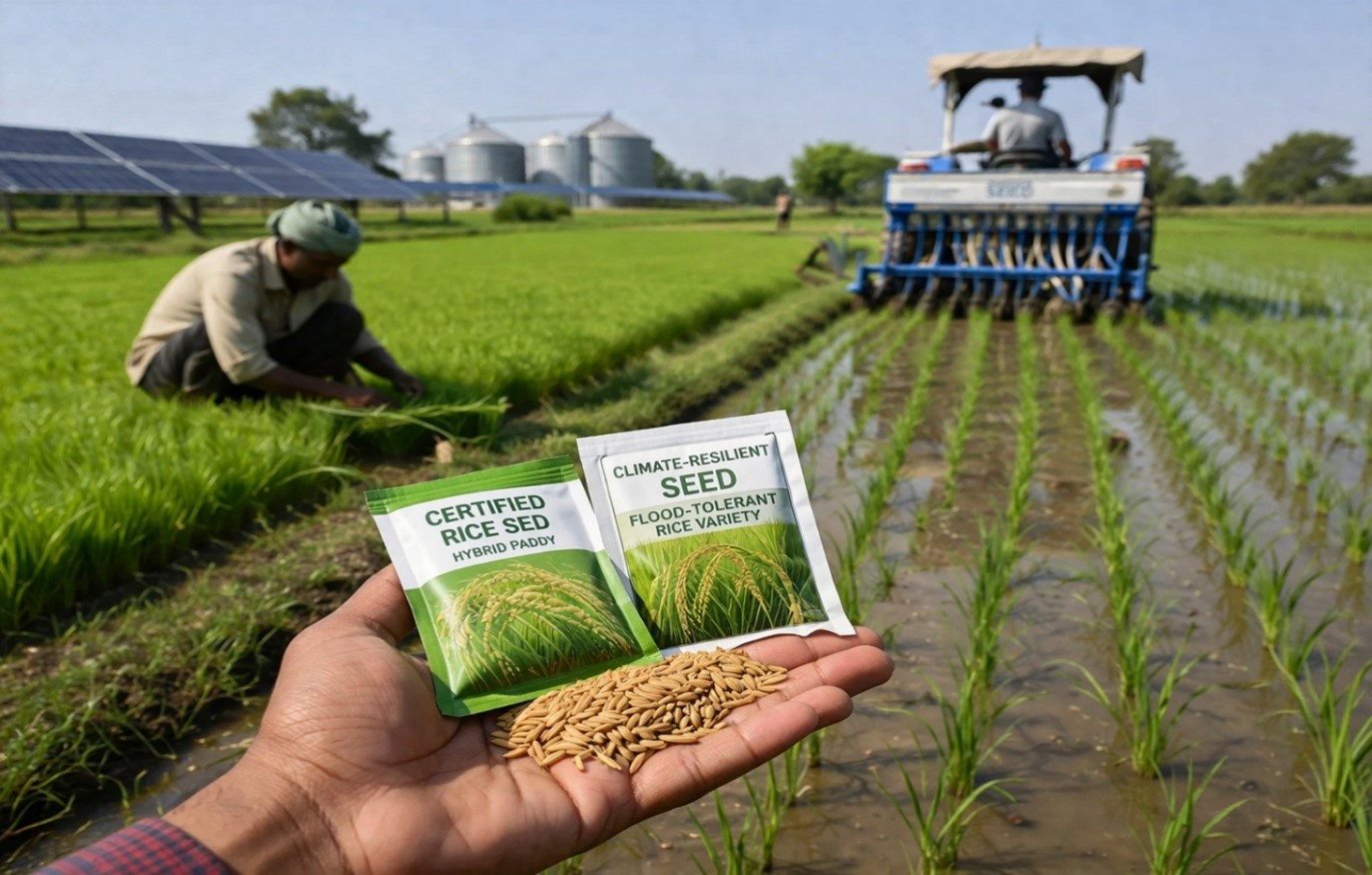
India will be shifting its approach to agriculture from an acreage-oriented model to a productivity-oriented one, rather than expanding farmland. The seed reform 2025-26 aims to address critical priorities for agricultural development as it stands as the most important element for the upcoming phase of agricultural transformation. Rising heat stress, unpredictable monsoon patterns, water shortages, and stringent export quality standards are increasing the need for crop varieties that mature faster, withstand climate variability, and meet region-specific requirements. High-quality seeds deliver optimal performance, generating yields up to 15-20% higher than conventional seeds. According to research conducted by the National Mission on Seeds, adoption of quality seeds provides 20-25% productivity gain.
The Government of India, through the Ministry of Agriculture and Farmers’ Welfare, organised an event for the unveiling of 184 new crop varieties across 25 field crops on January 4, 2026, in New Delhi. The Union Minister of Agriculture and Farmers Welfare, Mr. Shivraj Singh Chauhan introduced 60 rice, 50 maize and 13 oilseed varieties, which is expected to enhance climate adaptability and reduce farming expenses while boosting agricultural production. The proposed Draft Seeds Bill 2025 specifically aims to improve seed traceability and quality registration while safeguarding farmer rights.
India Market Overview and Growth
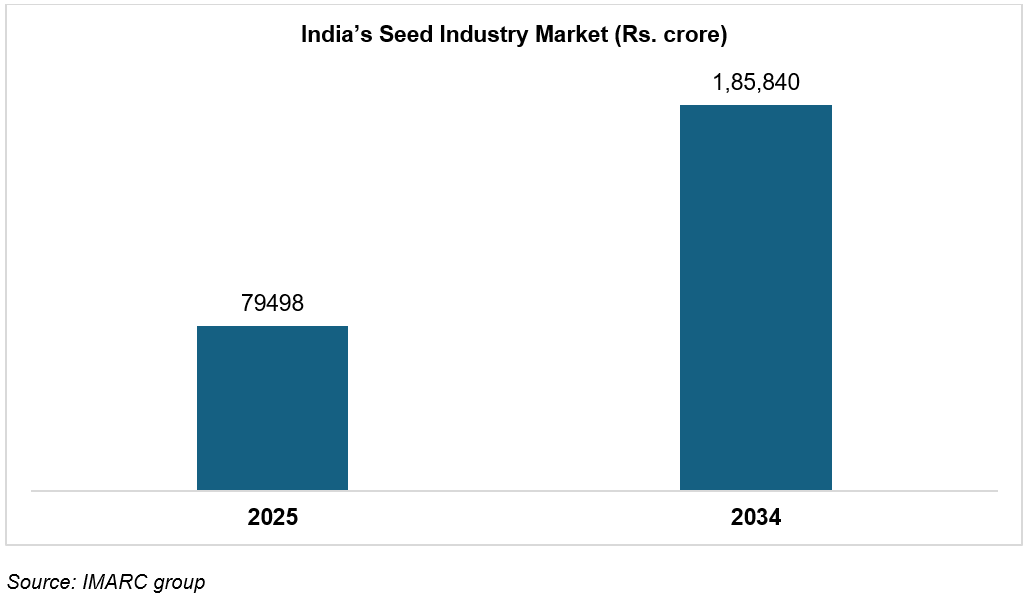
The seed sector in India is undergoing an expansion phase that is being facilitated by several factors including hybridization, climate-resilient crop varieties and increased varietal turnover rate in cereal, oilseeds, pulse and horticultural crops. The Indian seed market was estimated at Rs. 79,498 crore (US$ 8.6 billion) in 2025 and is forecast to grow to Rs. 1,85,840 crore (US$ 20.2 billion) by 2034 with increased demand for high-yielding hybrid seeds for maize, rice, cotton, and vegetable varieties. The private companies are recording notable growth in genomics, precision breeding and specialty seeds while the public bodies remain relevant players in the provision of breeder seeds and development of climate-resilient varieties.
The major structural shift for the year 2025-26 is that of the introduction of bio-fortified and climate resilient seeds in agriculture programs. The operational guidelines for the implementation of several food security programs indicate that the primary operational activity of these programs is the development and distribution of climate resilient, bio-fortified and pest-resistant varieties. The 2025-26 certified seed production forecasts show increased seed replacement rates across several crop clusters which demonstrates improved matching between breeder seed production and state demand predictions.
The seed market is a critical growth engine for India’s broader agri value chain through 2030, with expansion increasingly driven by downstream food processing, export-oriented farming, and precision agriculture.
Policy and Reform Momentum
India’s 2025-26 seed reforms are moving beyond traditional distribution support towards quality assurance, traceability and innovation-led regulation. The compulsory registration, stricter quality norms, farmer compensation safeguards and stronger anti-counterfeit provisions the Draft Seeds Bill, 2025 is projected to modernise the regulatory frame.
The National Food Security and Nutrition Mission (NFSNM) guidelines for FY26 have increased focus on certified climate-resilient and bio-fortified seed deployment, particularly in cereals, pulses and oilseeds. State-level reforms are also becoming significant. Uttar Pradesh’s 2026 roadmap proposes five integrated seed parks, combining seed production, testing, storage and traceability under a new state seed policy.
This reform drive is creating a stronger pipeline for certified, region-specific and technology-enabled seed systems.
Key Drivers and Emerging Trends
- Climate-resilient seed innovation will become the main driver of growth in 2025-26 as farmers need to grow flood-tolerant rice, heat-resistant wheat and short-duration pulses. The Indian government launched 184 new varieties of crops in January 2026 covering 25 types of crops which will increase productivity but will reduce inputs. The initiative enables states to adopt revised planting schedules while enhancing crop resilience to climate-related challenges
- The Draft Seeds Bill 2025 and modified National Food Security and Nutrition Mission (NFSNM) guidelines for 2025-26 drive the demand for seeds the government has implemented policy measures which require farmers to cultivate different crop varieties. The increasing distribution of bio-fortified millet, maize, oilseed varieties enable seed research to produce varieties which support nutritional needs, create self-sufficient edible oil production and high-quality export crops.
- Digital seed traceability and anti-counterfeit systems function as a major structural driver particularly as states begin to mandate QR-based authentication systems and batch-level seed certification processes. A recent example is Uttar Pradesh’s 2026 proposal for five integrated seed parks, which combines production, testing, storage and digital traceability to improve quality assurance and farmer confidence.
- Private sector genomics and precision breeding investments create fast innovation progress as they especially benefit hybrid maize, vegetable, oilseed and processing-related crop development. Corporations develop their breeding programs faster by using AI-based phenotyping, genomics and drone technology for trial observation.
- Export-oriented agriculture and food processing demand are reshaping seed priorities, with stronger demand emerging for starch maize, malting barley, processing tomatoes and residue-compliant vegetables. This is creating a direct linkage between seed innovation, downstream food processing efficiency and India’s long-term agri export competitiveness through 2030.
Outlook and Road Ahead: India’s Seed Productivity Path to 2030
The next growth cycle of seed ecosystem in India will be driven by AI-assisted breeding, genomics, climate adaptation, digital certification and export-oriented crop genetics. India’s seed ecosystem is likely to become one of the strongest pillars of climate-smart agriculture by 2030. India’s seed industry is expected to grow from Rs. 79,498 crore (US$ 8.6 billion) in 2025 to Rs. 1,85,840 crore (US$ 20.2 billion) by 2034, at a 9.70% CAGR (2026-2034).
The underlying potential, on the other hand, is associated with connecting seed innovation with processing-driven farming, climate change adaptation, and international food trade regulations, which will enable India to boost productivity while becoming competitive in exports and increasing farmers’ income levels. The integration will facilitate the production of premium-quality crops in compliance with international standards.
FAQs
Why is seed reform becoming critical for India’s agriculture in 2025–26?
As India’s agricultural position are shifting from acreage expansion to productivity, climate resilience and export-grade crop quality seed reform has become critical. Delayed monsoons, increasing heat stress and water scarcity are rising demand for climate-adaptive, short-term and region-specific seed varieties.
What are the latest trends in seed ecosystem development in India?
The latest trend is the launch of 184 new crop varieties in January 2026 across 25 crops, which would lead to greater resilience, lower costs, and higher production. The Seeds Bill, 2025 draft and new NFSNM guidelines have also been introduced to improve quality, traceability and use of certified seeds.
How do climate-resilient seeds improve farm productivity?
Climate-resilient seeds improve productivity by reducing crop losses which result from extreme heat conditions, floods, pest infestations and unpredictable rainfall patterns. Examples include flood-tolerant rice, heat-resistant cereals and short-duration pulses, which help farmers improve the survival rates, water efficiency and crop cycle management.
What role is digitalisation playing in India’s seed reforms?
Digitalisation is improving seed authentication, batch traceability, QR-based certification, AI-led breeding data and counterfeit seed detection. These systems are increasing farmer trust, improving seed quality compliance and supporting export-oriented farming supply chains.
How is the private sector contributing to seed innovation?
The private sector is increasingly engaging in investments towards hybrid breeding, genomic techniques, precision breeding, as well as using drones to carry out field trials. This has been especially important in developing maize varieties, vegetables, oil seeds and other crop varieties for processing.
What is the outlook for India’s seed sector by 2034?
India’s seed industry will grow from US$ 8.6 billion in 2025 to US$ 20.2 billion by 2034, at a 9.70% CAGR (2026–2034).
Partners