SEARCH
RECENT POSTS
Categories
- Agriculture (40)
- Automobiles (21)
- Banking and Financial services (36)
- Consumer Markets (59)
- Defence (6)
- Ecommerce (21)
- Economy (72)
- Education (14)
- Engineering (9)
- Exports (22)
- Healthcare (25)
- India Inc. (11)
- Infrastructure (32)
- Manufacturing (34)
- Media and Entertainment (17)
- Micro, Small & Medium Enterprises (MSMEs) (16)
- Miscellaneous (31)
- Perspectives from India (37)
- Pharmaceuticals (5)
- Railways (5)
- Real Estate (20)
- Renewable Energy (19)
- Research and Development (12)
- Retail (2)
- Services (8)
- Startups (16)
- Technology (67)
- Textiles (8)
- Tourism (16)
- Trade (10)
Authors






India's Blue Economy: Untapped Potential in Ports, Fisheries and Ocean Resources
- Nov 11, 2026, 11:35
- Infrastructure
- IBEF
The maritime space of India, which comprises the coastline, island areas, and the offshore region, is increasingly becoming a major contributor to economic development and trade in the country. Ports and shipping, fisheries, coastal tourism, offshore energy, and seabed minerals combine to constitute a blue economy connecting the coastal states with the rest of the world.
Investment in port facilities, ship construction, fishery development, and oceanic exploration, along with updated maritime law and increased private sector involvement, is opening up investment opportunities for both domestic and foreign investors in the maritime value chain.
India's Blue Economy at a Glance
The blue economy of India contributes around 4% of India's GDP, and sustains the livelihood of 3 crore fishermen and aquaculturists. In the new methodology, the total length of India's coastline has been revised from 7,516.6 kilometers to 11,098.81 kilometers, as per the Ministry of Earth Sciences (MoES). Also, the EEZ of India is larger than 2 million square kilometers and ranks at number 18 in the list of largest EEZ in the world. There are 12 major ports and more than 200 non-major ports, which handle about 95% of trade volume and 70% of trade value in India.
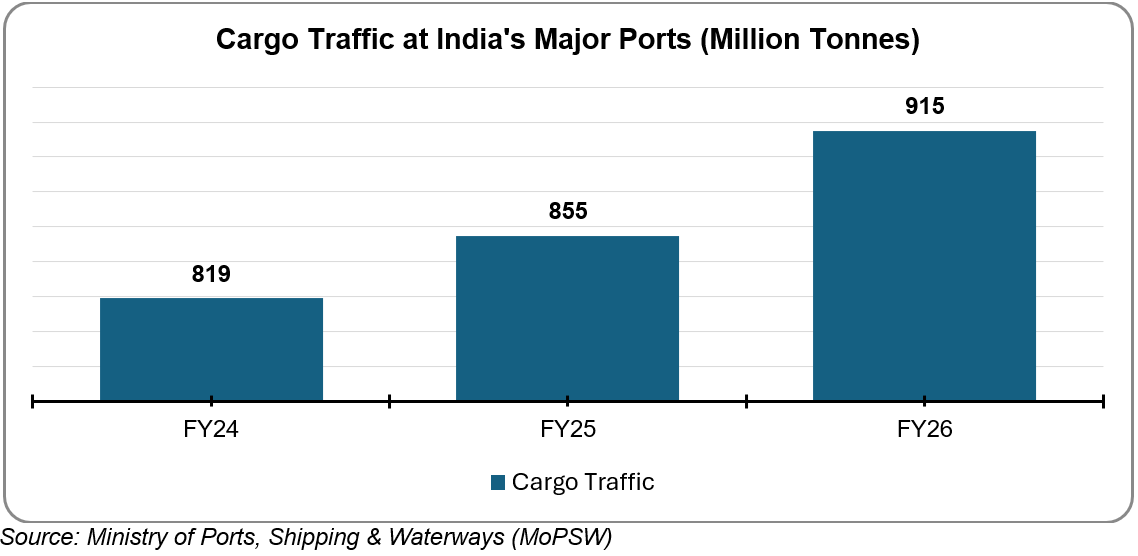
India's major ports witnessed an all-time high movement of 915.17 MT of goods in FY26, recording a rise of 7.06% against the last financial year and surpassing the set target of 904 MT, the MoPSW said. The average time for vessel turnaround fell from 96 hours in 2014 to 49.5 hours in 2025, and nine Indian ports have come up in the list of top 100 ports globally, with Visakhapatnam ranking among the top 20 ports.
Policy Architecture Supporting the Blue Economy
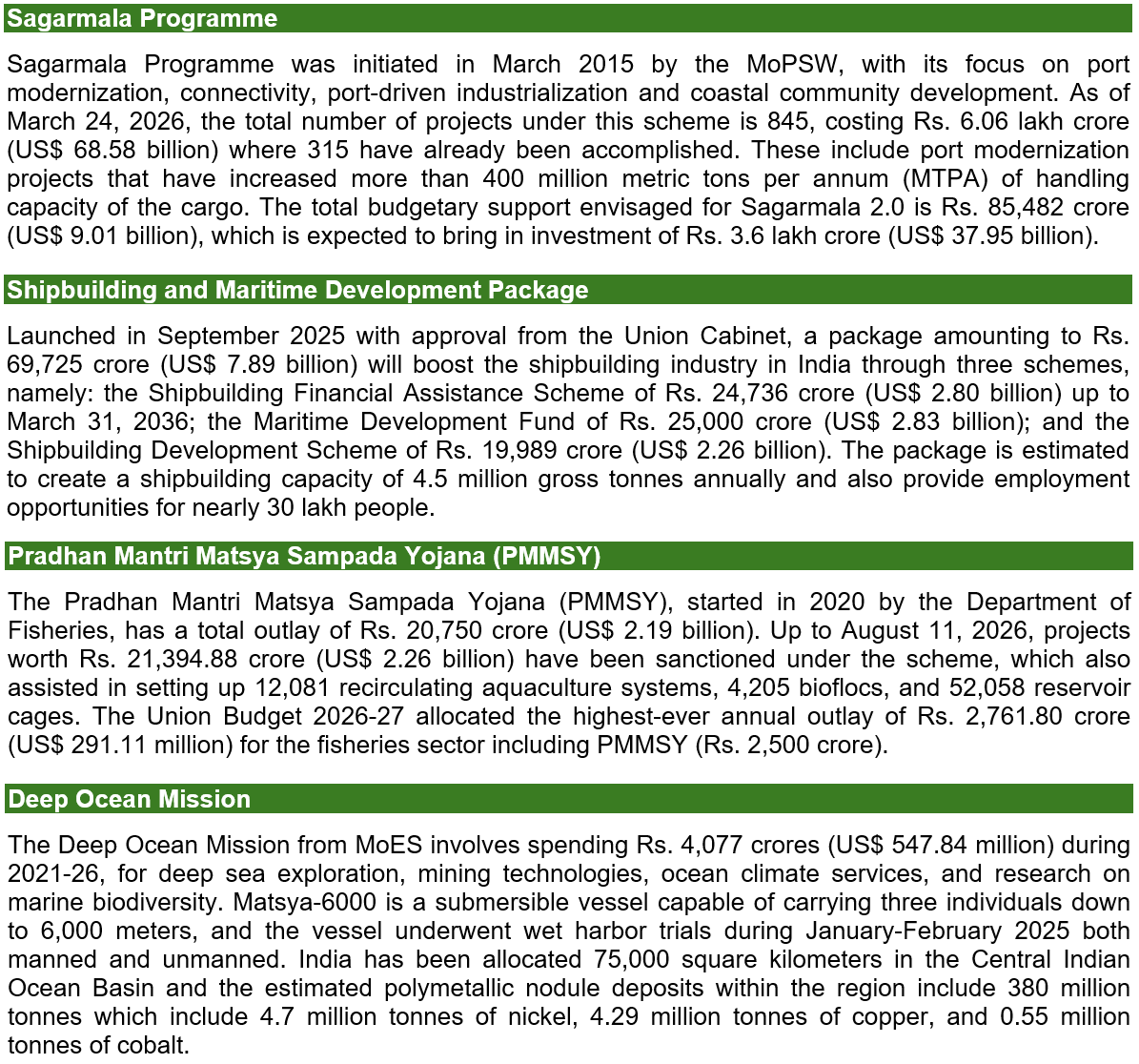
National programs include both government spending on maritime infrastructure as well as shipbuilding, fishing industry development and oceanic research.
Key Segments of India's Blue Economy
Outlook and Road Ahead
The Indian blue economy will see further growth through Sagarmala 2.0, ship-building, deep-sea ports, and fishing initiatives. India with its vast coastline, geographical location near key shipping routes, and robust policy framework is in an ideal position to grow its port, fishery, and maritime resources into a strong pillar of the country’s economy.
FAQs
What is the size of India's blue economy?
The blue economy of India is thought to generate almost 4% of its GDP. India has a coastline of 11,098.81 km, EEZ exceeding 2 million sq. km., and ports handling about 95% of its trade by volume.
How much cargo did India's major ports handle in FY26?
India’s major ports have moved a record 915.17 million metric tonnes (MMT) of cargo in FY26, up 7.06% from the 854.88 MMT carried in FY25, beating its annual target of 904 MMT.
What is the Sagarmala Programme?
The Sagarmala programme, launched in March 2015, emphasizes port-centric development. As of March 24, 2026, the Sagarmala programme consists of 845 projects worth Rs. 6.06 lakh crore (US$ 68.58 billion), of which 315 projects have been completed.
How have India's fisheries and seafood exports performed?
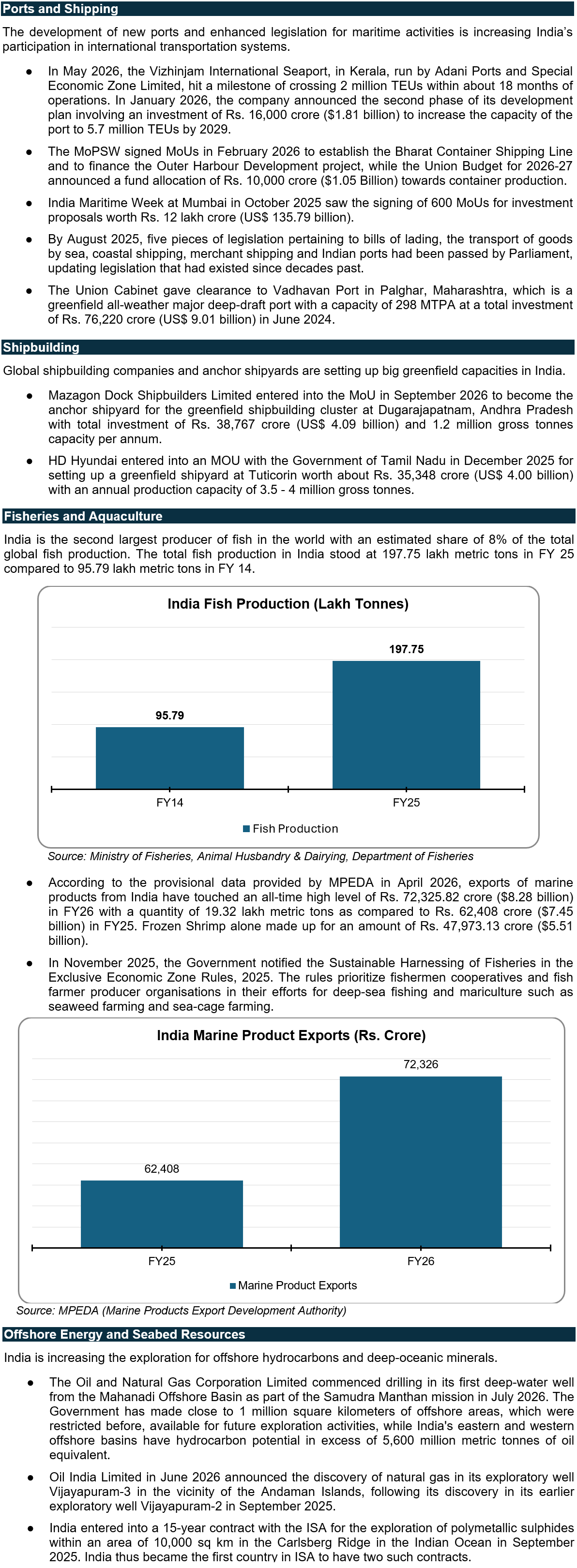
The output of fish was recorded at 197.75 lakh tonnes during FY25, which is more than twice the quantity of fish produced during FY14, while exports of marine products touched a record high of Rs. 72,325.82 crore (US$ 8.28 billion) during FY26.
What is the Deep Ocean Mission?
The MoES' Deep Ocean Mission, with an allocation of Rs 4,077 crore (US$ 547.84 million) for the period of 2021-26, is a project for deep-ocean research, which includes Matsya-6000, a submersible capable of taking three people to depths of 6,000 metres.
Partners