SEARCH
RECENT POSTS
Categories
- Agriculture (37)
- Automobiles (20)
- Banking and Financial services (35)
- Consumer Markets (56)
- Defence (6)
- Ecommerce (21)
- Economy (72)
- Education (14)
- Engineering (8)
- Exports (21)
- Healthcare (25)
- India Inc. (10)
- Infrastructure (31)
- Manufacturing (32)
- Media and Entertainment (16)
- Micro, Small & Medium Enterprises (MSMEs) (16)
- Miscellaneous (31)
- Perspectives from India (37)
- Pharmaceuticals (5)
- Railways (4)
- Real Estate (20)
- Renewable Energy (19)
- Research and Development (12)
- Retail (1)
- Services (7)
- Startups (16)
- Technology (66)
- Textiles (8)
- Tourism (16)
- Trade (8)
Authors






India's Coworking Space Market: Driving Innovation, Entrepreneurship and Flexible Work

- Sep 17, 2026, 17:35
- Real Estate
- IBEF
India's workplace ecosystem is undergoing a significant transformation as businesses increasingly adopt flexible office models to enhance operational agility, optimise costs and meet evolving workforce expectations. Coworking spaces professionally managed shared workspaces offering flexible lease tenures, modern infrastructure and collaborative environments have emerged as an integral part of this transition. While initially catering to freelancers, startups and entrepreneurs, these spaces are now widely used by micro, small and medium enterprises (MSMEs), multinational corporations and Global Capability Centres (GCCs), reflecting a fundamental shift in how organisations approach office infrastructure.
The rise of hybrid work accelerated digital transformation and growing enterprise demand for scalable workplaces have positioned flexible workspaces as one of the fastest-growing segments of India's commercial real estate market. According to CRISIL Ratings, India's flexible workspace capacity is expected to expand by 16–18% during FY26 and FY27, reaching 140–145 million sq. ft., following a strong 23% CAGR over the previous three fiscal years. The report attributes this growth to increasing demand from GCCs, domestic corporates and startups seeking cost-efficient, technology-enabled office solutions. Complementing this momentum, Colliers projects India's Grade A office demand to remain strong at 70–75 million sq. ft. in 2026, supported by five structural growth drivers which is GCC expansion, rising adoption of flexible workspaces, REIT-led institutionalisation, technology-enabled workplaces and sustainability-focused office developments. As organisations increasingly adopt the 'core-plus-flex' workplace strategy, coworking spaces are evolving beyond shared offices into strategic business infrastructure that supports innovation, investment and long-term economic growth.
India's Coworking Space Market: Size, Growth and Investment Potential
The Indian market of coworking spaces is already one of the most active segments of the commercial real estate market in the country as well as reflecting the growing preference for flexible office solutions across industries. As a part of a larger market of flexible workspaces, coworking offices have become a preferred option for companies wishing to operate in flexible terms avoiding long-term commitments related to regular leasing of office spaces.
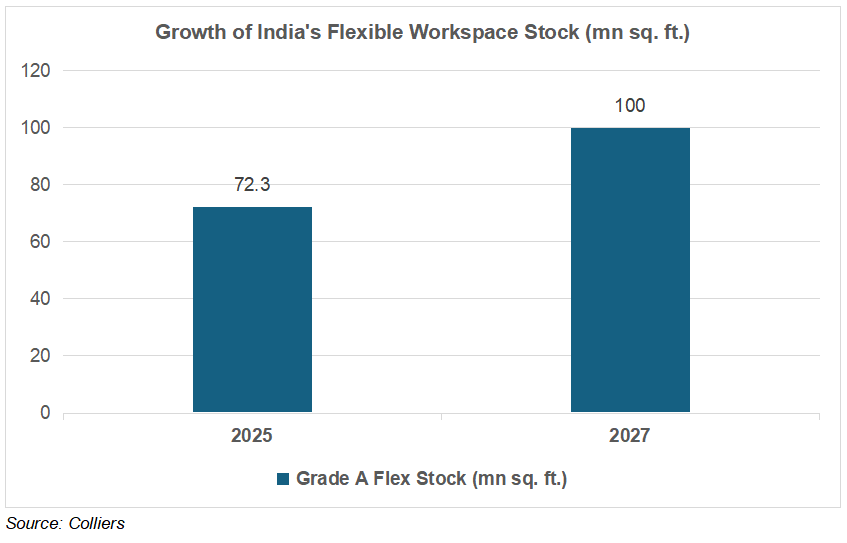
India has become one of the major markets of flexible workspaces in the Asia-Pacific region driven by the rapid expansion of office supply and rising occupier demand. According to Colliers, the amount of Grade A flexible workspace in the top seven cities in the country reached 72.3 million sq. ft. in 2025 projected to surpass 100 million sq. ft. by 2027, increasing penetration. At that time, the penetration of this market in the office market will grow from 8.5% up to more than 10.5%. At the moment, almost 31% of flex stock in India belongs to Bengaluru, whereas the highest penetration was achieved in Pune and the fastest growth was observed in Chennai during the last five years.
The market's rapid expansion is also reflected in leasing activity. Knight Frank India estimates that the office space leasing by flexible workspace operators has grown from 2.2 million sq. ft. in 2017 to 18.6 million sq. ft. in 2025, which amounts to almost 25% of all office leases in the leading office markets of the country. Moreover, according to CBRE, flexible workspaces have become an important element of corporate real estate portfolio due to increasing institutional participation, high-quality managed office space developments and significant investments.
The maturity of the industry is evident in the listing of organised players in the market, increased involvement of investors via CRE platform as well as expansion of the major local players. All this makes India's coworking industry an increasingly attractive investment opportunity.
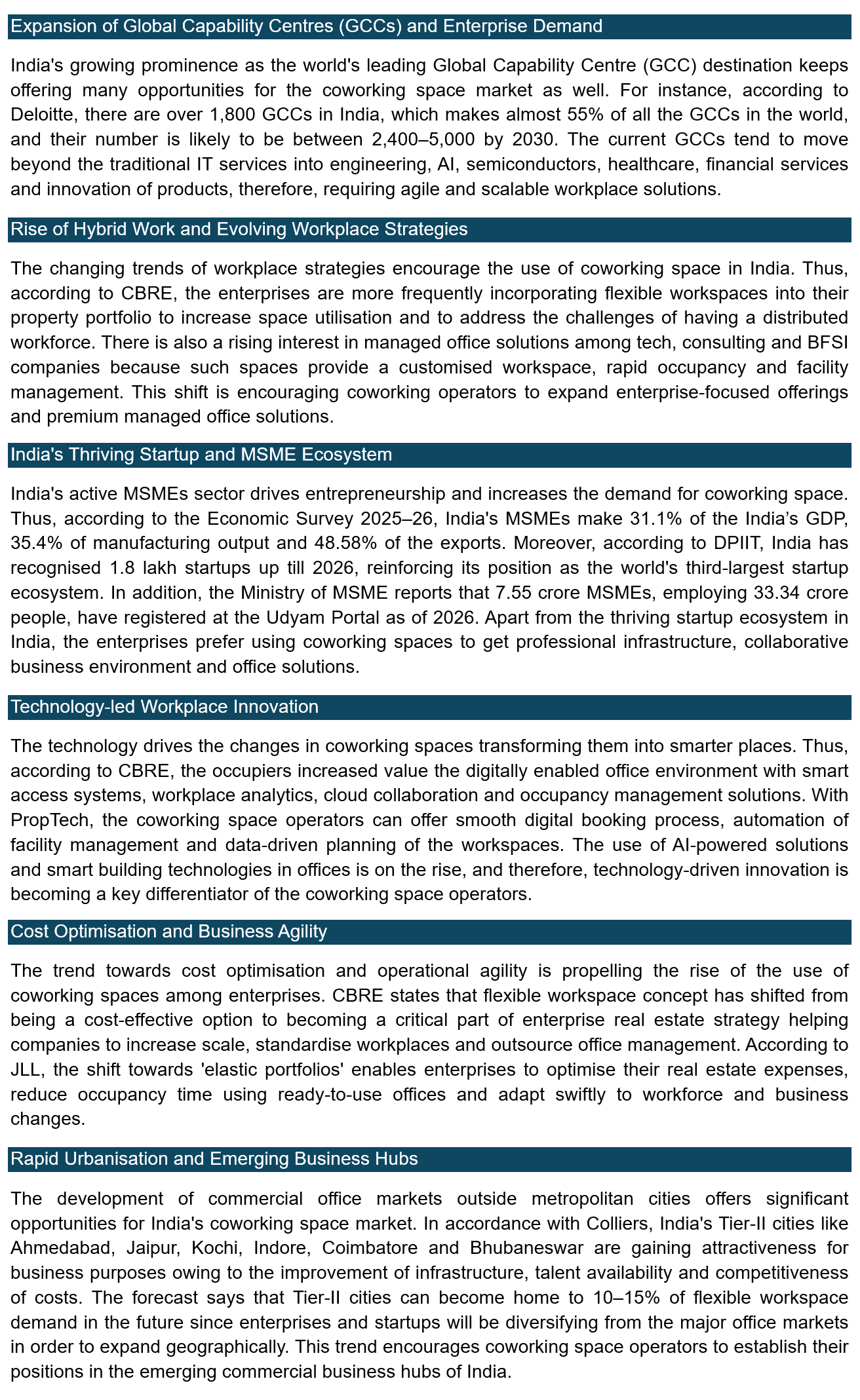
Key Growth Drivers of India's Coworking Space Market
Outlook and Road Ahead
It is expected that India's coworking space market will become an essential pillar of commercial real estate and business in India. As flexible workplace model becomes increasingly popular among enterprises and India transforms into innovation-oriented economy, it is likely that India's coworking space providers will diversify from the traditional office services portfolio by providing their customers with value-adding solutions such as business support, networking, talent attraction and innovation-oriented workspace. This transformation is bound to enhance the role of coworking spaces in promoting entrepreneurship, enterprise collaboration and knowledge exchange.
According to JLL, India's office market is projected to become one of the most dynamic in the Asia-Pacific region in the upcoming years due to continuous corporate growth, foreign investment inflow and economic development. At the same time, according to Deloitte, India's GCC ecosystem will expand to 2,400-5,000 centres in 2030 indicating the rising importance of India as a centre of global business and thus offering new opportunities for organised coworking space providers to create dedicated workspace solutions. As businesses increasingly prioritise flexibility, productivity and employee-centric workplaces, India's coworking market is well positioned to support the country's vision of becoming a globally competitive business and innovation hub.
FAQs
How large is India's coworking space market expected to become?
According to CRISIL Ratings, India's flexible workspace capacity is expected to reach 140–145 million sq. ft. by FY27, growing at 16–18% during FY26 and FY27. This growth is driven by rising demand from enterprises, startups, and Global Capability Centres (GCCs).
Why is India's coworking space market growing rapidly?
The market is being driven by increasing adoption of flexible working environments, fast-growing GCCs, the vibrant startup ecosystem in India, prevalence of hybrid work model and rising need for managed office solutions. Other factors fueling the long-term growth include rising institutional investments and development of commercial office markets.
Which industries are the largest users of coworking spaces in India?
Occupants of coworking spaces include firms from the technology sector, ITeS, BFSI, consulting, e-commerce, engineering, healthcare, professional services and GCCs. There is a significant change in terms of large enterprises making flexible workspaces an integral part of their real estate strategy.
Which cities are driving India's coworking space market?
Geography continues to influence the market as top coworking markets include Bengaluru, Delhi-NCR, Mumbai, Hyderabad, Pune and Chennai because of well-developed office markets in these locations. At the same time, secondary cities including Ahmedabad, Jaipur, Kochi, Indore and Coimbatore are becoming important markets owing to improved infrastructure and economic activities.
How is coworking supporting India's economic growth?
coworking spaces facilitate ease of doing business through provision of flexible and technology enabled workspaces for entrepreneurship, growth and investment purposes. They help startups and existing firms to grow faster and make collaboration and innovation possible. They contribute towards growth of commercial real estate market in India and creation of jobs.
Partners