SEARCH
RECENT POSTS
Categories
- Agriculture (40)
- Automobiles (21)
- Banking and Financial services (36)
- Consumer Markets (59)
- Defence (6)
- Ecommerce (21)
- Economy (73)
- Education (14)
- Engineering (9)
- Exports (22)
- Healthcare (25)
- India Inc. (11)
- Infrastructure (32)
- Manufacturing (34)
- Media and Entertainment (17)
- Micro, Small & Medium Enterprises (MSMEs) (16)
- Miscellaneous (31)
- Perspectives from India (37)
- Pharmaceuticals (5)
- Railways (5)
- Real Estate (21)
- Renewable Energy (19)
- Research and Development (12)
- Retail (2)
- Services (8)
- Startups (16)
- Technology (67)
- Textiles (8)
- Tourism (16)
- Trade (10)
Authors






Investment Opportunities in India: Sectors With Strong Growth Potential

India has emerged as a potential investment destination owing to its economic growth, expanding consumer population, improving manufacturing sector and infrastructure. Such policies that encourage the production, use of technologies, and participation of the private sector have increased the list of sectors where investors can make their investments.
The focus is increasing on sectors where demand is structural and policies play a complementary role, such as electronics and semiconductors, digital infrastructure, renewable energy and defence manufacturing. These sectors attract investment from global technology firms, Indian manufacturers and international investors because they believe in India's future growth.
India's Investment Landscape
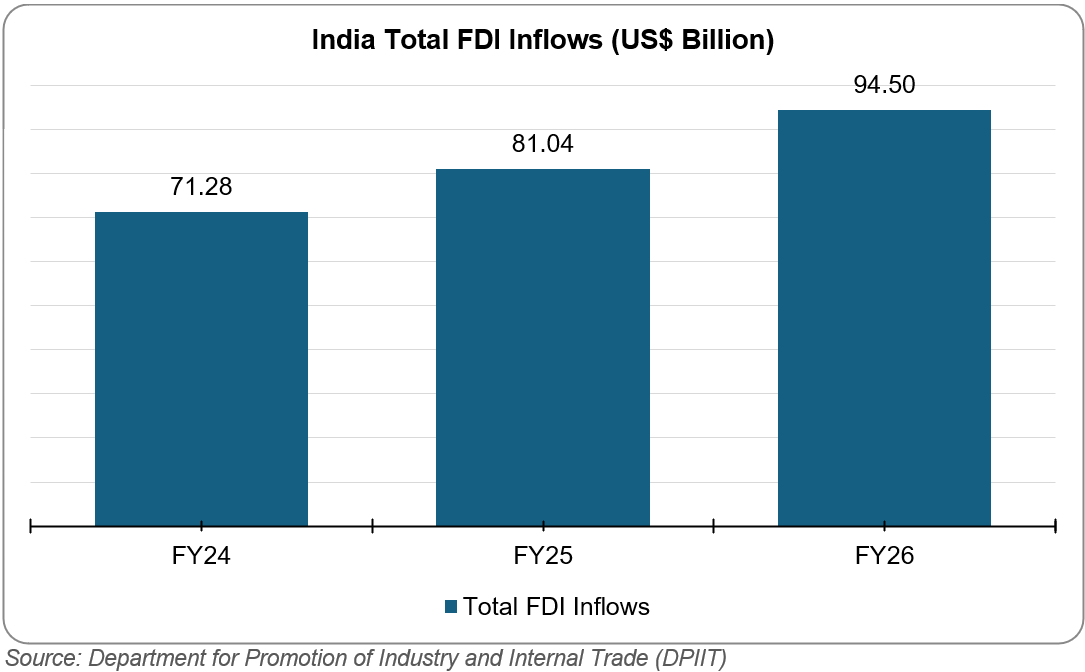
Foreign Direct Investment inflow into India stood at Rs. 8.35 lakh crore (US$ 94.50 billion) in FY26, recording a growth of 17 percent from Rs. 6.85 lakh crore (US$ 81.04 billion) in FY25, said the Department for Promotion of Industry and Internal Trade (DPIIT). FDI equity inflows rose 18% to Rs. 5.20 lakh crore (US$ 58.84 billion) over the same period. Computer software and hardware attracted the largest share of equity inflows at Rs. 1.23 lakh crore (US$ 13.95 billion), followed by the services sector at Rs. 88,458 crore (US$ 10.01 billion).
Investment base is also broadening. FDI inflows from the United States have doubled from Rs. 46,144 crore (US$ 5.45 billion) in FY25 to Rs. 98,709 crore (US$ 11.17 billion) in FY26. Meanwhile, Singapore, Mauritius, Japan and the Netherlands remain among the top investors. Maharashtra, Karnataka and Delhi rank as the top three states in terms of foreign equity inflows.
Policy Architecture Supporting Investment
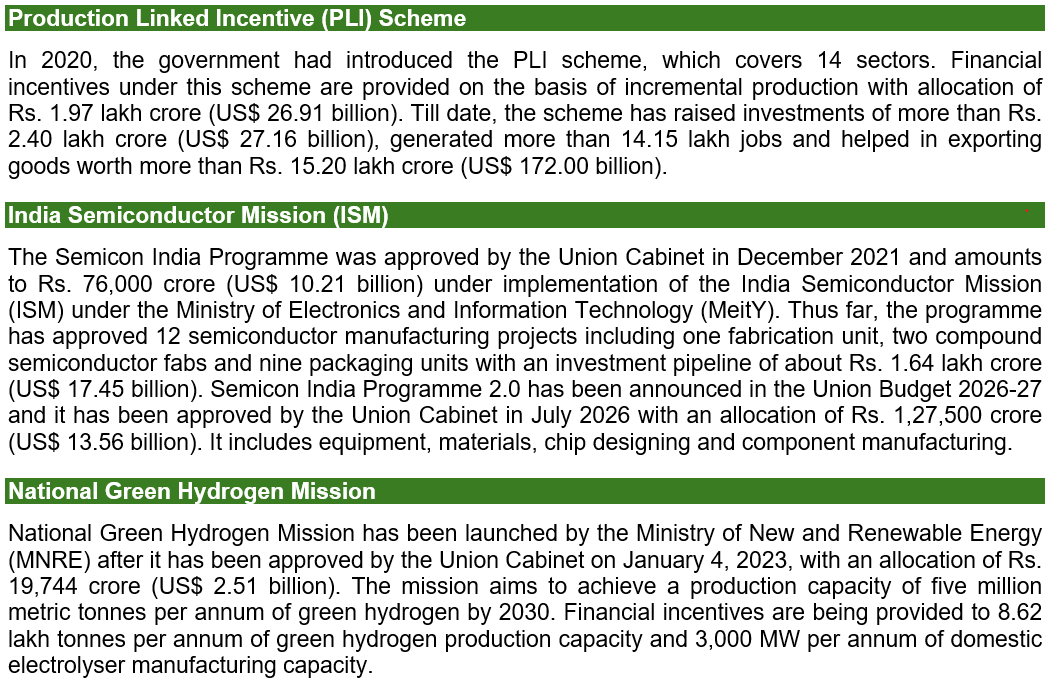
There are also national level schemes that enhance the investment landscape in India, which offer financial incentives based on production, innovation and renewable energy generation in the country.
Sectors With Strong Growth Potential
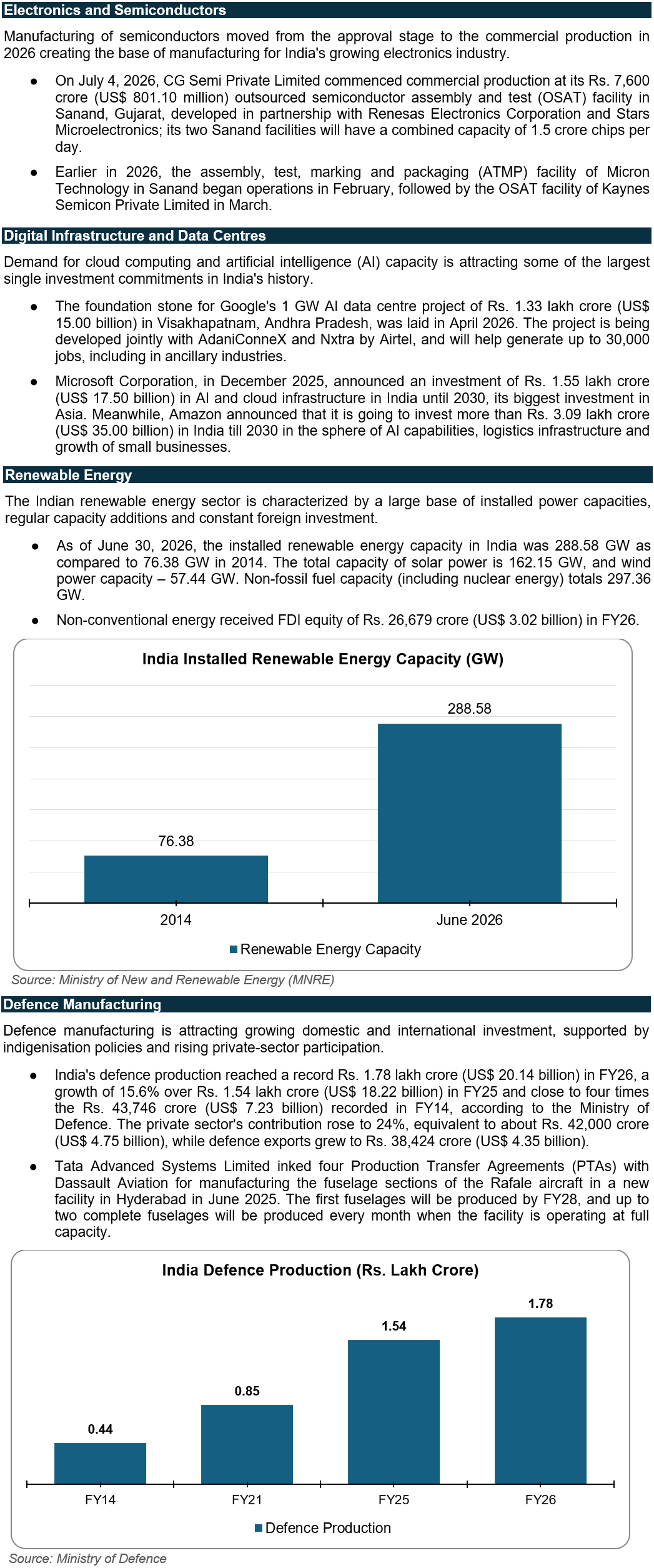
Several investments made in different spheres demonstrate how the combination of policy, domestic demand, and diversification of the supply chains will be generating the future opportunities.
Outlook and Road Ahead
India's investment climate will be positively influenced by further development of incentives for the manufacturing sector, the next stage of India Semiconductor Mission, the growth of the capacity in the clean energy sector and digital infrastructure build-up. Growing FDI inflow, widening base of countries providing FDI, and development of big projects from the approval stage to the operational one prove the sustainability of investor confidence. It makes India one of the leading destination for long-term investments in manufacturing, IT and energy sectors.
FAQs
How much FDI did India receive in FY26?
FDI inflow in FY26 reached Rs. 8.35 lakh crore (US$ 94.50 billion), which is 17% more than the inflow in FY25, and FDI equity inflow grew by 18% to Rs. 5.20 lakh crore (US$ 58.84 billion).
Which sectors attract the most FDI in India?
The computer software and hardware got the largest inflow of FDI equity in FY26 (Rs. 1.23 lakh crore or US$ 13.95 billion), then follow services (US$ 10.01 billion), trading and non-conventional energy.
What has the Production Linked Incentive (PLI) scheme achieved?
Till 31st March, 2026, the total investments received through PLI were more than Rs. 2.40 lakh crore (US$ 27.16 billion), more than 14.15 lakh employment generated and total export was around Rs. 15.20 lakh crore (US$ 172.00 billion).
What is the status of semiconductor manufacturing in India?
Twelve semiconductor manufacturing projects have received approval through the Semicon India Program with an investment pipeline of around Rs. 1.64 lakh crore (US$ 17.45 billion).
How large is India's defence manufacturing sector?
The Defence Production in India has attained a record of Rs. 1.78 lakh crore (US$ 20.14 billion) in FY26 where private sectors' share is around 24% while the defence exports stood at Rs. 38,424 crore (US$ 4.35 billion).
Partners