SEARCH
RECENT POSTS
Categories
- Agriculture (37)
- Automobiles (20)
- Banking and Financial services (35)
- Consumer Markets (56)
- Defence (6)
- Ecommerce (21)
- Economy (72)
- Education (14)
- Engineering (8)
- Exports (21)
- Healthcare (25)
- India Inc. (10)
- Infrastructure (31)
- Manufacturing (32)
- Media and Entertainment (16)
- Micro, Small & Medium Enterprises (MSMEs) (16)
- Miscellaneous (31)
- Perspectives from India (37)
- Pharmaceuticals (5)
- Railways (4)
- Real Estate (18)
- Renewable Energy (19)
- Research and Development (12)
- Retail (1)
- Services (7)
- Startups (15)
- Technology (66)
- Textiles (8)
- Tourism (16)
- Trade (8)
Authors






Leather Industry in India: Growth, Trends & Export Potential
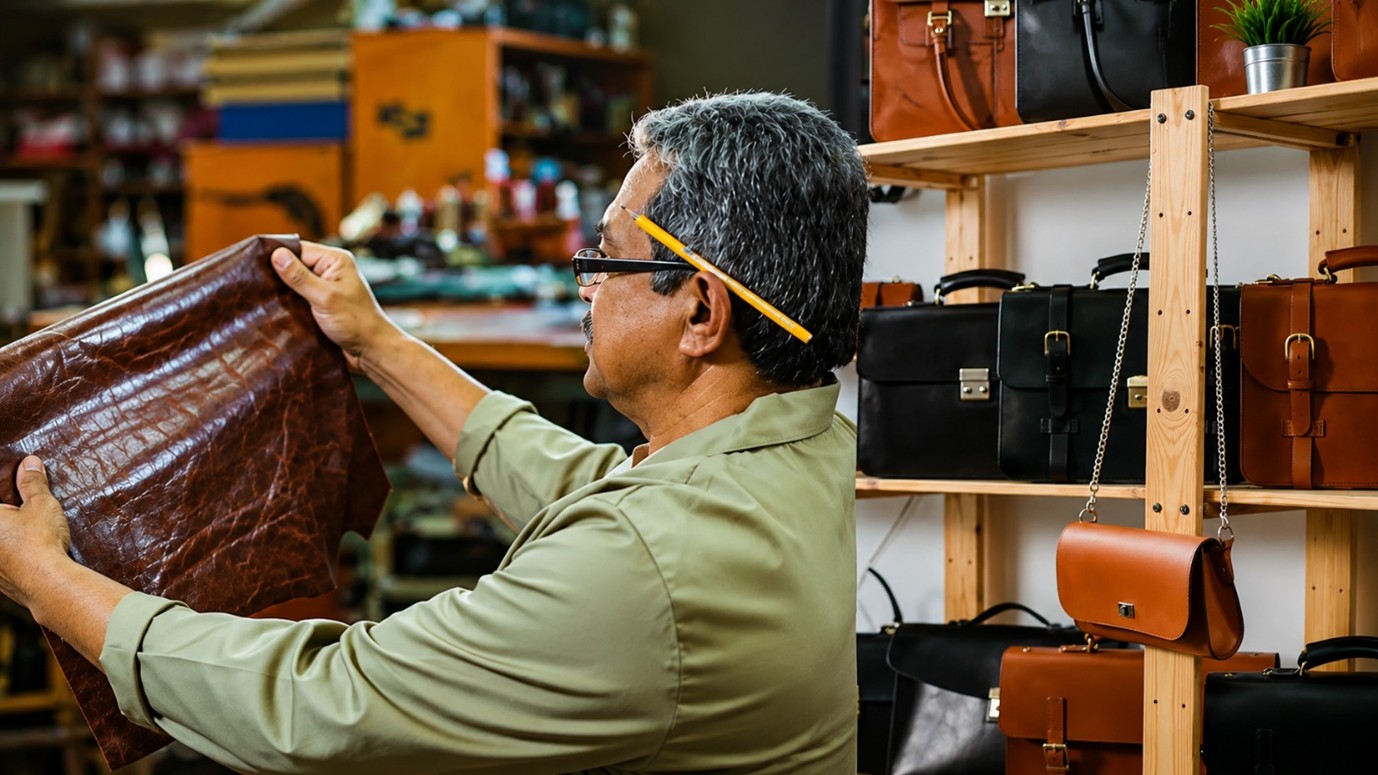
The leather industry in India is among the major export-oriented industries in the nation, driven by its solid foundation of raw materials, trained workforce, and increasing international demand for leather goods such as shoes. India is the world’s second-largest exporter of leather garments, third-largest exporter of saddlery and harness products, and fourth-largest exporter of leather goods. It is also considered one of the top foreign exchange-earning and employment-generating sectors, especially for women workers and small-scale enterprises.
The industry continues to evolve owing to factors such as sustainable practices, technology upgrade and increasing involvement in the international supply chain. Rising demand for quality footwear, non-leather products and fashion accessories has encouraged the leather industry to adopt automation and product innovation technologies.
Some recent policy changes can help make the leather industry more competitive. The Union Budget of India for 2026-27 has brought about measures such as duty rationalization, duty-free import of certain raw materials, and simpler export procedures, along with the signing of the India-EU Free Trade Agreement (FTA) in January 2026.
Market Expansion and Growth of India’s Leather Industry
The leather industry of India has grown into a diverse manufacturing system which includes leather shoes, leather clothing, saddlery goods, accessories, and non-leather footwear. There is also strong support provided by the significant number of consumers within the domestic market along with the export-oriented manufacturing abilities. The leather industry has transformed from a material-centric business environment to one that values manufacturing systems.
Production of leather-related products has shown steady recovery following pandemic-related disruptions. Total production across leather garments, tanned leather and accessories increased from Rs. 3,535.30 crore (US$ 0.40 billion) in FY23 to Rs. 4,102.80 crore (US$ 0.46 billion) in FY25, while production reached Rs. 4,216 crore (US$ 0.48 billion) during 9M FY26. Leather garments recorded strong growth, increasing from Rs. 739.20 crore (US$ 0.08 billion) in FY23 to Rs. 1,370.10 crore (US$ 0.16 billion) during 9M FY26. Accessories production also remained strong at Rs. 2,171.80 crore (US$ 0.25 billion) during 9M FY26.
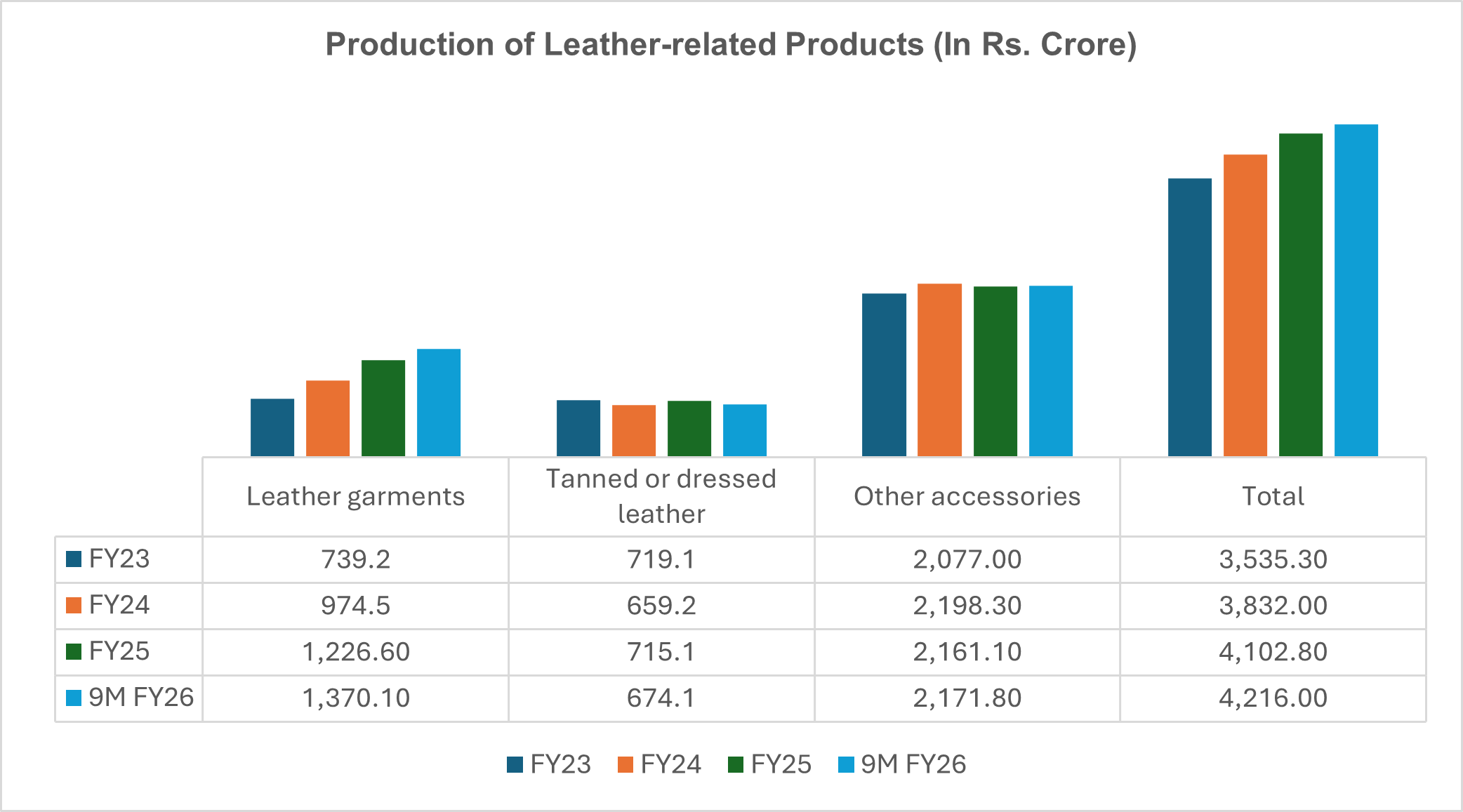
Source: Centre for Monitoring Indian Economy
New trade trends will help enhance export competitiveness in Indian manufacturing firms. As per CareEdge Ratings, the Free Trade Agreement (FTA) between India and European Union (EU) countries will bring down the customs duties on leather exports from India to Europe from around 17% to zero. The FTA agreement between India and New Zealand in April 2026 will aid Indian leather exports and footwear.
Export Performance and India’s Global Position
Exports remain one of the key growth drivers for India’s leather industry, with leather, footwear and related products exported to more than 100 countries. The USA and Europe still play a significant role in exports, particularly those of shoes and leather products. The Indian industrial sector has a well-trained workforce that keeps it well-established in global leather value chains.
As per industry reports, India’s leather and footwear industry is estimated to grow to almost Rs. 4.60 lakh crore (US$ 50 billion) by 2030, inclusive of exports worth Rs. 1.21 lakh crore (US$ 13.70 billion). Leather and footwear and non-leather footwear exports surged by 25% to stand at Rs. 48,667 crore (US$ 5.70 billion) in FY25. The Council for Leather Exports (CLE) forecasts leather and footwear exports to exceed Rs. 57,444 crore (US$ 6.50 billion) in FY26. Footwear exports remain the highest contributor to India’s leather and footwear exports.
The US contributed to almost 22% of India’s leather exports in FY25. Nonetheless, an increase in US tariffs in 2025 affected the export competitiveness of leather goods from India, and manufacturers have diversified their market base to other international markets. Recently, trade initiatives like the India-EU FTA are anticipated to enhance the competitiveness of exports of leather and leather products by decreasing tariffs to zero from nearly 17% in European markets.
Additionally, the Indian leather industry has incorporated state-of-the-art technology, computer-aided design for products, and environmentally friendly processes in order to cater to the needs of international customers. Although there have been steady growths in exports, leather and leather goods have accounted for just 4.37% of the country’s total export trade in 2024-25, compared to 6.03% in 2014-15.
Government Initiatives Supporting the Leather Industry
Various government measures, trade agreements, and export promotion policies have been instrumental in building up the leather manufacturing value chain in India and enhancing its competitive position globally. The Council of Leather Exports (CLE) founded in 1984, is still serving as the apex export promotion agency in the country. It supports the exporters through various export promotion programs, such as trade exhibitions, buyer-seller meetings, market intelligence services, and many others. Additionally, it implements the Indian Footwear & Leather Development Program (IFLDP) 2021-26, which concentrates on developing infrastructure facilities, upgrading technologies, and generating employment opportunities.
India-US Trade Agreement trade discussion in February 2026, and the India-EU Free Trade Agreement (FTA) will improve the competitive strength of Indian leather products in the foreign market environment. Furthermore, various government measures have been taken by the Union Budget 2026-27, including duty-free imports of designated inputs and extended period of export obligations.
Some trade promotion activities are also taking place in India for global integration. The 38th India International Leather Fair (IILF) was organized in Chennai in February 2025. It attracted more than 17,000 business visitors from 491 companies.
Growth Drivers and Key Trends
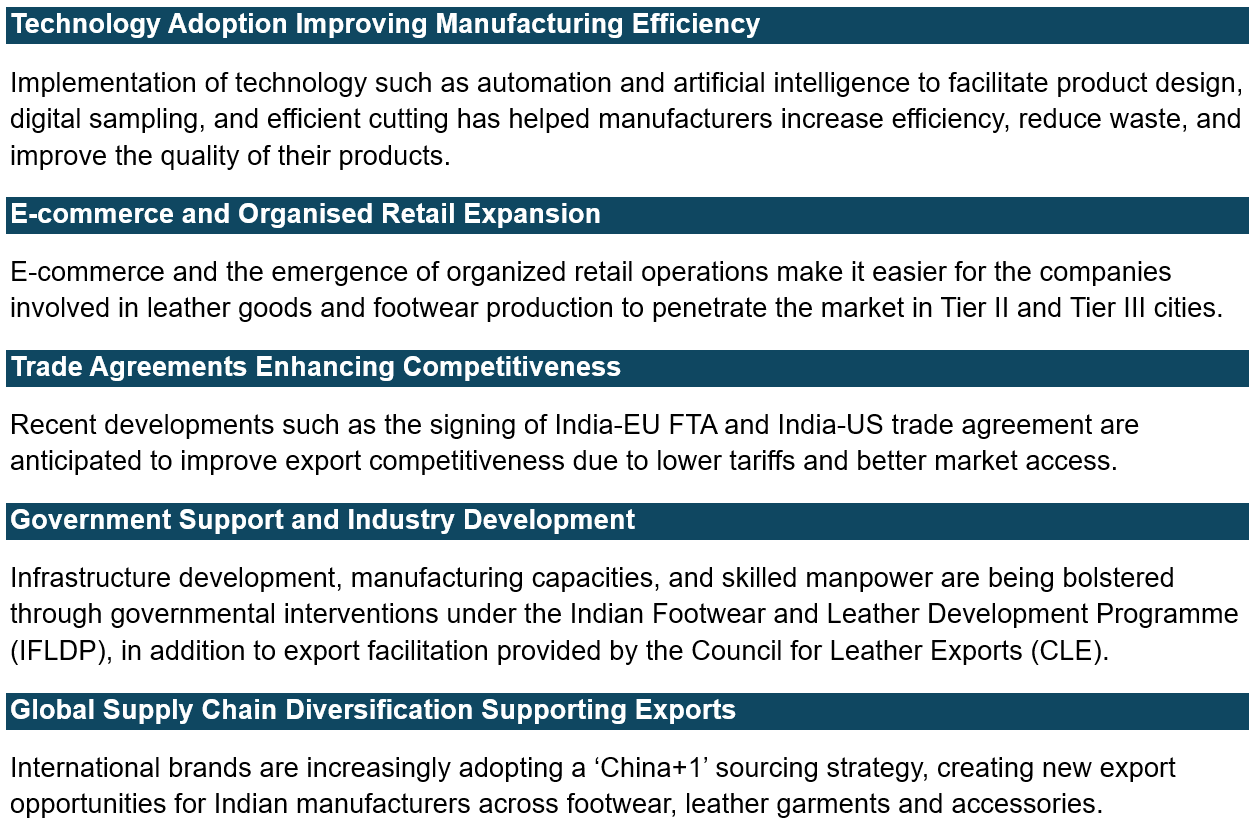
The following factors are driving the expansion and shaping the evolution of India’s leather industry:
Outlook and Road Ahead
It is expected that the leather industry in India will have strong growth over the long term due to higher exports, chain diversification, and supportive trade policies. The leather industry has become one of the key winners of the 'China + 1' policy for sourcing in the world, particularly in the areas of footwear, leather products, and leather processing.
As per industry estimates, the leather and footwear sector in India will grow to become worth around Rs. 4.60 lakh crore (US$ 50 billion) by 2030 due to exports worth Rs. 1.21 lakh crore (US$ 13.70 billion). As per the Council for Leather Exports (CLE), leather exports from India are estimated to exceed Rs. 57,444 crore (US$ 6.50 billion) in FY26.
Favourable agreements such as the India-EU FTA and the India-US trade agreement will continue to aid in enhancing exports. Technological development and green leather manufacturing processes will help consolidate India’s position within the leather value chain ecosystem.
FAQs
What is driving the growth of India’s leather industry?
Rising exports, premiumisation, global supply-chain diversification, sustainability initiatives and favourable trade agreements are major drivers supporting the growth of India’s leather industry.
What is the future growth potential of the industry?
India’s leather and footwear industry is targeting an overall turnover of nearly US$ 50 billion by 2030, supported by export expansion, manufacturing growth and increasing global demand.
How will the India-EU FTA benefit the leather sector?
The India-European Union (EU) Free Trade Agreement is expected to reduce tariffs on Indian leather exports from nearly 17% to zero, significantly improving export competitiveness in European markets.
What role does the Council for Leather Exports (CLE) play?
CLE supports the industry through export promotion activities, buyer-seller meets, trade fairs, policy advocacy and implementation of the Indian Footwear and Leather Development Programme (IFLDP).
What are the key challenges facing the industry?
Competition from countries such as Vietnam and Bangladesh, sustainability compliance costs, tariff-related uncertainties and dependence on labour-intensive manufacturing remain major challenges for the sector.
Partners




