SEARCH
RECENT POSTS
Categories
- Agriculture (39)
- Automobiles (20)
- Banking and Financial services (36)
- Consumer Markets (57)
- Defence (6)
- Ecommerce (21)
- Economy (72)
- Education (14)
- Engineering (9)
- Exports (22)
- Healthcare (25)
- India Inc. (10)
- Infrastructure (31)
- Manufacturing (33)
- Media and Entertainment (17)
- Micro, Small & Medium Enterprises (MSMEs) (16)
- Miscellaneous (31)
- Perspectives from India (37)
- Pharmaceuticals (5)
- Railways (4)
- Real Estate (20)
- Renewable Energy (19)
- Research and Development (12)
- Retail (1)
- Services (7)
- Startups (16)
- Technology (66)
- Textiles (8)
- Tourism (16)
- Trade (9)
Authors






Rural Tourism in India: Empowering Villages and Reviving Local Economies
Rural tourism is emerging as a key driver of India’s inclusive growth strategy. With nearly 68.84% of Indians living in about 6,38,000 villages, village-focused tourism can unlock new income and jobs for rural communities. Recognising this, the Ministry of Tourism (MoT) released a Draft National Strategy in June 2021 to prioritise and guide rural tourism development. In broad terms, the draft defines rural tourism as “any form of tourism that showcases the rural life, art, culture, and heritage at rural locations, thereby benefiting the local community economically and socially”. It emphasises active visitor participation in village life. For example, involving tourists in farming, crafts or homestay experiences. The strategy notes that rural tourism is multi-faceted, encompassing agri-tourism, cultural tourism, nature tourism, adventure and eco-tourism. This diversity of offerings, from farm stays and village festivals to trekking and river rafting expands beyond conventional sights, aligning with modern experiential tourism trends.
Importantly, the MoT’s draft links rural tourism to wider development goals. India’s villages are described as “repositories of the country’s culture, tradition, crafts, heritage”, and promoting these local products can generate rural incomes and jobs. The draft highlights that expanding village tourism is essential to the vision of a self-reliant economy (“Aatmanirbhar Bharat”). It explicitly aims to create livelihoods in villages by generating income for youth and women, thus reducing migration and lessening poverty. In fact, the strategy pledges to converge tourism with schemes on poverty reduction and women’s empowerment. In all, rural tourism is framed as both an economic opportunity and a tool for preserving India’s living heritage in situ.
Benefits and socio-economic impact
Studies consistently find that rural tourism can transform village economies. By attracting visitors into rural areas, it diversifies income sources and generates employment. Rural tourism generates employment for the local community and diversifies the economy and regional employment. Such tourism brings benefits both in monetary and social terms to villages. For example, homestays and farm stays allow farmers or artisans to earn supplementary income from hosting guests, while local guides and vendors also gain business. The MoT strategy similarly lists job creation as a key opportunity, aiming for creation of jobs, retention of jobs and new business opportunities in rural areas.
Impact
This boost in livelihoods can yield broader social gains. By offering viable employment locally, rural tourism helps curb migration to cities. If villages are developed into tourist spots, villagers will get adequate number of alternative job scope and the tendency to leave home is likely to fall, improving socio-economic conditions. In real life, this means that more families are able to live together and not be forced to move out of their villages just to get a job. Women are also encouraged by rural tourism since they can operate guest houses and sell their hand-made crafts. The national policy underlines the fact that village tourism works to the advantage of both women and youth empowerment. When tourism dollars reach a village, they support schools, infrastructure and conservation of local traditions Tourism dollars that come to a countryside village help the village to maintain schools, infrastructure and also to protect the local customs. Experts say that tourism is one of the most powerful ways to eliminate poverty in rural areas and it thus provides a much-needed escape for villagers towards a better livelihood.
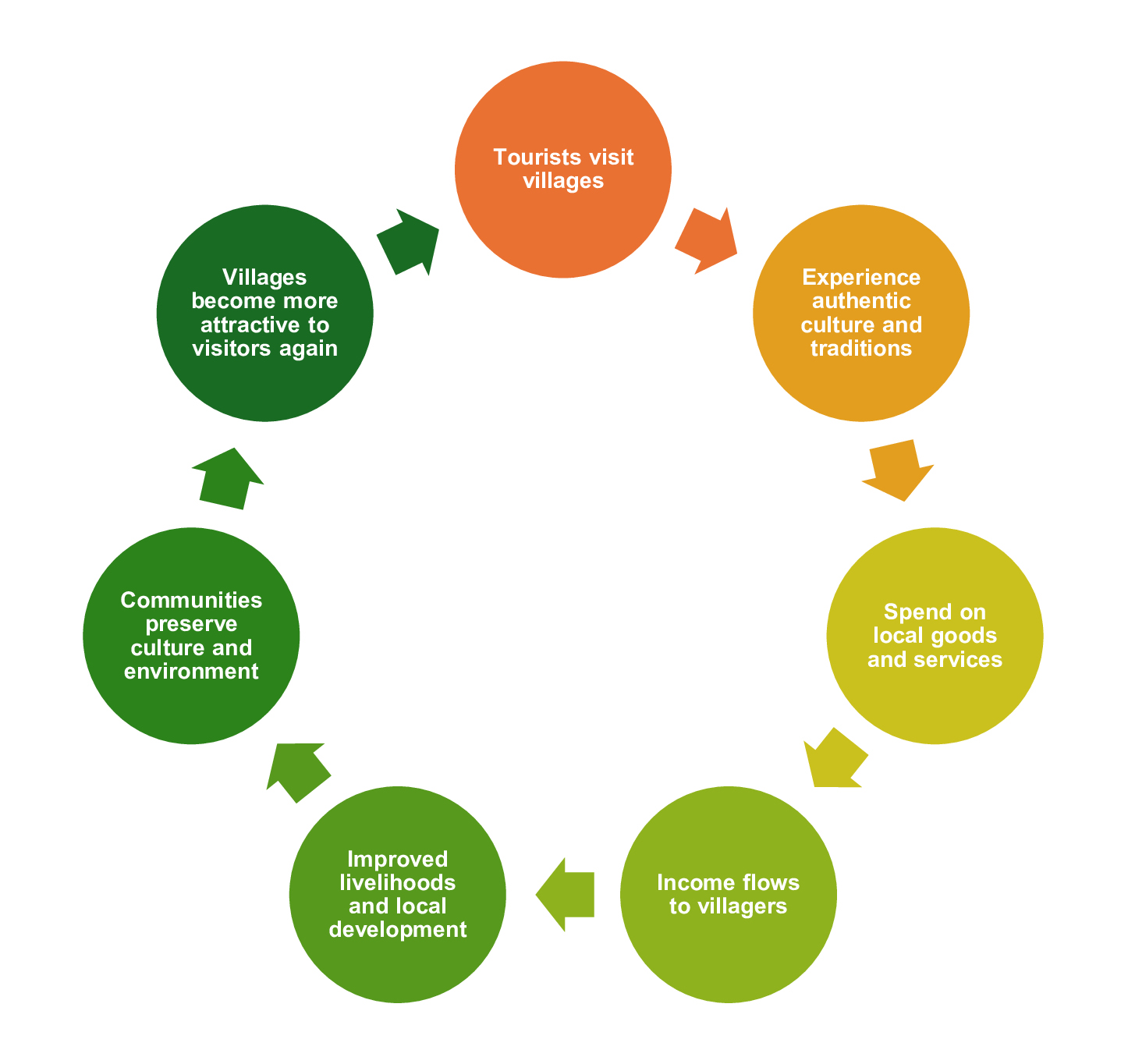
Momentum is growing. Both central and state governments are moving to support villages. The MoT draft proposes cluster development, marketing support and capacity building for village tourism operators. It also outlines partnerships with NGOs and industry to provide training and FAM tours (familiarisation trips). As one expert review concludes, with the right policies rural tourism can “improve the quality of life in rural communities” while preserving heritage. The coming years will test how quickly villages can plug into this strategy and turn potential into reality.
State-level initiatives: Uttar Pradesh and Sikkim
Several states have launched flagship schemes to promote rural tourism. For example, Uttar Pradesh (UP) recently hosted a “Rural Tourism Conclave 2025” in Lucknow to position itself as a top village-tourism destination. There the state announced an ambitious action plan. The Government of UP has decided on 234 villages that will become tourism centers and has promised to back more than 750 farm stays and homestays in these areas. The financial and training offers: these 234 hubs will receive backing through financial and facilitation measures. The conclave highlighted new projects such as integrating silk-farming clusters with agri-tourism, and training programmes, subsidies and community mobilisation schemes to involve local people in tourism.
The case of Uttar Pradesh
UP’s plan reflects a holistic approach. For instance, officials announced that an upcoming familiarisation trip will take stakeholders through selected villages to showcase farm stays, handicrafts and rural hospitality. This “connects culture, community and commerce” by linking tourist activities with local crafts and food and emphasises inclusive growth. Tourism Minister Jaiveer Singh underlined that rural tourism is a way to reclaim “dignity, income and identity for our villages”. In his vision, villages, the soul of India’s culture, can drive the state’s broader development if tourism “goes beyond monuments” to rural life (including women’s empowerment and entrepreneurship).
The case of Sikkim
Another such case is Sikkim that is in the northeastern part of the country. In March 2025, the state government declared a bunch of new initiatives to boost rural and adventure tourism. Mr. Tshering Thendup Bhutia, Minister for Tourism, Government of Sikkim, revealed that Sikkim is introducing attractions such as bungee jumper and hot-air balloon ride in rural areas. These are clearly directed at extending the stay of tourists and spending in villages. These are explicitly aimed at lengthening tourist stays and increasing spend in villages. As Minister Bhutia noted after trying the new ride, ballooning is “one of the most thrilling activities in adventure tourism,” and such attractions “encourage longer stays, benefiting the local economy”. Overall, Sikkim’s programme seeks to create jobs in remote areas by tying adventure experiences to rural homestays and guiding services.
These state examples show how policy can mobilise communities. The focus of UP on homestays and agri-tourism as well as the new range of activities in Sikkim are both intending to bring tourism to the rural areas. The two states can be seen adopting different methods: on one hand, Uttar Pradesh is forming convergence plan village clusters, while on the other, Sikkim is promoting itself as an adventure-rural destination. Nonetheless, the prime objective is always the same in these instances: to turn the tourism profits into rural support and local economy revival.
Conclusion
Rural tourism in India has huge potential to uplift villages and bring back to life the local economies. It is capable of creating employment, inflating the income of the local people and enriching the cultural heritage by visiting the remote areas of the country. As studies and policy reports agree, properly managed village tourism offers “vast potential for economic growth, job creation and cultural preservation”. The Draft National Strategy together with the newly introduced state programmes in the states of UP and Sikkim reflect a great endeavour to realise this potential. They have a shared objective of connecting culture, community and trade by fostering homestays, sharing traditional skills and inviting visitors to farms, thus making it possible for the very money that the tourists pay to be kept in the village.
In sum, rural tourism is already being recognised as a tool for inclusive development in India. With continued policy support and community engagement, it can indeed help strengthen dignity, income and identity for our villages and drive balanced growth.
FAQs
What is rural tourism in India?
Rural tourism in India lets travellers explore village life, culture and traditions. It includes homestays, farm visits, crafts and festivals that support local income and preserve heritage.
What are the benefits of rural tourism in India?
Rural tourism creates jobs, empowers women and youth and reduces migration. It supports local crafts, farming and responsible tourism while strengthening rural economies.
What is community-based tourism in India?
Community-based tourism in India involves local people managing tourism in their villages. It ensures income stays within the community and promotes sustainable, responsible travel.
What is agritourism in India?
Agritourism in India connects visitors with farm life. Tourists can take part in farming, enjoy local food and learn about rural practices while helping farmers earn extra income.
How is the Government promoting village tourism in India?
The Government promotes rural tourism through village clusters, homestay schemes and skill training. States such as UP and Sikkim are leading with farm stays and adventure tourism.
Partners