SEARCH
RECENT POSTS
Categories
- Agriculture (39)
- Automobiles (21)
- Banking and Financial services (36)
- Consumer Markets (58)
- Defence (6)
- Ecommerce (21)
- Economy (72)
- Education (14)
- Engineering (9)
- Exports (22)
- Healthcare (25)
- India Inc. (10)
- Infrastructure (31)
- Manufacturing (33)
- Media and Entertainment (17)
- Micro, Small & Medium Enterprises (MSMEs) (16)
- Miscellaneous (31)
- Perspectives from India (37)
- Pharmaceuticals (5)
- Railways (5)
- Real Estate (20)
- Renewable Energy (19)
- Research and Development (12)
- Retail (2)
- Services (8)
- Startups (16)
- Technology (66)
- Textiles (8)
- Tourism (16)
- Trade (9)
Authors






Tourism in Jammu & Kashmir: A Key Economic Driver
Tourism remains one of the biggest drivers of Jammu & Kashmir's economic performance, supporting employment generation, hospitality, handicrafts, transport services and MSMEs. Tourism accounts for around 7% of the GDP of the Jammu & Kashmir. The tourism industry generates employment for almost five lakh people of the local population both directly and indirectly. The GSDP of Jammu & Kashmir is estimated at Rs. 2.86 lakh crore (US$ 32.9 billion) in FY26, reflecting growth of 5.82%.
Moreover, there have been investments in improving the tourism infrastructure facilities such as roads, railways, airport, and development of tourist destinations. There have also been investments in hotels’ infrastructure facilities, homestays, ropeway, wellness tourism, and adventure tourism. These investments are expected to support long-term growth of the tourism sector. Policies adopted lately for tourism development would be beneficial in developing tourism in Jammu & Kashmir. Various forms of tourism like eco-tourism, winter tourism, film tourism, rural tourism, and religious tourism have been considered by the government of Jammu & Kashmir.
Tourism Growth and Market Expansion inJammu & Kashmir
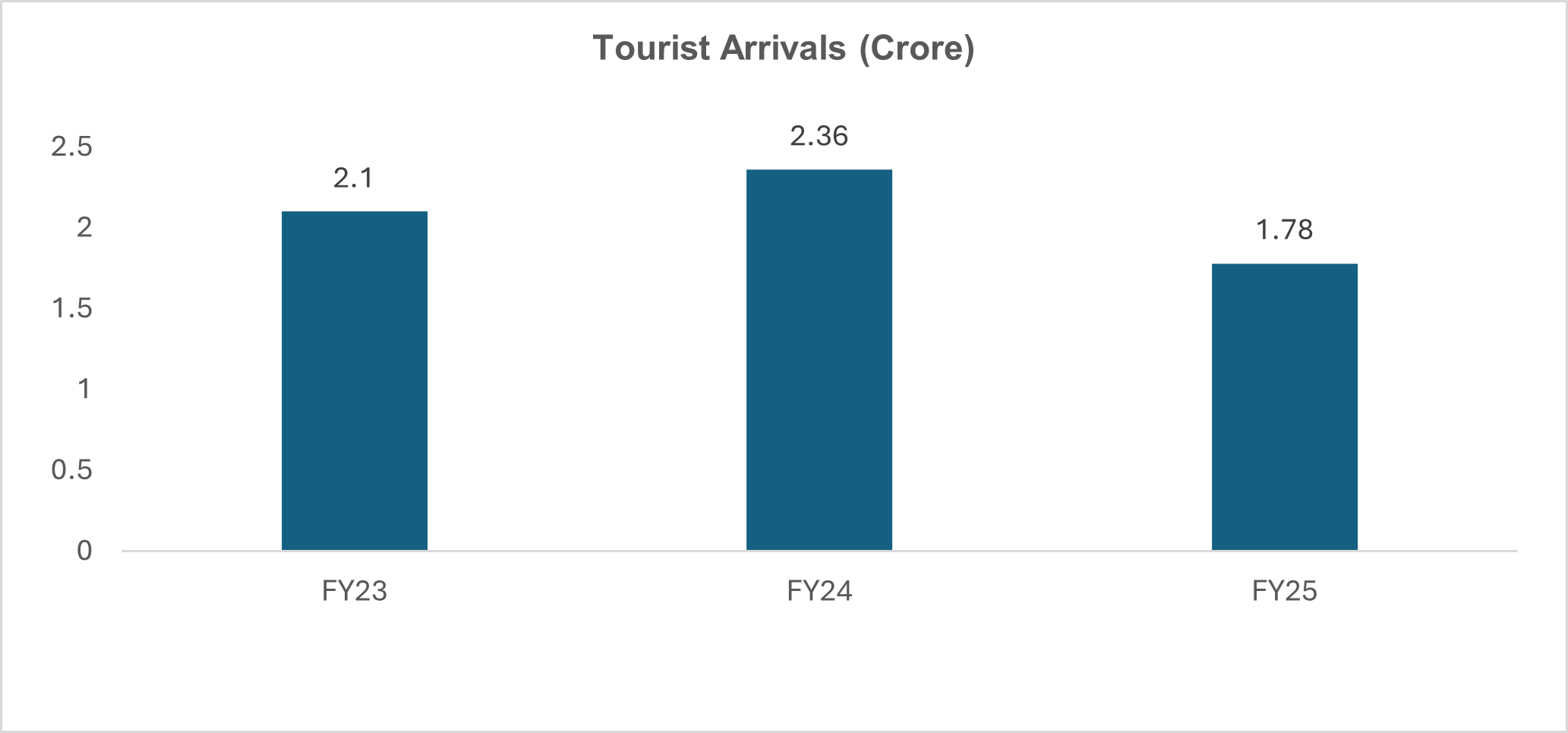
Tourist arrivals have increased significantly in terms of the number of tourists owing to the development of domestic tourism along with the accessibility in this regard. As stated in the Economic Survey of 2025-26, there were around 1.78 crore tourists who visited Jammu & Kashmir, out of whom there were 36,000 foreign tourists. Religious tourism was also another major factor contributing to this sector. Over 69.32 lakh visitors came to Shri Mata Vaishno Devi Shrine, whereas over 10.56 lakh people visited Shiv Khori.
The Economic Survey 2025-26 suggests that the Compound Annual Growth Rate (CAGR) of the Gross State Domestic Product (GSDP) was 4.47% in 2024-25 from 2019-20. Adventure tourism has emerged as an important growth segment in recent years. The activities associated with skiing, trekking, river rafting, mountain biking and camping are attracting both domestic as well as international tourists. Gulmarg continues to retain its reputation as one of India’s best destinations for winter tourism, while trekking activities across the Kashmir Valley and Jammu region are gaining popularity among tourists. Film tourism has also gained momentum; incentives have been provided for film production activities in Jammu & Kashmir.
Source: Economic Survey 2025-26
Infrastructure Development Supporting Tourism Growth
Tourism infrastructure development remains instrumental in increasing accessibility of tourism in Jammu & Kashmir. Development of more roads, railways and expansion of airport infrastructure will lead to an increase in tourist inflows to Jammu & Kashmir in the coming years.
In order to support tourism's economic impact, considerable amount of public money has been invested in tourism infrastructure. According to the UT Sector Capex Budget for 2025-26, tourism infrastructure is estimated to receive allocations worth Rs. 390 crore (US$ 43.82 million). Additionally, 611 projects related to tourism infrastructure have been completed in Jammu & Kashmir, including the development of infrastructure projects in relation to Amarnath Yatra.
Centrally sponsored schemes such as PRASAD Scheme, SWADESH Darshan Scheme and other sector-specific schemes have been useful in developing major tourist sites, pilgrim spots and emerging tourist sites.
Tourism’s contribution to the overall economy is yet another aspect which is emphasized in the Economic Survey of 2025-26, considering that tourism is interrelated with the provision of trade, handicrafts and small businesses. The job creation capacity and infrastructure development of tourism were cited as the two main drivers of inclusive growth.
Udhampur-Srinagar-Baramula Rail Link (USBRL) project was fully completed and became operational in June 2025, making railway transportation significantly improved connectivity between the Kashmir Valley and the rest of India. The Jammu-Srinagar Vande Bharat train service extension has commenced its operations from May 2, 2026, onwards.
pImprovements and developments at Srinagar International Airport and Jammu Airport have been taking place in 2025-26, which includes better handling of passengers and improved night landing facility, according to the J&K Economic Survey 2025-26.
The government has increased focus on the development of tourism infrastructure via ropeways, convention centers, tourism facilitation centers, waterfronts and smart city projects. Among these projects are development of ropeway in Jammu and Patnitop, Vista Dome Rail Services, and Sonamarg (Z-Morh) Tunnel which was inaugurated in January 2025 to improve all-weather connectivity to Sonamarg and other tourist spots. Completion of Tawi Barrage Project, which is more than 84% complete, would further help develop tourism in Jammu.
Economic Contribution of Tourism in Jammu & Kashmir
The tourism sector also remains a vital source of economic activity for Jammu & Kashmir due to its linkage with tourism and the hospitality industry, arts and crafts, transportation, and trading activities. As per Economic Survey 2025-26, the share of tertiary activities in Gross State Value Added (GSVA) in 2024-25 is close to 61.7% showing the significance of tourism activities along with other industries in the UT. Tourism has also contributed a great deal towards development in the handicrafts and handlooms industry by enhancing demand for products such as Kashmiri carpeting, Pashmina shawl and papier-mâché products that have created employment opportunities for thousands of craftsmen.
The hospitality sector has grown significantly due to the rising tourist’s arrival. Guesthouses, hotels, resorts, restaurants, houseboats, and many others have witnessed an increase in their occupancy rates in high tourist seasons. The increasing trend in wellness and luxury tourism has opened avenues of investment for luxury hotels. Job creation through tourism in areas like transportation services, tour operations, photography services, adventure sports and the business of local cuisine is a major development. Women’s participation in entrepreneurship in sectors like handicrafts, hospitality, and homestays is encouraging.
Growth Drivers and Key Trends
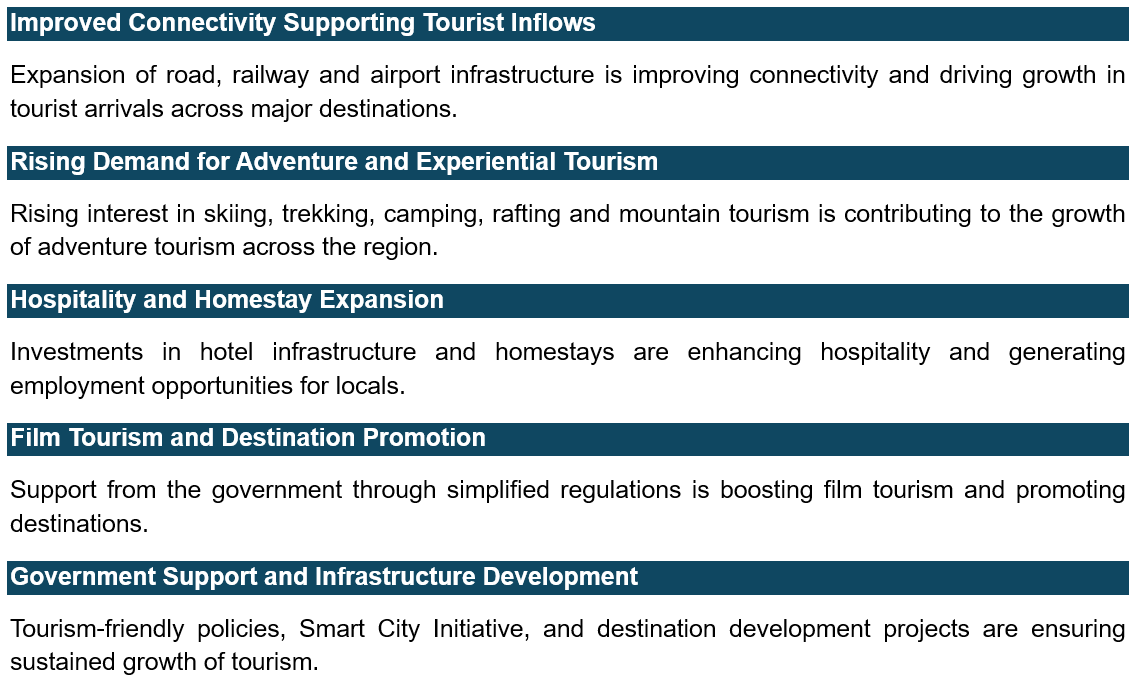
The following factors are driving the expansion and shaping the evolution of Jammu & Kashmir’s tourism sector:
Outlook and Road Ahead
The tourism sector in Jammu & Kashmir will continue its growth for the long term because of an increase in tourists and investments made towards developing their infrastructure. An improvement in connectivity in terms of rail links such as the Udhampur Srinagar Baramulla Rail link (USBRL), Vande Bharat trains, and improved airports can prove advantageous for tourists. The Government is increasingly becoming interested in encouraging specific segments within tourism, such as adventure tourism, ecotourism, film tourism, wellness tourism, and religious tourism, amongst others.
Investments in hotel chains, homestays, ropeways, and other destination development projects could boost employment generation and growth of MSMEs. As tourism contributes approximately 7% towards the GSDP of Jammu & Kashmir, this industry will continue to contribute towards growth in the economy of the region.
FAQs
Why is tourism important for Jammu & Kashmir’s economy?
Tourism is a major contributor to Jammu & Kashmir’s economy, supporting employment generation, hospitality, handicrafts, transport services and MSMEs. The sector contributes nearly 7% to the Union Territory’s GSDP.
How many tourists visited Jammu & Kashmir in 2025?
According to the Economic Survey 2025-26, Jammu & Kashmir recorded nearly 1.78 crore tourist visits in 2025, including over 36,000 foreign tourists.
Which are the major tourism segments in Jammu & Kashmir?
Religious tourism, adventure tourism, eco-tourism, film tourism and wellness tourism are among the major tourism segments driving growth in the region.
How is the Government supporting tourism growth?
The Government helps tourism by its investments in Infrastructure, Smart Cities, better connections through railways, airports, and ropeways/destinations.
What are the key growth drivers for tourism in Jammu & Kashmir?
Better connectivity, increasing demands of Experience Tourism, and efforts made by the Government in terms of development of Hospitality and Infrastructure facilities are among the main factors influencing tourism development.
Partners