RECENT CASE STUDIES
How Indian Pharmaceutical Companies Are Strengthening Their Position in Global Markets
Last updated: Nov, 2026
India has become a key player in the pharmaceutical industry of the world, which can be described in terms of the following factors: large-scale manufacturing, low-cost production, and strong international distribution system. It ranks among the top producers of pharmaceuticals and provides medicines to other countries worldwide, making 20% of the global generic medicines supply. During the fiscal year of 2026 (FY26), the exports of India's pharmaceutical sector made up approximately US$31 billion, while the Government of India aims to increase it to US$50 billion in 2030.
The transition to complex generics, specialty medicines, biosimilars, and innovation-driven drugs is being observed within the pharmaceutical industry of India. It results from the growing interest in research, advanced manufacturing technologies, international cooperation, and differentiation of treatments, which makes it possible for the companies in India to take part in global value chains.
It is apparent in the development strategy of leading pharmaceutical companies of India. Through mergers and acquisitions, strategic partnerships, international manufacturing facilities, improved regulatory abilities, and investment in high-value treatments, they increase their presence not only in the markets of the developed countries but also in those of emerging markets.
India's Pharmaceutical Industry: Global Market Overview
India takes one of the strongest positions in the pharmaceutical industry of the world due to its vast manufacturing system, low-cost production and strong international distribution system. The Government of India sees India as the third-largest pharmaceutical industry by volume, which provides its pharmaceutical products to the markets worldwide. The scale of the industry has allowed it to build lasting relationships with both regulated and emerging markets, making a strong basis for its international expansion.
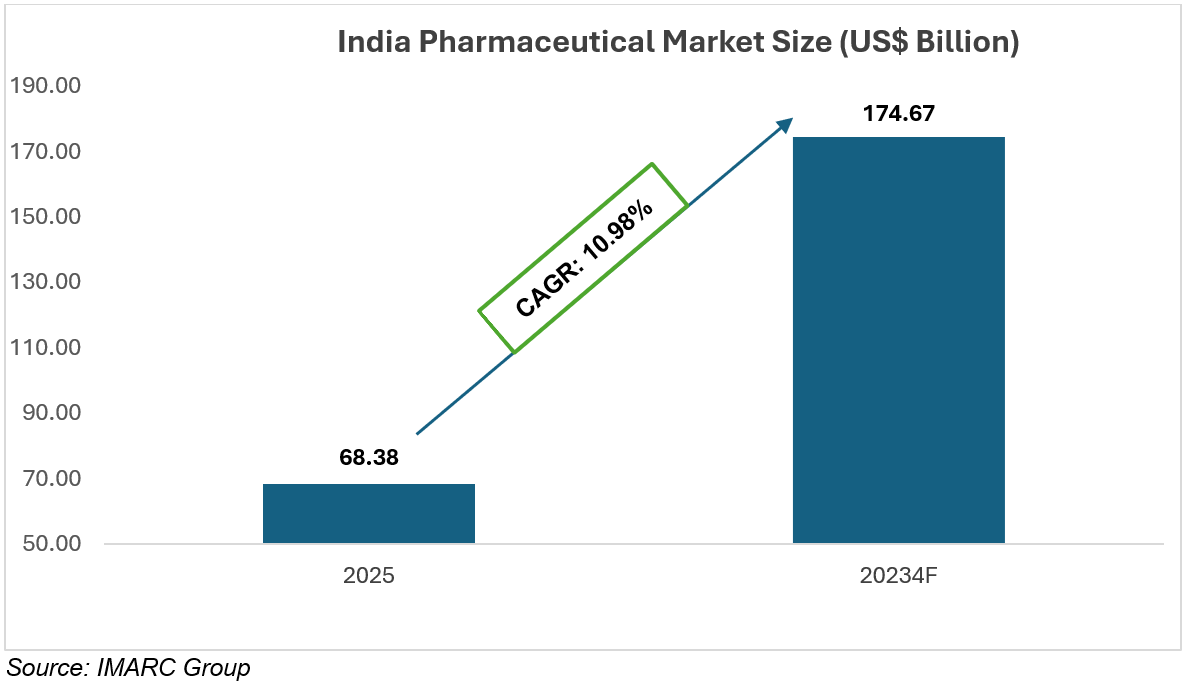
The pharmaceutical market of India is also growing, providing the basis for development of this sector and its competitiveness in the international environment. According to the data of IMARC Group, in 2025 the Indian pharmaceutical market was worth US$68.38 billion and was estimated at US$75.89 billion in 2026. It is expected to grow up to US$174.67 billion in 2034 at the CAGR of 10.98% during 2026-2034 due to the growing demand for health care and development of pharmaceutical products and services.
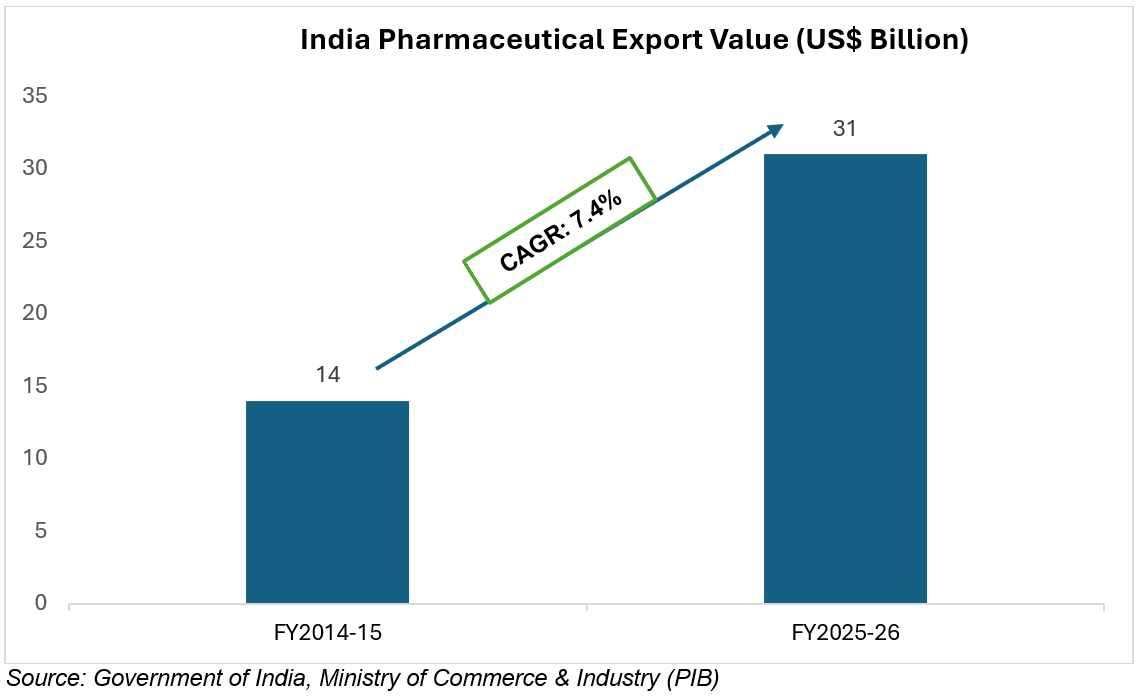
The export potential of India has been growing as well. According to the Ministry of Commerce & Industry, the pharmaceutical exports grew from approximately US$14 billion in FY2015 to US$31 billion in FY2026, providing its medicines to the patients of more than 200 countries. The Government of India also highlighted the continuous leadership of India in generic medicines and growing inclination of this sector to innovation-driven growth.
The presence of India in the global regulated markets only goes on to strengthen India’s global presence. As per Economic Survey 2025-26, India stands at 11th position in the list of top exporters of pharmaceuticals based on value, with exports of pharmaceutical products to 191 countries in FY25. About 50% of these export values went to the highly regulated markets like that of the US and Europe, thus indicating the capability of the industry to maintain quality in accordance with the regulations. India's substantial base of US Food and Drug Administration (USFDA) registered manufacturing facilities further supports its integration into global pharmaceutical supply chains.
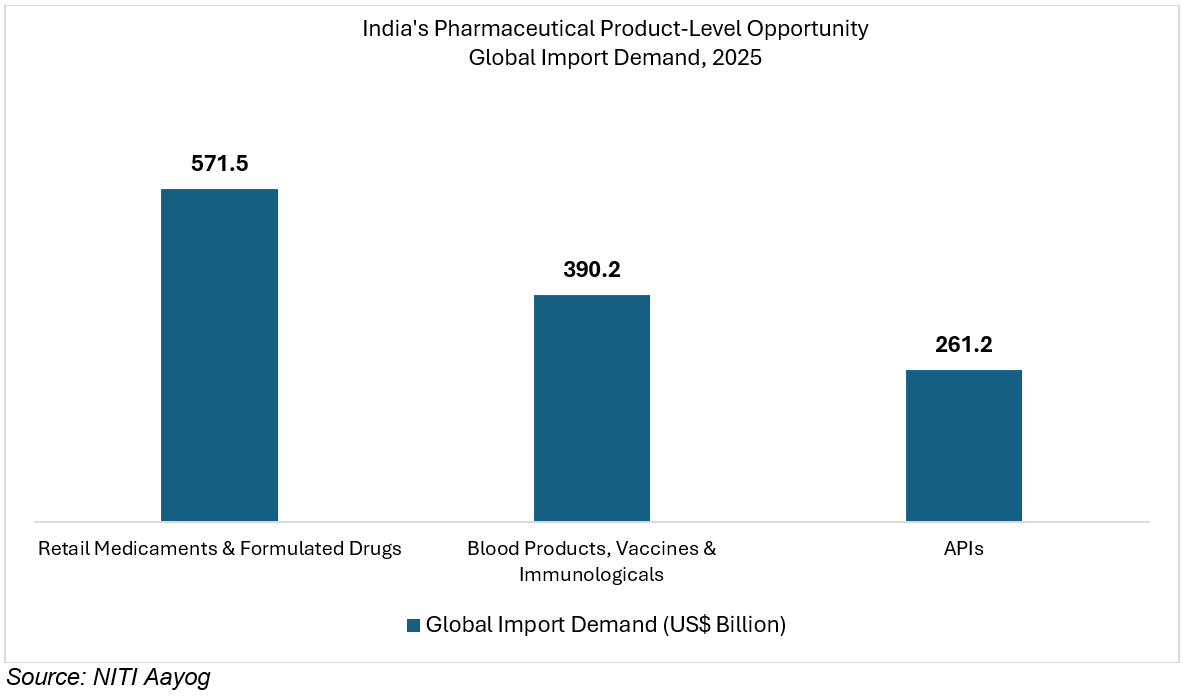
The country's export strength is particularly pronounced in generic and formulated medicines. NITI Aayog's pharmaceutical trade analysis estimates that retail medicaments and formulated drugs accounted for US$ 571.5 billion of global import demand in 2025, while India's exports in this category were around US$ 22.6 billion, representing a 4.0% share of global demand. By comparison, India's exports of blood products, vaccines and immunological stood at approximately US$ 2.2 billion, representing only 0.6% of global import demand. This difference points to substantial headroom for Indian companies to strengthen their participation in biologics, advanced therapies and other higher-value pharmaceutical segments.
India's pharmaceutical industry operates in the environment enabled by industrial and scientific infrastructure. According to NITI Aayog, there are more than 3,000 companies in India's pharmaceutical industry and 10,500 manufacturing units. Thus, the scale of the industry enables the development and export of products and cooperation with international firms. The combination of manufacturing capacity, regulatory market access, and advanced technologies creates a strong platform for further growth of Indian pharmaceutical companies.
Global Expansion and India's Pharmaceutical Value Chain
The global expansion of Indian pharmaceutical companies is creating effects that extend beyond export growth, strengthening capabilities across manufacturing, research, employment and supply chains. As companies increase their presence in international markets, demand is also rising for higher-quality manufacturing infrastructure, specialised talent, regulatory capabilities and supporting industrial ecosystems. This is gradually enabling India to capture greater value across the pharmaceutical value chain while strengthening its role in global healthcare supply.
Greater Domestic Manufacturing and Value Addition
The growth in high-value-added activities in pharmaceuticals correlates with higher investments in local production capacity. According to data obtained from the PLI scheme of the government, the total cumulative investment in pharmaceutical-drug projects stood at Rs. 45,158 crore (US$ 5.11 billion) by March 2026, with eligible manufacturing activities providing around 1.15 lakh job openings. Increased investment strengthens the capability of local production and helps in developing an industrial base around pharmaceutical production.
Strengthening Employment and Skilled Capabilities
The pharmaceutical operations worldwide require skills in various areas like research, clinical development, regulatory affairs, quality control, engineering, and advanced manufacturing. As the Indian companies grow to offer more advanced products in the international market, there is a need for higher skill competencies in the industry. Such developments can help in developing pharmaceutical workforce in India as well as other allied industries.
Deeper Integration Across the Supply Chain
Global competitiveness increasingly depends on the ability to integrate upstream inputs with formulation, manufacturing and international commercialisation. India's efforts to strengthen API and critical-input production are therefore important to the broader value chain. The Government reported that 56,800 tonnes per annum of manufacturing capacity for 28 critical KSMs, drug intermediates and APIs had been created by December 2025, strengthening domestic supply capabilities and reducing vulnerabilities associated with import dependence.
Technology Transfer and Innovation Spillovers
International expansion can also accelerate the transfer of technologies, manufacturing practices and regulatory knowledge into India's pharmaceutical ecosystem. Partnerships with global companies expose Indian businesses to advanced development processes, quality systems and specialised technologies, while domestic R&D and manufacturing capabilities provide a base for adapting and commercialising these capabilities in India.
Greater Integration with Global Healthcare Markets
The global presence of Indian pharma companies has helped increase the level of inclusion of India within the global healthcare supply chains. The official discourses have focused on the importance of trade arrangements and international cooperation as means of ensuring increased market access for Indian medicines and technology. Such ties can lead to the creation of further opportunities for Indian producers along with the strengthening of India's position as a reliable provider of high-quality, low-cost healthcare products.
All these indicate that the process of internationalization of Indian pharma firms is one of capability-building. An increase in investments, creation of skill-based jobs, domestic content, use of technology and international linkages can reinforce each other and help India transform itself from being a large exporter of medicines to an important part of the global healthcare value chain.
The Road Ahead: Moving Up the Global Pharmaceutical Value Chain
The Indian pharmaceutical industry is reaching a stage where the global competitive edge of the industry would be based not only on the cost advantage it already holds, but also on the depth of capabilities that can be built along with the existing advantage. The move by Indian companies into specialty therapies, complex products, biosimilars, high technology, and global partnerships is building an enlarged base for value-adding participation in global pharmaceutical markets. Success in the future could further consolidate the role of Indian companies not only as medicines producers but also as developers and manufacturers.
Further expansion will require the capacity to develop distinguishing competencies in those fields where more sophistication in science and technology is needed. The interaction between pharmaceuticals, research and development institutions, start-ups, and global collaborators may be helpful in introducing such complicated drugs and biological products.
The strategy of acquisitions, licensing, and international collaborations will remain an effective means of technology acquisition, product acquisition, distribution capabilities, and unique expertise. In parallel, diversification in both developing and developed countries can provide Indian companies with further opportunities for growth without being dependent on any geographical location.
The future phase of growth in international markets will require the development of competencies that cover the full pharmaceutical value chain, including research and development, key inputs, specific production processes, compliance requirements, and global marketing of products. The development of such competencies in India may help add to domestic value addition and contribute to increasing its influence within the global healthcare supply chain.
Thus, it appears that the Indian pharmaceutical industry is provided with a possibility to move beyond being a manufacturing and generic drugs giant and become a diversified pharmaceutical industry capable of innovation. The combination of well-established manufacturing practices, research and development, unique products, and globalization can help with increasing value creation and ensure India’s place in the international pharmaceutical market.
Partners