RECENT CASE STUDIES
SUV Dominance and the Future of Passenger Vehicles
Last updated: Sep, 2026
India's passenger vehicle industry over the past two decades have been gone under significant changes. In particular, the market has been transformed from being mostly populated by small hatchbacks into one being dominated by sports utility vehicles (SUVs). Being driven by India's economic growth, increased income levels, rapid urbanization, and changing consumer behavior, demand has been shifting towards vehicles that provide higher comfort and safety levels as well as technological innovations.
Traditionally positioned as premium products available to few, SUVs have become more affordable due to their compact and mid-sized versions being made available in different segments in terms of their prices. The process of product innovation, improvements in fuel economy, added safety features, and availability of connectivity technology have expanded the range of users to first-time buyers and car owners alike. According to the Society of Indian Automobile Manufacturers (SIAM), India's passenger vehicle industry recorded its highest-ever domestic sales of 4.64 million units in FY2025-26, with utility vehicles continuing to account for the largest share of passenger vehicle sales and remaining the principal driver of industry growth.
While there have been significant changes in consumer behavior driving the popularity of SUVs, there has also been structural change within the Indian automobile industry. This change will affect production processes, supply chains, localization initiatives, adoption of new technology, and investments into hybrid and electric mobility solutions. The rise of SUVs on multiple ICE, hybrid, and BEV platforms will make them an important vehicle type for future growth.
India's Passenger Vehicle Market Transformation: How SUVs Reshaped the Industry
Passenger Vehicle Market at a Glance
The passenger vehicles market in India has witnessed sustained momentum over the past decade owing to favorable macroeconomic fundamentals, increasing incomes, financing facilities, construction of infrastructure, and consumer inclination towards personal transport. These factors combined with continuous product innovation from carmakers have led to the development of the passenger vehicles market into one of the fastest-growing sectors globally.
Although there were some setbacks with the advent of the BS-VI emissions norms in 2020 and the pandemic that ensued, the sector showed resiliency despite these challenges. As supply chains began to ease, consumer sentiment improved, and as many utility vehicles were rolled out in various price segments, the production and sales levels started improving.
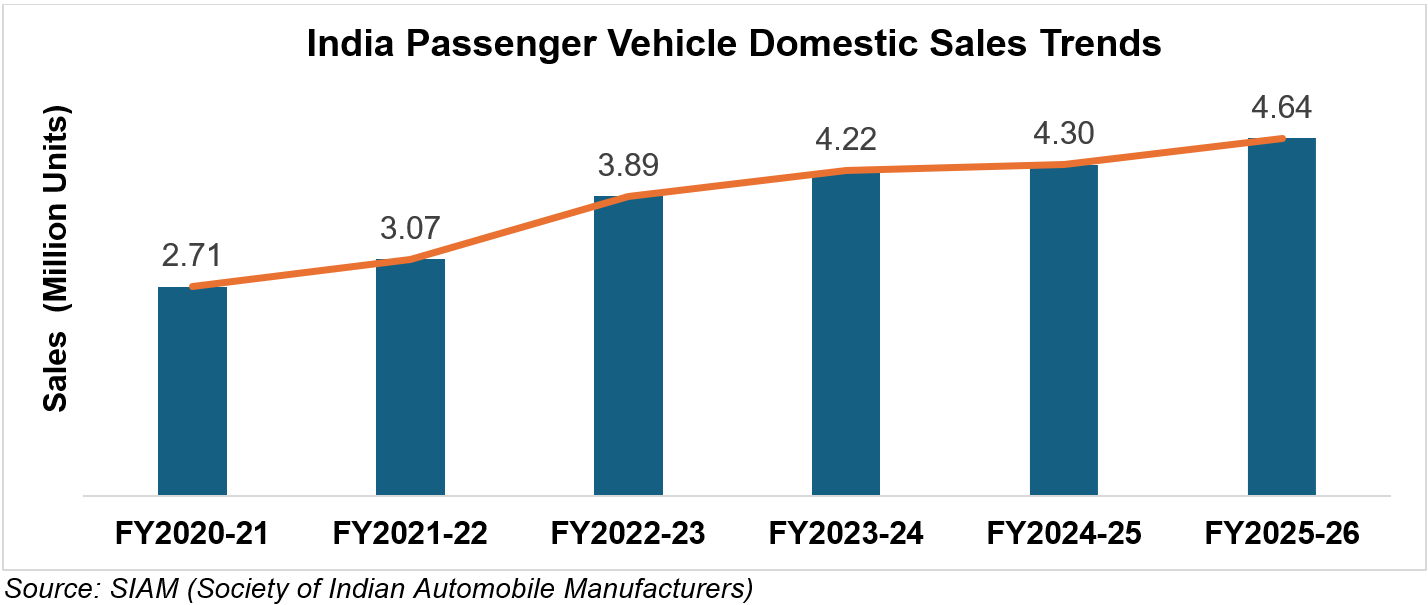
The industry's performance reached a new milestone in FY2025–26, when domestic passenger vehicle sales increased to a record 4.64 million units, registering 7.9% year-on-year growth, while exports also reached an all-time high of 0.91 million units, reflecting India's growing importance as both a domestic automotive market and a global manufacturing hub. These achievements demonstrate the sector's strong fundamentals and its ability to adapt to evolving consumer expectations and technological advancements.
This growth does not just stem from rising car ownership but a change in consumer needs altogether. People now care less about price and more about performance, safety, comfort, and the latest in automotive technology, forcing car makers to focus on utility cars. This has led to the passenger vehicle industry moving from volume growth to value growth, with SUVs being the main force behind this value growth.
The Rise of Utility Vehicles: Reshaping India's Passenger Vehicle Market
Among the key trends within the Indian passenger vehicle industry has been the rise of the utility vehicle (UV). The trend of the rise of UVs has changed the nature of the market from one characterized by passenger vehicles to one where the sport-utility vehicle has become the main growth driver. This shift has had a major impact on the nature of passenger vehicle sales within the country.
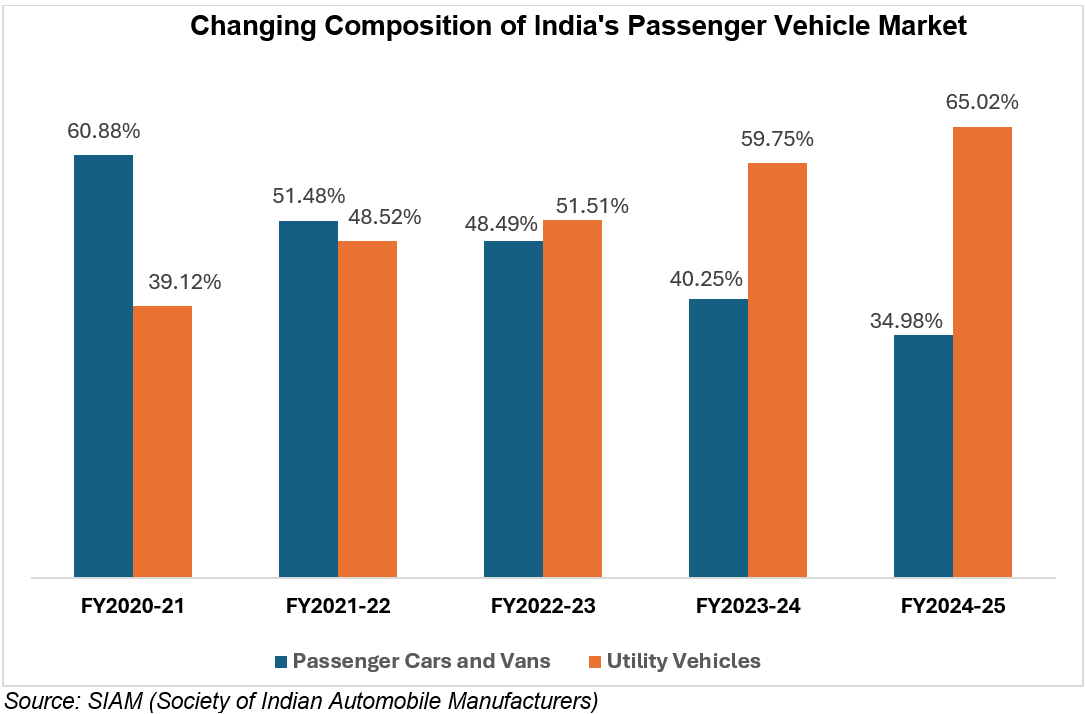
According to SIAM data, a significant structural change in the market took place during FY2020–21-FY2024–25. During this period, utility vehicle sales rose from 10.61 lakh units to 27.97 lakh units in FY2024–25, which is an increase by more than 160%. Meanwhile, passenger car sales dropped from 15.42 lakh units to 13.53 lakh units, whereas van sales did not experience substantial changes (they remained on average equal to 1.5 lakh units per year). Thus, utility vehicles managed to surpass passenger cars in terms of unit sales and became the most important part of the Indian passenger vehicle market.
Contrary to traditional sport utility vehicles, which traditionally were marketed as expensive lifestyle goods, the next-generation compact and midsize utility vehicles managed to combine affordability, functionality, and innovations. Examples of these vehicles include Hyundai Creta, Maruti Suzuki Brezza, Tata Nexon, Kia Seltos, Mahindra Scorpio-N, and Mahindra XUV700. These models helped manufacturers to widen their utility vehicles range of cars and attract both first-time buyers and people who upgrade from other types of cars like hatchbacks and sedans. Consequently, the manufacturers expanded the customer base of SUVs and increased the competition level in the segment.
Thus, the rising popularity of utility vehicles led to changing the product strategy in the long term by automobile manufacturers. Manufacturers redirected investments into vehicle platforms that are dedicated to SUV production, localization of operations, and capacity expansion to satisfy growing customer demand. Moreover, the firms started introducing innovative products equipped with connected features, enhanced safety equipment, and hybrid electric engines, thus making the utility vehicles the focus of the future product development. Therefore, SUVs stopped being just a high-growth segment and became the industry's main volume driver.
This changing structure of the Indian passenger vehicle market can be regarded as a structural change rather than just a temporary fluctuation of consumers' demand. Passenger cars remain an important part of the industry, but utility vehicles turned out to become the dominant segment of the market. This trend demonstrates how changes in consumers' preferences and product innovation affected the structure of the Indian passenger vehicles market and how SUVs became the most important type of cars today.
Strategic Priorities of Leading Automakers
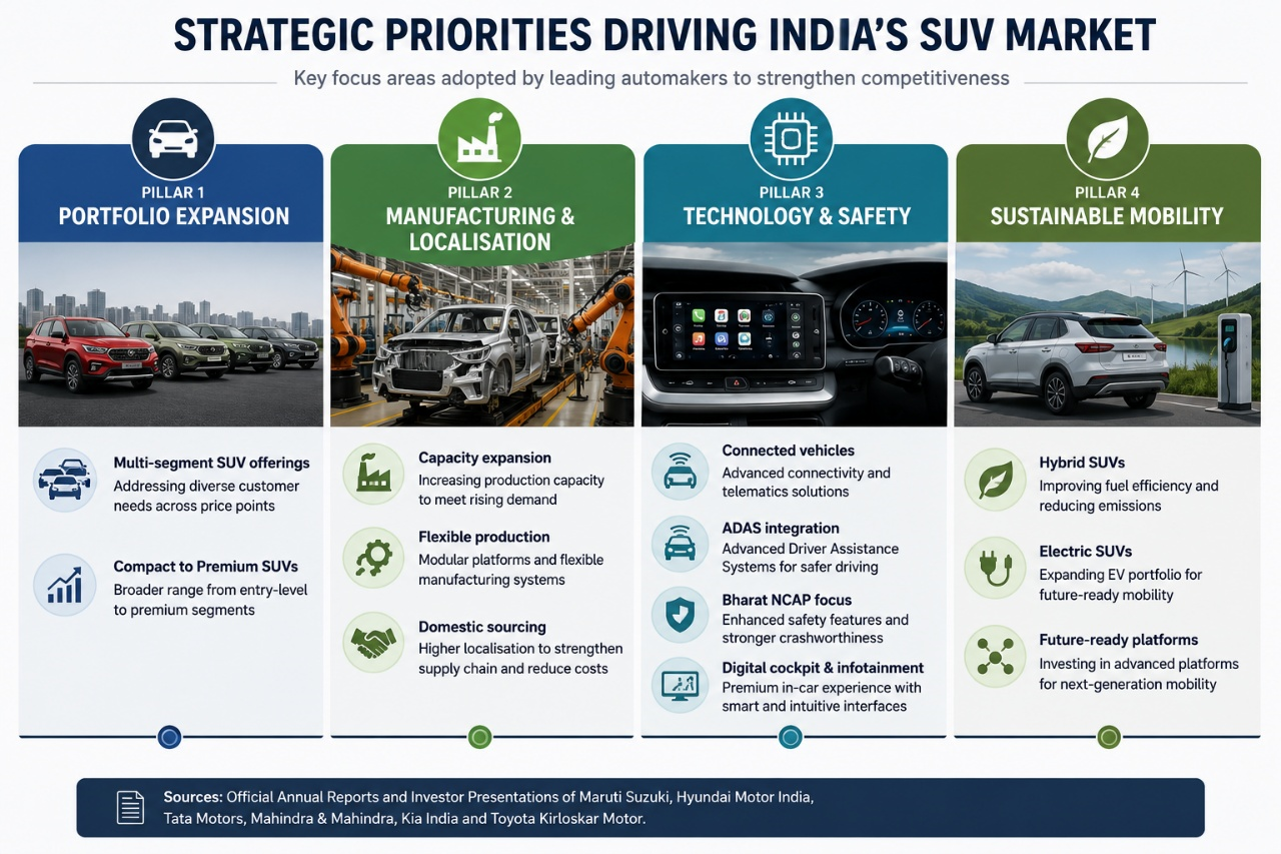
Growth in the Indian SUV market has compelled automobile makers to embark upon extensive strategic efforts going beyond mere product introductions. With changes in customer preferences and increased competition, the focus of the top OEMs has shifted toward portfolio enhancement, production efficiency, technological advancements, and sustainable mobility. While all automobile companies have adopted different business strategies, there are certain common priorities for strategy that have become evident within the industry.
Expansion of SUV Portfolios
One of the prominent trends in the automobile industry has been the swift increase in the number of sport utility vehicles (SUVs) across various pricing levels. Automakers have widened their range of products to cater to new buyers, families, and luxury car owners. Maruti Suzuki strengthened its position in the market through Brezza, Fronx, and Grand Vitara, Hyundai enlarged its Portfolio through the introduction of Venue, Creta, Alcazar, and Tucson, while Tata Motors launched Punch, Nexon, Harrier, Safari, and Curvv. On the other hand, Mahindra has introduced Thar, Scorpio-N, and XUV700 in the list of its sport utility vehicles, and Kia India launched Sonet, Seltos, Carens, and Syros to increase competition.
Investment in Manufacturing and Localisation
The producers have increased their investments in production capability, localization, and supply chain management to cater to the increasing demand for SUVs. The use of flexible manufacturing systems and modular platforms, in addition to better sourcing from domestic suppliers, has led to improved production capabilities and reduced risk in the supply chain. The establishment of more manufacturing units by OEMs has contributed towards India's position as a manufacturer and exporter of passenger cars.
Technology and Safety Enhancement
Technology has come to form one of the pivotal axes of competitive distinction within the SUV category. Automakers have continued to incorporate technological aspects such as connected car technology, digital instrument panels, infotainment systems, and advanced driver assistance systems (ADAS) within their product lines. This has been paralleled by growing attention toward passenger safety by incorporating multiple airbags, ESC, and Bharat NCAP-based vehicle development.
Transition Towards Sustainable Mobility
The top OEM companies in India are simultaneously aligning their strategic goals with the changing requirements from the shift towards green vehicles. They have expanded their range of products to hybrid and battery electric SUVs in addition to improving the fuel efficiency of conventional internal combustion engines. The investment made in the areas of electrification, powertrains, and future platforms shows the readiness of the automobile industry to assist in the development of the Indian mobility system.
In sum, all these strategic priorities demonstrate that the success of the SUV market in India is based not only on growing consumer demand for such vehicles but also on the ability of automobile manufacturers to constantly change their approach. With the help of simultaneous investments in product range expansion, manufacturing, technology, and sustainable mobility, top OEM companies have secured their competitive advantage.
Government Initiatives Supporting India's SUV Revolution
The Government of India has played a significant role in shaping the growth and evolution of the passenger vehicle market through a combination of policy interventions, manufacturing incentives and infrastructure development initiatives. These measures aim to promote domestic automobile production, accelerate the adoption of cleaner mobility solutions and strengthen the overall automotive ecosystem, thereby supporting the sustained growth of the SUV segment in the country.
- Production Linked Incentive (PLI) Scheme for Automobile & Auto Components: The Government approved the PLI Scheme with a budgetary outlay of Rs. 25,938 crore (US$ 2.93 billion) for FY2022–23 to FY2026–27 to promote the manufacturing of Advanced Automotive Technology (AAT) products. As of 30 September 2025, the scheme had facilitated cumulative investments of Rs. 35,657 crore (US$ 4.22 billion) and determined sales of Rs. 32,879 crore (US$ 3.89 billion), strengthening domestic manufacturing capabilities and localisation across the automotive value chain.
- Make in India and Foreign Direct Investment (FDI): The automobile sector permits 100% FDI under the automatic route, enabling global OEMs to establish manufacturing facilities, expand production capacity and strengthen India's role as a global automotive manufacturing and export hub. These measures have supported long-term investments in passenger vehicle production, including SUVs.
- Road Infrastructure Development: Continued investments under Bharatmala Pariyojana and the expansion of India's national highway and expressway network have significantly improved intercity connectivity and logistics efficiency. Bharatmala Phase-I envisages the development of approximately 34,800 km of highways and associated infrastructure, while India's operational expressway network had expanded to over 7,300 km by April 2026, improving long-distance mobility and supporting greater adoption of SUVs.
- Vehicle Safety and Emission Standards: The implementation of BS-VI emission norms and the launch of the Bharat New Car Assessment Programme (Bharat NCAP) have encouraged manufacturers to improve vehicle safety, crashworthiness and environmental performance. These initiatives have accelerated the integration of advanced safety technologies and cleaner powertrains across passenger vehicle portfolios.
- Electric Mobility Support: The PM E-DRIVE Scheme, with an outlay of Rs. 10,900 crore (US$ 1.23 billion), supports electric mobility through incentives for electric vehicles, charging infrastructure and advanced battery technologies. The initiative is encouraging manufacturers to accelerate investments in electric and hybrid SUVs, supporting India's transition towards sustainable mobility.
Looking ahead, India's passenger vehicle industry is expected to benefit from favourable demographic trends, rising household incomes, expanding road infrastructure and continued policy support for advanced automotive manufacturing. At the same time, manufacturers will need to navigate challenges including evolving emission regulations, supply chain resilience, raw material availability, affordability concerns and intensifying competition. Despite these challenges, India's strong domestic demand, improving manufacturing ecosystem and growing integration into global automotive value chains position the country for sustained long-term growth. The SUV revolution has therefore become more than a shift in vehicle preference it represents the beginning of a broader transformation towards a safer, smarter and more sustainable passenger vehicle market.
Partners




