RECENT CASE STUDIES
Smart Metering Deployment in India Policy Framework, Institutional Structure and National Implementation Status
Last updated: Jul, 2026
India’s electricity distribution sector has undergone a gradual structural transition over the past decade, moving from conventional metering systems towards digitally enabled monitoring and billing infrastructure. Smart metering has emerged as a central component of this transformation, driven by the need to improve operational efficiency, strengthen financial sustainability of distribution utilities and enable data-driven electricity management. The deployment of smart meters represents one of the largest digital infrastructure programmes within India’s power sector, combining policy intervention, institutional coordination and technology-led execution at national scale.
The power distribution segment has historically been challenged with issues related to high aggregate technical and commercial (AT&C) losses, delayed billing cycles, low consumption visibility, and inefficient revenue realization mechanisms. The conventional electromechanical and static meters were limited to manual readings that often led to billing inaccuracies and disputes between the consumer and the distribution company. With the growth in electricity consumption driven by the increasing rate of urbanisation, industrialisation, and rural electrification, these issues were becoming more acute.
Smart meters are significantly different from conventional meters based on their functional capabilities. Smart meters are enabled to transmit information to the distribution company at predetermined intervals. These meters are capable of two-way communication that eliminates the need to manually read the meters. Smart meters can transmit information on consumption patterns on a near real-time basis. The information generated through smart meters can help utilities to accurately bill the consumers based on the consumption pattern.
The move towards smart metering has acquired greater relevance with the sustained financial stress being experienced by the distribution utilities. The difference between Average Cost of Supply and Average Revenue Realised has remained an important concern for the sector. Smart metering is not just a technology upgrade but a structural change to bring greater transparency and accountability to the distribution sector.
Government Policy Initiatives and Institutional Framework Driving Smart Meter Rollout
The push to deploy smart meters in India is primarily driven by policy initiatives, which are backed by coordinated efforts by the central ministries, lenders, and distribution companies. The Ministry of Power has been instrumental in integrating smart metering into the broader initiatives aimed at transforming the distribution sector.
The most notable initiative in the smart metering space in India has been the Revamped Distribution Sector Scheme (RDSS). The initiative aims to reduce Aggregate Technical and Commercial (AT&C) losses, improve the efficiency of the billing process, and enhance the overall performance of the utilities by modernizing the distribution sector. The initiative has been keen on prepaid smart meters to improve payment discipline and reduce outstanding dues. The initiative has been keen on the standardization of technology, interoperability, and models of deployment linked to outcomes.
The initiatives taken prior to the introduction of the Revamped Distribution Sector Scheme (RDSS) include the Integrated Power Development Scheme (IPDS), the Deen Dayal Upadhyaya Gram Jyoti Yojana (DDUGJY), and the National Smart Grid Mission (NSGM), which provided hands-on experience to the utilities through the deployment of smart metering technology and the communication technology associated with it.
The institutional structure supporting implementation involves multiple stakeholders:
- Ministry of Power responsible for policy direction and programme oversight
- Power Finance Corporation Limited (PFC) and Rural Electrification Corporation (REC) Limited providing financing and monitoring support
- Energy Efficiency Services Limited (EESL) acting as an implementation agency in several deployments
- State distribution companies responsible for consumer onboarding and operational integration
- Advanced Metering Infrastructure Service Providers responsible for deployment and maintenance under performance-based contracts
The shift to Design-Build-Finance-Own-Operate-Transfer has enabled utilities to roll out the projects on a large scale without requiring significant capital expenditures. The utilities fund the rollout of the services and recover the costs through ongoing payments based on the performance of the systems, for example, the speed of the bills and the uptime of the systems.
Policy initiatives have supported the development of domestic manufacturing and production of smart meters, which has been part of the broader push to secure the local supply chain. This has helped develop an ecosystem of meter manufacturers, communication technology providers, and data management system developers.
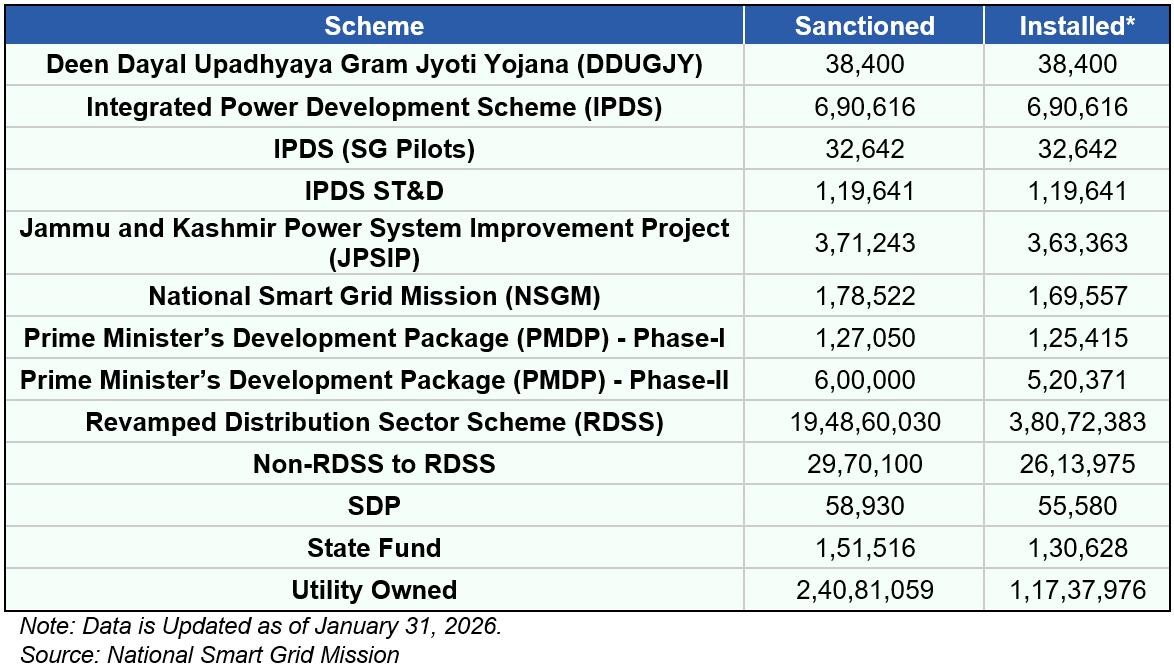
Schemewise Smart Consumer Meters Installation Progress (Units) (As of January 31, 2026)
Deen Dayal Upadhyaya Gram Jyoti Yojana (DDUGJY)
The Deen Dayal Upadhyaya Gram Jyoti Yojana (DDUGJY), introduced in December 2014, focused on strengthening rural electric distribution infrastructure and enhancing the reliability of power supply in rural areas. Its key initiatives involved separating feeders for agricultural and non-agricultural consumers, improving sub-transmission infrastructure, and installing meters at feeder and distribution transformer points to enhance billing accuracy.
The DDUGJY scheme was one of the first to integrate metering into distribution infrastructure enhancement, especially in rural areas where metering was limited. Under this scheme, 38,400 smart meters were sanctioned and implemented, providing a preliminary step towards digitalization in rural areas. Although this figure is low in comparison to subsequent initiatives, it helped set a precedent for utilities to adopt digital metering.
Integrated Power Development Scheme (IPDS)
The Integrated Power Development Scheme (IPDS) was launched in December 2014 to strengthen sub-transmission and distribution infrastructure in urban areas and improve reliability of power supply. The scheme included components such as consumer metering, feeder metering, IT enablement, enterprise resource planning systems and smart metering pilots to reduce Aggregate Technical and Commercial losses.
The total outlay of IPDS was approximately Rs. 32,612 crore (US$ 3.67 billion), reflecting the government’s emphasis on urban distribution modernisation. Under IPDS, 6,90,616 smart meters were sanctioned and fully installed, while additional deployments under IPDS smart grid pilots and system strengthening and distribution components accounted for 32,642 and 1,19,641 installations respectively. IPDS therefore served as a transition phase where smart metering moved beyond pilot demonstrations and became integrated within mainstream distribution infrastructure projects.
National Smart Grid Mission (NSGM)
The National Smart Grid Mission (NSGM) has been established to take forward smart grid technology, which includes advanced metering infrastructure, automation, and the overall communication systems driving the entire sector. The primary objective of the NSGM leaned more towards pilot projects, technology development, and building capabilities in the utilities to facilitate the future digital grid deployment.
With the support of the NSGM, 1,78,522 smart meter approvals were made, out of which 1,69,557 were deployed. Even though the numbers were low, the NSGM has been instrumental in driving the overall technical guidelines, interoperability, and overall familiarity in the advanced metering infrastructure space.
Jammu and Kashmir Power System Improvement Project (JPSIP)
The Jammu and Kashmir Power System Improvement Project (JPSIP) focused on improving the distribution network and increasing billing efficiency in areas affected by technical and commercial losses. Smart metering was a key component of the program, which was intended to increase the efficiency of energy accounting and reduce revenue loss. As part of the JPSIP, 371,243 meters were sanctioned, and 363,363 meters were installed.
Prime Minister’s Development Package (PMDP) — Phase I and Phase II
The Prime Minister Development Package (PMDP) for Jammu and Kashmir has emphasized the upgradation of infrastructure in the state, with particular focus being given to the transmission and distribution infrastructure. As part of the PMDP initiative, the state has adopted the use of smart metering technology to enhance the efficiency of the consumption of energy at the consumer level. In all, 7,27,050 smart meters were approved under Phase I and Phase II, with 6,45,786 smart meters having already been installed.
Non-RDSS to RDSS Transition Deployments
The category of Non-RDSS to RDSS includes projects that have been approved under older frameworks and have been aligned to the implementation structure of the Revamped Distribution Sector Scheme. In this category, a total of 29,70,100 meters has been sanctioned, and 26,13,975 installations have been completed. These numbers establish the link between the older attempts to strengthen the distribution sector and the ongoing, widespread reform effort currently underway under the RDSS.
Revamped Distribution Sector Scheme (RDSS)
The Revamped Distribution Sector Scheme (RDSS), launched in FY22, represents the most significant scale-up in India’s smart metering programme. The scheme aims to improve operational efficiency, reduce losses and enhance financial sustainability of distribution companies through infrastructure modernisation and prepaid smart metering deployment. The total scheme outlay is Rs. 3,03,758 crore (US$ 34.14 billion) over five years.
Under RDSS, 19,48,60,030 smart consumer meters have been sanctioned, with 3,80,72,383 installations completed so far. RDSS accounts for the largest share of ongoing installations and marks the transition of smart metering from limited deployment to nationwide infrastructure rollout.
State-funded and Utility-owned Deployments
In addition to centrally sponsored schemes, several state governments and utilities initiated smart metering independently to address operational challenges. State-funded deployments account for 1,51,516 sanctioned meters and 1,30,628 installations, while utility-owned initiatives represent a significant share with 2,40,81,059 sanctioned meters and 1,17,37,976 installations. These deployments demonstrate early adoption by utilities seeking to improve billing efficiency and reduce losses even before central programmes reached scale.
Conclusion: Smart Metering as a Structural Transformation in India’s Power Distribution Landscape
Overall, smart metering emerges as a foundational reform within India’s electricity distribution sector. The transition began as a policy-led initiative to address operational inefficiencies and financial stress within distribution utilities. Through programmes such as the Revamped Distribution Sector Scheme (RDSS) and earlier smart grid initiatives, smart metering has evolved into a national infrastructure programme with significant scale and institutional backing.
The deployment phase established the technological and organisational foundation required for transformation. Installation progress, supported by coordinated efforts of government agencies, financing institutions and utilities, demonstrates the scale at which digital infrastructure is being integrated into the power sector. The operational phase has shown measurable improvements in billing efficiency, revenue discipline and consumption transparency, while also initiating behavioural shifts among consumers.
Going forward, smart metering is no longer just about measurement; it’s about enabling. Smart metering has a big part to play in the integration of renewable energy into the mix, the acceleration of the modernization of the grid, and the support of data-driven decision-making in the entire electricity supply chain.
The success of smart metering in India depends on the quality of the data management system it has the potential to provide. The continued evolution of the regulatory environment, consumer participation, and investment in digital technology will determine the potential of the energy sector to fully transition into a digital energy service provider. Smart metering is likely to be a key component of India’s journey to a secure, efficient, and sustainable electricity system.
Partners