RECENT CASE STUDIES
How Digital Payments Are Enhancing Efficiency for Small Businesses in India
Last updated: Jun, 2026
India’s digital payments ecosystem has emerged as a pillar of Micro, Small, and Medium Enterprises (MSMEs) economies. MSMEs in India are estimated to contribute to 30% of the country’s Gross Domestic Product (GDP), over 45% of exports, and employ over 24 crore individuals. Therefore, these segments acting with high degrees of efficiency are crucial to India’s vision of becoming a US$ 5 trillion economy. The structural impediments and historical limitations of these small-scale commercial efforts have been a hindrance to their growth. Earlier, these sectors depended entirely upon the cash economy, and their access to mainstream financial alternatives was limited. However, with the rapid development and saturation of various aspects of Digital Public Infrastructure (DPI), these limitations have come to be erased. The scale and growth of Unified Payments Interface (UPI), from 91.5 crores in FY18 to over 18,586 crores in FY25, indicate this sector’s transition from a mere fintech innovation to becoming omnipresent in Indian society.
Digital Payments as a Productivity Engine
India's economic scenario is undergoing a significant period of change, and the Micro, Small, and Medium Enterprises are at the heart of this change. Termed the ‘growth engine of the nation’, MSMEs are the key to the ambitions of achieving a Rs. 450 lakh crore (US$ 5 trillion) economy by FY28.
The Scale of the Sector
India has a vast scope to support livelihoods for over 24.40 crore people, according to recent government figures.
- Classification Dominance: The major share of the registered units is held by micro-enterprises at 98.60% (5.69 crore units).
- Economic Footprint: This industry contributes approximately 30.10% of India’s GDP and generates approximately 36.00% of the sum of all Indian manufacturing output.
Export Resilience: MSME exports have witnessed a remarkable ascent, surging from Rs. 3.95 lakh crore (US$ 47.10 billion) in FY21 to Rs. 12.39 lakh crore (US$ 147.80 billion) in FY25.
The MSME landscape in India is huge and all-encompassing, supporting the livelihoods of more than 20.39 crore people who are registered on the Udyam portal. The resilience of the sector best reflects in its trade performance: MSME exports have risen sharply from Rs. 3.95 lakh crore (US$ 47.1 billion) in FY21 to Rs. 12.39 lakh crore (US$ 147.8 billion) in FY25. The ecosystem has become increasingly global, with MSME export counts swelling from 52,849 to 1,73,350 in the same window. MSMEs accounted for about 45.79% of India's total exports by May 2024, thus underlining their essentiality in the trade performance of the country.
In earlier phases, this growth was constrained by a high dependence on physical cash, leading to an environment characterized mainly by a fragmented and informal atmosphere. This transformation into full digital bloom was accelerated by the COVID-19 pandemic and, for India’s fintech scenario, marked a watershed moment. The outcome is a clear and accelerating trajectory as digital payments moved from niche convenience to core mainstream necessity across the country for small businesses.
Efficiency in today’s competitive environment for a small business in India has evolved to become a full-fledged productivity machine with four key pillars:
- Operational Time Savings: Digital payments eliminate the time lag associated with dealing with physical currencies. Push for instant settlements will help entrepreneurs save time to focus on growing businesses rather than dealing with this time drain.
- Cost Optimization: Removing cash from the equation eliminates security, transport, and storage costs. The relatively low digital transaction charges result in increased profitability.
- Democratized Market Reach: Tier-2 and Tier-3 MSMEs can access the global e-commerce value chain through a partnership with digital payment gateways.
- Formalization and Credit Access: The digital footprint facilitates smooth compliance with GST, helping lenders assess the credibility of borrowers. This bridges the long-standing credit gap for MSMEs, enabling them to obtain institutional support via alternative methods of obtaining credit.
As the RBI’s Digital Payments Index increased to 493.22 in March 2025, it is evident that the digital payment system has become the core of the Indian economy.
Evolution of Digital Payments in India
Before 2016, India's economy was large on cash and informality. Digital payments were either big-ticket transfers via RTGS/NEFT or were largely intended for use in cities, mainly for card payments. The small business or MSME depended mostly upon cash, meaning minimal verifiable financial data and difficulty in accessing formal credit existed. The Bahi-Khata (physical ledger) system and traditional manual ledger systems limited operational transparency and scalability.
Demonetisation: The Strategic Inflection Point
The year 2016 may be treated as a defining trend since the event of demonetisation acted as a behavioral trigger, forcing the populace to opt for a digital solution. This change helped to chip away at the mental barrier to using digital finance by fueling a surge in the uptake of mobile wallets. This can thus be treated as the ‘fertile ground’ in which the National Payments Corporation of India (NPCI) initiatives were taken forward.
The Foundation: JAM Trinity & Infrastructure
India's success was not an accident, but the result of a deliberate, layered strategy known as the JAM Trinity:
- Jan Dhan (Banking): More than 558.3 million bank accounts opened under the PMJDY initiative (as of July 2025), helping the unbanked population access financial services.
- Aadhaar (Identity): Providing a unique digital identity for biometric authentication (e-KYC), thereby facilitating and making the process of account opening effortless. Since its inception, over 142 crore Aadhaar cards have been issued cumulatively as of June 30, 2025, and have been the backbone of several digital services such as UPI.
- Mobile (Connectivity): The speedy deployment of 5G technology, with approximately 4.74 lakh active base stations reaching every district in the country. This construct caters to the service needs of the 116 crore mobile subscribers in the country by the year 2025 and provides the world's cheapest data rates, from Rs. 308 per GB in 2014 to below Rs.10per GB. Smartphones are essentially mobile payment systems for the masses.
UPI: The Global Benchmark
The Unified Payments Interface, introduced in April 2016, revolutionised the payments landscape completely with capabilities such as one-to-one instant, round-the-clock transactions between banks on a simple Virtual Payment Address or QR code.

- Global Dominance: Based on an IMF report issued in June 2025, UPI has been recognized as the largest retail fast payment system across the world, accounting for an approximate share of 49% out of the total global real-time digital transactional systems.
Digital Adoption in Action
The transition from a cash-heavy operation to a digital-first business model is transforming the efficiency and creditworthiness of India's 6.3 crore (63 million) MSMEs.
The Kirana Store: From Manual Ledgers to Digital Credit
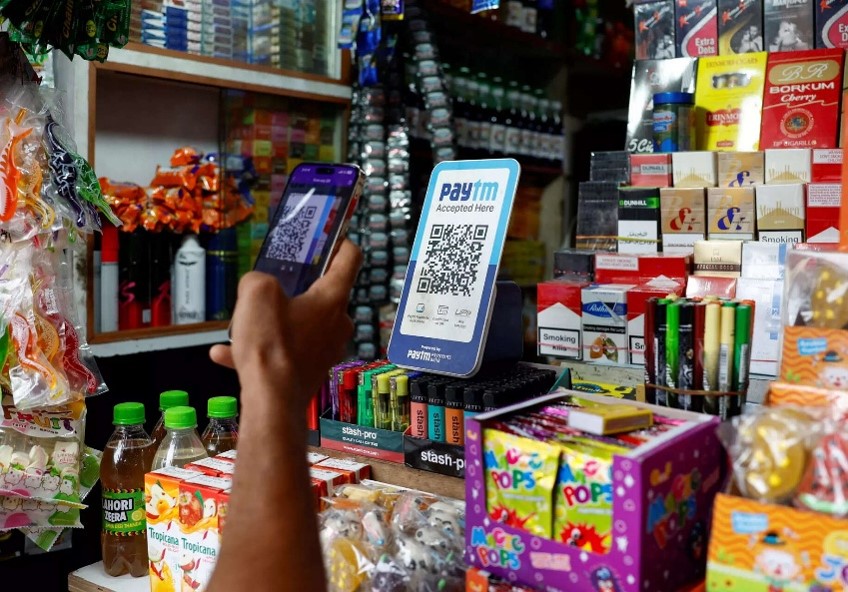
Scenario: Corner shops in the local neighbourhood, called Kirana shops, are increasingly using their everyday transactions and connecting them to the mainstream financial system using integrated systems such as QR codes and Digital Banking Units (DBUs).
- Transformation: By moving away from manual bahi-khata (handwritten ledgers) and adopting QR-based digital payments, stores create digital transaction records that build a verifiable financial history, improving their visibility within formal banking and credit ecosystems.
- Economic Impact: Policy discussions on Digital Banks note that technology-driven models can lower operating costs and improve credit assessment using digital cash-flow data, enabling better credit access for small merchants, though official reports do not prescribe fixed interest rate comparisons.
- Operational Gain: UPI Soundbox devices provide instant audio confirmation of successful payments, helping merchants immediately verify transactions, reduce disputes, and handle higher customer volumes during peak business hours.
The Street Vendor: The PM SVANidhi Success Loop
Scenario: Urban street vendors are integrated into the formal financial fold through the PM Street Vendor’s AtmaNirbhar Nidhi (PM SVANidhi) scheme.
- Transformation: Vendors would be given collateral-free working capital loans, and they would earn cashback each month if they made digital payments.
- Credit Laddering: Timely repayment of digital loans would enable vendors to move from the initial limit of Rs. 10,000 (US$ 119.80) to a third tranche of Rs. 50,000 (US$ 599.03) and benefit from a subsidy of 7% interest on loan repayment.
- Direct Benefit: As of late 2025, the scheme’s restructuring aims to benefit more vendors and profile them for linkage to social welfare and financial inclusion initiatives (e.g., digital transaction incentives and potential pension linkages) under the SVANidhi se Samriddhi initiative.
Small Service Units: Digitalizing Agri-Business & Dairy
Scenario: Small-scale service providers and farmers are using integrated digital platforms to capture and verify every transaction.
- Agri-MSMEs: More than 45,000 small or marginal farmers across Odisha, Tamil Nadu, and Uttar Pradesh are profiled digitally with the help of the KANCHI platform. The profiles are built by aggregating data on finances and transactions, facilitating formal engagement and opening doors to access to potential credits.
- Dairy Efficiency: In Dairy, Automatic Milk Collection is a digital platform that captures every dairy transaction, including quantity, quality, and remuneration. This platform, by late 2025, covers over 17.3 lakh milk producers across 54 milk unions. The farmer is paid directly through their bank account without any middleman involved.
- Outcome: These digital tools aggregate transactional data on a large scale, improving transparency and enhancing visibility for rural producers in formal markets and allowing them to access wider socio-economic relationships.
Conclusion
India’s digital payments system has grown from a tool for financial inclusion into a key driver of productivity for the country’s MSMEs. Platforms like UPI and the wider Digital Public Infrastructure now make real-time payments, automated records, and data-based credit easier for small businesses. These changes have reduced daily hassles, improved cash flow, and helped more businesses become formal. Government programs such as Zero MDR, PM SVANidhi, and the Payments Infrastructure Development Fund have made it easier for MSMEs to get started. At the same time, fintech companies have opened new avenues for borrowing. MSMEs now make up almost 30% of India’s GDP and over 45% of exports. Digital payments are not just making transactions easier; they are changing how businesses compete, how people access finance, and how the economy grows. To sustain this progress, it will be important to close digital skills gaps, improve internet access, and strengthen cybersecurity so that all MSMEs can benefit from a more digital and connected economy.
Partners