RECENT CASE STUDIES
The Rise of Contract Manufacturing in India's Electronics Sector
Last updated: Aug, 2026
India's rise to become a large center for electronics manufacturing services is one of the most significant manufacturing changes in India's recent history. A decade ago, the industry was very reliant on imports, while domestic manufacturing was poorly developed even though there was increasing demand for mobile phones, consumer electronics, and home appliances.
However, a lot has changed over the last decade. Currently, India is the second largest manufacturer of mobile phones by volume and an important production center for several leading global tech companies. Smartphone exports are rising rapidly, while Apple and other companies along with their suppliers are increasingly relying on Indian plants as one of the main export centers, which is another indicator of rising local manufacturing and competitiveness on the export market.
Such development is possible through various measures including PLI Scheme, SPECS, EMC 2.0, India Semiconductor Mission, and Electronics Components Manufacturing Scheme (ECMS) along with the changing geopolitical situation and increased popularity of China+1 strategy. The result of all these measures is that the EMS industry became one of the fastest growing parts of the industrial economy of India.
Why Contract Manufacturing Has Become Strategic for India's Electronics Sector
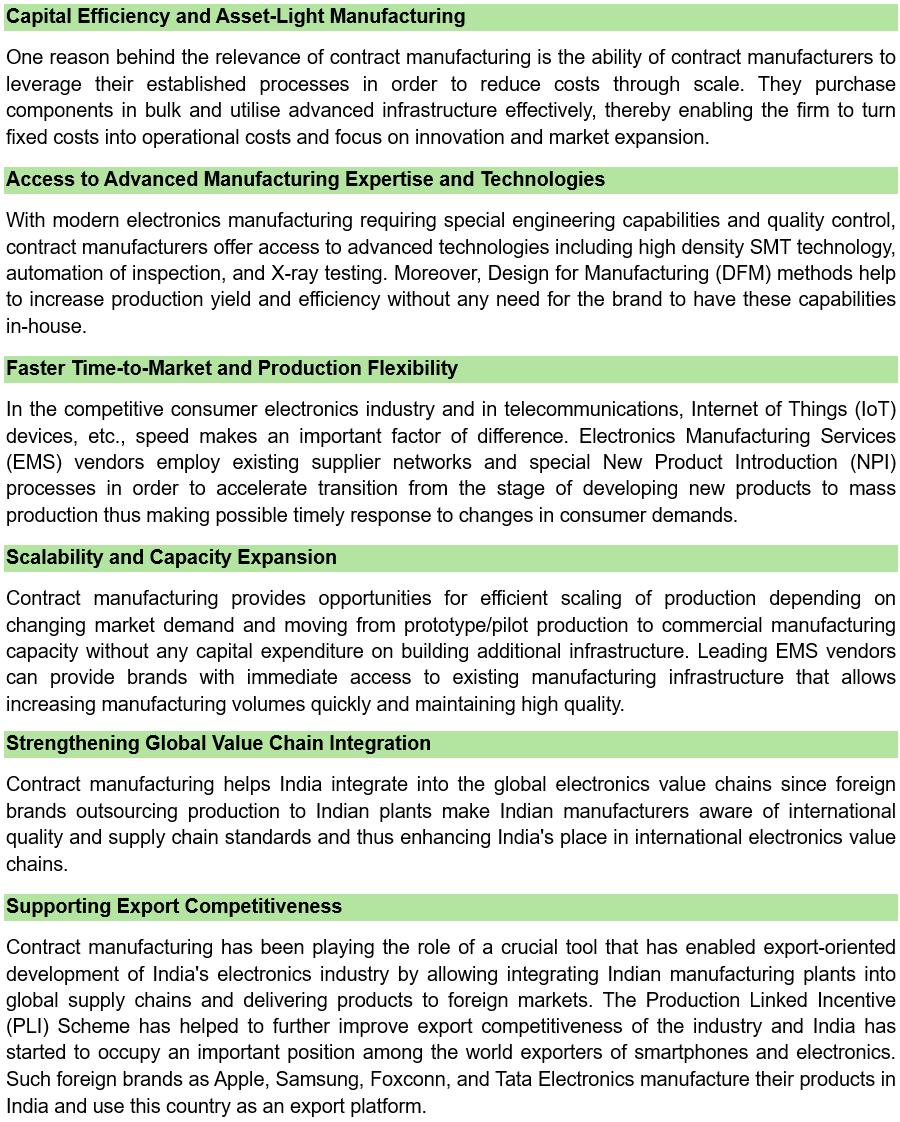
As evident, one reason behind the importance of contract manufacturing is the evolution of the electronics industry worldwide towards innovation-oriented and asset-light business models where the companies look for manufacturing partners capable of offering scale, capability, and flexibility without any capital investment
Market Size and Growth
The EMS sector in India has become one of the fastest-growing sectors in the manufacturing sector of the country. According to KPMG, the Indian EMS market grew to approximately Rs. 3.38–3.81 lakh crore ($ 40-$45 billion) in FY25 and is set to reach beyond Rs. 12.68 lakh crore ($150 billion) by FY30.
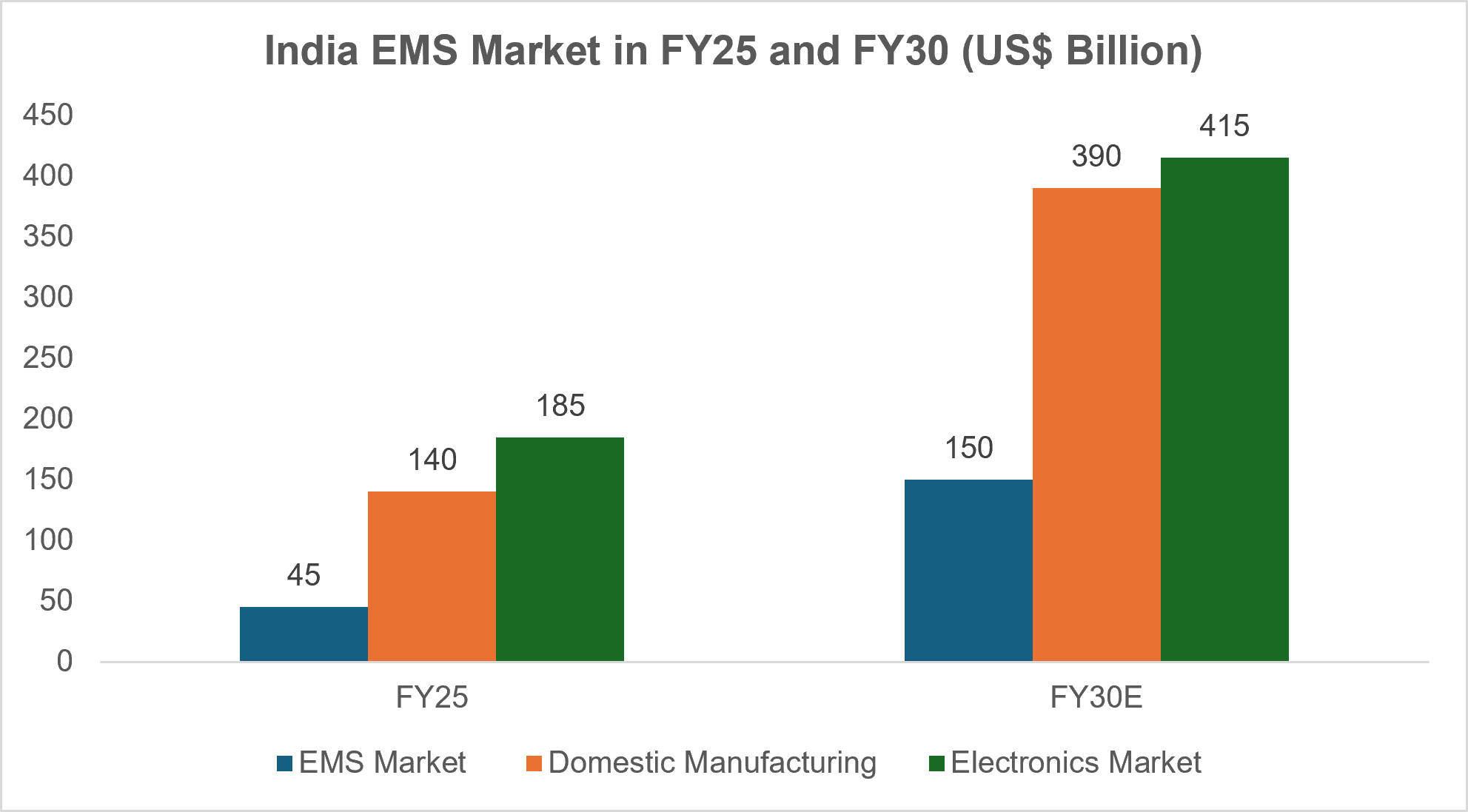
Source: KPMG
In addition to that, government initiatives such as PLI Scheme, Electronics Cleaning Manufacturing Services (ECMS), SPECS, and India Semiconductor Mission have brought many investments from foreign companies as well as from domestic manufacturers. Revenue CAGR in the EMS sector was around 24% between FY19 and FY24, and is estimated to grow around 27% between FY24-FY29 on account of the 'China+1' policy.
The electronics manufacturing sector saw an almost four-fold growth between FY15 and FY25, where the manufacturing increased Rs. 1.9 lakh crore (US$ 31 billion) in FY15 to Rs. 11.3 lakh crore (US$ 130 billion) in FY25. As a result of this, electronics have moved from the seventh-largest export segment in FY22 to be one of the top export segments in FY25.
Despite these achievements, India still only makes up around 5-6% of the total EMS manufacturing output in the world, which means there is plenty of scope left for growth. Although India is good at smartphone assembly and PCBAs manufacturing, one of the major issues that still exists is dependency on imported components, where China and Hong Kong make up a large percentage of component imports.
The next stage of growth will be fueled by investments in electronic components manufacturing, semiconductor manufacturing, and higher domestic value addition as multinational companies move away from China and India develops its component ecosystem through ECMS and India Semiconductor Mission.
Road Ahead
India’s contract manufacturing of electronics industry has evolved from being a new manufacturing destination to become a key part of global electronics value chain, reaching the position of second biggest smartphone manufacturer in terms of quantity. The Government’s efforts, including such programs as Production-Linked Incentive Scheme, Electronics committed Manufacturing Scheme (ECMS), India Semiconductor Mission, SPECS, and EMC 2.0 are trying to close the identified weaknesses of the value chain, but quite a significant part of components are still imported which makes the domestic value addition limited.
The target is to create an ecosystem worth of Rs. 42.28 lakh crore (around US$ 500 billion) by 2030 which will consist of Rs. 33.82 lakh crore (around US$ 400 billion) worth of manufactured products and Rs. 8.46 lakh crore (around US$ 100 billion) worth of components. In order to meet the target, the strategy needs to move away from assembly-driven to design-driven manufacturing.
In future, the following events can become key: the implementation of ECMS for decreasing import dependency, the further investments in semiconductor design and packaging and the diversification into IT hardware, telecommunication, automotive and medical electronics in addition to smartphones production.
With increasing diversification of global supply chains and expanding demand for electronics, India is capable of growing its manufacturing power if it continues having policy support and adopting new technologies..
Partners




