RECENT CASE STUDIES
How ‘Make in India’ Is Strengthening Manufacturing Industries in India
Last updated: Apr, 2026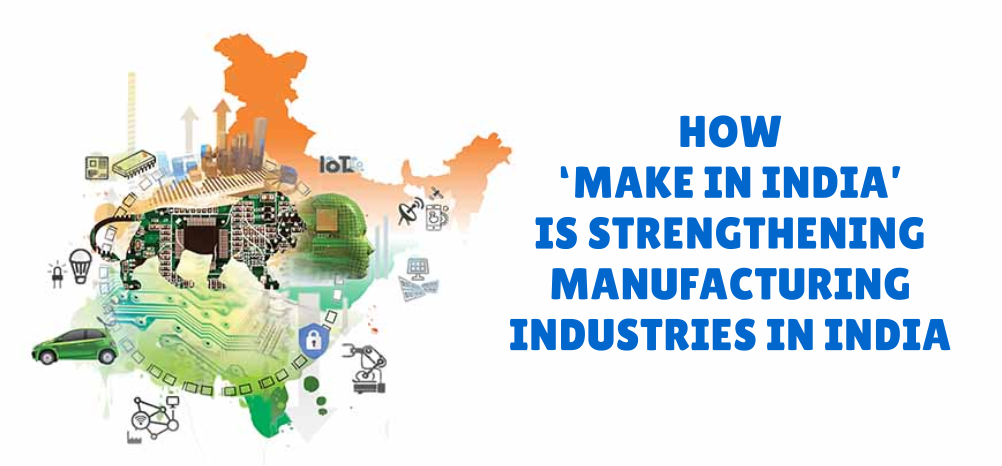
The ‘Make in India’ campaign was launched by Prime Minister Mr. Narendra Modi on September 25, 2014, as part of a wider set of nation-building initiatives. It aims to enhance India's position as a manufacturing hub for the world. The push came when the economy was slowing and the country needed fresh engines of growth. The campaign’s main goals are to support investment, enhance innovation and build top-of-the-line infrastructure. Bold reforms and the ‘Make in India’ initiative over the past decade have started to make India an industrial powerhouse. The nation is now the world’s second-largest mobile phone maker and its local electronics’ production has boomed.
‘Make in India’ is built on four pillars aimed at improving competitiveness. These are:
- New processes: Streamlining regulations and enhancing the ease of doing business. This involves digitising approvals, reducing compliance burdens and simplifying procedures for enterprises.
- New infrastructure: Building industrial corridors, smart cities and modern transport networks to provide factories with state-of-the-art facilities. Upgrading rail, road, ports, airports and communication networks under programmes such as PM GatiShakti to plug logistical gaps.
- New sectors: Opening previously restricted areas to foreign investment. Liberalising foreign direct investment (FDI) rules in sectors such as defence, insurance, railways and medical devices, and inviting global companies to set up factories. Introducing special incentives (such as Production-Linked Incentives [PLI]) in 14 key sectors, from electronics to pharmaceuticals to telecom to textiles, to spur large-scale investment.
- New mindset: Positioning the Indian government as a partner rather than a regulator. Enabling public agencies to work more closely with industry and embracing “Vocal for Local”. Also, pursuing zero tolerance for corruption, to build investor confidence. Cutting bureaucratic red tape, and enabling policymakers to actively woo investors through roadshows and single-window clearance systems.
These reforms have yielded early wins. FDI inflow into manufacturing increased: during FY14-FY25, India received Rs. 16,62,036 crore (US$ 184.2 billion) of manufacturing FDI. Electronic hubs in Pune (Maharashtra) and Bengaluru (Karnataka) and smartphone factories in Chennai (Tamil Nadu) and Noida (Uttar Pradesh) were among the new factories that sprung up across states. Complementary policies have also been introduced by the government: the National Logistics Policy (2022) to reduce the cost of logistics and improve global rankings and Startup India (2016) to establish the third-largest startup ecosystem in the world, which has generated more than 17.69 lakh jobs by January 2025. By the 10th anniversary, the Make in India campaign had established the manufacturing potential of India in the world map. In 2021, the programme was expanded into Make in India 2.0, which includes 27 sectors and introduces a new focus on advanced technologies, further developing the initial agenda and becoming a new impulse towards self-reliance.
Make in India 2.0 and frontier technologies
Building on the first phase, ‘Make in India 2.0’ emphasises advanced, high-tech manufacturing and integration of frontier technologies. The government has explicitly linked this to the Viksit Bharat 2047 vision of a developed India, aiming to raise manufacturing’s GDP share to ~25% by 2035 and to become a global innovation hub by 2047. A new policy framework, the National Manufacturing Mission (NMM) (announced in Budget 2025-26), provides the strategic backbone. The NMM is a mission-mode programme across ministries and states, designed as a “single, unified vision” to boost innovation, competitiveness and capacity in key sectors. It explicitly focuses on emerging areas such as electric vehicle batteries, green hydrogen, solar photovoltaics and advanced materials, aligning industrial growth with sustainability goals. The NMM also targets skill development and cleaner manufacturing, making India’s industrialisation compatible with its net-zero commitment by 2070.
A centrepiece of ‘Make in India 2.0’ is the adoption of frontier technologies in manufacturing. NITI Aayog’s roadmap identifies key “4.0” technologies including artificial Intelligence (AI), digital twins, robotics and advanced materials as enablers of a factory transformation. The goal is to embed these digital and smart solutions deeply into Indian factories to boost efficiency, flexibility and quality. For example, AI-powered predictive maintenance and robotics are being piloted in automotive plants; digital twin simulations help design production lines for complex products such as aircraft; and new materials (such as composites) are used in aerospace and defence manufacturing. By 2035, accelerated technology adoption could raise manufacturing’s share of GDP to ~25% and create over 100 million high-quality jobs. NITI’s analysis suggests that failing to adopt these technologies could leave India’s manufacturing share around 9-10% by 2035, whereas full adoption adds US$ 1 trillion to manufacturing GDP by 2047 and yields 100+ million skilled jobs.
To realise this vision, Make in India 2.0 leverages new policy tools. The PLI programmes themselves now include cutting-edge segments: for instance, the PLI for Drones and Aerospace Components encourages local development of autopilot systems and avionics. The government is also encouraging “Industry 4.0” investments through tax breaks for automation (under the Income Tax Act) and funding for tech upskilling. State governments have launched innovation missions (e.g. the Tamil Nadu Precision Engineering Mission, Maharashtra EV Mission) to promote sectoral R&D and startup incubation. Public–private partnerships and research consortia are being set up in institutions such as IITs and IISc to develop manufacturing-grade AI and 3D printing capabilities.
The frontier tech push is tied to the National Manufacturing Mission’s broader agenda. The NMM envisages modern clusters and digital infrastructure. For example, the government plans special “Manufacturing Innovation Centers” which will house testbeds for Industry 4.0, accessible to large firms and MSMEs alike. New Public Procurement policies may require government projects to use domestic smart products (AI-enabled robotic machinery, drones for survey etc.). The idea is not just incremental factory upgrades, but re-engineering the entire ecosystem. If implemented effectively, India could leapfrog older manufacturing models and emerge as a global leader in advanced production by mid-century.
Future outlook
Looking ahead to 2047, Make in India aims to make manufacturing a prime engine of a $35 trillion economy. By then, the goal is for manufacturing to contribute roughly one-quarter of GDP, as part of the broader Viksit Bharat 2047 vision. The policy roadmap includes scaling up infrastructure (industrial corridors, ports, power grids); promoting deep technology adoption (5G/6G networks, IoT for factories); and intensifying skill programmes (vocational training tied to cluster needs). The National Logistics Policy and Industrial Corridors initiative will continue improving connectivity and reducing costs. The government has set targets (e.g. raising annual FDI to Rs. 8,72,900 crore (US$ 100 billion), getting logistics costs down to 8% of GDP) to measure progress.
The next decade is framed as India’s “Manufacturing Decade,” capitalising on shifting global supply chains. By offering reliability, scale and a large domestic market, India hopes to attract companies looking to diversify from China or Association of Southeast Asian Nations (ASEAN). Bilateral and multilateral trade agreements (with Australia, EU, UK, etc.) are being negotiated to provide market access for Indian goods. In parallel, policies such as PLI may be extended or refreshed to maintain investment momentum. There is also talk of a new “Defence Industrial Export Policy” to further boost arms exports.
However, sustaining progress will face challenges. India must continuously improve its competitive advantages. Land acquisition and financing hurdles often slow factory projects and will need further streamlining. Export competitiveness depends on productivity – closing the gap with global leaders requires both technological upgrades and workforce skilling. Environmental compliance and the shift to clean manufacturing also pose short-term cost challenges (e.g. higher input costs under carbon taxes). Geopolitical risks and trade tensions mean that India will have to diversify its export destinations and raw material sources. Moreover, unless frontier technologies are widely adopted, India may miss out on a significant share of global manufacturing value – as one analysis warns, failing to scale up tech use could reduce manufacturing’s GDP contribution to under 10% by 2035.
Maintaining momentum will thus demand continued policy focus. The government is likely to persist with reforms (e.g. further labour law simplification, power sector improvements) to ease doing business. Ensuring that PLI and other incentive schemes deliver as intended will be crucial (addressing any bottlenecks in implementation and subsidy disbursement). Strengthening vocational education and apprenticeships will help meet the need for millions of skilled technicians and engineers in new factories. Efforts to improve supply chain integration, such as developing domestic sources for critical inputs such as semiconductors and specialty chemicals, will reduce vulnerability.
In summary, the ‘Make in India’ campaign has set the foundation for a manufacturing-led future, but realising that future fully will require perseverance. The Viksit Bharat 2047 targets are ambitious: they assume a transformation of India’s industrial landscape. With coordinated policy measures such as the National Manufacturing Mission and active promotion of cutting-edge manufacturing, India has a clear roadmap for this transformation. The coming years will test the ability of policymakers and industry to build on this platform. If successful, India could shift from being a regional producer to a manufacturing and innovation powerhouse, with millions of new jobs and a stronger economy to match its ambitions.
Partners