RECENT CASE STUDIES
The New-Age Logistics Revolution in India: Drone Deliveries, Cold Chains, and Hyperlocal Solutions
Last updated: Mar, 2026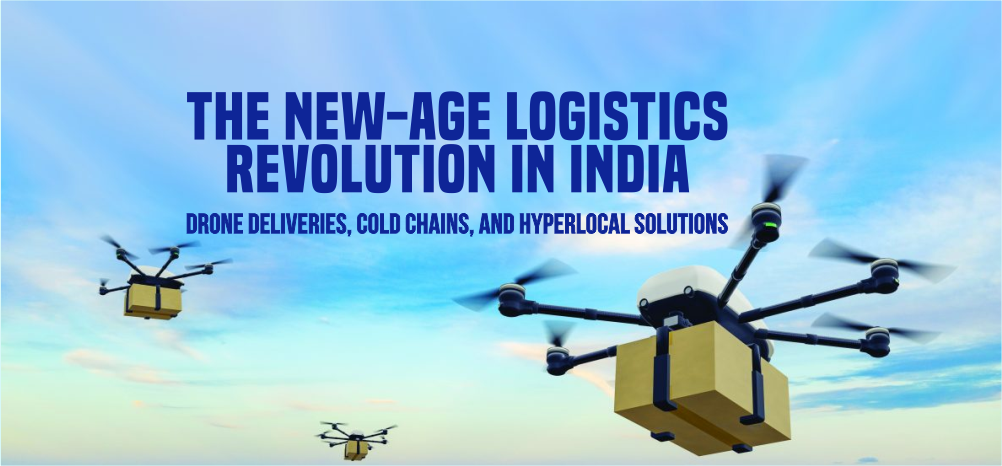
India’s logistics sector is undergoing a transformative revolution, driven by digitalization, new delivery models, and proactive policy support. The Indian logistics market reached an estimated US$ 228 billion in 2024 and is projected to nearly double to US$ 428.7 billion by 2033. This rapid growth is fueled by the e-commerce boom, rising consumer demand for fast deliveries, and huge investments in infrastructure. Traditionally, India’s supply chains were fragmented and cost-inefficient, where logistics costs have been about 13-14% of GDP (versus ~8% globally). However, the tide is turning. From drone-enabled aerial deliveries to tech-powered cold storage and hyperlocal services, innovative solutions are redefining efficiency and reliability in Indian logistics. Government initiatives like the National Logistics Policy 2022 aim to reduce costs and improve India’s global Logistics Performance Index ranking, while industry players aggressively adopt AI, IoT, and automation for smarter operations.
The rise of drone deliveries
Unmanned aerial vehicles (drones) have emerged as a game-changer for last-mile logistics in India. Once seen as experimental, drones are rapidly proving their value in delivering packages faster, farther, and greener than traditional means. India’s drone delivery ecosystem is still nascent in scale (valued at around US$ 23 million as of 2024). However, it is expanding quickly, thanks to supportive policies and successful pilots.
Advantages of aerial logistics: Drones offer unique benefits well-suited to India’s diverse geography. They can bypass ground traffic and poor road infrastructure, reaching remote or rural areas that are costly to serve by truck. By taking to the skies, delivery times drop dramatically as drones can transport items in 30 minutes or less over distances that might take hours by road. This speed is crucial for time-sensitive goods like medicines or perishable foods. Moreover, drones have a lighter environmental footprint. Each drone delivery cuts carbon emissions by avoiding gasoline vehicle trips. In fact, one study found that a single drone in service can save up to 45 tons of CO₂ per year, equivalent to planting 1,800 trees. Recent deployments in India confirm these advantages. Skye Air, a drone delivery startup, has launched an ultra-fast service in Bengaluru where drones drop packages in just 7 minutes for residents. By cruising above congestion, such drones not only delight customers with nearly instant service, but they also reduce delivery costs for businesses by almost 50%. Importantly, aerial logistics expands reach: in suburban or hilly regions with sparse delivery networks, drones can bridge the service gap, improving accessibility and equity in logistics.
Challenges and regulatory framework: While promising, drone deliveries face several challenges, but India is turning these into opportunities through progressive regulation and innovation.
Operating in dense urban environments: Flying over crowded cities raises safety and privacy concerns, and finding secure landing zones or drop points is non-trivial. Rather than seeing this as a blocker, Indian innovators are engineering solutions (e.g., winch-and-drop mechanisms or designated “drone pods” for drop-offs).
Payload capacity and battery range: Currently, many drones carry only a few kilograms. Indian startups are tackling this with new drone designs. For instance, Skye Air’s flagship drone can carry up to 10 kg per trip and uses “Skye Tunnel” designated air corridors to maximize efficiency. Weather resilience (heavy monsoons) is a challenge that drives the development of sturdier drones and scheduling algorithms.
On the regulatory front, India has made remarkable strides. The government introduced liberalized Drone Rules in 2021, streamlining permissions and increasing the allowable drone weight to 500kg for cargo purposes. Although fully autonomous beyond-visual-line-of-sight (BVLOS) operations are still in the trial phase, regulators have created a sandbox for experiments. In 2021, 20 consortia (including Swiggy, Dunzo, Zomato, and others) were granted permission to conduct BVLOS test flights to shape future regulations. These trials, which are part of a deliberate “learn-first” approach, have yielded insights that informed policy updates. For example, after initial strict requirements stalled some pilot programs, the government relaxed certain conditions under the new Drone Rules to enable Telangana’s “Medicine from the Sky” vaccine delivery trials. This iterative regulatory evolution demonstrates India’s commitment to fostering drone innovation while ensuring safety. Further boosting the sector, the government launched a PLI (Production-Linked Incentive) scheme for drones, slashed GST on drones from 18-28% down to 5%, and rolled out the Drone Shakti program to nurture drone startups. These measures, combined with the DigitalSky one-stop permission platform, aim to make India a global drone hub by 2030.
Already, real-world implementations showcase drone logistics’ potential. In addition to Skye Air’s Bengaluru and Gurugram networks, global pioneer Zipline partnered with the Maharashtra government and Serum Institute in 2019 to establish an autonomous drone medical supply network, aiming to cover 120 million residents with on-demand blood and vaccine deliveries. While regulatory approvals and the pandemic delayed full-scale operations, pilot distribution centers near Pune and Nandurbar began laying the groundwork for routine emergency drone deliveries in rural areas. Likewise, Telangana’s trials demonstrated drones ferrying vaccines to remote clinics, proving life-saving use cases. Private sector interest is surging as logistics giants like Blue Dart Express and DTDC have tied up with Skye Air to explore integrating drones into their delivery chain. Food and grocery platforms are not far behind; Swiggy and Zomato have both experimented with drone delivery for hyperlocal orders. The commercial viability has been validated globally, with over 1.4 million drone deliveries completed worldwide and costs per delivery projected to drop below US$ 5-10 as scale increases. For India, drones present an exciting opportunity to leapfrog logistics constraints, and with enabling regulation and investment, the challenges are steadily being converted into opportunities. The momentum suggests drone deliveries will play an increasingly mainstream role, especially in suburbs, rural regions, and urgent delivery scenarios, thereby complementing traditional transport for a faster, smarter supply chain.
The road ahead: Policy, investment, and future opportunities
As India’s new-age logistics transformation accelerates, the road ahead is filled with opportunities, provided policy support and investments keep pace. The convergence of technology and new operating models positions India to build a world-class logistics ecosystem. Stakeholders are focused on strengthening infrastructure, nurturing startups, developing skills, and refining policies to close existing gaps. The larger vision is a seamless, smart, and sustainable logistics network that supports domestic supply chains and enhances global competitiveness.
Policy and infrastructure remain central to this growth. The National Logistics Policy aims to reduce logistics cost from about 14% of GDP to under 10% while improving global rankings. It acts as an umbrella framework aligning infrastructure with process reforms. PM Gati Shakti’s GIS-led planning integrates highways, railways, ports, airports, and industrial corridors. Multimodal Logistics Parks being developed through public-private partnerships will consolidate warehousing, rail sidings, and trucking facilities to reduce handling time and transit costs.
Regulatory simplification is progressing. GST removed interstate check-posts and improved trucking efficiency. E-way bills, FASTag, and digital permits have streamlined road movement. The government is now working on unified logistics standards, digital interoperability across ports and customs, and a framework for drone traffic management. Rules for autonomous bots and new-age technologies will evolve through controlled trials.
Investment is driving the next wave of expansion. Logistics continues to attract strong capital from domestic and global investors. Several Indian startups have turned unicorns by solving challenges in warehousing automation, freight efficiency, and delivery optimization. Initiatives like Make in India and the PLI scheme for drones and electronics are strengthening the domestic manufacturing base for logistics hardware. Global firms such as DHL and Maersk are expanding warehousing and integrated logistics operations to capture India’s growing market.
Skill development is equally important. As technology reshapes logistics, the workforce needs training in digital tools, automation systems, data analysis, and drone operations. The Logistics Skill Council and NSDC are scaling programs for roles such as supply chain analysts and warehouse automation technicians. With over 8 million workers already employed, logistics can become a major job creator if skills keep pace with technological change.
Several innovations are emerging. India’s digital public infrastructure could transform logistics just as UPI transformed payments. An Open Logistics Network is being explored to help small trucking firms and warehouse owners access a shared digital marketplace. Rural logistics offers substantial potential as better roads and geocoding technologies make remote villages accessible. This can bring e-commerce, supply chain services, and market linkages to farmers and microenterprises.
Sustainability will shape the sector’s trajectory. Electric and hydrogen long-haul trucks, solar-powered warehouses, biofuels, and carbon tracking systems are likely to become more common. Logistics companies may integrate carbon credits into business models, aligning growth with India’s clean mobility and renewable energy push.
Improved logistics infrastructure is also strengthening India’s position in global trade. Efficient ports, expanded capacity, digital port systems, inland terminals, and the Dedicated Freight Corridors are easing long-standing bottlenecks. Better container movement and greater reliability are attracting global manufacturers exploring India as an export base. Smooth internal movement of goods will be essential as new trade agreements come into force.
India is also adopting global innovations such as IoT-enabled containers, predictive analytics, and blockchain-based documentation. With strong tech talent, the country can emerge as a global leader in logistics technology.
Challenges persist, including timely project execution, evolving regulations for new technologies, and sustained financing. Models such as logistics REITs and infrastructure investment trusts will be important. However, the government’s prioritization of logistics shows long-term commitment.
Overall, India’s logistics sector has a positive and opportunity-rich outlook. With continued reforms, technology adoption, and sustainability integration, India can build a fast, cost-efficient, resilient, and green logistics network that supports economic aspirations for decades to come.
Partners




