SEARCH
RECENT POSTS
Categories
- Agriculture (39)
- Automobiles (21)
- Banking and Financial services (36)
- Consumer Markets (58)
- Defence (6)
- Ecommerce (21)
- Economy (72)
- Education (14)
- Engineering (9)
- Exports (22)
- Healthcare (25)
- India Inc. (10)
- Infrastructure (31)
- Manufacturing (33)
- Media and Entertainment (17)
- Micro, Small & Medium Enterprises (MSMEs) (16)
- Miscellaneous (31)
- Perspectives from India (37)
- Pharmaceuticals (5)
- Railways (5)
- Real Estate (20)
- Renewable Energy (19)
- Research and Development (12)
- Retail (1)
- Services (8)
- Startups (16)
- Technology (66)
- Textiles (8)
- Tourism (16)
- Trade (9)
Authors






How Homestays Are Changing Accommodation Choices in India

The homestay market in India is developing into an important sector in the country's tourism and hospitality industry. An increase in domestic tourism, the increasing demand for experience-based accommodation and the rise of online booking sites are opening up avenues for different forms of accommodation in established and upcoming tourist locations.
There is an increased level of professionalism in the sector as well. Alongside the family-operated homestays, professionally managed villas, holiday homes and heritage homestays are adding a variety of accommodation to the sector. Online booking sites are enabling property owners to get increased visibility and access to customers, while professional management companies are bringing about standardized property management and marketing.
Tourism promotion policies by the government, rural and community-based enterprises, along with changing government regulations, are also playing a role in the development of the sector. The homestay sector in India is thus increasingly becoming a part of the country's larger accommodation system.
Why Homestays Matter for India's Travel Economy
India’s homestay industry is progressively becoming essential to the growing tourism and hospitality sector in the country with increased domestic travel and demand for experience and locally located accommodation. According to NITI Aayog, India’s homestay industry had sales revenues worth Rs. 4,722 crore (US$ 558.88 million) in 2024 and is estimated to grow by an 11% compound annual growth rate (CAGR) between 2024 to 2031. On this growth path, the industry is set to become worth approximately Rs. 8,832 crore (US$ 935.79 million) in 2030.
Additionally, the use of digital platforms is critical for reaching out and expanding the homestay industry in the country. For instance, MakeMyTrip’s homestay business was responsible for about 10% of hotel room nights sold, while the homestay offering on the platform exceeded 100,000 room nights.
In addition to this growth, the homestay industry can benefit from the growing expansion of the tourism and hospitality industry in India that is projected to generate sales revenue worth nearly Rs. 5.66 lakh crore (US$ 60 billion) in 2028. The sector benefits from policy interventions that improve affordability of accommodation services such as reduction of GST on hotel accommodation costing up to Rs. 7,500 (US$ 79.47) per unit per day from 12% to 5%, excluding the input tax credit.
The combination of rising digitalization, experiential travel trends and rural/communal based tourism can create extra incomes opportunities for homeowners and rural/communities.
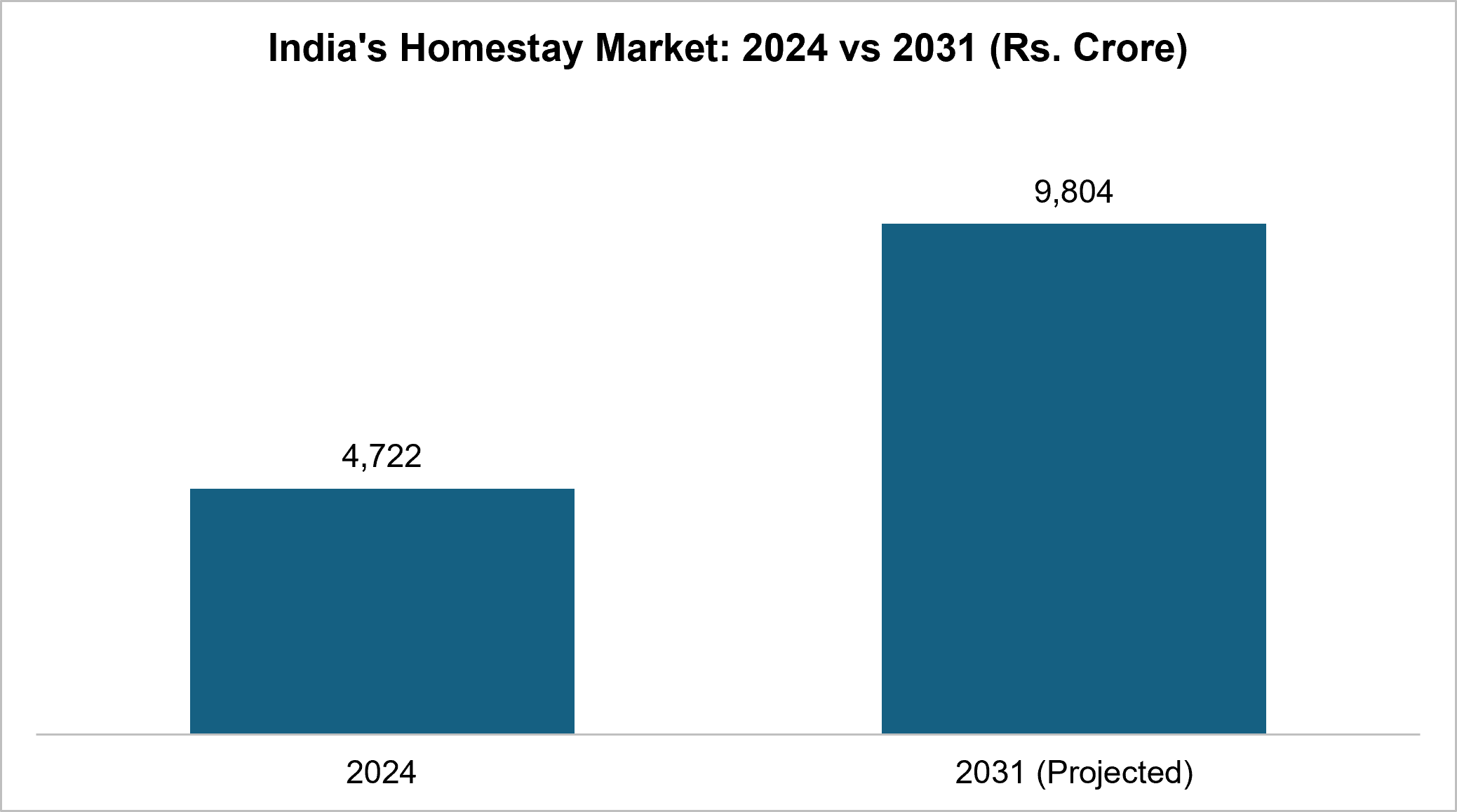
Source: NITI Aayog
Government Initiatives and Policies Driving Change
A combination of central classification schemes and growing state level regulatory initiatives is making efforts to bring the massive unorganized sector of Indian homestays under regulation and growth-oriented structure.
- Incredible India Homestay Scheme: The Ministry of Tourism runs a voluntary classification scheme for Bed & Breakfast and homestay units falling in gold and silver categories. The NIDHI+ platform is helping in the digital registration and visibility of accommodation units in India. According to data on 25th July 2026, there were 7,902 homestays registered in NIDHI+ Database.
- MUDRA loans for homestays: The Government has announced collateral-free institutional credit through MUDRA loans for homestays in the Union Budget 2025-26 with the motive to promote the development of economical accommodation.
- Revised state-level regulatory structure: Rajasthan has launched Rajasthan Homestay (Paying Guest House) Scheme, 2026 replacing the previous scheme in 2021. Uttar Pradesh has launched Bed & Breakfast and Homestay Policy 2025 that helps to expand safe and affordable accommodation facilities along with promoting rural tourism.
- Tribal and Community Based Tourism: Under Pradhan Mantri Janjatiya Unnat Gram Abhiyan (PM-JUGA), Ministry of Tourism launched Development of Homestays in Tribal Areas programme in FY26. This program aims to establish 1,000 homestays in tribal areas. It provides financial assistance of up to Rs. 5 lakh (US$ 5,657.01) for village community needs, Rs. 5 lakh (US$5,657.01) for construction of two new rooms and Rs. 3 lakh (US$ 3,394.20) for renovation of existing rooms. Ladakh also launched its Holistic Homestay Support Framework in March 2026 to support sustainable and community-based tourism.
- Accommodation targets by state: Andhra Pradesh in May 2026 set a target of developing 10,000 homestays along with 50,000 classified hotel rooms and considers homestays as a formal component of accommodation capacity.
Key Players Building the Managed-Homestay Model
Technologically driven platforms have been increasingly enabling the growth of India’s alternative accommodations market by providing professionally managed villas, holiday homes, homestays and alternative accommodation options.
StayVista, an alternate luxury villas and holiday homes management platform based out of Mumbai, became profitable in FY25, recording 29% growth in revenue from operations to Rs. 181 crore (US$ 20.93 million) from Rs. 140 crore (US$ 16.91 million) recorded in FY24. The firm had also raised Rs. 40 crore of Series B funding in 2025.


SaffronStays, which has been managing over 450 luxury villas and holiday homes in India, secured US$ 3.5 million in June 2026 to enhance its portfolio and technology capabilities.
India-based hospitality technology firm OYO, via OYO Home, has also been expanding the digital availability of holiday homes and alternative accommodation offerings at various destinations and price levels.


Further, global home-sharing platform Airbnb has continued to be an enabler for India’s alternative accommodation space by providing travellers access to homes, heritage properties and unique accommodation offerings. According to the Oxford Economics' report on economic contribution by Airbnb in India, the value contribution of Airbnb in India was calculated to be
Rs. 11,300 crore (US$ 1.20 billion), indicating the importance of home-sharing sites in promoting tourism and stimulating economic activities in India. As per the travel trends in August 2026 on Airbnb site, there has been growing interest among Indian travelers for taking vacation trips to locations such as Coorg, Kochi, Udaipur, Varkala, Jaipur and Goa.
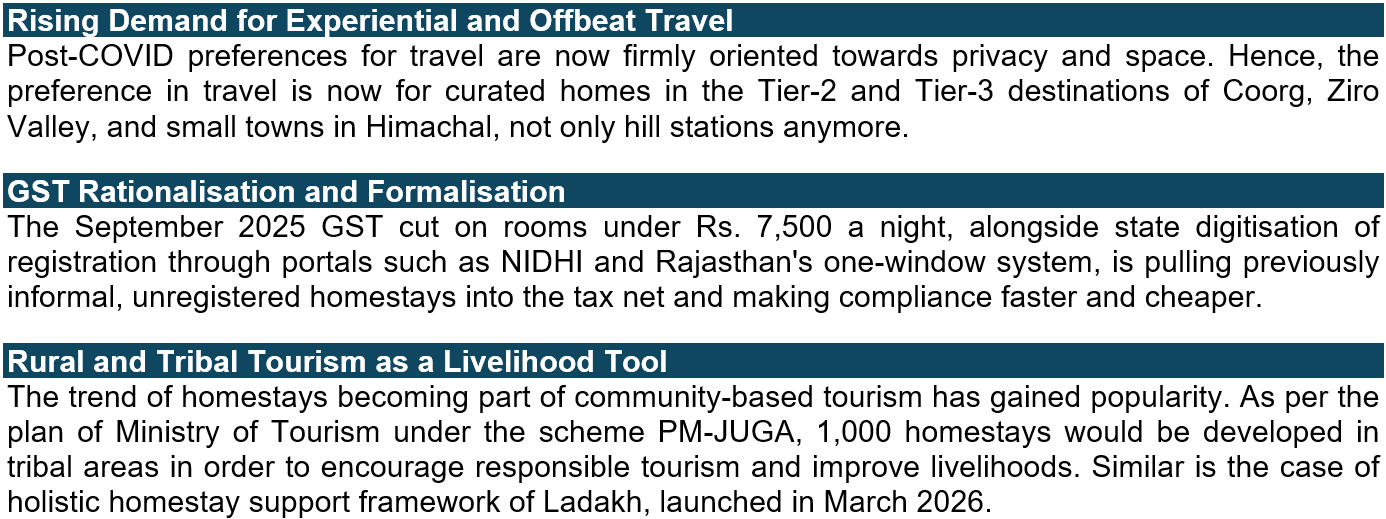
Growth Drivers and Key Trends
The following factors are reshaping how Indian travellers choose where to stay:
Outlook and Road Ahead
The future of homestays in India looks bright since they are expected to become even more prominent in India’s tourism and accommodation landscape due to the increasing popularity of experiential travel, increased digitalization, and professional homestay service providers. The next stage of development of homestays depends on the efficiency of regulatory mechanisms as well as greater harmonization of policies in various Indian states. Examples like PM-JUGA, digital registration, and increased support for rural and community tourism indicate that the homestays have potential to increase the accommodation capacity of India while creating new income sources for local populations.
FAQs
How large is India's homestay market?
As per NITI Aayog, the Indian homestay market has registered a revenue of Rs. 4,722 crore (US$ 558.88 million) in 2024 and is anticipated to witness a growth of 11% during 2024-2031. At a similar growth rate, the homestay market could touch approximately Rs. 8,832 crore (US$ 935.79 million) by 2030.
What is driving the growth of homestays in India?
Main growth factors include growing experiential/travel trends, digital adoption, rural/ community-based tourism initiatives by the government and professionally managed holiday-home platforms.
What government initiatives support homestays in India?
Some government initiatives for the segment include the Incredible India Bed & Breakfast and Homestay Classification Scheme, MUDRA loans for homestays, and 1,000 homestays for tribal areas under PM-JUGA
How are digital platforms supporting India's homestay sector?
Digital platforms have helped in professional management of homestays and increased their accessibility. The homestay inventory of MakeMyTrip crossed 1 lakh rooms, and platforms like StayVista, SaffronStays, OYO and Airbnb are working towards expanding professionally managed accommodation spaces in India.
What is the outlook for India's homestay sector?
India's homestay sector is expected to play an increasingly important role in the tourism and accommodation ecosystem. Continued policy support, digital registration, community-based tourism initiatives and professionally managed accommodation platforms could further strengthen the sector's contribution to inclusive and sustainable tourism growth.
Partners