Introduction

Andhra Pradesh (AP) is in the southern peninsula of India. The state shares its borders with Chhattisgarh on the north, Odisha on the northeast, Telangana and Karnataka on the west, Tamil Nadu on the south, and the Bay of Bengal on the east.
The erstwhile state of Andhra Pradesh has been bifurcated into two states, Telangana and residuary Andhra Pradesh (Seemandhra), by the Andhra Pradesh Reorganisation Act, 2014, or the Telangana Act. The Act consisted of the aspects of the division of assets and liabilities, the boundaries of the proposed new states, and the status of the capital city Hyderabad after the separation of the state.
It is the first state in the country to have enacted the Industrial Single Window Clearance. The Act made it compulsory for new industries to register with a single window to obtain clearances quickly. It also simplified procedures for getting industrial clearances. The state also has separate acts for development in sectors such as solar power, electronic hardware, and food processing.
With 26 districts and a geographical area of 1,62,970 sq. km., Andhra Pradesh ranks as the 8th largest state in the country. The state has a well-developed social, physical, and industrial infrastructure, as well as virtual connectivity.
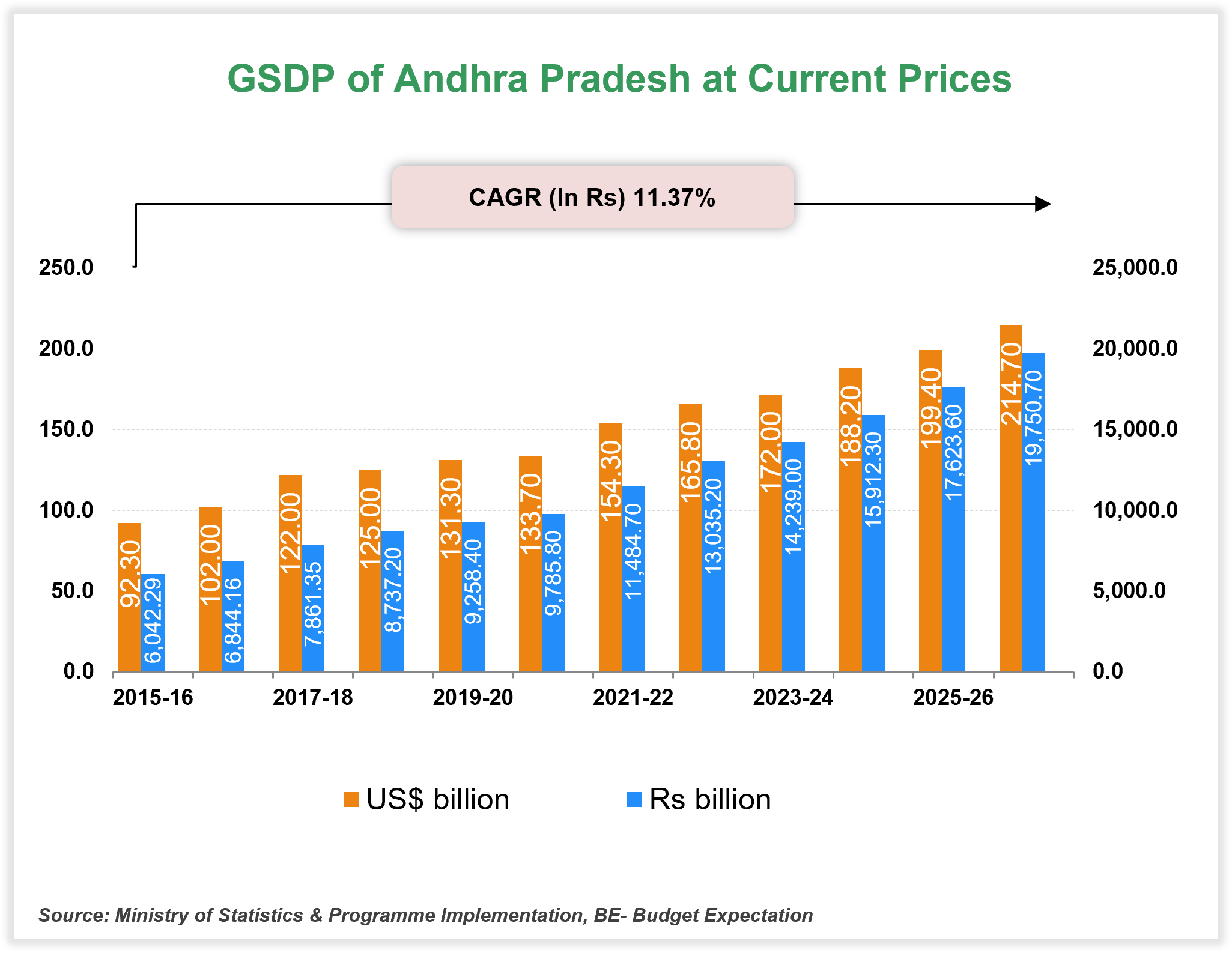
It also has good power, airport, IT, and port infrastructure. At current price, Andhra Pradesh's Gross State Domestic Product (GSDP) is expected to be Rs. 19,750.7 billion (US$ 214.7 billion) for FY27. The GSDP increased at a CAGR (in Rs.) of 11.37% between FY16 and FY27.
The government is striving towards creating quality infrastructure, coupled with a congenial industrial environment in the state, to make AP an attractive destination for both domestic and foreign investors.
According to Department for Promotion of Industry and Internal Trade (DPIIT), FDI inflow in Andhra Pradesh between October 2019 to March 2026 stood at Rs. 14,119.64 crore (US$ 1.72 billion).
Merchandise exports from Andhra Pradesh is Rs. 1,59,099 crore (US$ 18.1 billion) in FY26. Engineering Goods are the largest export category of the state, accounting for around 20.89% of the total exports in FY26 while marine products being the second most exported item stood at 18.20% of total exports.
Andhra Pradesh has most of the power projects of undivided Andhra Pradesh. Coal-based power plants are mostly located in the state due to their proximity to the ports. As of March 2026, Andhra Pradesh has a total installed power generation capacity of 30419.54 MW. Of the total, private utilities contributed 18,787.14 MW, state utilities contributed 8,995.89 MW and central utilities contributed 2,636.51 MW.
Recent Developments in Key Sectors
- In February 2026, Blue Jet Healthcare announced an investment of Rs. 2,300 crore (US$ 250 million) to establish a greenfield pharmaceutical manufacturing facility at Rambilli Industrial Park in Andhra Pradesh.
- On September 10, 2025, Andhra Pradesh signed a memorandum of understanding (MoU) with the Vietnam Travel Association to boost tourism, particularly targeting Buddhist-circuit travellers from Southeast Asia.
- Andhra Pradesh has granted “Industry Status” to the tourism and hospitality sector across all segments, recognising its role in economic growth, job creation and regional development. Under the AP Tourism Policy 2024-29, the state will extend customised incentives to Mega and Ultra Mega projects to accelerate tourism infrastructure and investment.
- The state produced 4.13 million tonnes of fish and prawn in 2024-25 as compared to 3.71 million tonnes in 2022-23.
- In FY26, marine products exports from the state stood at about Rs. 30,275 crore (US$ 3.43 billion) while it touched Rs. 28,466 crore (US$ 3.21 billion) in FY25.
- Andhra Pradesh, contributing 41% of India’s fish production in 2022-23 and 7.4% of its GSDP, supports nearly 14.5 lakh people across nine coastal districts. With GST on fish oils, preserved products, gear, engines and chemicals cut to 5% from 12-18%, the state’s fisheries sector will see lower input costs and stronger competitiveness. Accounting for over 30% of India’s seafood exports, primarily through Visakhapatnam Port to the US, China, the EU, Southeast Asia and the Middle East, the reforms are set to enhance exports, improve affordability and sustain coastal livelihoods.
- As a part of Swarna Andhra @ 2047 initiative, the Andhra Pradesh Community Managed Natural Farming (APCNF) programme is gearing up towards coverage of all the Gram Panchayaths of the state, under Natural Farming by 2026-27 and the necessary field level strategies, action plans are being worked out. It is planned to enrol 41 lakh farmers with a practicing extent of 19 lakh Ha by 2028-29 under Natural Farming in AP.
- Andhra Pradesh's agriculture, forestry and fishing sector grew from Rs. 94,008 crore (US$ 11.4 billion) in 2011-12 to Rs. 5.39 lakh crore (US$ 61.0 billion) in 2025-26, driven by sustained growth in agriculture, horticulture, livestock and fisheries.
- Pharmaceutical exports from the state stood at Rs. 14,847 crore (US$ 1.70 billion) in FY26.
- The Nakkapalli Bulk Drug Park in Andhra Pradesh, covering 2,001 acres and costing approximately Rs. 1,877 crore (US$ 211 million) is scheduled for Phase one completion by March 2026. The park aims to attract Rs. 11,542 crore (US$ 1.3 billion) in total investments and generate 54,000 jobs by providing common infrastructure for bulk-drug manufacturing.
- As per budget estimates FY27:
- In the FY27 Budget, Andhra Pradesh allocated Rs. 32,308 crore (US$ 3.51 billion) for school education, making it the largest departmental allocation and reinforcing the state's focus on human capital development.
- In the Budget FY27 speech, Andhra Pradesh announced road improvement works covering 6,036 km with an investment of Rs. 2,499 crore (US$ 271.6 million), aimed at improving connectivity, logistics efficiency and road safety.
- In the Budget FY27 speech, Andhra Pradesh reported that Bhogapuram International Airport (Alluri Sitarama Raju International Airport) is 97% complete, expected to significantly enhance air connectivity and tourism potential.
- In Budget FY27, Andhra Pradesh plans to develop Kakinada SEZ Port through the PPP model, supported by external infrastructure including roads, water supply and power connectivity, improving industrial and export logistics.
- Rs. 4,000 crore (US$ 468.2 million) has been made for the Dr. Nandamuri Taraka Ramarao Vaidya Seva Trust, while Rs. 1,385 crore (US$ 162.1 million) has been designated for teaching hospitals.
- In July 2023, Union Minister for Road Transport and Highways, Mr. Nitin Gadkari, laid the foundation stone for three NH projects in Tirupati, Andhra Pradesh. These projects include the Naidupate-Turpu Kanupur Section of NH-71, spanning 35 km and requiring an investment of Rs. 1,399 crore (US$ 167.9 million), the Chillakuru Cross-Krishnapatnam Port South Gate Section via Turpu Kanupur on NH-516W, covering 36 km and valued at Rs. 909 crore (US$ 109.1 million), and the Thamminapatnam-Narikellapalle Section, which extends the Dedicated Port Road from Eupuru to Krishnapatnam Port on NH-516W and NH-67, with a length of 16 km and valued at Rs. 610 crore (US$ 73.2 million).
Under AP Mandal Connectivity and Rural Connectivity Improvement project (APMCRCIP), government proposed to improve roads and & bridges of major district roads/other district roads for a length of 728.59 km with Rs.1987.60 crore (US$ 239 million).
Under Major District Roads (MDR) 31 road works with a length of 174.77 km and 5 bridge works have been completed for an amount of Rs. 355.77 crore (US$ 42.8 million).
- Andhra Pradesh is home to many global and national pharma players, and various companies have set up their manufacturing hubs in different cities of the state. Pharmaceutical exports from the state stood at US$ 2,199.56 million in FY24.
- Under the Ayushman Bharat Digital Mission (ABDM), Andhra Pradesh has become the first state in the nation to connect the electronic health records of one crore people to the central database.
- The Andhra Pradesh Industrial Infrastructure Corporation Limited (APIIC) is preparing to offer all of its services online in the near future. This will minimise the necessity for in-person meetings between the concerned entrepreneurs and officers. Additionally, it is creating a mobile application to make the services accessible on the go.
- The presence of rich climatic and soil conditions makes Andhra Pradesh a major agricultural belt. Few of the leading crops produced in the state include rice, chilly, oilseeds, cotton, pulses, and grams.
- The cost of installing electricity meters for agricultural pump sets would be borne by the state government.
- 52.38 lakh farmers received Rs. 7,016 crore (US$ 920 million) in financial assistance under the Rythu Bharosa scheme in 2021-22.
Andhra Pradesh is a major industrial and export-driven state on India’s east coast, supported by strong port-led infrastructure, single-window industrial clearances, and sector-focused policies in electronics, solar power, food processing and pharmaceuticals. With an estimated GSDP of Rs. 18.3 trillion (US$ 214.2 billion) in FY26 and exports of Rs. 1.84 trillion (US$ 20.8 billion) in FY25, the state is a leader in engineering goods, marine products and pharmaceuticals. It hosts large power capacity (28.4 GW), robust road and port connectivity, and major investments such as the Nakkapalli Bulk Drug Park and Amaravati capital development. Agriculture and fisheries remain key strengths, with Andhra Pradesh contributing over 40% of India’s fish production, while ongoing reforms, infrastructure spending and investor-friendly governance continue to position the state as a competitive destination for manufacturing, exports and sustainable growth.
FACTFILE
Capital
Hyderabad (for 10 years)Geographical Area (sq km)
160,205State Language
Telugu, Hindi, English and TamilLiteracy Rate
67.4 per centKey Industries:
Agro and food-based
Biotechnology
Bulk drugs and pharmaceuticals
IT and ITeS
Textile and leather
Tourism
Automotive and auto components
Gems and jewellery
Related News
MOREPartners