Karnataka is in the southern region of India. It is surrounded by the Arabian Sea on the west, Goa on the northwest, Maharashtra on the north, Andhra Pradesh on the east, Tamil Nadu on the southeast, and Kerala on the southwest.
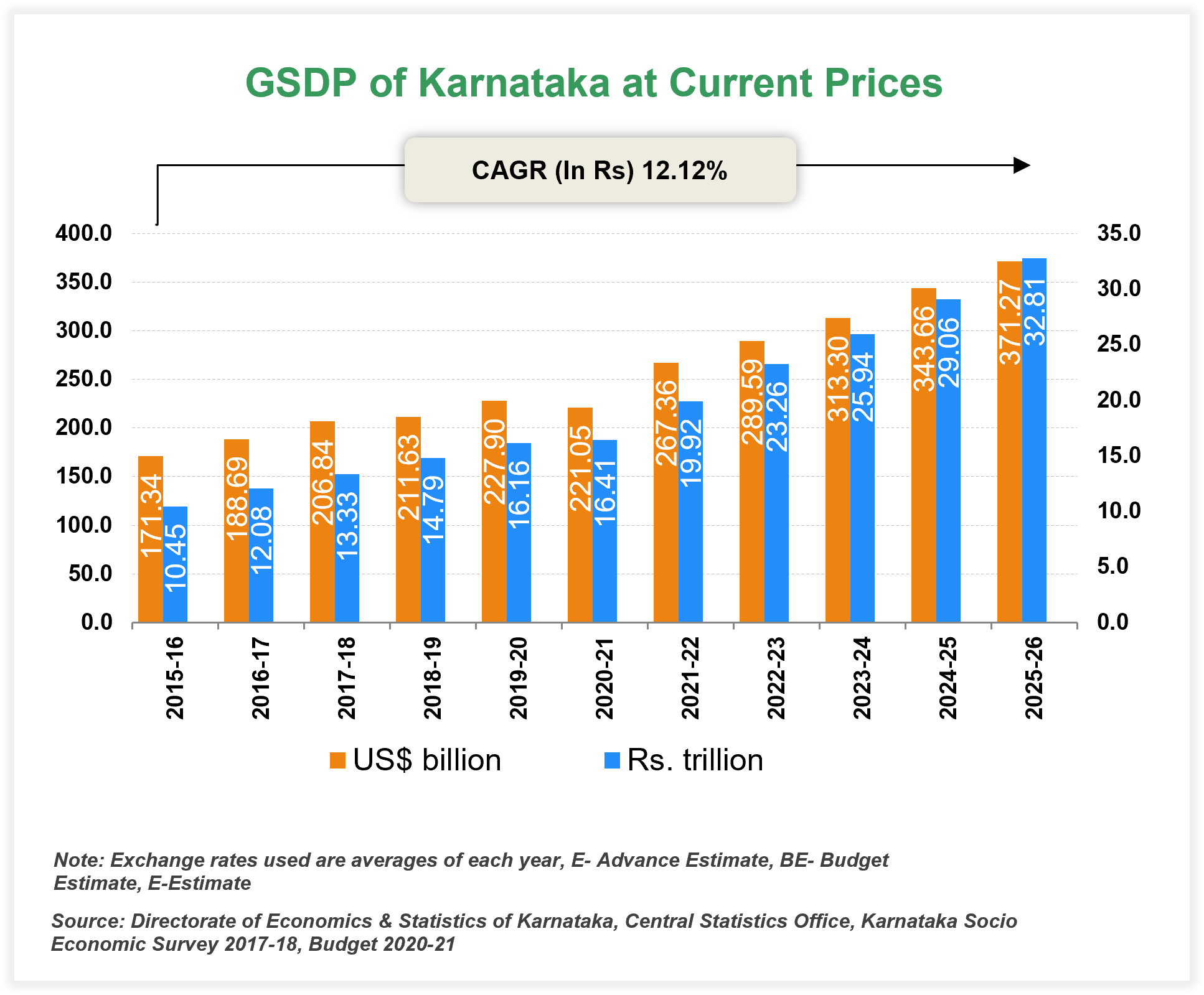
At current prices, Karnataka’s revised gross state domestic product (GSDP) was estimated to be Rs. 32.81 trillion (US$ 371.28 billion) in FY26. The state’s GSDP increased at a CAGR of 12.12% between FY16 and FY26.
Total exports from the state stood at Rs. 3,03,642 crore (US$ 34.39 billion) in FY26. Engineering Goods were the top exported item from Karnataka, accounting for 27.9% of the total exports in FY26, followed by Electronic Goods at 27.6%.
Karnataka’s services-sector exports hit Rs. 14,03,811 crore (US$ 159 billion) in FY25, marking a 13.7 % rise over the previous year and nearly doubling from Rs. 6,86,896 crore (US$ 77.8 billion) in FY19; the state led the country in total services exports.
According to the Karnataka Economic Survey 2025-26, the state had 38 operational Special Economic Zones (SEZs) as of December 2025. These SEZs attracted cumulative investments of Rs. 23,331 crore (US$ 2.64 billion) and generated employment for 4,25,696 persons.
According to the India Tourism Statistics 2025, Karnataka recorded 304.56 million domestic tourist visits in 2024, compared with 284.12 million visits in 2023, registering a growth of 7.2% year-on-year. The state accounted for 10.33% of India's total domestic tourist visits during 2024.
Karnataka offers a wide range of fiscal and policy incentives for businesses under the Karnataka Industrial Policy 2020-25, with simplified procedures for investment.
According to the Department for Promotion of Industry and Internal Trade (DPIIT), the state’s cumulative FDI inflow stood at Rs. 5,58,383 crore (US$ 70.58 billion) between October 2019-March 2026, the second highest in the country after Maharashtra, and accounted for 21% of India’s cumulative FDI inflows.
For FY25, Rs. 150 crore (US$ 17 million) was allocated for the development of minor airports, of which Rs. 100 crore (US$ 11.3 million) was released up to December 2024. This includes Rs. 20 crore (US$ 2.3 million) for land acquisition at Raichur Airport and Rs. 75.75 crore (US$ 8.6 million) for ongoing works at Shivamogga Airport.
According to the Karnataka Economic Survey 2025-26, construction of the Vijayapura Airport has reached an advanced stage, with physical and financial progress of 99.7% and 99.6%, respectively. The airport is being developed to handle Airbus A320 and equivalent aircraft.
As of April 2026, the state had an installed power generation capacity of 38,375.91 MW. Of this, central utilities contributed 4,687.70 MW, private utilities 24,229.97, and state utilities 9,458.24 MW.
Of the total installed power generation capacity, 10,814.95 MW was contributed by thermal power, followed by nuclear 698.00 MW, renewable power 23,231.36 MW and hydropower 3,631.60 MW.
As per the State Budget FY27:
- Under the Chief Minister's Infrastructure Development Programme, the Government has announced the second phase of infrastructure projects worth Rs. 4,000 crore (US$ 434.8 million), following the initiation of infrastructure works worth Rs. 8,600 crore (US$ 934.8 million) under the first phase. The programme focuses on strengthening roads, irrigation facilities and urban infrastructure across the state.
- The Government has continued its support for the agriculture sector through free electricity supply to irrigation pump sets. Over the last three years, electricity subsidies worth Rs. 48,000 crore (US$ 5.22 billion) have been provided to nearly 36 lakh farmers across Karnataka.
- The Gruha Jyothi Scheme continues to be one of the state's flagship welfare programmes. The FY27 Budget has allocated Rs. 10,100 crore (US$ 1.10 billion) for providing free electricity to eligible households.
- School Education and Literacy received the highest departmental allocation of Rs. 36,898 crore (US$ 4.01 billion) in FY27. The Government has also earmarked Rs. 3,900 crore (US$ 423.9 million) over three years for upgrading 800 schools into Karnataka Public Schools and strengthening educational infrastructure.
- The Government has allocated an additional Rs. 400 crore (US$ 43.5 million) for implementation of the Ayushman Bharat–Arogya Karnataka scheme during FY27. Treatment package rates under the scheme will also be revised in line with HBP-2022 standards.
- To support farmers, the Government has provided financial assistance of Rs. 100 crore (US$ 10.9 million) under the Market Intervention Scheme for procurement of maize and other agricultural commodities, while continuing measures to strengthen farm incomes, market access and value addition through the newly announced Chief Minister's Krishi Vistara Scheme.
Karnataka has seen significant growth in rooftop solar installations, surpassing 600 MW total capacity, but experts highlight the need for increased consumer awareness and state promotion of the Surya Ghar: Muft Bijli Yojna to fully tap its solar potential.
The Government of Karnataka launched its Industrial Policy 2024-29, targeting generation of 20 lakh jobs by 2029 and attracting investments of around Rs. 7,50,000 crore (US$ 84.95 billion).
Karnataka is set to launch a Rs 48,686 crore (US$ 5.84 billion) long-term infrastructure plan for Bengaluru, aimed at transforming the city into a world-class tech hub, with projects including improved transportation, highways, and the Peripheral Ring Road to address traffic congestion and enhance economic growth.
Karnataka reached another milestone in terms of improving connectivity as the Shree Siddharoodha Swamiji Station in Hubballi now has the longest platform in the world. It is a 1,507-metre-long platform and was built at a cost of about Rs. 20 crore (US$ 2.4 million).
The Karnataka government and the British Council have launched four skilling programs, SCOUT, English Skills for Youth, Capacity Building Training for International Officers, and a Freemium Digital Library Wall, aimed at enhancing higher education, improving employability, and facilitating students' transition into the workforce.
Karnataka is the first state which came out with an aerospace policy in the country. Karnataka Aerospace Policy has identified an investment potential of US$ 12.5 billion in this sector during 2013-23 and plans to develop aerospace clusters in different regions of the state. In August 2022, the Karnataka government cleared the 'Karnataka Aerospace and Defence Policy 2022-27‘, which is expected to attract investments worth Rs. 45,000 crore (US$ 5.48 billion).
Karnataka continues to stand out as one of India’s most competitive and investment friendly states, supported by strong industrial capabilities, a thriving services ecosystem and a clear policy focus on technology driven growth. The state’s leadership in IT, electronics, aerospace, biotechnology and advanced manufacturing reflects a diversified economic base that is both resilient and future ready. Significant progress in infrastructure, renewable energy, skilling, regional development and connectivity is further strengthening its growth fundamentals. With rising exports, steady FDI inflows, long term industrial and urban development plans and a supportive governance framework, Karnataka is well positioned to sustain its upward economic trajectory and reinforce its role as a key driver of India’s long term growth story.